June 8, 2026
The Material Science Revolution Quietly Transforming Aerospace Manufacturing
Across high-performance manufacturing sectors, the search for materials that simultaneously reduce mass and improve structural integrity has driven decades of intensive research. Conventional aluminium alloys long dominated lightweight applications, but their inherent limitations in additive manufacturing contexts, particularly their susceptibility to hot cracking and inconsistent microstructures, created a persistent performance ceiling. The emergence of aluminium-scandium alloy research in additive manufacturing represents one of the most consequential responses to that challenge, combining metallurgical precision with next-generation fabrication technology to unlock component performance previously unachievable through traditional routes.
When big ASX news breaks, our subscribers know first
What Makes Aluminium-Scandium Alloys Uniquely Suited to Metal 3D Printing?
The Metallurgical Advantages That Set Al-Sc Apart From Conventional Alloys
The case for aluminium-scandium alloys in additive manufacturing begins at the atomic scale. When scandium is introduced into an aluminium matrix, typically at concentrations between 0.1 and 0.6 weight percent, it forms nanoscale Al₃Sc precipitates during solidification. These precipitates function as highly effective heterogeneous nucleation sites, seeding grain formation throughout the solidifying material and producing a microstructure that is fundamentally finer and more uniform than anything achievable with unmodified aluminium alloys.
This grain refinement mechanism is critically important in additive manufacturing contexts. The rapid heating and cooling cycles inherent to laser powder bed fusion processes would, in conventional aluminium alloys, tend to produce coarse columnar grains aligned with the thermal gradient, creating directional mechanical properties that complicate component design and qualification. Scandium additions interrupt this pattern, driving the formation of equiaxed grains that deliver more isotropic behaviour across different build orientations.
Beyond grain structure, Al₃Sc precipitates provide substantial strengthening through the Orowan mechanism, where dislocations moving through the aluminium matrix must bow around these coherent, thermally stable particles rather than cutting through them. The result is a significant elevation in yield strength without the ductility penalties that often accompany other strengthening strategies. The near-perfect lattice match between Al₃Sc and the aluminium matrix (a misfit of approximately 0.1%) maintains precipitate coherency and interfacial stability over extended service periods.
Grain Refinement, Hot Crack Suppression, and Printability: A Technical Breakdown
Hot cracking represents the single most persistent obstacle to broader aluminium adoption in laser powder bed fusion. It occurs when the final stages of solidification leave thin liquid films trapped between growing grains; when thermal contraction then pulls those grains apart, the liquid films cannot accommodate the strain and the material tears. Conventional aluminium alloys with wide solidification temperature ranges are particularly vulnerable to this failure mode.
Scandium additions address this problem through two complementary pathways. First, the abundance of Al₃Sc nucleation sites dramatically increases the number of grains forming simultaneously, reducing the grain size and shortening the distance over which liquid films must remain continuous. Second, scandium modifies the solidification morphology from cellular to more refined dendritic structures, reducing dendritic arm spacing and improving the ability of residual liquid to feed shrinkage voids before cracking can initiate.
The practical consequence is a dramatic improvement in printability. Components that would routinely crack during fabrication using standard aluminium alloys can be produced with high integrity using Al-Sc formulations, even in geometrically complex configurations where thermal gradients are difficult to control. Furthermore, research into wire arc additive manufacturing of 5-series aluminium alloys has confirmed that scandium's grain-refining and crack-suppressing effects extend across multiple additive manufacturing process types, not just laser-based methods.
Comparing Al-Sc to Other Lightweight Alloys Used in Laser Powder Bed Fusion
| Property | Al-Sc Alloy | Standard Al Alloy (AlSi10Mg) | Titanium (Ti-6Al-4V) |
|---|---|---|---|
| Density | Low | Low | Medium |
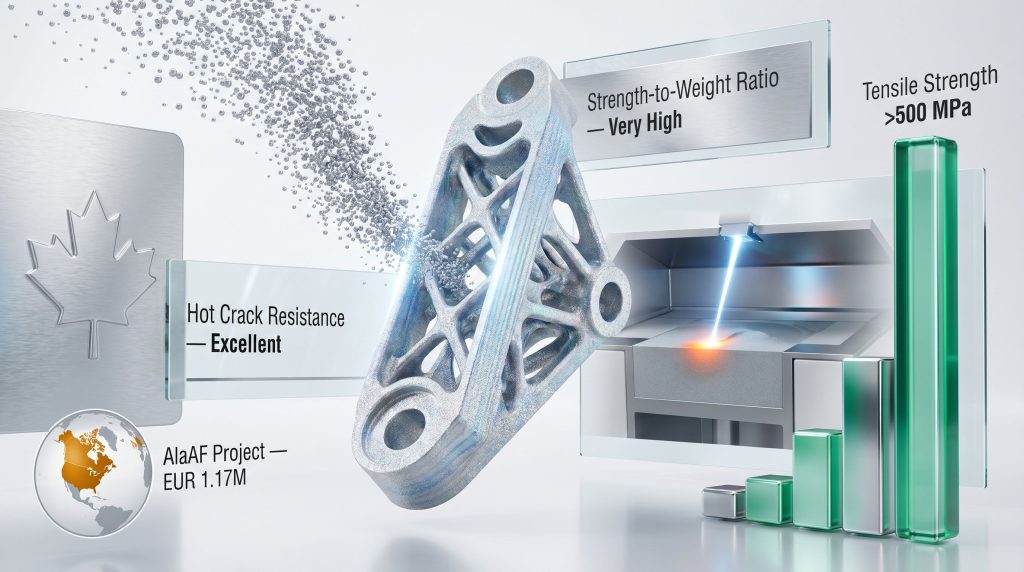
| Strength-to-Weight Ratio | Very High | Moderate | High |
| Hot Crack Resistance | Excellent | Poor to Moderate | Good |
| Grain Structure Control | Fine (Sc-driven) | Coarser | Fine |
| AM Printability | High | High | Moderate |
| Cost | High (Sc premium) | Low | High |
| Aerospace Suitability | Very High | Moderate | Very High |
How Does Laser Powder Bed Fusion Work With Scandium-Enhanced Aluminium?
The LPBF Process Explained: From Powder to High-Performance Component
Laser Powder Bed Fusion builds metal components by selectively melting thin layers of metal powder using a focused, high-powered laser. After each layer is fused, a fresh layer of powder is spread across the build platform and the process repeats until the full three-dimensional geometry is complete. The process is characterised by extremely rapid thermal cycles, with localised heating and cooling rates that can reach 10³ to 10⁶ degrees Kelvin per second depending on laser parameters and material properties.
Technical Snapshot: When aluminium is alloyed with scandium, the resulting microstructure benefits from refined grain boundaries that resist deformation under thermal stress. This is a critical advantage during the rapid heating and cooling cycles inherent to LPBF, where conventional aluminium alloys frequently suffer from columnar grain growth and associated mechanical anisotropy.
For Al-Sc alloys, these extreme thermal conditions are actually advantageous. The rapid solidification retains scandium in solid solution within the aluminium matrix, preserving it for subsequent controlled precipitation during post-build heat treatment. This two-stage process, solution retention during printing followed by deliberate ageing, provides manufacturers with precise control over the final precipitate size, distribution, and morphology.
Why Scandium's Role in LPBF Is Different From Traditional Casting or Wrought Processing
In conventional casting or wrought processing, aluminium-scandium alloys are subjected to relatively slow cooling rates that allow Al₃Sc precipitates to form and coarsen during initial solidification. The resulting precipitate distribution is often coarser and less uniform than what LPBF conditions produce, limiting the degree of strengthening achievable. LPBF's rapid solidification effectively suppresses premature precipitation, leaving the scandium in solid solution and enabling a far more controlled and finer precipitate distribution to develop during post-build ageing at temperatures typically between 300 and 400°C.
This distinction matters enormously for mechanical performance. The finer, more uniformly distributed precipitates achievable via LPBF plus controlled ageing create greater resistance to dislocation motion than the coarser structures typical of conventionally processed material, translating into superior yield strength and fatigue performance in the final component.
Key Manufacturing Parameters That Determine Al-Sc LPBF Outcomes
-
Laser power and scan speed: Directly influence melt pool dynamics and grain nucleation behaviour, with higher energy densities generally promoting finer grain structures but also increasing residual stress risk.
-
Layer thickness: Affects scandium precipitate distribution across the build, with thinner layers providing more uniform thermal histories but increasing build time and cost.
-
Powder particle size distribution: Determines flowability and packing density in the powder bed, influencing the consistency of energy absorption and melt pool geometry across successive layers.
-
Heat treatment protocols: Post-build ageing at controlled temperatures activates Al₃Sc precipitate strengthening mechanisms, with time and temperature profiles critically influencing final strength and ductility.
-
Atmosphere control: Inert gas environments prevent oxidation of scandium-rich surfaces during both printing and post-processing, preserving the integrity of the precipitate-forming elements.
What Is the Current State of Global Al-Sc Additive Manufacturing Research?
A Multi-Region Research Landscape: North America, Europe, and Beyond
Aluminium-scandium alloy research in additive manufacturing has evolved from isolated laboratory investigations into a genuinely global research programme spanning North America, Europe, and parts of Asia. The convergence of interest reflects both the material's compelling technical attributes and the growing urgency within aerospace and defence supply chains to identify viable alternatives to titanium for weight-critical applications. Indeed, the broader context of critical minerals demand is accelerating investment across all advanced alloy systems, with Al-Sc among the most strategically significant.
Each regional research cluster brings different strengths. North American programmes tend to emphasise the integration of domestic supply chain development with alloy optimisation, recognising that technical advances alone cannot drive adoption if reliable material supply remains geographically concentrated. European efforts, particularly in Germany, have prioritised the engineering of alloy compositions that reduce scandium content without sacrificing structural performance, addressing cost barriers from the alloy chemistry side.
Key Research Themes Driving the Field Forward in 2026
| Research Priority | Description | Relevance to Industry |
|---|---|---|
| Scandium content reduction | Targeting 0.1 to 0.3 wt.% Sc versus approximately 0.6 wt.% in Scalmalloy | Dramatically lowers alloy cost |
| Multi-element alloying | Adding Zr, Y, Mn to compensate for lower Sc content | Maintains mechanical performance |
| LPBF parameter optimisation | Defining repeatable build settings for Al-Sc powders | Enables industrial scalability |
| Supply chain localisation | Developing domestic Sc sources in North America | Reduces geopolitical supply risk |
| Mechanical data generation | Creating certified datasets for manufacturer qualification | Unlocks aerospace adoption |
Scalmalloy and Its Role as a Benchmark Commercial Al-Sc Alloy
Scalmalloy, a commercially available aluminium-magnesium-scandium alloy developed specifically for additive manufacturing, has demonstrated tensile strengths exceeding 500 MPa in LPBF-built components. This performance benchmark has become the reference point against which all emerging lower-cost Al-Sc formulations are evaluated, with the central engineering challenge being the preservation of comparable mechanical properties at substantially reduced scandium concentrations.
Industry Reference Point: The gap between Scalmalloy's established performance credentials and the cost limitations imposed by its relatively high scandium content defines the commercial opportunity space for next-generation Al-Sc alloy development. Closing that gap without compromising structural performance represents the dominant engineering challenge in the field today.
Why Is Scandium So Expensive and What Does That Mean for Al-Sc Alloy Adoption?
The Supply Chain Economics of Scandium: Scarcity, Concentration, and Cost
Scandium's pricing structure is unlike that of almost any other engineering metal. Rather than being mined and refined as a primary product, scandium reaches the market almost exclusively as a by-product of uranium and titanium refining operations. This dependency on other mining processes creates a supply volume that is measured in tonnes globally per year rather than the thousands of tonnes typical of other specialty metals, and it generates a structural mismatch between supply responsiveness and demand growth.
The absence of a centralised, liquid commodity market for scandium compounds these challenges. Pricing is negotiated bilaterally between buyers and sellers, making cost forecasting genuinely difficult for manufacturers attempting to build long-term production cost models for Al-Sc alloy components. Price spikes driven by upstream disruptions in uranium or titanium refining can propagate unpredictably into scandium availability. These dynamics closely mirror the broader vulnerabilities observed across strategic mineral supply chains, where by-product dependency creates systemic fragility.
How Scandium's Price Premium Creates a Commercialisation Bottleneck
-
Scandium is produced primarily as a by-product of uranium and titanium refining, fundamentally limiting primary supply responsiveness.
-
Global annual scandium production remains at very low tonnage levels compared to virtually all other engineering metals.
-
Price volatility makes long-term alloy cost forecasting difficult for manufacturers planning commercial production programmes.
-
The absence of a centralised commodity market adds procurement risk that many manufacturers are not equipped to manage.
Strategies Researchers Are Using to Reduce the Scandium Cost Burden
-
Reducing Sc content in alloy compositions without sacrificing strength or printability, targeting the 0.1 to 0.3 wt.% range versus Scalmalloy's approximately 0.6 wt.%.
-
Substituting complementary elements such as zirconium and yttrium to replicate grain-refining effects through alternative precipitate-forming mechanisms.
-
Optimising powder production processes to minimise scandium losses during gas or plasma atomisation, improving the material efficiency of an already costly input.
-
Developing domestic supply chains in North America to reduce dependence on imported scandium oxide and improve supply reliability and price stability.
How Is North America Positioning Itself as a Hub for Al-Sc Alloy Innovation?
Canada's Emerging Role in Scandium Supply Chain Development
Canada has emerged as a strategically significant node in the evolving global aluminium-scandium supply chain, driven by the intersection of mineral resource endowments, advanced manufacturing research infrastructure, and active industry-academic collaboration. The country's ability to develop domestic scandium supply at meaningful scale would represent a significant shift in the current supply landscape, where geographic concentration of production creates both cost and resilience risks for manufacturers seeking to build Al-Sc alloy programmes.
The formalisation of a research collaboration between Scandium Canada's Scandium+ division and the University of Waterloo's Multi-Scale Additive Manufacturing Laboratory reflects a deliberate effort to address the full commercialisation pathway simultaneously, from supply chain development through to the generation of technical qualification data that manufacturers require before committing to new alloy systems. Consequently, the titanium supply chain pressures emerging across North American aerospace have only intensified interest in viable Al-Sc alternatives that can be produced and qualified domestically.
University-Industry Collaboration Models Driving Al-Sc Research
Strategic Observation: The most effective model for advancing Al-Sc alloy commercialisation combines laboratory-scale alloy optimisation with real-world powder production and procurement capabilities. Partnerships that bridge academic materials science expertise and industry-led supply chain development create a more complete pathway to market than either sector could achieve working independently.
This collaboration model also accelerates the generation of the publicly accessible technical datasets that the broader industry requires. Individual companies working in isolation tend to treat alloy characterisation data as proprietary, creating fragmented knowledge bases that slow sector-wide qualification efforts. University partnerships provide a mechanism for generating credible, independently validated data that can support manufacturer certification processes across multiple organisations simultaneously.
The Multi-Scale Additive Manufacturing Laboratory (MSAM) at the University of Waterloo: Research Capabilities and Focus Areas
-
Located at Catalyst137 in Kitchener, Ontario, a purpose-built advanced manufacturing innovation hub designed to host cutting-edge research in close proximity to industrial partners.
-
Research leadership through Professor Mihaela Vlasea, Co-Director of MSAM and Canada Research Chair in Sustainable Additive Manufacturing, bringing internationally recognised expertise in metal additive manufacturing processes.
-
MSAM's multi-scale research approach examines alloy behaviour from the powder particle level through to full component performance, enabling integrated insights that single-scale studies cannot provide.
-
Active focus on generating industry-relevant technical datasets that specifically support manufacturer qualification processes, directly addressing the data gap that currently limits commercial adoption.
The next major ASX story will hit our subscribers first
What Role Does Rio Tinto Play in the North American Al-Sc Supply Ecosystem?
Quebec Operations and the Amaero Partnership: Supplying Aerospace-Grade Al-Sc Powder
Rio Tinto's partnership with Amaero to supply aluminium-scandium alloy powder from its Quebec operations represents one of the most advanced examples of Al-Sc material moving from research context toward industrial application. The Quebec supply infrastructure provides a geographically accessible source of scandium-enhanced aluminium powder for North American manufacturers, reducing the logistical and procurement risks associated with offshore supply. Rio Tinto's first commercial sale of aluminium-scandium alloy for 3D printing marked a significant milestone in demonstrating the material's readiness for industrial deployment.
Boeing and the Aerospace Validation Pipeline for Al-Sc Alloys
The involvement of Boeing in evaluating Al-Sc alloy powder derived from Rio Tinto's Quebec operations for aerospace and defence applications is a meaningful signal about the material's commercial trajectory. Boeing's qualification processes are among the most rigorous in the global aerospace sector, and the company's engagement with Al-Sc materials suggests that the alloy system has progressed beyond early-stage research into serious industrial evaluation.
Market Signal: The movement of Al-Sc alloy powder through an aerospace qualification process connected to a major commercial aircraft manufacturer mirrors the commercialisation pathway followed by other advanced structural alloys before achieving widespread adoption. Qualification timelines in aerospace are measured in years rather than months, but the initiation of that process is the critical threshold.
How Does Europe's AlaAF Programme Compare to North American Al-Sc Research Initiatives?
EUR 1.17 Million in German Government Funding: What the AlaAF Project Is Targeting
Germany's AlaAF programme, backed by EUR 1.17 million in government funding, is specifically focused on advancing the use of high-strength aluminium alloys in metal additive manufacturing for aerospace structures. The programme addresses alloy composition, process parameter development, and structural performance validation, representing a systematic effort to bridge the gap between laboratory-scale alloy capability and industrial aerospace application. In addition, the programme's emphasis on reducing scandium content while preserving performance directly addresses the cost barriers that have historically constrained broader adoption of critical minerals processing technologies at industrial scale.
A Comparative View of Global Al-Sc Additive Manufacturing Research Programmes
| Programme or Initiative | Region | Focus Area | Funding Model |
|---|---|---|---|
| University of Waterloo Collaboration | Canada | LPBF parameter development, supply chain | Industry-academic partnership |
| Rio Tinto-Amaero Partnership | Canada and USA | Aerospace-grade Al-Sc powder supply | Commercial joint venture |
| AlaAF Project | Germany | High-strength Al alloys for aerospace AM structures | Government-funded (EUR 1.17M) |
| Scalmalloy Commercial Deployment | Europe and Global | Benchmark Al-Sc AM alloy for aerospace | Commercial product development |
The diversity of funding models across these programmes is itself strategically significant. Government-funded research in Europe provides longer time horizons and tolerance for exploratory outcomes, while industry-academic partnerships in North America create tighter feedback loops between research findings and commercial application requirements. The co-existence of both models accelerates overall progress by allowing different parts of the technical and commercial problem to be addressed simultaneously through structures best suited to each.
What Technical Data Do Manufacturers Need Before Adopting Al-Sc Alloys at Scale?
The Qualification Gap: Why Performance Data Is as Important as the Alloy Itself
The most underappreciated barrier to Al-Sc alloy adoption is not the alloy itself but the absence of the standardised, publicly available performance datasets that manufacturers require before committing to new materials in regulated industries. Aerospace and defence customers operate under certification frameworks that demand documented, statistically robust evidence of material performance across a wide range of conditions before any new alloy can be approved for use in structural applications.
Critical Datasets Required for Industrial Al-Sc LPBF Qualification
-
Tensile and fatigue performance data across multiple build orientations, establishing the degree of mechanical anisotropy and its implications for component design.
-
Thermal stability profiles showing precipitate behaviour during post-build heat treatment across a range of time and temperature combinations.
-
Porosity and defect characterisation under varying LPBF parameter sets, defining the process windows within which consistent, defect-minimised builds can be achieved.
-
Powder recyclability data demonstrating consistency in alloy chemistry and particle characteristics across multiple print cycles, a critical consideration for production economics.
-
Corrosion resistance benchmarks relevant to aerospace and marine operating environments, where surface degradation mechanisms can compromise long-term structural integrity.
-
Comparative cost-per-part modelling versus incumbent titanium and conventional aluminium alloys, providing the economic context that procurement and engineering teams require for material selection decisions.
What Are the Aerospace and Defence Applications Driving Al-Sc Alloy Demand?
Weight Reduction Without Performance Compromise: The Core Value Proposition
The fundamental value proposition of aluminium-scandium alloys for aerospace and defence applications is straightforward: they offer strength-to-weight ratios that approach or match titanium while retaining aluminium's cost and density advantages, in component geometries that LPBF makes possible but conventional manufacturing cannot produce. This combination creates a compelling case in applications where every gram of structural mass removed translates into operational or economic benefit. Furthermore, the role of these alloys within the broader energy transition minerals framework is increasingly recognised, as lightweight structural materials directly enable more energy-efficient aerospace and transport systems.
Specific Application Categories Where Al-Sc LPBF Components Offer Competitive Advantage
-
Structural brackets and housings: Complex topologically optimised geometries achievable via LPBF that are impossible or prohibitively expensive with conventional machining, reducing mass while maintaining load-bearing capacity.
-
Heat exchangers: The fine-grain Al-Sc microstructure supports thin-wall printing with high dimensional accuracy and thermal conductivity, enabling more efficient thermal management in space-constrained assemblies.
-
UAV and drone airframes: The extreme weight sensitivity of unmanned aerial vehicles makes high-strength Al-Sc alloys particularly competitive, where every gram saved translates directly into extended range or payload capacity.
-
Satellite components: Low mass combined with high specific strength aligns directly with launch cost reduction imperatives, where payload mass is costed at thousands of dollars per kilogram.
-
Defence-grade tooling: Rapid prototyping and low-volume production of mission-critical components in certified materials, reducing lead times that conventional manufacturing supply chains cannot match.
Frequently Asked Questions: Aluminium-Scandium Alloys in Additive Manufacturing
What is an aluminium-scandium alloy and why is it used in 3D printing?
An aluminium-scandium alloy is a metal material in which small quantities of scandium, typically between 0.1 and 0.6 weight percent, are added to an aluminium base to significantly improve grain structure, strength, and resistance to cracking during manufacturing. In additive manufacturing, particularly LPBF, these properties translate directly into higher-quality printed components with fewer defects and more consistent mechanical performance across complex geometries.
How does scandium improve the printability of aluminium alloys?
Scandium acts as a grain refiner during solidification, producing a finer and more uniform microstructure than unmodified aluminium alloys. This refinement reduces the tendency for hot cracking, a common failure mode in aluminium LPBF, and improves the mechanical consistency of printed parts across different build orientations, reducing the need for extensive orientation optimisation during component design.
What is Scalmalloy and how does it relate to Al-Sc research?
Scalmalloy is a commercially available aluminium-magnesium-scandium alloy specifically engineered for additive manufacturing. It serves as the primary benchmark material in Al-Sc additive manufacturing research, with current studies focused on developing lower-cost alternatives that reduce scandium content while maintaining comparable strength and printability characteristics.
Why is scandium so difficult to source reliably?
Scandium is not mined as a primary commodity. It is produced almost exclusively as a by-product of other mining and refining operations, which severely limits supply volume and creates price instability. Building dedicated domestic scandium supply chains, particularly in North America, is a central objective of current industry-academic research programmes.
What industries are most likely to adopt Al-Sc alloys from additive manufacturing first?
Aerospace and defence are the most advanced sectors in terms of Al-Sc alloy evaluation and qualification. The combination of strict weight reduction targets, tolerance for premium material costs, and access to advanced manufacturing infrastructure makes these industries the most natural early adopters of LPBF-produced Al-Sc components.
What is LPBF and why is it the preferred process for Al-Sc alloys?
Laser Powder Bed Fusion is a metal additive manufacturing process in which a laser selectively melts successive layers of metal powder to build three-dimensional components. It is preferred for Al-Sc alloys because the rapid solidification conditions inherent to LPBF are particularly well-matched to the grain-refining mechanisms that scandium enables, producing parts with superior microstructural uniformity compared to many conventional manufacturing routes.
The Road Ahead: What Will Determine Whether Al-Sc Alloys Achieve Mainstream Adoption?
Three Structural Barriers That Research Must Overcome
-
Cost: Scandium pricing must become more stable and accessible for manufacturers to commit to Al-Sc alloy programmes at industrial scale, requiring either reduced alloy scandium content, expanded supply, or both.
-
Supply: Reliable, geographically diversified scandium supply chains are a prerequisite for industrial adoption, as manufacturers in regulated industries cannot accept single-source or geopolitically concentrated material inputs for critical structural components.
-
Qualification data: Standardised, publicly available mechanical and process datasets are needed before aerospace and defence customers can certify Al-Sc components for operational use, and generating these datasets requires coordinated effort across research institutions and industry partners.
The Compounding Effect of Parallel Research Programmes Globally
What makes the current moment in aluminium-scandium alloy research in additive manufacturing particularly significant is the simultaneous activation of multiple research programmes across different regions and institutional structures. Each programme generates knowledge that compounds the value of others, with European alloy composition research informing North American parameter optimisation efforts, and North American supply chain development providing the material security that European manufacturers need to commit to Al-Sc alloy adoption programmes.
This parallel structure accelerates overall progress more effectively than any single concentrated programme could, distributing both the intellectual and financial risk while creating multiple independent pathways to the same commercial destination.
Why 2026 to 2030 Represents a Critical Window for Al-Sc Commercialisation
Forward-Looking Perspective: The convergence of government-funded research in Europe, industry-academic partnerships in North America, and the emergence of dedicated scandium supply infrastructure suggests that the period from 2026 to 2030 may represent the most consequential phase in the commercialisation trajectory of aluminium-scandium alloys for additive manufacturing. Whether this window translates into widespread industrial adoption will depend largely on the speed at which the qualification data gap is closed and scandium supply economics improve.
The parallel maturation of multiple enabling conditions, technical capability, supply chain development, and qualification data generation, creates the possibility of a rapid adoption inflection point once the cost and data barriers are sufficiently reduced. The aerospace and defence sectors have demonstrated repeatedly that once a new material clears qualification hurdles and achieves cost parity with incumbents, adoption can accelerate quickly. The industry's task over the next four years is to engineer the conditions that make that inflection point achievable.
Readers seeking additional context on aluminium alloy developments and industry trends in the downstream aluminium sector can explore related reporting and analysis available through AL Circle, which covers ongoing developments across the global aluminium value chain.
This article contains forward-looking observations regarding material commercialisation timelines, adoption trajectories, and market development. These perspectives are based on current research trends and publicly available industry information and should not be interpreted as investment advice or guarantees of future commercial outcomes. All investment and procurement decisions should be made on the basis of independent due diligence.
Want to Know Which ASX-Listed Scandium and Critical Mineral Discoveries Are Emerging Right Now?
Discovery Alert's proprietary Discovery IQ model scans ASX announcements in real time, instantly identifying significant mineral discoveries — including the scandium and critical mineral finds that underpin next-generation alloy supply chains like those explored in this article. Explore historic examples of major mineral discoveries and their market returns, then begin your 14-day free trial to position yourself ahead of the market.