
July 8, 2026
The Hidden Cost Architecture Undermining India's Aluminium Recycling Ambitions
When a manufacturing economy imposes higher tariffs on its raw material inputs than on the finished goods produced from those same inputs, something has gone fundamentally wrong with its trade policy logic. This is precisely the situation facing India's secondary aluminium sector in 2026, where a web of overlapping duties, surcharges, and tax obligations continues to inflate the cost of imported aluminium scrap at exactly the moment when global supply is tightening and domestic demand is accelerating.
Understanding why this matters requires looking beyond the headline 2.5% figure and examining the full architecture of India's aluminium scrap import duty regime, the structural supply gap it is widening, and the geopolitical forces converging to make reform increasingly urgent.
When big ASX news breaks, our subscribers know first
What the India Aluminium Scrap Import Duty Actually Costs Importers
The 2.5% basic customs duty applied to aluminium scrap under HS Code 7602 is, in isolation, a modest-sounding levy. The reality of landed cost impact is considerably more severe. Importers are also liable for an 18% Integrated Goods and Services Tax (IGST) and a 10% Social Welfare Surcharge, both calculated on the CIF (Cost, Insurance, and Freight) value of the shipment. When these obligations are stacked, the cumulative cost burden on every tonne of imported scrap substantially exceeds what the headline rate implies.
This layered structure is not merely an accounting inconvenience. For small and medium-sized enterprises (SMEs) operating on thin margins in the secondary aluminium processing sector, the combined duty burden inflates working capital requirements in ways that larger, vertically integrated producers can absorb but that smaller recyclers cannot easily offset.
How Aluminium Scrap Compares to Other Metal Scrap Categories
The policy inconsistency becomes particularly stark when the aluminium scrap tariff is placed alongside the treatment of other base metal scraps under India's import framework.
| Metal Scrap Category | Basic Customs Duty (2025-26 Budget) |
|---|---|
| Aluminium Scrap | 2.5% |
| Copper Scrap | 0% (exempted) |
| Zinc Scrap | 0% (exempted) |
| Lead Scrap | 0% (exempted) |
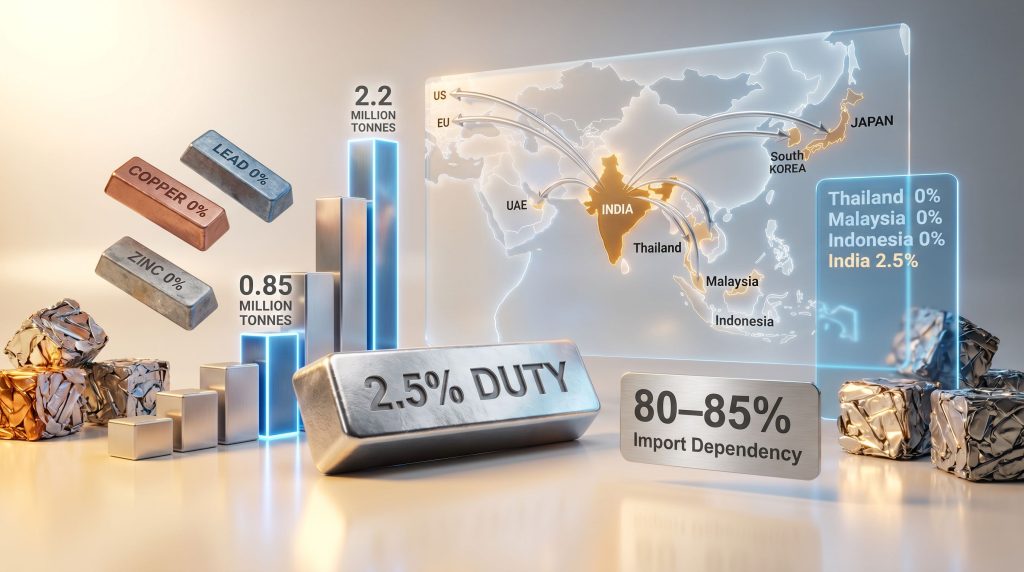
Following the 2025-26 Union Budget, copper, zinc, and lead scrap were all granted full import duty exemptions. Aluminium scrap now stands as the only major base metal scrap category still subject to a basic customs duty in India, a distinction that the Material Recycling Association of India (MRAI) argues lacks coherent industrial justification. Furthermore, Indian aluminium recyclers have publicly sought import duty relief as global scrap supply continues to tighten.
"The selective retention of the aluminium scrap duty, while exempting all comparable metal scrap categories, creates a structural anomaly within India's own tariff schedule that is difficult to defend on either competitiveness or revenue grounds."
India's Structural Import Dependency: The Numbers Behind the Gap
India's secondary aluminium industry has expanded at a remarkable pace over the past decade. Output grew from approximately 0.85 million tonnes in FY2015-16 to nearly 2.2 million tonnes in FY2025-26, representing cumulative growth of roughly 159% over ten years. Recycled aluminium now accounts for approximately 35% of total national aluminium consumption, a share that NITI Aayog projects will rise to around 45% by 2028.
Yet this expansion has outpaced the development of domestic scrap collection infrastructure, creating a supply gap that imports must fill.
| Metric | Data Point |
|---|---|
| Annual aluminium scrap imports | 1.8-2.0 million tonnes |
| 2025 full-year import volume | ~2.0 million tonnes |
| January-April 2026 import volume | ~560,000 tonnes |
| Import share of total scrap requirement | 80-85% |
| India's per capita aluminium consumption | 3.3 kg |
| Global average per capita consumption | 16 kg |
Why Domestic Supply Cannot Bridge the Gap
The root cause of India's import dependency is a consumption-driven structural deficit. With per capita aluminium consumption at just 3.3 kg against a global average of 16 kg, the volume of end-of-life aluminium available for domestic collection and reprocessing is simply too limited to support the recycling sector at scale. More aluminium must first enter use before it can re-enter the scrap stream.
This is not a short-term imbalance. Industry estimates suggest that India's domestic scrap ecosystem may require 15 to 20 additional years to reach a maturity level at which import dependency could meaningfully decline. In addition, the urban mining potential of India's growing aluminium stock remains largely untapped at this stage of development. During this transitional period, imported scrap is not a discretionary supplement to domestic supply — it is an operational necessity.
The Inverted Duty Structure: A Competitive Handicap Built Into Policy
The concept of an inverted duty structure describes a situation where the tariff burden on raw material inputs is disproportionately higher than the effective duty burden on finished goods derived from those inputs. In India's aluminium recycling context, this distortion operates through a specific mechanism:
-
Imported aluminium scrap attracts 2.5% basic customs duty, plus 18% IGST, plus 10% Social Welfare Surcharge.
-
Finished aluminium alloys imported from competing manufacturing economies including Thailand, Malaysia, Indonesia, Japan, and South Korea enter India under free trade agreements at zero duty.
-
Net effect: Indian secondary aluminium producers face higher input costs than foreign manufacturers who can ship finished alloy products into the Indian market completely duty-free.
Competing Economies Operating Under Zero-Duty Scrap Regimes
| Country/Region | Aluminium Scrap Import Duty |
|---|---|
| Thailand | 0% |
| Malaysia | 0% |
| Indonesia | 0% |
| Japan | 0% |
| South Korea | 0% |
| India | 2.5% basic duty + IGST + surcharge |
The competitive disadvantage this creates is not solely a function of the 2.5% headline rate. It is the cumulative landed cost differential relative to peer manufacturing economies that erodes margin viability across India's secondary aluminium sector. Indian recyclers are, in effect, being asked to compete internationally while carrying an input cost burden that their foreign competitors do not face. For context, broader tariff impacts on supply chains across global industries demonstrate just how significantly duty structures can distort competitive positioning.
Global Scrap Export Restrictions: A Compounding Supply Risk
The domestic tariff problem does not exist in isolation. A parallel and equally consequential trend is unfolding across India's primary aluminium scrap supply regions: the progressive tightening of scrap export policies in the very markets that currently fill India's supply gap.
| Supplier Region | Export Policy Measure | Approximate Share of India's Imports |
|---|---|---|
| European Union | Domestic retention policies tightening | ~22% |
| United States | Secure Aluminium Supply Chains Act (Congressional review) | ~20% |
| UAE | 100 AED/tonne export duty + temporary export ban on certain recyclables | Part of ~20% Gulf share |
| Saudi Arabia | 5% export tax on aluminium scrap | Part of ~20% Gulf share |
| South Africa | Export controls introduced | Partial contributor |
| Nigeria, Kenya, Ghana | Export duties or restrictions introduced | Partial contributor |
The US Legislative Risk Factor
The Secure Aluminium Supply Chains Act, currently before the United States Congress, proposes a formal legislative review of the national security and economic implications of aluminium scrap exports. Given that the US supplies approximately one-fifth of India's imported aluminium scrap, any statutory restriction on outbound US scrap flows would represent a material supply chain disruption for Indian recyclers. Moreover, the broader effects of US aluminium tariffs on global trade flows are already reshaping how scrap and primary metal move between markets.
"The convergence of tightening export policies across multiple major supply regions at the same time that India's domestic tariff structure is inflating input costs creates a compounding risk scenario. The policy window for removing the import duty while scrap remains globally tradeable at scale may be narrowing faster than policymakers currently appreciate."
Downstream Consequences: Which Industries Are Exposed?
Secondary aluminium produced by Indian recyclers is not a niche or low-specification material. Products meeting Bureau of Indian Standards (BIS) and international quality benchmarks are already embedded across several of India's most strategically significant manufacturing sectors:
- Automotive: Components supplied to major original equipment manufacturers including Tata Motors, Maruti Suzuki, Honda, and TVS Motor.
- Steel: Aluminium deoxidisers and alloying additions used by producers including Tata Steel and JSW Steel.
- Construction and Engineering: Structural and fabrication applications across the building and infrastructure sectors.
- Packaging: Lightweight aluminium alloy applications in consumer and industrial packaging.
NITI Aayog's projection that secondary aluminium will account for approximately 45% of total domestic aluminium demand by 2028 elevates the cost and availability of recycled aluminium from an industry-level concern to a variable with national industrial policy implications.
The SME Vulnerability That Rarely Features in Policy Debate
One dimension of this issue that receives insufficient attention in policy discussions is the disproportionate impact on SMEs. Unlike large integrated aluminium producers that can absorb input cost volatility through vertical integration, long-term supply contracts, or hedging instruments, smaller recyclers have limited options when scrap costs rise.
The MRAI has also noted that primary aluminium producers already benefit from a 7.5% basic customs duty on aluminium imports, providing meaningful protection for their end of the value chain. Critics of the current scrap tariff argue that maintaining additional indirect protection through scrap duties amounts to a double layer of insulation for primary producers at the expense of recyclers and the downstream manufacturers who purchase from them.
The next major ASX story will hit our subscribers first
The Stakeholder Divide: Not All Industry Voices Agree
It is important to recognise that India's aluminium value chain is not unified in its regulatory preferences. Different segments of the industry hold materially different positions, and understanding this tension is essential to reading how policy reform may actually unfold.
| Stakeholder | Position | Core Rationale |
|---|---|---|
| Primary aluminium producers | Retain or increase scrap duty | Protect domestic primary production from low-cost recycled substitutes |
| Secondary aluminium recyclers / MRAI | Abolish the 2.5% duty | Reduce input costs, improve competitiveness, support SME viability |
| Aluminium Association of India (AAI) / FIMI | Increase duty to 7.5-10% | Restrict inflow of substandard scrap; protect quality thresholds |
| Downstream manufacturers (auto, steel) | Favour duty removal | Lower input costs improve finished goods competitiveness |
The AAI and FIMI's proposal to increase the scrap duty to 7.5-10% represents an entirely different policy logic from the recycling sector's position. The former frames the issue as a quality control and domestic production protection problem; the latter frames it as a competitiveness and input cost problem. These are not easily reconcilable positions, and their divergence complicates the path toward any single reform outcome. Indeed, how the aluminium industry leaders at the primary production end of the value chain respond to reform pressure will significantly shape the eventual policy direction.
A Note on US-Canada Trade Agreement Provisions
One lesser-known feature of India's current import framework is that aluminium scrap imports originating from the United States and Canada may qualify for a 0% basic customs duty rate under applicable bilateral trade provisions, while the standard 2.5% rate applies to imports from the EU, Middle East, and other trading partners.
Additionally, under HS Code 7602, aluminium waste and scrap is classified as Restricted under India's import policy, meaning that compliance with specific regulatory conditions including quality certifications and environmental compliance standards is required prior to customs clearance. This classification adds procedural friction and cost to the import process beyond the tariff burden itself.
The Make in India Contradiction
India's Make in India and Atmanirbhar Bharat industrial policy frameworks are designed to reduce manufacturing input costs and expand domestic value-addition capacity. Sustaining an import duty on a critical raw material for which no viable domestic substitute exists at scale creates a direct contradiction with both of these stated objectives. Furthermore, the pressures this creates are similar to those observed across the broader aluminum and alumina markets, where policy-driven cost distortions consistently undermine competitiveness.
Removing the duty on aluminium scrap during the 15 to 20 year transitional period before domestic supply chains can reach self-sufficiency would:
- Reduce raw material costs for the approximately 80-85% of scrap supply currently sourced through imports.
- Improve the cost competitiveness of Indian-manufactured aluminium alloy components in both domestic and export markets.
- Align India's input cost framework with peer manufacturing economies already operating duty-free scrap import regimes.
- Support SME investment in processing infrastructure by removing the drag of elevated input costs.
- Accelerate progress toward NITI Aayog's target of secondary aluminium representing 45% of domestic demand by 2028.
Frequently Asked Questions: India Aluminium Scrap Import Duty
What is the current India aluminium scrap import duty rate?
The basic customs duty on aluminium scrap is 2.5%. However, importers are also liable for an 18% IGST and a 10% Social Welfare Surcharge on the CIF value, making the effective total cost impact substantially higher than the headline rate alone suggests.
Why does India's aluminium scrap duty create an inverted duty structure?
Because finished aluminium alloys can be imported from several competing manufacturing economies under free trade agreements at zero duty, while the raw material input required to produce those same alloys domestically faces a positive tariff. This structurally disadvantages Indian recyclers relative to foreign alloy producers selling into the Indian market.
What share of India's aluminium scrap demand is met by imports?
Imports satisfy an estimated 80-85% of India's total aluminium scrap requirement, with annual import volumes running at approximately 1.8-2.0 million tonnes per year.
What is the MRAI's position on the current duty?
The Material Recycling Association of India has formally called for the abolition of the 2.5% basic customs duty, arguing that it increases input costs for recyclers and downstream manufacturers while placing Indian industry at a structural competitive disadvantage relative to duty-free manufacturing hubs in Southeast and East Asia.
Are there exemptions available for aluminium scrap imports into India?
Imports originating from the United States and Canada may qualify for a 0% duty rate under applicable trade provisions. Standard rates apply to other major supplier regions including the EU, Gulf states, and African countries.
The Strategic Stakes: Circular Economy, Supply Security, and Industrial Competitiveness
The debate over India's aluminium scrap import duty is, at its core, a debate about what kind of industrial economy India wants to build over the next two decades. Recycled aluminium requires approximately 95% less energy to produce than primary aluminium from bauxite, making secondary production a critical pillar of any credible industrial decarbonisation strategy. A tariff structure that raises the cost of recycled aluminium's primary feedstock runs directly counter to circular economy ambitions.
At the same time, the tightening of scrap export policies across the EU, US, Gulf states, and African supplier nations signals that the global scrap trade is entering a more restricted phase. Countries and regions are increasingly treating aluminium scrap as a strategic domestic resource rather than an exportable commodity. India's window to secure reliable, cost-competitive access to imported scrap may consequently be narrowing.
The combination of domestic tariff pressure, global supply tightening, a 15-20 year domestic scrap maturity horizon, and an accelerating downstream demand trajectory from automotive, steel, and construction sectors makes the case for duty reform structurally compelling. Whether policymakers respond to the MRAI's call ahead of the next budget cycle will determine whether India's secondary aluminium sector expands on a competitive footing or continues to absorb avoidable costs in an increasingly supply-constrained global market.
This article is intended for informational and analytical purposes only. It does not constitute financial, investment, or legal advice. All projections, industry estimates, and policy interpretations are subject to change. Readers should conduct independent research and seek professional advice before making decisions based on the information presented here.
Want to Stay Ahead of the Next Major ASX Mineral Discovery?
Discovery Alert's proprietary Discovery IQ model delivers real-time alerts on significant ASX mineral discoveries — instantly cutting through complex data across more than 30 commodities to surface actionable investment opportunities ahead of the broader market. Start your 14-day free trial today and explore historic discoveries that have generated extraordinary returns for investors who positioned early.