July 8, 2026
The Supply Chain Fault Lines That Make Sulphur Bangladesh's Most Dangerous Import Dependency
Commodity markets rarely telegraph their vulnerabilities through a single procurement notice. Yet when a state-owned entity issues an identical tender for the second time within three months, and the first attempt ends without an award, the signal is impossible to ignore. Bangladesh seeks 15,000t of sulphur through tender, and this procurement situation has moved well beyond routine supply management. It now represents one of the most acute commodity sourcing crises in South Asia, one that threatens to cascade through fertilizer production, leather manufacturing, and industrial chemistry simultaneously.
Understanding why requires looking past the tender itself and into the structural mechanics of how Bangladesh acquires, processes, and deploys one of the most underappreciated industrial inputs in the global commodity system. Furthermore, the broader implications for global commodity markets make this situation worthy of close attention.
When big ASX news breaks, our subscribers know first
Why Sulphur Is Far More Consequential Than Its Profile Suggests
Sulphur occupies an unusual position in industrial economics. It is rarely discussed in the same breath as oil, copper, or lithium, yet it underpins the production of phosphate fertilizers, sulphuric acid for battery manufacturing, leather tanning chemicals, and a broad range of industrial processes. For Bangladesh specifically, the dependency is acute.
The country converts raw sulphur into sulphuric acid, which then feeds into the production of phosphate fertilizers critical for rice and vegetable cultivation. Bangladesh's agricultural calendar leaves almost no buffer: delayed or insufficient fertilizer supply during planting windows does not simply reduce yields, it can structurally alter food security outcomes for a population of over 170 million people.
Beyond agriculture, sulphuric acid is central to the leather goods sector, Bangladesh's second-largest export industry by value. Tanning processes require consistent acid supply at stable prices. An 8-to-10 times surge in sulphuric acid costs, which is precisely what parts of the Bangladeshi industrial sector have been confronting, does not merely compress margins. It makes entire production lines economically unviable.
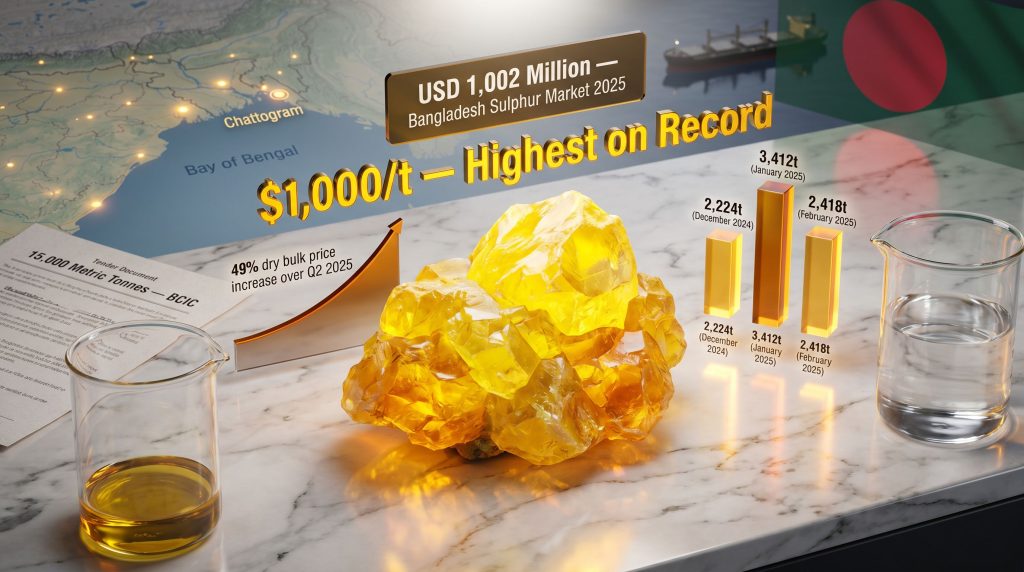
The Bangladesh sulphur market was valued at approximately USD 1,002 million in 2025, with projections pointing toward USD 1,436 million by 2032. That growth trajectory assumes a functioning import pipeline. The current disruption, however, places that assumption under serious pressure.
Record-Breaking Prices and the Collapse of the Middle Eastern Supply Corridor
Bangladesh has historically sourced an estimated 50 to 60 percent of its sulphur from the Middle East, with Saudi Arabia serving as the dominant counterparty. That concentration, acceptable during periods of regional stability, has become a textbook vulnerability as geopolitical turbulence disrupts established trade corridors. Consequently, supply chain disruptions of this nature are increasingly shaping how import-dependent economies must rethink their sourcing strategies.
The pricing consequences have been severe and, by historical standards, unprecedented. In July 2026, two of the region's primary state sulphur producers announced official price revisions that shattered previous records.
Global Sulphur Benchmark Pricing: July 2026
| Supplier | July OSP / KSP | Month-on-Month Change | Historical Significance |
|---|---|---|---|
| ADNOC (Abu Dhabi) | $1,000/t fob Ruwais | +$140/t | Highest on record; $180-200/t above the 2008 peak of $800-820/t fob |
| KPC (Kuwait) | $950/t fob Kuwait | +$145/t | Record level; $460/t above the previous record of $490/t set in June 2022 |
| Implied CFR India (ADNOC) | ~$1,105-1,108/t | – | Inclusive of $105-108/t freight for 40,000-45,000t vessel to east coast India |
| Implied CFR China (KPC) | ~$1,058-1,066/t | – | Inclusive of $108-116/t freight for 30,000-35,000t vessel to Chinese ports |
These are not incremental price movements. ADNOC's July official selling price eclipses the previous all-time record set during the commodity supercycle of 2008 by a significant margin. KPC's Kuwait Sulphur Price sits $460 per tonne above its own prior record, a figure that reflects not just supply tightness but a fundamental repricing of the risk premium attached to Middle Eastern sulphur exports.
For Bangladesh, which must add freight and insurance costs on top of these fob benchmarks, delivered prices to Chattogram port are realistically approaching or exceeding $1,100 to $1,200 per tonne cfr, compared to historical norms that would have been a fraction of those levels. The financial burden on Bangladesh's state procurement apparatus is, in turn, substantial.
The Phosphoric Acid Transmission Mechanism
Sulphur price inflation does not stay contained. It moves through the supply chain with mathematical precision. India's third-quarter phosphoric acid settlement, agreed between importer Coromandel and Jordanian producer JPMC, came in at $1,700/t P2O5 cfr India, representing a $340 per tonne increase from the second quarter.
Dry bulk sulphur prices to India rose by 49 percent over Q2 2025, and that cost escalation fed directly into the phosphoric acid figure. According to Argus Media sulphur market reporting, these price movements reflect a combination of tightening supply and elevated geopolitical risk premiums that are unlikely to unwind quickly.
For Bangladesh, which shares much of the same regional supply infrastructure as India, this pricing environment creates compounding pressure. Every dollar increase in sulphur prices translates into downstream cost inflation across fertilizers, acids, and chemicals, ultimately landing on the balance sheets of farmers, manufacturers, and exporters who have limited ability to absorb the shock.
Anatomy of the BCIC Tender: What the Numbers Reveal
The Bangladesh Chemical Industries Corporation, known as BCIC, is the state-owned body responsible for procuring industrial raw materials for Bangladesh's fertilizer and chemical manufacturing base. On 6 July 2026, BCIC issued a buy tender seeking 15,000 metric tonnes of crushed lump sulphur, with a tolerance of plus or minus 10 percent, specifying the grade standard as Bright Yellow Rock Sulphur.
The tender's closing date is 7 September, with a delivery requirement to Chattogram port within 30 days of letter of credit opening.
Key Tender Parameters at a Glance
- Issuing authority: Bangladesh Chemical Industries Corporation (BCIC)
- Volume: 15,000 metric tonnes (±10%)
- Grade specification: Crushed lump / Bright Yellow Rock Sulphur
- Submission deadline: 7 September 2026
- Delivery point: Chattogram (Chittagong) port
- Delivery window: 30 days from letter of credit opening
Bright Yellow Rock Sulphur is the standard industrial-grade specification used across South Asian fertilizer and chemical processing. It is important to distinguish this from liquid sulphur, which requires heated storage and specialised shipping infrastructure. Rock sulphur, while more logistically straightforward in some respects, still demands appropriate bulk handling facilities, and Chattogram's capacity constraints add a layer of practical complexity to any winning bid.
Why Did the April Tender Fail?
BCIC launched an identical 15,000-tonne tender in April 2026. No award resulted. This outcome is the most revealing data point in the entire situation. Possible explanations include:
- Price ceiling mismatch: Supplier bids exceeded BCIC's acceptable price parameters amid record global sulphur pricing, making an award economically indefensible for the state buyer.
- Thin supplier participation: With spot market alternatives offering comparable or superior returns, suppliers may have had little incentive to engage with a structured tender process at a moment of extreme commodity market volatility.
- Freight risk premiums: Geopolitical disruption across the Middle Eastern shipping corridor has elevated freight costs and introduced delivery risk that suppliers may be pricing in, pushing total bids above buyer thresholds.
- Logistics constraints at Chattogram: The 30-day delivery window post-LC opening is tight by current bulk freight standards, particularly when vessel availability and port scheduling are under pressure.
A second failed tender would not represent a procurement anomaly. It would confirm a systemic breakdown in Bangladesh's ability to access sulphur through standard commercial mechanisms at prevailing global prices.
Import Volatility: Bangladesh's Procurement Pipeline in Numbers
Monthly sulphur import data reveals a procurement pipeline that is structurally fragile well before the current price shock. Bangladesh's import volumes during the final months of 2024 and into early 2025 exhibited month-to-month swings that expose the absence of any meaningful buffer stock strategy:
| Month | Sulphur Import Volume |
|---|---|
| December 2024 | 2,224 tonnes |
| January 2025 | 3,412 tonnes |
| February 2025 | 2,418 tonnes |
A swing of more than 35 percent between consecutive months in a commodity as foundational as sulphur is not a sign of responsive procurement. It is a sign of a buying strategy that operates hand-to-mouth, leaving industrial consumers exposed to any external disruption with virtually no inventory cushion to absorb the shock.
Reports of Bangladeshi industrial facilities operating with as little as 8 days of sulphur-derived raw material inventory underline the severity of the position. In supply chain terms, 8 days of stock is not a buffer. It is a countdown.
Regional Benchmarking: How Does Bangladesh Compare to South Asian Peers?
Bangladesh's procurement vulnerability becomes even sharper when viewed against the strategies employed by neighbouring economies.
| Country | Procurement Method | Key Suppliers | Vulnerability Profile |
|---|---|---|---|
| Bangladesh | State tender via BCIC | Saudi Arabia, Middle East | High: concentrated sourcing, minimal buffer stocks |
| India | Long-term bilateral contracts plus spot purchases | Middle East, Canada, Kazakhstan | Medium: diversified but still price-exposed |
| Pakistan | State and private sector hybrid | Middle East, Central Asia | High: fiscal constraints limit price flexibility |
| Sri Lanka | Spot market dependent | Regional re-export hubs | Very High: small volumes, minimal negotiating leverage |
India's approach to sulphur procurement is instructive. By combining long-term bilateral supply agreements with selective spot market participation, India maintains greater pricing flexibility and supplier diversification. Kazakhstan has emerged as an increasingly relevant non-Middle Eastern sulphur source for Asian buyers, given the country's large sulphur output from oil and gas processing.
Canadian oil sands generate substantial sulphur volumes as a byproduct, though freight economics to South Asia make this a higher-cost alternative under normal conditions. For Bangladesh, the case for pursuing long-term bilateral agreements with diversified counterparties has never been more economically compelling. The commodity price impacts flowing from this environment are, furthermore, reshaping procurement calculus across the entire region.
The next major ASX story will hit our subscribers first
Three Scenarios for What Happens Next
Scenario A: Successful Tender Award at Market Price
BCIC accepts bids reflecting current global benchmarks. Bangladesh secures 15,000 tonnes at an estimated delivered cost of $1,100 to $1,200 per tonne cfr Chattogram. Critical industries receive short-term supply relief, but the underlying sourcing concentration remains unreformed and the financial burden on the state procurement budget intensifies.
Scenario B: A Second Consecutive Failed Tender
Bids again fall outside acceptable parameters, or supplier participation remains insufficient. Industrial shutdowns accelerate across fertilizer blending, leather processing, and battery acid production. The government faces pressure to intervene through emergency procurement channels or import subsidies, placing additional strain on foreign exchange reserves.
Scenario C: Policy-Led Structural Reform
The current crisis provides the political impetus for Bangladesh to establish a strategic sulphur reserve framework, pursue long-term bilateral supply agreements with geographically diversified partners, and invest in Chattogram's bulk handling infrastructure. This pathway offers medium-term market stabilisation, though price exposure will remain tied to global sulphur benchmarks as long as Bangladesh remains an import-dependent economy. In addition, the growing battery materials demand globally will only add further pressure to sulphur supply chains over the coming years.
What This Tender Signals for Commodity Market Participants
For market participants tracking South Asian commodity flows, the Bangladesh sulphur situation carries several broader implications worth monitoring. According to the World Bank commodity markets outlook, structurally elevated input costs in import-dependent developing economies represent a persistent and growing risk to industrial output and food security simultaneously.
- Price environment: Middle Eastern sulphur OSPs and KSPs are at all-time highs in July 2026, creating a structurally elevated cost floor for all import-dependent South Asian buyers.
- Procurement fragility: Two consecutive tenders for identical volumes, with one already failing to result in an award, points toward systemic dysfunction rather than a routine procurement gap.
- Cascade risk: Sulphur scarcity does not stay within one sector. It propagates through fertilizers, leather chemicals, and battery acid production simultaneously, amplifying the economic damage across Bangladesh's industrial base.
- Strategic reserve imperative: The absence of any meaningful strategic sulphur reserve leaves Bangladesh's entire downstream industrial complex exposed to external price and supply shocks with no policy buffer.
- Alternative supplier opportunity: The current environment creates openings for non-traditional sulphur exporters, including Central Asian producers and potentially those accessing longer freight routes, to compete for South Asian market share if pricing dynamics align.
Bangladesh seeks 15,000t of sulphur through tender for the second time in three months, and the outcome of this procurement round will serve as a definitive indicator of whether the country's industrial supply chain can withstand the most challenging sulphur pricing environment in recorded history. The stakes extend well beyond a single commodity purchase.
This article is intended for informational and analytical purposes only. It does not constitute financial or investment advice. Price projections, market scenarios, and forward-looking statements involve inherent uncertainty and should not be relied upon as forecasts of actual outcomes. Readers should conduct independent due diligence and consult qualified advisers before making any commercial or investment decisions based on the information presented.
Want to Stay Ahead of Commodity Supply Chain Disruptions Like This One?
Discovery Alert's proprietary Discovery IQ model scans ASX announcements in real time, delivering instant alerts on significant mineral discoveries across sulphur, phosphate, and over 30 other commodities — explore historic discovery returns on the Discovery Alert discoveries page to see how early positioning in major finds has driven exceptional outcomes, then begin your 14-day free trial to secure a market-leading edge before the broader market catches on.