July 8, 2026
When Diplomatic Architecture Crumbles: Oil Markets and the Hormuz Risk Premium
Geopolitical risk premiums in energy markets behave in a counterintuitive way. They compress quietly during periods of diplomatic optimism, often faster than the underlying fundamentals justify, and then rebuild violently when that optimism is punctured. The speed and severity of the rebuilding phase almost always catches traders positioned for calm off guard. That dynamic is now playing out in real time across global crude benchmarks as Trump declares Iran ceasefire over, sending oil prices sharply higher and reintroducing tail risk scenarios that many market participants had begun to dismiss.
Understanding why this escalation was structurally predictable, and what it means for energy markets going forward, requires looking beyond the immediate headlines and examining the foundational weaknesses that were baked into the agreement from the start. The current crude market overview reveals just how rapidly sentiment can shift when diplomatic frameworks collapse.
When big ASX news breaks, our subscribers know first
The Ceasefire That Was Never Fully Engineered
The diplomatic framework established in April 2026 between Washington and Tehran was built around a single, non-negotiable precondition: unimpeded commercial shipping access through the Strait of Hormuz. In exchange for Iranian cooperation on transit security, the U.S. Treasury's Office of Foreign Assets Control issued General License X, dated June 21, 2026, which temporarily authorised the production, delivery, and sale of Iranian crude oil, petrochemical products, and petroleum products during a 60-day negotiation window.
On paper, the agreement represented a meaningful step. In practice, it contained a structural flaw that analysts are now describing as the root cause of its collapse: the two sides never established enforceable technical protocols for managing the strait's traffic lanes.
The Fatal Gap: Operational Details That Were Never Resolved
The memorandum of understanding that underpinned the ceasefire left the granular management of the Strait of Hormuz essentially undefined. Both parties operated under incompatible interpretations of what constituted compliant transit behaviour. Iran asserted dominance over vessel routing through the strait and considered ships transiting via the southern Hormuz passage through Omani waters, without coordination with Iranian authorities, to be a direct challenge to its sovereign claims over the waterway.
The United States and international shipping operators, by contrast, regarded those southern passages as legitimate international routes. That interpretive gap meant that any vessel transit had the potential to be framed as a provocation by one side or the other. Furthermore, the geopolitical trade tensions underpinning this dispute had been building well before the ceasefire was ever signed.
The inability to reach agreement on something as operationally narrow as shipping lane protocols is widely interpreted by senior energy analysts as a leading indicator that progress on Iran's nuclear programme under the current U.S. administration faces near-insurmountable obstacles.
When three commercial vessels were struck within a single 24-hour window in the Strait of Hormuz, the ceasefire framework had no absorptive mechanism. The accumulated tension snapped.
Trump Declares Iran Ceasefire Over: What the NATO Summit Announcement Actually Signals
On July 8, 2026, during a press meeting at the 2026 NATO Summit in Ankara, Türkiye, President Trump stated publicly that he considered the ceasefire to be finished and indicated he no longer wished to pursue active negotiations with Tehran. His framing was unambiguous: further diplomatic engagement was, in his view, unproductive.
The geopolitical subtext of this declaration is as significant as its content. Announcing the effective termination of a bilateral ceasefire from within a NATO summit venue signals to allied nations that Washington may be repositioning the Iran conflict within a broader multilateral security framework rather than continuing to treat it as a bilateral dispute amenable to quiet diplomacy.
The timing also matters because it came against the backdrop of an intensifying exchange of military actions. U.S. Central Command confirmed it had launched strikes on more than 80 Iranian targets in response to the vessel attacks, characterising Iran's aggression as a clear violation of the ceasefire. Iran, in turn, targeted U.S. military installations in Bahrain and Kuwait. Speaker of Iran's Parliament Mohammad Bagher Ghalibaf publicly listed what Tehran described as major MOU violations by the United States, including persistent strike threats, the reinstatement of oil sanctions, and attacks on southern Iran. For context on how the oil markets under trade war conditions have historically reacted to such ruptures, the parallels are striking.
Comparing This Breakdown to Prior U.S.-Iran Diplomatic Ruptures
| Diplomatic Episode | Year | Key Outcome | Crude Market Response |
|---|---|---|---|
| JCPOA Withdrawal | 2018 | Sanctions fully reimposed | Brent rose approximately 40% over 12 months |
| Maximum Pressure Campaign | 2019-2020 | Iranian tanker seizures; tanker war dynamics | Repeated volatility spikes |
| 2026 MOU Ceasefire Signed | April 2026 | Sanctions waiver issued; prices fell on optimism | Risk premium compressed sharply |
| Ceasefire Declared Over | July 8, 2026 | Sanctions reinstated; strikes launched | Brent surged more than 5% intraday |
Each prior breakdown followed a similar pattern: diplomatic optimism compresses the risk premium, a structural failure triggers rapid re-escalation, and markets are caught positioned for the wrong scenario.
The Strait of Hormuz: Why This Waterway Holds the Global Economy Hostage
No single piece of maritime infrastructure exerts more leverage over global energy supply than the Strait of Hormuz. The numbers are stark:
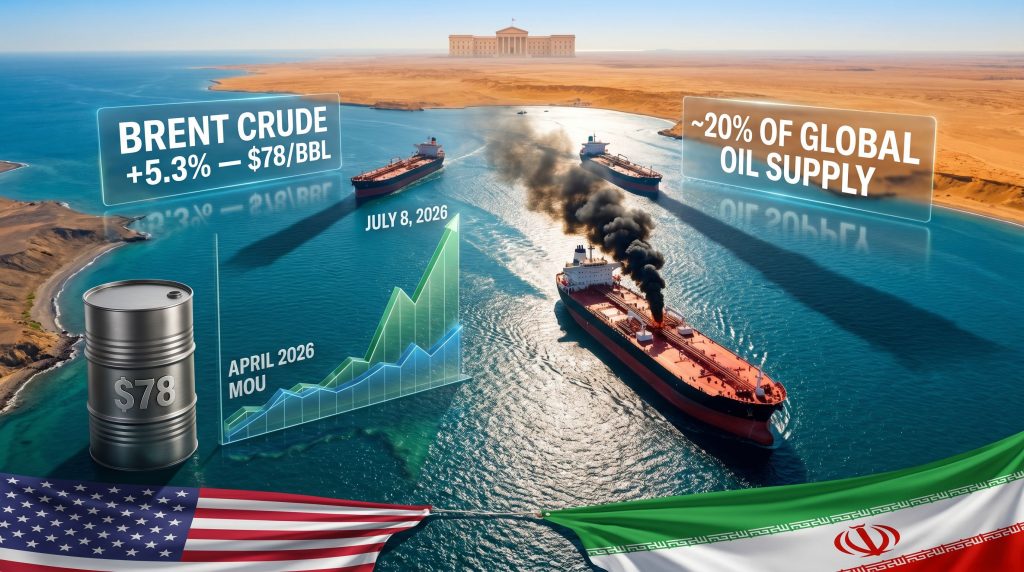
- Approximately 20% of global daily oil supply transits through the strait
- Estimated throughput of 17 to 18 million barrels per day of crude and petroleum products
- The navigable channel narrows to approximately 33 kilometres at its tightest point
- Disruption would immediately affect supply chains serving Asia, Europe, and North America
- No combination of alternative pipeline infrastructure, including Saudi Arabia's East-West Pipeline and the UAE's ADCO pipeline, can fully compensate for a complete Hormuz closure at scale
A full or partial closure of the Strait of Hormuz would effectively remove approximately one-fifth of the world's daily oil supply from global markets. Even a partial disruption sustained over days rather than weeks would generate severe price spikes, given the absence of any scalable bypass infrastructure capable of absorbing that volume.
What makes the current situation particularly complex is that the strait has not physically closed. It remains technically open but operationally hazardous, with elevated vessel attack risk translating directly into surging marine war risk insurance premiums. Those insurance costs function as a hidden tax on global energy trade even before any physical supply disruption materialises. This is consistent with BBC reporting on the Twelve-Day War ceasefire and its broader regional consequences.
The Risk Premium Mechanics Behind Today's Price Surge
GivTrade Technical Analyst Waleed Said has described the current crude price movement as a rebuild of the Middle East risk premium, driven by growing concerns around Iranian tensions, shipping security, and Strait of Hormuz transit risk. Critically, the market is pricing the possibility of supply disruption before any confirmed physical impact has occurred, a pattern entirely consistent with historical Hormuz escalation episodes.
Standard Chartered Bank's Energy Research Head Emily Ashford noted that the market had been positioned heavily short entering this escalation, meaning the price moves have been particularly severe relative to the actual supply impact so far. Importantly, she pointed out that despite the sharp intraday gains, crude remains at approximately a $50 per barrel discount to peak conflict levels recorded earlier in the escalation cycle, highlighting how aggressively the risk premium had been compressed during the ceasefire period.
Crude Price Action: Reading the Numbers
At the time of writing on July 8, 2026, crude benchmarks were reflecting the full force of the risk premium rebuild:
| Benchmark | Price | Intraday Change | Notable Level |
|---|---|---|---|
| Brent Crude | Above $78/barrel | +5.33% | Recovered above $76 psychological threshold |
| WTI Crude | Near $74/barrel | +5.2% | Two-week high |
| Natural Gas | $3.30 | +1.19% | Secondary risk asset uplift |
The recovery of Brent above $76/barrel is analytically significant. That level had been flagged by Saxo Bank as a potential trigger for short-covering activity among hedge funds, meaning the price surge may have been amplified by forced covering of bearish positions rather than purely representing new bullish conviction. Understanding the interplay of crude trade and geopolitics is essential context for interpreting these movements correctly.
Sanctions Architecture: The Revocation of General License X
On July 7, 2026, OFAC formally revoked General License X and replaced it with General License X1, which winds down all previously authorised Iranian oil transactions. The practical consequences for global crude markets are multi-layered:
- New purchases of Iranian crude by any entity subject to U.S. jurisdiction are immediately prohibited
- Wind-down provisions apply to contracts already in progress under the original licence
- Secondary sanctions risk is reinstated for third-party buyers, particularly across Asia, where Iranian crude had been flowing under the waiver
- The progressive removal of Iranian export volumes from global supply adds a structural bullish factor that persists beyond the immediate risk premium spike
Iran's Ministry of Foreign Affairs formally condemned the revocation, describing it as a unilateral breach of the negotiated framework.
The next major ASX story will hit our subscribers first
Scenario Analysis: Three Trajectories From Here
Scenario 1: Rapid Diplomatic Re-engagement (Low Probability Near-Term)
A breakthrough facilitated by Gulf state intermediaries, combined with resolution of strait management protocols, could de-escalate the situation relatively quickly. In this outcome, OPEC+'s agreed August production quota increase would exert meaningful downward pressure on prices, and Brent could retrace toward the $70-72 range. This scenario's probability is constrained by the demonstrated inability of both sides to agree even on technical operational details during the MOU negotiation period.
Scenario 2: Prolonged Low-Intensity Conflict (Base Case)
Both sides continue exchanging calibrated responses without crossing into full-scale warfare. The strait remains technically open but operationally dangerous, sustaining elevated insurance premiums and a persistent geopolitical risk premium. Brent trades in a $76-85 range characterised by high volatility and sensitivity to individual incident reports.
Scenario 3: Major Escalation Including Strait Closure (Tail Risk)
A full or partial Strait of Hormuz closure, or coordinated strikes on Gulf energy infrastructure on either side of the conflict, represents the tail risk scenario. Senior market analysts, including XS.com's Senior Market Analyst Samer Hasn, have explicitly flagged the risk of strikes on vital energy facilities across the region as non-trivial under the current escalation trajectory. In this scenario, crude prices could exceed $100/barrel within days, with cascading inflationary effects across the global economy and immediate implications for monetary policy settings.
In this severe escalation scenario, OPEC+'s production increase decisions would become effectively irrelevant in the near term, with the market moving into a structural supply deficit that no quota adjustment could offset.
The OPEC+ Paradox and the Gasoline Price Political Dimension
The timing of this ceasefire collapse creates an acute paradox for OPEC+ and for U.S. domestic politics simultaneously. OPEC's market influence had already been a key variable prior to this escalation, with Gulf producers steadily increasing output to add downward pressure to prices. However, that entire supply-side calculation has now been scrambled.
Additional barrels agreed on paper face real-world delivery risk given the security environment in and around the Strait of Hormuz. Hasn has characterised this as a scenario where the OPEC+ production increase decision risks remaining unenforceable for as long as the current security situation persists.
On the political dimension, the proximity of U.S. midterm elections and the persistence of retail gasoline prices near $4 per gallon creates a domestic incentive structure that may ultimately push Washington toward re-engagement, even if the stated position is one of disengagement. This is arguably the single most credible pathway to a rapid diplomatic breakthrough — not diplomatic goodwill, but electoral arithmetic.
FAQ: Trump Declares Iran Ceasefire Over
When did Trump declare the Iran ceasefire over?
Trump made the declaration on July 8, 2026, during a press meeting at the 2026 NATO Summit in Ankara, Türkiye, stating publicly that he considered the ceasefire finished and that further negotiations were unproductive.
What caused the ceasefire to collapse?
Three commercial vessels were attacked in the Strait of Hormuz within a 24-hour window. The U.S. attributed these attacks to Iran and responded with strikes on more than 80 Iranian targets while simultaneously revoking the sanctions waiver that had permitted Iranian oil sales. Iran described the vessel transit route used as a violation of the MOU. For further background, the Wikipedia entry on the Twelve-Day War ceasefire provides useful historical context on the preceding conflict phase.
How much did oil prices rise?
Brent Crude rose more than 5.3% to above $78/barrel, while WTI Crude surged approximately 5.2% to near $74/barrel, with both benchmarks reaching two-week highs.
What sanctions have been reimposed on Iran?
OFAC revoked General License X, effective July 7, 2026, and issued General License X1, which winds down all previously authorised Iranian crude oil and petrochemical product transactions.
What are the risks to global oil supply?
The Strait of Hormuz carries approximately 20% of global daily oil supply. Sustained disruption to transit, whether through vessel attacks, closure threats, or infrastructure strikes, poses significant upside risk to crude prices and inflationary pressure across the global economy.
Could a diplomatic resolution emerge quickly?
U.S. domestic political pressures, particularly approaching midterm elections and elevated retail gasoline prices, create a structural incentive for re-engagement. However, the demonstrated failure to resolve even narrow technical questions during MOU negotiations makes the probability of rapid breakthrough low in the near term.
What to Monitor in the Days Ahead
For energy market participants, the key data points and developments to track include:
- Brent crude price action relative to the $80/barrel threshold, which would signal significant further risk premium rebuilding
- Back-channel diplomatic activity between Washington, Tehran, and Gulf intermediaries including Qatar and Oman
- U.S. Central Command operational posture and any further strike authorisations against Iranian targets
- Iranian parliamentary and military response to the sanctions reinstatement, particularly any formal escalation declarations
- OPEC+ emergency communications regarding whether the August quota increase remains operational or is effectively suspended by the security environment
- U.S. retail gasoline price trajectory and its political implications as midterm election campaigning intensifies
- Marine war risk insurance premiums as a real-time proxy for the operational risk level in Hormuz transit lanes
The collapse of the 2026 U.S.-Iran ceasefire was not an unpredictable accident. It was the outcome of a framework that never resolved the operational questions that mattered most. With Trump declaring the Iran ceasefire over and both sides trading military responses, the path back to diplomatic stability is long, and crude markets are repricing that reality in real time.
Disclaimer: This article contains forward-looking statements, scenario projections, and market analysis that are inherently speculative. None of the content constitutes financial or investment advice. Commodity prices are subject to rapid and material change based on geopolitical developments. Readers should consult qualified financial advisors before making investment decisions.
Want to Stay Ahead of the Next Major Commodity Price Shift?
When geopolitical shocks send energy and resource markets into sharp repricing cycles, timing is everything — and Discovery Alert's proprietary Discovery IQ model delivers real-time alerts on significant ASX mineral discoveries, ensuring subscribers can identify actionable opportunities before the broader market reacts. Explore how historic discoveries have generated substantial returns on Discovery Alert's discoveries page, and begin your 14-day free trial today to position yourself ahead of the next major market move.