July 8, 2026
When Sovereign States Borrow Against Tomorrow's Oil
Across sub-Saharan Africa, a quiet but consequential financing revolution has been unfolding for decades. Governments sitting atop vast hydrocarbon reserves yet locked out of conventional bond markets have turned to a financial instrument that converts future crude barrels into present-day cash. This mechanism, known as oil-backed prepayment financing, has become the fiscal lifeline of some of Africa's most resource-dependent economies. Yet when production stumbles, political instability flares, or competing creditors emerge, the same instrument that kept governments solvent can rapidly become a tool of legal warfare.
The South Sudan BB Energy oil dispute is the most vivid recent illustration of exactly how this architecture can fracture under pressure.
When big ASX news breaks, our subscribers know first
How Oil Prepayment Financing Actually Works
The Mechanics Behind the Money
At its core, an oil prepayment arrangement is deceptively straightforward. A commodity trader advances a lump sum of capital to a resource-producing government. In return, the government commits to delivering a predetermined volume of crude oil over a future period, effectively repaying the debt in barrels rather than currency. The trader monetises those barrels on global markets, recovering the advance plus an implicit financing margin built into the pricing terms.
For governments like South Sudan, the appeal is obvious. These arrangements provide immediate liquidity without the credit ratings, bond prospectuses, or investor roadshows that conventional sovereign debt requires. The crude itself serves as both the collateral and the repayment instrument.
However, the structural vulnerabilities embedded in this model are significant. Commodity trading giants operating in frontier markets face compounding layers of risk that are rarely fully priced into the initial deal terms:
- Production risk: If output declines due to infrastructure failure, conflict, or natural causes, the physical barrels required for repayment may not materialise.
- Price volatility risk: Traders often price prepayment terms against forward crude benchmarks. When spot prices diverge sharply from those benchmarks, the economic assumptions underpinning the deal can collapse.
- Competing creditor risk: When a government has entered multiple prepayment agreements against the same crude streams, each new deal dilutes the security available to existing creditors.
- Governance opacity: The absence of centralised disclosure frameworks means that traders extending new facilities often lack full visibility over prior obligations against the same cargo pool.
Dar Blend and Nile Blend: The Twin Pillars of South Sudan's Export Economy
South Sudan's crude export profile is built around two primary grades: Dar Blend and Nile Blend. Both are landlocked production streams that transit through Sudan via pipeline to the Port of Sudan before loading onto export vessels, adding both logistical complexity and geopolitical risk to every cargo.
Oil revenues constitute the overwhelming majority of government income in South Sudan, a dependency ratio that makes the country extraordinarily sensitive to any disruption in crude export flows. Furthermore, the geopolitical risk landscape surrounding the transit route through Sudan adds an additional layer of uncertainty that conventional creditors consistently underestimate.
When the same barrels simultaneously represent the government's primary revenue stream and the collateral pool for multiple overlapping debt obligations, the risk concentration becomes extreme.
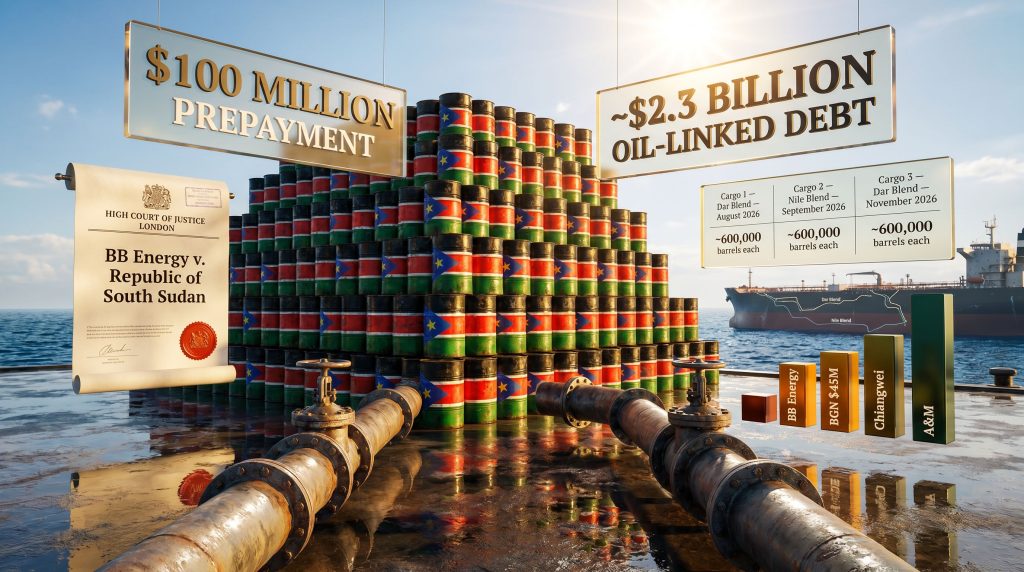
South Sudan carries an estimated $2.3 billion in total oil-linked debt owed to a combination of international banks and commodity trading firms. At this scale of indebtedness, every exported barrel is simultaneously an income asset and a liability instrument.
The Origins of the South Sudan BB Energy Oil Dispute
A $100 Million Prepayment and Its Aftermath
In February 2025, commodity trader BB Energy extended a $100 million prepayment facility to the Republic of South Sudan. The contractual structure was standard for the sector: South Sudan would repay the advance through a series of physical crude oil deliveries, with each cargo representing a tranche of debt reduction.
The arrangement began functioning as designed. One cargo was successfully loaded in February 2026. Then deliveries stalled. What followed was a commercial dispute that escalated rapidly into international legal proceedings, exposing the broader fragility of South Sudan's prepayment financing architecture.
The total value of the dispute, spanning BB Energy's 2024 and 2025 prepayment arrangements with South Sudan, reached approximately $142 million. With global crude prices rising during the dispute period, BB Energy's estimated economic exposure expanded further, with trader loss projections cited at between $150 million and $180 million when adjusted for prevailing market prices.
The Multi-Creditor Problem: When Multiple Traders Hold Claims on the Same Barrels
The South Sudan BB Energy oil dispute did not exist in isolation. South Sudan had entered concurrent prepayment arrangements with multiple commodity trading counterparties, each holding advance claims against the same Dar Blend and Nile Blend cargo pools.
| Counterparty | Reported Prepayment Exposure |
|---|---|
| BB Energy | ~$100–142 million (2024–2025 arrangements) |
| BGN (Dubai-based) | ~$45 million |
| Chiangwei | Undisclosed |
| A&M | Undisclosed |
This multi-layered creditor structure created a dangerous dynamic. When crude deliveries slowed, every trader holding a prepayment claim faced the same problem: fewer barrels available for allocation than the total contractual entitlement. The rational response for any individual creditor is to move first, seeking injunctive protection before competitors can secure priority access to the remaining cargo pool.
The simultaneous existence of multiple prepayment claims against the same crude cargo pool is not unique to South Sudan. It reflects a structural risk embedded in how frontier oil states manage liquidity shortfalls through sequential or parallel trading arrangements, often without transparent disclosure of prior obligations.
This "first-mover enforcement incentive" is one of the least-discussed but most consequential dynamics in frontier commodity finance. It transforms what begins as a bilateral financing arrangement into a multi-party race to the courthouse. In addition, commodity market volatility during the dispute period further complicated the valuation of outstanding claims, making negotiated settlement considerably harder to achieve.
London's High Court and the Injunction Against a Sovereign State
How English Courts Exercise Jurisdiction Over Sovereign Commercial Disputes
In May 2026, London's High Court granted BB Energy an injunction preventing South Sudan from entering into new prepayment contracts for Dar Blend and Nile Blend crude until outstanding obligations to the trader were addressed. A London court subsequently upheld a broader restriction, effectively locking South Sudan out of its primary external financing mechanism.
The process by which an English court issues and enforces an injunction against a sovereign state in a commercial context involves several distinct steps:
- The creditor files for emergency injunctive relief, citing the risk of irreparable financial harm if the sovereign is permitted to continue transacting.
- The court evaluates whether the balance of convenience favours the preservation of assets pending resolution.
- An interim ruling or consent order is issued, restricting the sovereign's commercial activity within the scope of the order.
- The sovereign must then choose between compliance, negotiated settlement, or a legal challenge to the injunction's terms.
The critical legal distinction here is between sovereign immunity in diplomatic and governmental contexts, and the commercial law framework that governs trade finance agreements conducted under English law jurisdiction. When sovereigns elect to use English law as the governing framework for prepayment contracts, they implicitly accept English court jurisdiction over enforcement disputes. This is a well-established principle, but its practical consequences are only now becoming widely visible as African oil producers face increasing creditor pressure.
English courts have become the primary venue for resolving commodity trade disputes involving African sovereign entities. This jurisdictional concentration raises important long-term questions about whether the current architecture appropriately balances creditor enforcement rights against the fiscal sovereignty of resource-dependent states.
The July 2026 Settlement: A Partial Resolution with Outstanding Questions
What the Consent Order Actually Provides
Following what BB Energy described as constructive commercial discussions involving South Sudan and other market participants, a consent order was filed at London's High Court in July 2026. The agreement provided BB Energy with a structured crude allocation while partially restoring South Sudan's ability to access prepayment financing.
The delivery schedule agreed under the consent order is as follows:
| Cargo | Crude Grade | Scheduled Delivery | Volume |
|---|---|---|---|
| Cargo 1 | Dar Blend | August 2026 | ~600,000 barrels |
| Cargo 2 | Nile Blend | September 2026 | ~600,000 barrels |
| Cargo 3 | Dar Blend | November 2026 | ~600,000 barrels |
The combined allocation of approximately 1.8 million barrels represents a partial reduction of the outstanding debt. Critically, none of these three cargoes can be included in any new prepayment arrangement. They are explicitly ring-fenced for BB Energy's account.
In exchange, BB Energy agreed to relax the existing injunction restrictions, restoring South Sudan's ability to accept advance payments for future Dar Blend and Nile Blend cargoes under specified conditions. This injunction relief remains operative until the end of November 2026, after which both parties have committed to negotiating a comprehensive long-term settlement covering the full remaining debt balance.
Neither party disclosed the residual value of the outstanding obligation following the July 2026 agreement.
What Remains Unresolved
The consent order is explicitly a partial and time-limited arrangement. Several material questions remain open:
- The total remaining debt balance has not been publicly quantified.
- The structure and timeline of any long-term settlement are yet to be determined.
- The concurrent claims of BGN, Chiangwei, and A&M against South Sudan's crude pool remain unresolved.
- South Sudan's ability to honour all outstanding obligations simultaneously depends on maintaining stable production output, which has historically been vulnerable to both infrastructure deterioration and civil instability.
The Systemic Risk Behind the Bilateral Dispute
When Fiscal Policy and Debt Collateral Are the Same Asset
The South Sudan BB Energy oil dispute is instructive precisely because it exposes a circular risk that is not unique to this country. When a government's primary revenue source is also its primary debt collateral, any disruption to production creates simultaneous fiscal pressure and creditor default risk. These two forces compound each other rather than operating independently.
South Sudan's near-total dependence on crude exports means that a production shortfall does not merely reduce government income. It also impairs the government's ability to service prepayment obligations, which triggers creditor enforcement actions, which restrict access to new financing, which further constrains the government's fiscal capacity. The feedback loop is self-reinforcing and can accelerate rapidly. Moreover, oil price disruption during periods of geopolitical tension compounds these pressures substantially.
Comparative risk profile across frontier African oil producers:
| Risk Factor | South Sudan | Generalised Frontier Peer |
|---|---|---|
| Revenue dependence on crude exports | Near-total | Moderate to high |
| Capital market access | Severely constrained | Limited |
| Governing law for trade contracts | English law | English or New York law |
| Transparency of prepayment obligations | Low | Generally low |
| Risk of overlapping cargo claims | High (evidenced) | Moderate |
| Creditor enforcement mechanism | London High Court | London or ICC arbitration |
The Cascading Default Scenario
A hypothetical but analytically credible scenario illustrates the systemic risk clearly. If South Sudan's production output were to decline materially, whether through infrastructure deterioration, renewed conflict, or pipeline transit disruptions, the volume of deliverable barrels would fall below the aggregate entitlements held by all prepayment creditors simultaneously.
Each creditor would face rational incentives to pursue injunctive relief in London's High Court before competitors could secure priority. In a compressed timeframe, the entire export revenue stream could become encumbered by overlapping litigation, locking the government out of all advance financing simultaneously while the underlying production deficit worsened.
This is not a purely theoretical concern. South Sudan's oil output has been on a long-term structural decline since its peak, with infrastructure investment constrained by the same fiscal pressures that drive the government toward prepayment financing in the first place.
The Transparency Gap and Why It Matters for Creditors
One of the least-examined structural problems in frontier oil finance is the absence of any centralised registry or disclosure framework for prepayment obligations. When BB Energy extended its facility in February 2025, the full extent of South Sudan's concurrent commitments to BGN, Chiangwei, A&M, and other counterparties was not publicly available information.
International financial institutions have periodically recommended greater transparency in resource-backed financing arrangements, including the disclosure of prepayment volumes, repayment schedules, and creditor priority rankings. Consequently, oil trading sanctions regimes operating in parallel markets have inadvertently highlighted just how opaque frontier prepayment structures remain, even when compared to heavily scrutinised trade flows. Without such frameworks, each new creditor entering a prepayment arrangement is effectively operating with incomplete information about the true encumbrance level of the crude cargo pool they are financing against.
The policy reform most likely to reduce the frequency of disputes like the South Sudan BB Energy case is not primarily a legal one. It is an information one: building creditor registries and mandatory disclosure requirements for oil-backed financing in frontier markets.
The next major ASX story will hit our subscribers first
Frequently Asked Questions: South Sudan BB Energy Oil Dispute
What is the South Sudan BB Energy oil dispute?
The dispute centres on a $100 million prepayment facility extended by commodity trader BB Energy to South Sudan in February 2025, under which South Sudan committed to repaying the advance through crude oil deliveries. After a single cargo was loaded in February 2026, deliveries ceased, prompting BB Energy to seek legal protection through London's High Court.
How much does South Sudan owe BB Energy?
The combined value of BB Energy's 2024 and 2025 prepayment arrangements with South Sudan reached approximately $142 million. Price-adjusted loss exposure estimates have been cited at between $150 million and $180 million. The remaining balance following the July 2026 consent order has not been publicly disclosed.
What did London's High Court rule?
The court granted BB Energy an injunction blocking South Sudan from selling three specific crude cargoes and subsequently upheld a broader restriction preventing South Sudan from entering new prepayment agreements until BB Energy's claims were addressed.
What is the July 2026 settlement?
South Sudan agreed to allocate three crude cargoes totalling approximately 1.8 million barrels to BB Energy as partial debt reduction. In exchange, BB Energy relaxed the injunction to permit South Sudan to resume accepting advance payments for future crude under specified conditions. Relief remains in place until the end of November 2026.
Who are the other traders involved?
Beyond BB Energy, Dubai-based BGN reportedly prepaid $45 million against South Sudan's crude streams. Traders Chiangwei and A&M also hold concurrent prepayment claims, creating a multi-creditor conflict over the same physical cargo pool.
What is South Sudan's total oil-linked debt?
South Sudan's total oil-linked debt to banks and commodity trading firms is estimated at approximately $2.3 billion, underscoring the systemic nature of its dependence on crude-backed financing.
Key Takeaways
-
The South Sudan BB Energy oil dispute exposes the inherent fragility of prepayment financing when used as a primary budgetary mechanism rather than an emergency liquidity tool.
-
Multi-party creditor overlap, where several traders hold concurrent advance claims against the same crude cargo pool, creates a structural race-to-enforcement dynamic that individual bilateral agreements cannot resolve.
-
English court jurisdiction over sovereign commercial disputes is well-established and increasingly utilised, with significant implications for African oil producers that elect English law as their governing framework for trade finance.
-
The July 2026 consent order is a partial and time-limited resolution. The full debt balance remains under negotiation, and the broader creditor conflict involving BGN, Chiangwei, and A&M is unresolved.
-
South Sudan's $2.3 billion oil-linked debt burden means the BB Energy dispute is symptomatic of a systemic financing architecture under stress, not an isolated commercial disagreement.
-
Structural policy reform, including creditor registries and mandatory prepayment disclosure frameworks, represents the most durable long-term solution to preventing cascading default scenarios in frontier oil states.
Disclaimer: This article is intended for informational and analytical purposes only. It does not constitute financial, legal, or investment advice. Financial figures and projections cited are based on publicly reported estimates and may not reflect final or verified outcomes. Readers should conduct independent research before making any financial or commercial decisions.
Want to Stay Ahead of the Next Major Commodity Discovery on the ASX?
While sovereign oil disputes reshape frontier commodity markets, Discovery Alert's proprietary Discovery IQ model scans ASX announcements in real time, instantly identifying significant mineral discoveries across more than 30 commodities and converting complex data into clear, actionable investment insights — explore historic discovery returns on Discovery Alert's dedicated discoveries page and begin your 14-day free trial to position yourself ahead of the broader market.