July 8, 2026
The Geopolitical Risk Premium: How Military Escalation Reprices Global Crude
Energy markets operate on two distinct pricing layers that most casual observers conflate: the physical reality of barrels in transit, and the forward-looking probability that those barrels may be interrupted. When these two layers diverge sharply, as they do during periods of military escalation, the gap between what oil actually costs to produce and what traders are willing to pay for it can widen dramatically. Understanding that gap is the starting point for making sense of why oil rises as US strikes on Iran raise fears over shaky truce conditions have become a defining market narrative.
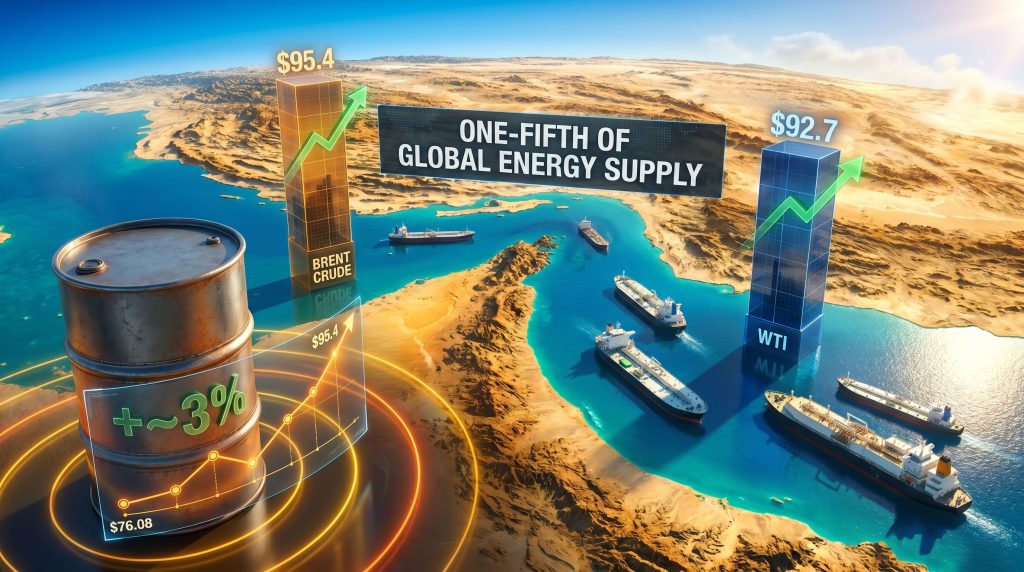
The latest bout of market turbulence stems from a sequence of events that has placed the Strait of Hormuz back at the centre of global energy risk calculations. Crude oil price trends tell only part of the story, as Brent and WTI futures each climbed approximately 2.6% on Wednesday and followed an earlier 3% surge on Tuesday after the US revoked the general licence permitting Iranian crude sales. The combined effect has been a rapid reassessment of risk across commodity markets, with price levels now sitting well above the range that prevailed during the brief diplomatic window following the truce agreement signed the previous month.
Benchmark Pricing in Context
The speed and magnitude of these price moves are best understood relative to where benchmarks were trading before tensions re-escalated.
| Benchmark | Price Level | Session Move |
|---|---|---|
| Brent Crude (Wednesday, 0400 GMT) | $76.08 per barrel | +2.6% |
| WTI Crude (Wednesday, 0400 GMT) | $72.26 per barrel | +2.6% |
| Brent (Tuesday session) | Approximately $74+ per barrel | ~+3% |
| WTI (Tuesday session) | Approximately $71+ per barrel | ~+3% |
Key Insight: These benchmark moves occurred before any confirmed reduction in physical oil supply reaching global markets. The price action reflects forward-looking risk repricing, not a present-day barrel shortage. That distinction carries enormous implications for how quickly prices could reverse if the diplomatic situation stabilises.
When big ASX news breaks, our subscribers know first
The Strait of Hormuz: One Waterway, Disproportionate Global Consequences
Few chokepoints in global infrastructure carry the systemic importance of the Strait of Hormuz. Before the conflict began in February, cargo transiting through this 21-mile-wide passage at its narrowest point accounted for roughly one-fifth of total global energy supply. This figure encompasses both crude oil and liquefied natural gas, meaning disruption affects multiple energy supply chains simultaneously rather than isolating the crude market alone.
What makes the Strait particularly difficult to work around is the absence of realistic alternatives at comparable scale. Overland pipeline capacity exists but cannot absorb anything close to the full volume normally transiting the waterway. Rerouting tankers around the Arabian Peninsula adds weeks to delivery schedules and significantly increases freight costs, both of which translate into higher landed energy prices for importing nations regardless of whether the Strait itself is formally blocked.
Furthermore, Iran has complicated the operational environment by directing commercial vessels to navigate a corridor closer to its own coastline rather than the Oman-adjacent route that operators have historically preferred. The United States has publicly insisted that the waterway must remain accessible under the same terms that existed before the conflict began, creating a direct jurisdictional disagreement that commercial shipping operators are caught in the middle of. The broader geopolitical oil price factors at play here extend well beyond a single bilateral dispute.
Three Scenarios for Strait Disruption: A Risk Modelling Framework
Analysts tracking the situation have identified three plausible trajectories, each with distinct market implications:
Scenario 1: Controlled Tension (Base Case)
- Military exchanges remain limited in scope and geographic reach
- The Strait stays operationally open, though under elevated surveillance
- Oil prices maintain a sustained risk premium above fundamental supply-demand equilibrium
- Traders who built short positions after the truce begin selectively covering, adding mechanical upward pressure
Scenario 2: Partial Operational Disruption (Elevated Risk Case)
- Iran enforces mandatory routing changes, pushing vessels onto longer, less efficient corridors
- Transit times increase materially; specialist war-risk insurance premiums spike for tanker operators
- Physical supply tightens at the margin as scheduling delays compound across multiple shipping cycles
- Prices push higher in a manner that begins to reflect genuine supply constraints rather than pure sentiment
Scenario 3: Sustained Traffic Collapse (Tail Risk Case)
- Strait throughput falls and remains below 50% of pre-war levels for an extended period
- Major consuming nations activate strategic petroleum reserves to bridge supply gaps
- Crude prices enter a structurally different pricing regime, with the geopolitical risk premium becoming the dominant pricing variable
- Energy security policy in importing nations undergoes rapid, forced recalibration
Analyst Perspective from MST Marquee research: Industry analysts at MST Marquee have noted that the current conflict serves as a pointed reminder of how fragile passage through the Strait remains, and that sustained below-capacity traffic levels could generate supply constraints sufficient to support materially higher oil prices over time. This framing is particularly relevant as a counterweight to the pre-escalation consensus that Middle Eastern supply was about to flood the market.
The Post-Truce Positioning Trap: Why Short Sellers Are Exposed
To understand why oil rises as US strikes on Iran raise fears over shaky truce conditions triggered such sharp price surges, it is necessary to understand the positioning landscape that existed immediately before the escalation. Following the truce agreement, crude benchmarks retraced significantly from their conflict-era peaks. This price decline appeared to validate the dominant market thesis: that pent-up Middle Eastern supply would soon re-enter global markets, and that the fundamental backdrop justified bearish positioning.
Traders responded by building record short positions in crude futures, concentrating bets on further price weakness. This created a structural trap. When US military strikes were confirmed and sanctions were reimposed, those short positions immediately became loss-generating. Holders were forced to buy back contracts to limit exposure — a process known as short-covering — which mechanically amplifies upward price moves well beyond what fundamental supply data alone would produce.
WTI and Brent futures both reflected this dynamic, as ING commodity strategists assessed that while the revocation of the licence authorising Iranian crude sales does not fundamentally alter oil market supply dynamics in the near term, it carries substantial weight from a sentiment and signalling perspective. Their assessment is that it heightens the perceived probability of a breakdown in the temporary diplomatic arrangement between the two nations, which is precisely what triggers the forced unwind of bearish futures positions.
The Sanctions Reinstatement Signal: More Than a Trade Policy Adjustment
Markets have a tendency to interpret sanctions reinstatement as a simple trade restriction with a calculable barrel impact. In practice, its more important function during a fragile ceasefire period is as a leading indicator of diplomatic trajectory. When a general licence permitting crude sales is revoked, it does not just restrict barrels. It signals that the framework underpinning the truce is under strain and that further deterioration is a live possibility.
This is why the sanctions news generated a price response disproportionate to its immediate physical effect. Traders are not pricing current supply; they are pricing the probability distribution of future supply scenarios. Consequently, even modest diplomatic signals can generate outsized market reactions in either direction.
Vessel Attacks, LNG Tankers, and the Escalation Sequence
The trigger for the most recent round of US military strikes was a series of attacks on commercial vessels transiting the Strait of Hormuz. Three ships were targeted, with Iran declining to claim responsibility while Qatar attributed the attacks to Iranian action. The vessels involved included a Qatari LNG tanker struck by a drone that ignited a fire in its engine room, and a Saudi-flagged crude supertanker believed to be the Wedyan, which sustained damage off the coast of Oman.
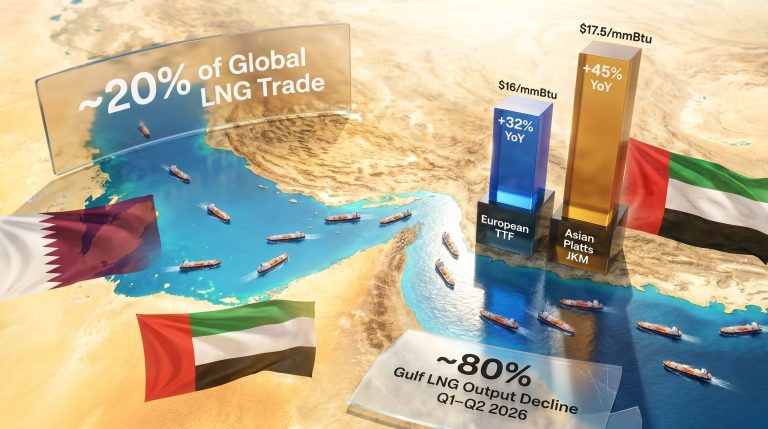
The involvement of an LNG tanker is notable beyond the immediate incident because it simultaneously injects risk into both crude oil and natural gas supply narratives. LNG vessels operate under entirely different commercial and logistical frameworks than crude tankers, serving markets from Europe to Northeast Asia that rely on consistent long-term supply contracts. When LNG tankers are targeted, the psychological impact on energy security planning in those importing regions extends well beyond the immediate price move in crude.
Insurance markets respond to LNG tanker incidents with particular speed. According to reporting on recent escalation events, war-risk premiums for vessels operating in the Persian Gulf and adjacent waters have historically spiked sharply following incidents involving specialised cargo carriers, and those premium increases feed directly into the landed cost of energy for importing nations.
Inventory Depletion: The Hidden Amplifier of Price Sensitivity
Geopolitical risk premiums are not fixed in magnitude. Their market impact is partly a function of how much buffer capacity exists within the global supply system to absorb a shock. On that measure, the current environment is notably unfavourable for consuming nations.
US crude oil inventories recorded a further decline in the most recent weekly reporting period, with market consensus drawn from data reported by the American Petroleum Institute pointing to a drawdown of approximately 2.4 million barrels for the week ending July 3. This follows a pattern of sustained inventory depletion that began when the conflict first disrupted supply flows in February.
Nations that have drawn down strategic reserves since the conflict began now have reduced capacity to cushion any additional supply shock. The feedback loop this creates is significant:
| Risk Factor | Market Effect |
|---|---|
| Depleted crude inventories | Reduces the system's shock absorption capacity |
| Record futures short positioning | Forces mechanical buying when escalation occurs |
| Sanctions reinstatement | Adds a sustained sentiment-driven risk premium |
| Restricted Strait traffic | Signals potential physical supply tightening ahead |
| LNG tanker attacks | Broadens the energy disruption narrative across fuel types |
Navigating the Current Environment: Strategic Considerations
For investors and energy market participants, the current environment demands a clear separation between what is confirmed and what is anticipated. The price moves that have occurred to date reflect a predominantly sentiment-driven and positioning-driven dynamic, not a confirmed reduction in physical barrel availability. That distinction matters because sentiment-driven moves can reverse rapidly if diplomatic signals improve.
The geopolitical market dynamics shaping this environment have also affected global crude shipments in ways that compound the uncertainty. Several structural questions will, however, determine whether the current risk premium is sustained or unwound:
- Will the truce framework recover? If diplomatic channels stabilise and vessel attacks cease, the short-covering dynamic reverses, and prices may give back a portion of recent gains.
- How quickly can alternative supply compensate? OPEC+ producers with spare capacity outside the Strait's influence zone represent the most credible offset, but mobilising that capacity takes time.
- At what point does sentiment risk become structural supply risk? The key threshold, based on available analyst commentary, is whether Strait traffic remains below half of pre-war levels for a sustained period.
Over a longer time horizon, the conflict has fundamentally elevated the strategic importance of maritime energy security. Energy policymakers in major importing nations are likely to reassess the concentration of global supply flows through a single narrow waterway. As analysts at CNBC have noted, these developments are accelerating discussions around strategic reserve adequacy, supply diversification, and alternative routing infrastructure in ways that could reshape long-term energy policy far beyond the immediate conflict.
Disclaimer: This article contains forward-looking analysis and scenario modelling that involves inherent uncertainty. Price levels, positioning data, and geopolitical trajectories can change rapidly. Nothing in this article constitutes financial or investment advice. Readers should conduct their own due diligence and consult qualified advisers before making any investment decisions.
The next major ASX story will hit our subscribers first
Frequently Asked Questions: Oil Prices, Iran Tensions, and the Strait of Hormuz
What share of global energy supply transits through the Strait of Hormuz?
Before the conflict began in February, cargo moving through the Strait of Hormuz represented approximately one-fifth of total global energy supply in transit volumes, covering both crude oil and LNG shipments.
Why does oil rise when no physical supply disruption has yet occurred?
Crude futures markets price forward-looking probability, not current physical availability. When military escalation intensifies, traders embed a risk premium reflecting the possibility of future supply disruption, even before a single additional barrel is withheld from the market.
What is short-covering, and why does it amplify oil price moves during escalation?
Short-covering occurs when traders who have bet on falling prices are forced to buy back their contracts to limit losses when prices instead rise. During escalation events, this mechanical buying adds significant upward momentum to price moves that fundamental supply data alone would not produce.
How does sanctions reinstatement affect oil market psychology?
Beyond any immediate impact on physical barrel flows, sanctions reinstatement signals that the diplomatic architecture supporting a ceasefire is deteriorating. Markets interpret this as a leading indicator of prolonged conflict risk and price accordingly, with oil rises as US strikes on Iran raise fears over shaky truce conditions representing the clearest recent example of this dynamic.
What would sustained Strait of Hormuz disruption mean for global energy markets?
If throughput falls and holds below half of pre-war levels for an extended period, the resulting supply constraints would likely create a structural price floor independent of broader demand conditions or OPEC+ production decisions, according to analysts tracking the situation.
For ongoing coverage of commodity markets and Middle East energy developments, Zawya's commodities section provides regularly updated analysis and reporting from regional and global sources.
Want to Stay Ahead of the Next Major Commodity Market Shift?
Discovery Alert's proprietary Discovery IQ model scans ASX announcements in real time, instantly identifying significant mineral discoveries across more than 30 commodities — transforming complex market data into actionable opportunities for both traders and long-term investors. Explore Discovery Alert's dedicated discoveries page to see how historic mineral discoveries have generated substantial returns, and begin your 14-day free trial today to secure a market-leading edge.