July 8, 2026
The Feedstock Paradox at the Heart of Europe's Recycling Economy
Across Europe's industrial heartland, a quiet contradiction has taken root. The continent's most ambitious recycling economy is simultaneously exporting its most critical raw material in growing volumes while its domestic processors report widespread scrap shortages. This paradox is not simply about Germany aluminium scrap exports Q1 2026 figures in isolation. It is the logical outcome of two powerful and opposing forces colliding inside Germany's aluminium value chain: a structurally weakened domestic manufacturing sector and a globally competitive export market offering superior returns.
Understanding how this tension has evolved through the first quarter of 2026 requires more than reading headline export figures. It demands a closer look at the multi-year production decline, the shifting geography of scrap demand, and the policy timeline that could reshape everything before the year is out. Furthermore, broader shifts in aluminum and alumina markets provide essential context for interpreting these domestic developments.
When big ASX news breaks, our subscribers know first
What the Q1 2026 Export Numbers Actually Reveal
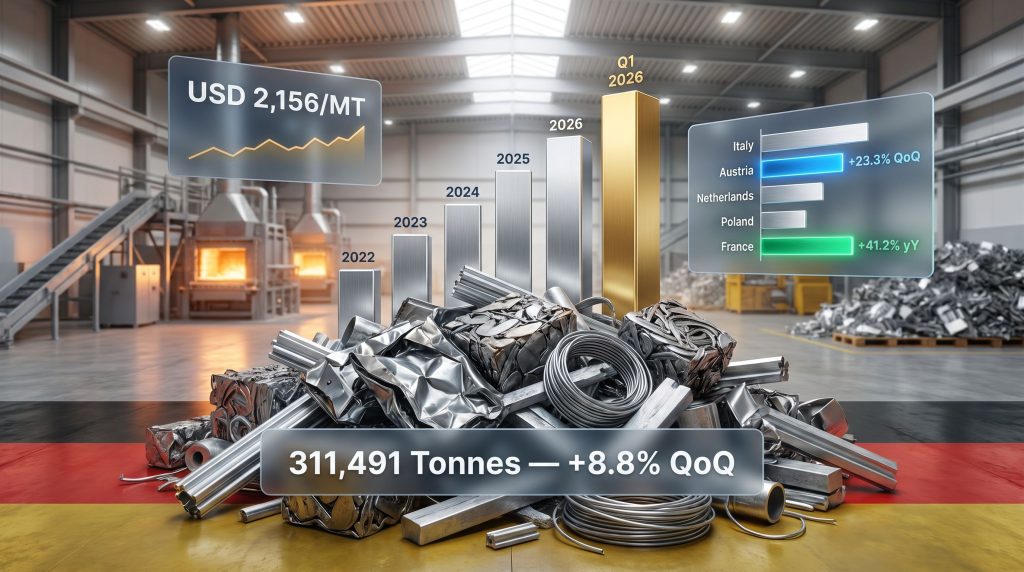
Germany's aluminium scrap exports reached 311,491 tonnes in Q1 2026, representing an 8.8% increase quarter-on-quarter from 286,285 tonnes in Q4 2025. On a year-on-year basis, the gain was more modest at 0.5% compared with 310,057 tonnes in Q1 2025.
Taken in isolation, these figures might suggest a routine seasonal rebound. Viewed against the broader context, however, the Q1 2026 uptick carries more weight. Germany's full-year 2025 exports totalled 1,162,477 tonnes, a 4.3% annual decline that extended a pattern of volume erosion seen since 2022. The quarterly rebound therefore represents a meaningful directional shift, even if the year-on-year comparison appears relatively flat.
Germany Aluminium Scrap Export Trend: Multi-Year Overview
| Period | Export Volume (Tonnes) | Change |
|---|---|---|
| 2022 | Decline phase | -8.2% YoY |
| 2023 | Recovery phase | Positive |
| 2024 | Continued recovery | Positive |
| 2025 full year | 1,162,477 | -4.3% YoY |
| Q4 2025 | 286,285 | Reference quarter |
| Q1 2026 | 311,491 | +8.8% QoQ / +0.5% YoY |
What distinguishes the current uptick from prior recovery phases is its context. Previous rebounds coincided with domestic demand stabilisation. The Q1 2026 increase has occurred against a backdrop of continued domestic weakness, suggesting the export growth is being pulled by external demand rather than pushed by domestic surplus in any traditional sense.
Destination-by-Destination Breakdown: Where Did German Scrap Flow in Q1 2026?
The geographic distribution of Germany's aluminium scrap exports in Q1 2026 reveals a market in transition. Volume growth was not uniform across destinations, and the relative standings among key importers shifted notably compared with prior periods.
Destination Performance Summary: Q1 2026
| Destination | Q1 2026 Volume (t) | YoY Change | QoQ Change |
|---|---|---|---|
| Italy | 46,941 | -2.3% | -0.7% |
| Austria | 43,838 | +13.2% | +23.3% |
| Netherlands | 31,438 | -8.5% | +9.8% |
| Poland | 22,859 | -25.6% | +3.5% |
| France | 20,026 | +41.2% | +8.4% |
Italy retained its position as Germany's largest scrap export destination with 46,941 tonnes, though volumes edged down 2.3% year-on-year and 0.7% quarter-on-quarter. Italy's full-year 2025 imports had totalled 189,523 tonnes, up 2.5% after prior-year declines, but the Q1 2026 softness suggests that recovery momentum may be fading.
Austria was the standout performer among established markets. Imports climbed 13.2% year-on-year and surged 23.3% quarter-on-quarter to 43,838 tonnes, narrowing the gap with Italy to just over 3,000 tonnes. This is the closest Austria has come to the top position in recent years, particularly notable given that its full-year 2025 imports had declined 7.5% to 144,333 tonnes. The Q1 2026 acceleration suggests Austria's secondary aluminium sector may be aggressively restocking after a period of inventory drawdown.
The Netherlands recorded a partial recovery, with imports rising 9.8% quarter-on-quarter to 31,438 tonnes despite an 8.5% annual decline. Full-year 2025 Netherlands imports fell 11.8% to 118,317 tonnes, reversing a prior-year gain. The sequential improvement indicates stabilisation rather than a sustained directional change.
Poland presented the most concerning annual picture, with imports falling a sharp 25.6% year-on-year to 22,859 tonnes. The modest 3.5% sequential recovery from Q4 2025 suggests the steepest losses may be past, but Poland's trajectory remains structurally weaker than it was during its 2022–2024 growth phase, when imports rose as much as 25.5% annually.
France delivered the strongest annual growth of any major destination, with imports jumping 41.2% year-on-year to 20,026 tonnes from just 14,180 tonnes in Q1 2025. The additional 8.4% quarter-on-quarter gain reinforces the upward trajectory. France's acceleration may reflect structural changes in its domestic procurement approach for secondary aluminium feedstock, though the volumes remain relatively modest compared with the top-tier destinations.
The Two Forces Driving Germany's Scrap Export Rise
Force One: Domestic Market Contraction Reduces Absorption Capacity
Germany's aluminium manufacturing ecosystem entered 2026 in a weakened state across multiple segments of the value chain. The data from Q1 2026 illustrates the breadth of the contraction:
- Recycled aluminium production fell approximately 3% year-on-year to 684,564 tonnes
- Semi-finished aluminium output declined 1% to 568,688 tonnes
- Extruded product output contracted 4%, signalling downstream pressure extending beyond the primary recycling segment
- Remelter output fell 4% to 555,925 tonnes, only partially offset by a 2% gain in refiner volumes to 128,639 tonnes
The downstream weakness matters because extruded products represent a major end-use channel for recycled aluminium. When extrusion output falls, the entire scrap-to-product chain loses throughput capacity, reducing domestic demand for feedstock at every upstream stage.
Industry sentiment data amplifies the production statistics. A survey of German industrial firms revealed:
- 66% of companies rated their current order books as either poor or very poor
- 71% reported operating at low capacity utilisation rates
- 57% expressed no expectation of improvement before year-end 2026
The depth of pessimism extends well beyond near-term cyclical conditions. A striking 76% of surveyed German industrial firms regard it as currently improbable or impossible for the country to achieve its 2045 climate neutrality targets while sustaining domestic industrial production at existing levels. This signals a structural confidence crisis that transcends the usual business cycle.
This combination of weak production, subdued end-use demand, and depressed industrial confidence creates a domestic market that simply cannot absorb the volume of scrap being generated. Material that cannot find a home domestically at competitive prices will inevitably seek higher-returning export channels.
Germany's Recycled Aluminium Production: Five-Year Decline
| Year | Recycled AL Output (Mt) | Annual Change |
|---|---|---|
| 2021 | 3.22 | Baseline |
| 2022 | 2.96 | -8.1% |
| 2023 | 2.79 | -5.7% |
| 2024 | 2.74 | -1.8% |
| 2025 | 2.71 | -1.1% |
| Cumulative 2021–2025 | -15.8% |
Demand has followed an almost parallel downward trajectory:
| Year | Recycled AL Demand (Mt) | Annual Change |
|---|---|---|
| 2021 | 1.29 | Baseline |
| 2022 | 1.29 | Stable |
| 2023 | 1.16 | -10.1% |
| 2024 | 1.11 | -4.3% |
| 2025 (est.) | 1.10 | -0.9% |
| Cumulative 2021–2025 | -14.7% |
The synchronised decline in both production and demand across a five-year period is not typical of a temporary cyclical downturn. It suggests structural shifts in Germany's industrial base, particularly the ongoing contraction of its automotive manufacturing sector, which remains among the country's largest aluminium-consuming industries.
Force Two: Intensifying Global Competition Creates External Pull
While Germany's domestic market contracted, the global appetite for European aluminium scrap expanded to record levels. EU aluminium scrap exports reached 1.27 million tonnes in 2025, approximately 50% above 2019 pre-pandemic baseline levels. This was not a random fluctuation but a sustained structural shift driven by expanding secondary aluminium capacity across Asia.
69% of Q1 2026 EU scrap export volumes were directed toward Asian markets, with India and China among the principal destination countries. Indeed, India and Thailand topped EU scrap export destinations in Q1 2026 despite annual declines, underscoring how deeply embedded Asian demand has become within European scrap trade flows. India's trajectory as an importer of German aluminium scrap deserves particular attention:
| Year | German Scrap Exports to India (t) | Annual Change |
|---|---|---|
| 2022 | Decline phase | -18.9% |
| 2023 | Recovery | +10.4% |
| 2024 | Acceleration | +19.8% |
| 2025 | 68,387 | +8.3% |
India's multi-year growth consistency distinguishes it from the volatile patterns seen across European destinations. The structural driver is straightforward: India's secondary aluminium sector is expanding rapidly, domestic scrap availability cannot keep pace with processing capacity growth, and European material offers a cost-competitive import option when freight economics allow.
German aluminium scrap prices reached approximately USD 2,156 per metric tonne in Q1 2026, up around 3.65% quarter-on-quarter. Notably, this price appreciation occurred against a backdrop of weak domestic consumption, strongly suggesting that the pricing signal is being driven by export demand rather than domestic absorption. Automotive original equipment manufacturers in Bavaria and Baden-Wurttemberg were among the demand contributors noted in the pricing data, though broader industrial demand remained subdued.
The Scrap Processing Chain: How Raw Material Becomes Recycled Metal
One reason the export surge carries such weight for Germany's recycling economy is that aluminium scrap is not a finished product. It is an essential industrial input that must undergo several transformation stages before it can re-enter manufacturing. The step-by-step process illustrates why feedstock availability and quality matter as much as volume:
-
Collection and sorting – Post-consumer and post-industrial scrap is gathered and categorised by alloy type, physical form, and grade. Alloy identification is increasingly performed using handheld X-ray fluorescence (XRF) analysers, which allow rapid non-destructive sorting critical to maintaining the quality of recycled output.
-
Pre-processing and contamination removal – Coatings, plastics, ferrous inclusions, and other contaminants are extracted through mechanical shredding, magnetic separation, eddy current separation, and thermal treatment. This stage determines the downstream purity achievable.
-
Remelting – Sorted scrap is charged into reverberatory furnaces or rotary furnaces and melted at controlled temperatures. Energy efficiency at this stage is a key competitive variable, particularly given European energy cost pressures.
-
Refining and composition adjustment – Alloying elements are added or adjusted to bring the melt into specification for downstream product requirements. This stage requires consistent feedstock chemistry, making scrap grade and alloy consistency critical inputs.
-
Casting – Refined aluminium is cast into ingots, billets, slabs, or other semi-finished forms ready for re-entry into fabrication and manufacturing processes.
The multi-stage nature of this process means that scrap shortages ripple through the entire chain. When feedstock availability tightens, remelters face higher input costs, refiners struggle to maintain alloy specifications, and the economics of domestic recycled aluminium production deteriorate relative to primary aluminium imports.
The Feedstock Paradox: Exporting What the Recycling Chain Needs
Perhaps the most structurally significant tension in Germany's current aluminium scrap picture is the simultaneous existence of rising exports and widespread domestic scrap shortages. Approximately 85% of German companies report experiencing aluminium scrap availability constraints, even as export volumes trend higher.
This apparent contradiction has a rational economic explanation. When domestic processors are operating at reduced capacity due to weak end-use demand, their willingness to pay for scrap feedstock decreases. Simultaneously, Asian buyers with expanding processing capacity and strong order books can offer more competitive prices. The material therefore flows to where it generates the highest return, regardless of domestic need.
Consequently, practices such as urban mining — recovering aluminium from existing built infrastructure and end-of-life products — are being examined more closely as a potential means of supplementing feedstock supply within Europe's circular economy framework.
This dynamic represents a core tension in Europe's circular economy ambitions. The policy objective is to keep secondary raw materials within the European industrial system. The market reality is that open trade flows and price signals direct material toward the highest bidder, which is increasingly located outside the EU.
The next major ASX story will hit our subscribers first
EU Policy Watch: The September 2026 Inflection Point
The European Union has been developing measures to address the outward flow of aluminium scrap from the bloc, motivated by concerns over raw material security and the integrity of Europe's critical minerals supply chain. Proposed export restriction measures have been delayed until September 2026, meaning Q1 2026 trade flows proceeded without meaningful regulatory friction.
However, aluminium tariff impacts from US trade measures have added further complexity to the global pricing environment, reshaping how European producers assess the competitiveness of their export options. The September 2026 implementation date represents the most significant near-term policy variable for Germany's scrap trade trajectory. Three scenarios emerge for the remainder of 2026:
Scenario A: Domestic Recovery Absorbs Export Pressure
If automotive sector order books stabilise and construction activity recovers, domestic scrap absorption could improve in H2 2026. However, with 57% of German firms expecting no business improvement before year-end, the conditions for this scenario appear difficult to achieve on the required timeline.
Scenario B: Export Volumes Sustain Through H1 2026 Before Regulatory Shift
If EU export restrictions remain the only policy catalyst and Asian demand continues, Q1 2026 volumes may be sustained or exceeded through the first half of the year, tightening domestic feedstock availability further before any policy intervention takes effect.
Scenario C: September 2026 Policy Implementation Reshapes Trade Flows
If the EU proceeds with export restrictions as scheduled, H2 2026 could see a structural break in the export data series. Material currently flowing to Asia may be redirected toward European processors, potentially easing feedstock shortages but creating short-term pricing volatility as the market reprices under new constraints.
A parallel development worth monitoring is the UAE's temporary aluminium scrap export ban, imposed between June and October 2026. While geographically separate from the EU system, this policy action signals that scrap export controls are becoming a more widely considered tool among industrial economies managing circular economy objectives against open trade pressures. Furthermore, efforts to build European raw materials supply security are shaping the longer-term institutional framework within which these trade policy decisions are being made.
According to Argus Media, the EU's aluminium scrap export measure is considered unlikely to materialise in 2026, adding another layer of uncertainty to how domestic processors and exporters plan their strategies for the remainder of the year.
Frequently Asked Questions: Germany Aluminium Scrap Exports Q1 2026
How Much Aluminium Scrap Did Germany Export in Q1 2026?
Germany exported 311,491 tonnes of aluminium scrap in Q1 2026, up 8.8% from 286,285 tonnes in Q4 2025 and marginally higher by 0.5% compared with 310,057 tonnes in Q1 2025.
Which Country Imported the Most German Aluminium Scrap in Q1 2026?
Italy remained the largest single destination with 46,941 tonnes, though Austria closed the gap significantly with a 23.3% quarter-on-quarter increase to 43,838 tonnes.
Why Did German Aluminium Scrap Exports Increase in Q1 2026?
The increase reflects two converging forces: reduced domestic scrap absorption capacity due to weak manufacturing demand across automotive, construction, and engineering sectors, combined with strong overseas demand, particularly from Asian markets seeking European secondary aluminium feedstock.
What Is the Current Price of Aluminium Scrap in Germany?
German aluminium scrap prices reached approximately USD 2,156 per metric tonne in Q1 2026, up around 3.65% quarter-on-quarter, with the price appreciation appearing to be driven primarily by export demand rather than domestic industrial consumption.
Will EU Export Restrictions Affect Germany's Aluminium Scrap Trade?
Proposed EU aluminium scrap export restriction measures have been delayed to September 2026. If implemented as scheduled, this regulatory shift could materially reduce Germany's H2 2026 export volumes by redirecting material toward domestic European processors.
How Much Has Germany's Recycled Aluminium Production Declined Since 2021?
Germany's recycled aluminium output fell approximately 15.8% between 2021 and 2025, declining from 3.22 million tonnes to 2.71 million tonnes across that period, reflecting sustained weakness in end-use demand from key manufacturing sectors.
Key Takeaways
- The 8.8% quarterly export increase in Germany aluminium scrap exports Q1 2026 reflects a structural push-pull dynamic rather than demand-led recovery
- Domestic recycled aluminium production and demand have both declined by more than 14% since 2021, fundamentally weakening the home market's scrap absorption capacity
- Austria and France were the most dynamic growth destinations in Q1 2026, while Poland recorded the sharpest annual decline at 25.6%
- EU aluminium scrap exports hit a record 1.27 million tonnes in 2025, with Asian markets absorbing 69% of Q1 2026 flows, representing a structural shift in global scrap geography
- The September 2026 EU export restriction deadline is the most significant near-term policy variable that could reshape Germany's scrap trade trajectory in the second half of the year
- The feedstock paradox persists: approximately 85% of German firms report scrap shortages while export volumes trend upward, capturing the central tension defining the country's recycling economy in 2026
This article contains forward-looking analysis, scenario projections, and references to pending regulatory changes. These elements involve uncertainty and should not be interpreted as definitive predictions of future market conditions. Readers should conduct independent research before making commercial or investment decisions based on this analysis.
Want to Capitalise on the Next Major Commodity Discovery Before the Market Moves?
Discovery Alert's proprietary Discovery IQ model scans ASX announcements in real time, instantly identifying significant mineral discoveries across 30+ commodities — including aluminium and critical materials reshaping global supply chains — and delivering actionable insights directly to subscribers. Explore how historic discoveries have generated extraordinary returns and begin your 14-day free trial at Discovery Alert to position yourself ahead of the broader market.