
June 30, 2026
When the Corridor Closes: Rethinking Aluminium Supply Risk in a Disrupted World
For decades, commodity markets operated on a foundational assumption: price is signal. When prices rise, supply is constrained. When prices fall, demand has softened. When inventories build, pressure eases. This logic shaped procurement models, hedging strategies, and capital allocation decisions across the global aluminium industry. It worked well in a world of relatively integrated, predictable trade flows.
That world is no longer the baseline. The cumulative effect of geopolitical tension, maritime disruption, carbon regulation, and Chinese market fragmentation has produced a new operating environment where traditional indicators no longer reliably reflect ground-level supply conditions. Gulf disruptions in aluminium supply chains have become the clearest expression of this structural shift, exposing vulnerabilities that span the entire value chain simultaneously.
When big ASX news breaks, our subscribers know first
Why Traditional Market Signals Are No Longer Reliable in Aluminium
The Decoupling of Price and Scarcity in a Disrupted Market
The relationship between headline price and physical availability has fundamentally weakened. Aluminium futures have climbed to multi-year highs, yet in some regions, inventory remains relatively stable. In others, buyers are paying substantial regional premiums simply to secure metal that exists on paper but cannot be delivered on time or at all.
This decoupling is not a temporary anomaly. It reflects a deeper structural shift in how supply and demand are balanced across geographies. The London Metal Exchange spot price, long treated as a reliable compass for procurement decisions, now increasingly diverges from the regional physical premiums that actually determine landed cost for manufacturers. For instance, green metals pricing dynamics are adding further complexity to what was once a relatively straightforward benchmark system.
"The gap between LME benchmark pricing and regional physical premiums has become the more meaningful metric for assessing true procurement costs, particularly for European buyers reliant on Gulf-sourced metal."
When High Prices Do Not Mean Shortage and Soft Demand Does Not Mean Relief
Two misconceptions are currently shaping poor procurement decisions. The first is that rising prices indicate global scarcity. In the current environment, elevated prices often reflect regional inaccessibility rather than aggregate shortfall. Metal exists in the system; reaching it is the constraint.
The second misconception is that soft demand signals breathing room. Weaker consumption in certain markets is not translating into eased supply pressure because the pressure itself is being redistributed unevenly across regions. As AL Circle reported in May 2026, weakening demand is not reducing market stress but rather concentrating it in geographies least positioned to absorb it.
What Procurement Teams Are Getting Wrong About Current Market Conditions
Procurement managers trained on historical aluminium market cycles are finding that their standard analytical toolkit is producing unreliable outputs. The core issue is that conventional models treat logistics as a cost variable rather than a market-shaping constraint. In the current environment, delivery reliability, route security, and contract force majeure exposure are functioning as primary determinants of effective supply availability.
Key signals that have become less reliable as standalone indicators:
- LME spot price as a proxy for physical scarcity
- Aggregate inventory data that does not account for accessibility or delivery security
- Futures curve positioning as a measure of disruption duration
- Chinese demand trends as a leading indicator of global market relief
The market has entered a structurally new phase where continuity, accessibility, and delivery timing have displaced price optimisation as the primary competitive differentiators for downstream buyers. Procurement teams that fail to update their analytical frameworks accordingly are likely to be caught underprepared when upstream disruptions intensify. Furthermore, commodity hedging strategies are increasingly being revisited to account for this new risk landscape.
The Gulf's Dual Exposure Problem: Why This Region Is Uniquely Vulnerable
A Corridor That Serves Both Ends of the Supply Chain Simultaneously
No other major aluminium-producing region carries the same structural vulnerability as the Gulf. The Strait of Hormuz is not merely an export corridor for finished primary metal. It is also the primary inbound route for the raw material inputs that Gulf smelters depend on entirely, specifically bauxite and alumina, almost none of which is sourced domestically.
This bidirectional dependency is what makes the Gulf's exposure profile categorically different from that of other global producers. When shipping through Hormuz is disrupted, Gulf smelters face simultaneous pressure at both ends of their production cycle. Input shortfalls reduce output capacity at exactly the moment when export routes are also constrained.
Inbound Feedstock vs. Outbound Metal: The Two-Way Hormuz Dependency
| Supply Chain Function | Gulf Region Role | Disruption Impact |
|---|---|---|
| Alumina and bauxite imports | Near-total seaborne dependency | Input shortages accelerate production curtailments |
| Primary aluminium exports | Approximately 6 million tonnes per year from GCC | Outbound shipments delayed or blocked |
| Energy supply | Gas-dependent electrolytic smelting | Output reductions at major facilities |
| Freight corridor | Strait of Hormuz transit for both flows | Rerouting adds weeks and significant cost |
A technical factor that compounds this vulnerability is the nature of aluminium smelting itself. Electrolytic reduction cells, the core production units in any smelter, are thermally sensitive and cannot simply be switched off and restarted without risking costly potline damage. This creates a perverse incentive for producers to continue operating even during escalating disruption, consuming scarce input stockpiles while struggling to export finished product. Once a potline is damaged through unplanned shutdown, repair costs and restart timelines can extend disruption impacts well beyond the original logistical event.
GCC Production Scale and Its Weight in Global Supply Balances
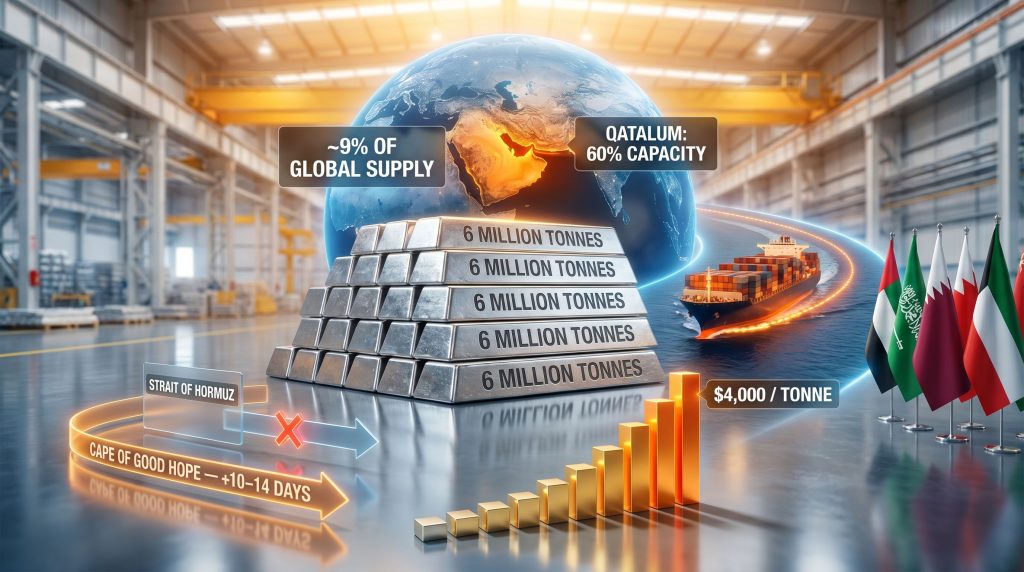
- GCC countries collectively produce approximately 6 million tonnes of primary aluminium per year
- The Middle East accounts for roughly 9% of total global aluminium supply
- Europe is the most exposed downstream region to Gulf export disruptions due to historical sourcing patterns
- Gulf smelters typically operate on lean raw material inventories, designed around historically reliable maritime access rather than disruption resilience
The scale of this production base means that even partial curtailments across multiple Gulf facilities create supply gaps that cannot be absorbed quickly by alternative producers, many of whom are already operating near capacity. Top aluminium producers globally are consequently under significant pressure to fill the void left by Gulf curtailments.
What Is Actually Happening at Gulf Smelters Right Now?
Force Majeure Declarations and What They Signal to Global Buyers
Force majeure declarations are not routine contractual instruments. In the context of long-term aluminium supply agreements, they represent acknowledgment by a producer that disruptions are material, structural, and beyond near-term resolution. When multiple Gulf producers issue such declarations within a compressed timeframe, it signals systemic constraint rather than isolated operational challenges.
According to Reuters reporting on the Middle East aluminium crisis, the scale of force majeure activity across the region is unprecedented in recent memory, reinforcing the structural nature of the current disruption.
Critical Warning for Buyers: Force majeure declarations from Gulf producers indicate supply losses that cannot be absorbed quickly by alternative sourcing, particularly for European and Asian buyers with established Gulf supply relationships.
Production Curtailments: From Partial Cuts to Full Operational Disruptions
Several major Gulf smelting operations have moved from precautionary measures to active output reductions:
- Emirates Global Aluminium (EGA): Declared force majeure on select contracts following damage at its Al Taweelah facility, indicating production losses that are material rather than temporary
- Alba (Aluminium Bahrain): Reduced output volumes and issued delivery disruption notices to contracted buyers
- Qatalum (Qatar): Reportedly operating at approximately 60% of nameplate capacity following gas supply pressure, a significant curtailment for one of the region's largest smelters
These combined reductions represent a consequential withdrawal from international trade flows. The combined annual output of these three producers alone represents a substantial share of global aluminium trade. Even partial curtailment at this scale creates tightness in regional markets that cannot be quickly remedied through spot purchasing or alternative sourcing arrangements.
The Shipping Reroute Effect: Cape of Good Hope and Its Cost Implications
Major carriers including Maersk suspended Strait of Hormuz crossings and redirected Middle East-Europe and Middle East-US services via the Cape of Good Hope. The practical implications for downstream buyers are significant:
- Cape rerouting adds approximately 10 to 14 days to transit times between the Gulf and European destinations
- Extended transit times directly affect inventory planning cycles, requiring manufacturers to hold larger buffers or accept supply gaps
- Freight cost increases from rerouting compound the landed cost impact of higher metal prices, creating dual cost pressure
- Extended time in transit means additional working capital is tied up in shipments, creating financing pressure particularly for smaller manufacturers
How the Logistics Layer Has Evolved from a Tactical Problem to a Structural Constraint
From Single-Point Disruption to a Market-Shaping Variable
The conceptual shift happening across the aluminium industry involves reclassifying logistics from an operational concern into a market-shaping variable with the same strategic weight as production capacity and pricing. This is not a semantic change. It reflects a genuine transformation in how physical supply and demand are balanced across geographies.
Stage 1: Pre-Disruption Operational Logic
- Logistics treated as a cost variable managed through long-term freight contracts
- Supply security treated as a function of smelter capacity and LME pricing signals
- Regional pricing premiums viewed as temporary anomalies that would self-correct
Stage 2: Current Disruption Reality
- Logistics functioning as a market-shaping constraint that determines which regions receive metal and when
- Supply security redefined as a function of route reliability, force majeure exposure, and contract structure
- Regional pricing premiums becoming persistent structural features rather than temporary distortions
Regional Market Fragmentation as a Direct Consequence
The transition from Stage 1 to Stage 2 logic has produced a fragmented global market where conditions vary dramatically by geography. Some regions are experiencing soft demand alongside rising inventories. Others face tighter availability and rising price pressure simultaneously. This fragmentation means that aggregate global supply statistics are increasingly poor predictors of actual procurement conditions in any specific market.
For downstream industries including automotive, construction, and packaging manufacturing, the consequence is asymmetric exposure depending entirely on geographic sourcing profile. A manufacturer sourcing primarily from Gulf producers faces a fundamentally different risk environment than one with diversified sourcing across Australian, Norwegian, or Canadian producers, even if both pay identical headline LME prices.
Carbon Exposure: The Slow-Burn Risk Compounding Gulf Disruptions in Aluminium Supply Chains
Why Carbon Compliance Is Harder to Navigate Than a Logistics Crisis
Logistics crises are visible, immediate, and ultimately resolvable through rerouting, alternative sourcing, or inventory drawdown. Carbon compliance challenges operate on a fundamentally different timeline and cannot be resolved through short-term operational adjustments. This distinction is critically important for understanding the full scope of structural pressure facing the aluminium industry.
Unlike the disruption created by a shipping route closure, carbon compliance requirements do not pause during geopolitical events. They accumulate, intensify through regulatory implementation schedules, and create procurement constraints that persist regardless of what happens in the Strait of Hormuz.
CBAM, Embedded Carbon, and the Tightening Compliance Environment
The European Carbon Border Adjustment Mechanism (CBAM) is increasing compliance complexity for aluminium imports with high embedded carbon intensity. Gulf aluminium, largely produced using natural gas-powered energy, carries a specific carbon intensity profile that is subject to scrutiny under evolving European regulatory frameworks.
Key dimensions of carbon risk in the current environment:
- Stricter regulatory requirements: CBAM implementation is increasing the compliance burden for aluminium imports with high embedded carbon intensity, adding cost layers beyond the metal price itself
- Fragile low-carbon supply chains: Verified low-carbon aluminium supply is concentrated among a small number of producers, creating concentration risk that mirrors the geographic concentration risk created by Gulf dependency
- Limited inventory buffers: Low-carbon certified metal carries a price premium and limited spot availability, reducing the ability to substitute during disruptions
- Pre-demand disruption risk: Carbon compliance failures or supply gaps may create procurement crises before any demand recovery materialises, creating vulnerability in the transition period
Analyst Perspective: Carbon risk is not a future concern layered on top of current disruptions. It is an active constraint already narrowing the pool of compliant, accessible supply for European and regulated-market buyers.
The industry-specific term to understand here is embedded carbon, which refers to the total greenhouse gas emissions generated across the full production process of a tonne of aluminium, from bauxite mining through refining, smelting, and transport. Different energy sources produce dramatically different embedded carbon profiles. Hydropower-based smelting in Norway or Canada generates a fraction of the embedded carbon produced by coal or gas-powered smelting. This differentiation, once a niche sustainability consideration, is now a procurement-critical compliance variable in regulated markets.
The next major ASX story will hit our subscribers first
China's Role in Amplifying Global Market Pressure
Domestic Weakness That Travels: How Chinese Demand Shapes International Trade Flows
China remains the dominant force in global aluminium, accounting for the majority of both global production and consumption. When Chinese domestic dynamics shift, the effects propagate through international trade flows in ways that can be counterintuitive. Weakening China industrial demand is not producing global market relief. Instead, it is redirecting Chinese aluminium into international trade channels, altering the competitive landscape for producers in other regions.
Current dynamics within the Chinese aluminium market include:
- Weakening domestic demand pushing producers to seek export outlets, altering global trade flow patterns
- Rising domestic inventories creating pricing pressure that ripples into international benchmark pricing
- Export trends from China influencing the speed at which the broader global market responds to Gulf supply losses
Why Chinese Demand Softness Does Not Equal Global Market Relief
A persistent misconception in current market commentary is that softer Chinese demand reduces overall market stress. The actual mechanism is more nuanced and in some respects more concerning. Chinese production has remained elevated even as domestic consumption softened, meaning excess supply is being redirected rather than cut. This redirection competes with supply from other regions in international markets, complicating the price discovery process.
The practical consequence is that pricing divergence between regions is widening. Markets that historically relied on Chinese supply flows are experiencing different price dynamics than those dependent on Gulf metal, creating a patchwork of regional market conditions that global benchmarks fail to capture accurately.
How Procurement Strategies Are Shifting in Response to Gulf Disruptions
From Price-Chasing to Continuity-First: The Strategic Pivot Underway
A measurable shift in procurement behaviour is underway across the aluminium industry. The dominant logic is moving decisively away from opportunistic price optimisation toward supply continuity as the primary procurement objective. This is not merely a strategic preference. It reflects a rational response to an environment where supply discontinuity carries greater operational risk than price variance.
Old procurement model priorities:
- Prioritise lowest landed cost per tonne
- Maintain lean inventories to minimise working capital
- React to market signals as they emerge, optimising timing opportunistically
Emerging procurement model priorities:
- Prioritise supply reliability and route security over marginal cost savings
- Build strategic inventory buffers ahead of anticipated disruptions
- Adopt early positioning strategies to lock in availability before upstream shocks materialise
As the AL Circle report from May 2026 observed, the market is shifting away from a wait-and-see mentality toward early positioning, with continuity, reliability, and inventory protection replacing price optimisation as the primary procurement objectives. Consequently, aluminium sector investment decisions are being reassessed with resilience and route diversification now central to capital allocation thinking.
What Early Positioning Means in Practice for Downstream Buyers
- Securing forward contracts with producers outside the disrupted Gulf corridor, particularly those operating in Australia, Canada, and Norway
- Diversifying sourcing geography to reduce single-corridor dependency, even when this involves higher per-unit cost
- Engaging in pre-emptive inventory builds at higher short-term cost to insulate against future supply gaps
- Monitoring upstream production input risks, including gas supply security and carbon compliance certification status, as leading indicators of future disruption
Strategic Implication: Reliable access to primary aluminium supply is becoming a competitive advantage in its own right, particularly for manufacturers in sectors where material shortages translate directly into production line disruptions.
Price Dynamics: What the Surge Tells Us and What It Does Not
Aluminium Futures at Multi-Year Highs: Reading the Signal Correctly
Aluminium prices have moved sharply higher in response to Gulf disruptions in aluminium supply chains, with futures reaching levels not seen for approximately four years. However, interpreting this price signal requires significant contextual overlay. The price surge reflects a combination of genuine supply loss and market anxiety about duration, but it does not capture the full complexity of regional market conditions. Analysis from Investing.com confirms that the repricing of the entire supply chain, rather than spot metal alone, is the defining feature of the current market dislocation.
| Price Indicator | What It Shows | What It Misses |
|---|---|---|
| LME spot price | Aggregate market sentiment | Regional supply fragmentation |
| Regional physical premiums | Actual procurement cost by geography | Forward availability and contract risk |
| Futures curve | Market expectations of disruption duration | Specific smelter recovery timelines |
| Inventory data | Aggregate stock levels | Accessibility and delivery reliability |
Why $4,000 per Tonne Scenarios Are Being Discussed
The combination of production losses at Gulf smelters and shipping route disruption creates a dual supply shock with no immediate offset mechanism. European buyers face the highest exposure given their historical reliance on Gulf metal. If Gulf production remains curtailed and Hormuz transits stay restricted for an extended period, the combined logistics and production shock creates conditions for sustained price elevation. Industry analysis has identified $4,000 per tonne as a plausible scenario under extended disruption conditions.
This figure is not a forecast but a scenario boundary that helps procurement teams stress-test their cost assumptions. Automotive and advanced manufacturing sectors face compounding cost pressure from both higher metal prices and longer lead times, which translate into increased work-in-progress inventory costs and potential production scheduling disruptions.
Disclaimer: Price projections and scenario analyses referenced in this article represent market observations and analytical frameworks rather than investment advice or definitive forecasts. Aluminium prices are subject to rapid change based on geopolitical, macroeconomic, and operational factors that cannot be predicted with certainty.
Sector-Level Exposure: Which Industries Face the Greatest Risk?
Comparative Vulnerability Assessment Across End-Use Sectors
The impact of gulf disruptions in aluminium supply chains is not distributed evenly across industries. Sectors with high specification requirements, limited substitution flexibility, and tight production scheduling face fundamentally different risk profiles than those with greater material flexibility and looser delivery tolerances.
| End-Use Sector | Gulf Aluminium Dependency | Substitution Flexibility | Disruption Tolerance |
|---|---|---|---|
| Automotive manufacturing | High | Low (specification-driven) | Very Low |
| Aerospace | Moderate | Very Low (certified supply only) | Very Low |
| Construction | Moderate to High | Moderate | Moderate |
| Packaging | Lower | Higher | Higher |
| Electrical and cable | Moderate | Low | Low |
Automotive Manufacturing: Tight Tolerances, Tighter Supply Windows
Automotive manufacturers represent the highest-risk category for several compounding reasons. First, aluminium specifications for automotive applications are typically tightly defined, limiting the ability to substitute alternative grades or sources without engineering validation processes that can take months. Second, just-in-time production models in automotive manufacturing mean that supply gaps translate directly into production line stoppages. Third, the sector's shift toward electric vehicles is increasing aluminium intensity per vehicle, raising the stakes of any supply disruption.
Aerospace: The Certified Supply Constraint
The aerospace sector faces a distinct but equally severe challenge. Material certification requirements mean that only aluminium from approved sources and with verified quality documentation can be used in aircraft manufacturing. This creates a constrained pool of eligible suppliers that cannot be rapidly expanded, making supply disruption in certified sources particularly difficult to navigate.
Construction and Packaging: Buffer Capacity and Regional Divergence
Construction and packaging sectors generally possess greater substitution flexibility and longer planning horizons, providing somewhat more resilience. However, construction projects with regional aluminium sourcing dependencies are exposed to significant cost escalation as regional premiums widen, potentially affecting project economics for infrastructure and commercial developments underway during the disruption period.
Frequently Asked Questions: Gulf Disruptions and Aluminium Supply Chains
What Is Causing Gulf Disruptions in Aluminium Supply Chains?
The primary driver is geopolitical conflict in the Middle East affecting the Strait of Hormuz, the critical maritime corridor through which Gulf aluminium producers export finished metal and import raw material inputs including bauxite and alumina. Direct facility damage, gas supply interruptions, and shipping route suspensions are combining to create a dual production and logistics shock that affects multiple points in the value chain simultaneously.
How Much Aluminium Does the Gulf Region Produce?
GCC countries produce approximately 6 million tonnes of primary aluminium per year, representing around 9% of global supply. This makes the region a material contributor to international trade flows, with particular significance for European and Asian buyers.
Which Companies Have Declared Force Majeure?
Emirates Global Aluminium (EGA) and Alba (Aluminium Bahrain) have both declared force majeure on certain contracts or issued delivery disruption notices. Qatalum in Qatar has reportedly reduced output to approximately 60% of nameplate capacity following gas supply pressure.
How Are Shipping Routes Being Affected?
Major carriers have suspended Strait of Hormuz transits and rerouted services via the Cape of Good Hope, adding approximately 10 to 14 days to transit times and materially increasing freight costs for aluminium shipments from the Gulf to European and North American destinations.
What Should Downstream Buyers Do Now?
Industry analysis points toward a shift to continuity-first procurement strategies. Practical steps include securing forward supply contracts with producers outside the disrupted Gulf corridor, diversifying sourcing geography, building strategic inventory buffers, and monitoring upstream production input risks, particularly gas supply security and carbon compliance certification status, as leading indicators of future disruption.
Will Aluminium Prices Continue to Rise?
Price direction depends on the duration of smelter outages and shipping disruptions. If Gulf production remains curtailed and Hormuz transits stay restricted, the combination of logistics and production losses creates conditions for sustained price elevation. Analysts have cited $4,000 per tonne as a plausible scenario under extended disruption, though near-term price movement is inherently uncertain and subject to rapid geopolitical change.
Strategic Outlook: What the Next Phase Means for Global Aluminium
Three Scenarios for Market Resolution
Scenario A: Rapid Normalisation (3 to 6 months)
Shipping routes reopen, smelters return to full capacity, and regional premiums compress. Market reverts toward pre-disruption pricing dynamics, and procurement strategies partially unwind. This scenario requires both a geopolitical resolution and rapid restoration of smelter output, including time for potline stabilisation at facilities that underwent unplanned production reductions.
Scenario B: Extended Disruption (6 to 18 months)
Sustained production losses and continued shipping rerouting compel European buyers to accelerate sourcing diversification toward Australian, Canadian, and Norwegian producers. Structural premium divergence persists between Gulf-dependent and Gulf-independent regions. Carbon compliance requirements begin to constrain the addressable market for high-emission Gulf metal in regulated markets.
Scenario C: Structural Realignment (18 months or beyond)
Gulf aluminium loses meaningful market share in key export corridors as buyers establish new long-term supply relationships with alternative producers. Carbon compliance requirements further reduce the addressable European market for high-intensity Gulf metal. New long-term supply agreements reshape global trade flow geography in ways that persist well beyond any eventual geopolitical resolution.
The Competitive Advantage of Supply Security in a Fragmented Market
As the AL Circle reporting of May 2026 noted, having reliable access to a supply of primary aluminium could increasingly become a competitive edge as the industry faces a tightening rather than stabilising system. This insight captures a broader strategic truth that is becoming increasingly relevant across the global manufacturing landscape.
Supply chain resilience is transitioning from a procurement function into a strategic business capability with direct implications for competitive positioning. Companies that invest in supply diversification, early positioning strategies, and carbon compliance infrastructure are building structural advantages that will differentiate them from competitors who continue to optimise purely for price.
The experience of gulf disruptions in aluminium supply chains is, in this sense, a case study in how geopolitical events accelerate strategic pivots that market forces would eventually have driven anyway. Carbon regulation, supply diversification, and logistics resilience were all trends predating the current disruption. The Strait of Hormuz crisis has compressed the timeline for adaptation, rewarding those who had already begun the transition and penalising those who had not.
This article draws on industry reporting from AL Circle and references publicly available market analysis. It is intended for informational purposes only and does not constitute financial or investment advice. Readers should conduct independent due diligence before making procurement or investment decisions based on any market analysis.
Want to Spot the Next Major Mineral Discovery Before the Market Does?
While Gulf disruptions are reshaping aluminium supply chains and forcing a fundamental rethink of commodity risk, Discovery Alert's proprietary Discovery IQ model is scanning the ASX in real time — instantly alerting subscribers to significant mineral discoveries across 30+ commodities the moment they are announced. Explore how historic discoveries have generated extraordinary returns on Discovery Alert's dedicated discoveries page, and begin your 14-day free trial today to position yourself ahead of the broader market.