July 15, 2026
The Infrastructure Metal Reshaping the Global Energy Economy
Every major civilisational shift in energy has required a corresponding leap in the materials that carry it. The transition from coal to electrified industry in the twentieth century was enabled by copper. The transition now underway, from fossil-fuel generation to distributed renewable power and electrified mobility, is increasingly being enabled by aluminium. Specifically, aluminium wire rod demand to 2030 represents one of the most structurally important industrial materials trends of the 2020s, feeding conductor manufacturing, cable production, and electrical wiring systems globally.
This is not a cyclical demand story. The forces reshaping aluminium wire rod consumption through 2030 are structural, simultaneous, and geographically concentrated in ways that create distinct investment and supply chain implications. Understanding those forces, and the regional architecture of where demand will be concentrated, is where the real strategic value lies.
When big ASX news breaks, our subscribers know first
Why Aluminium Wire Rod Is No Longer Just a Commodity Input
For most of its commercial history, aluminium wire rod was treated as an undifferentiated raw material input, priced against LME aluminium with modest fabrication premiums and consumed primarily by established wire and cable producers serving utility clients. That characterisation is increasingly outdated.
Three compounding structural forces have elevated aluminium wire rod from commodity input to critical infrastructure enabler:
- Grid modernisation at a scale not seen since post-war electrification programmes
- Renewable energy deployment creating entirely new transmission requirements in geographies previously underserved by high-voltage infrastructure
- The electrification of transport systems demanding lightweight, high-conductivity materials at volumes that were negligible just a decade ago
The convergence of these three forces creates what might be described as a structural demand floor — a baseline level of consumption that is unlikely to contract even in periods of broader economic softness, because the underlying drivers are policy-committed, capital-allocated, and multi-decade in duration.
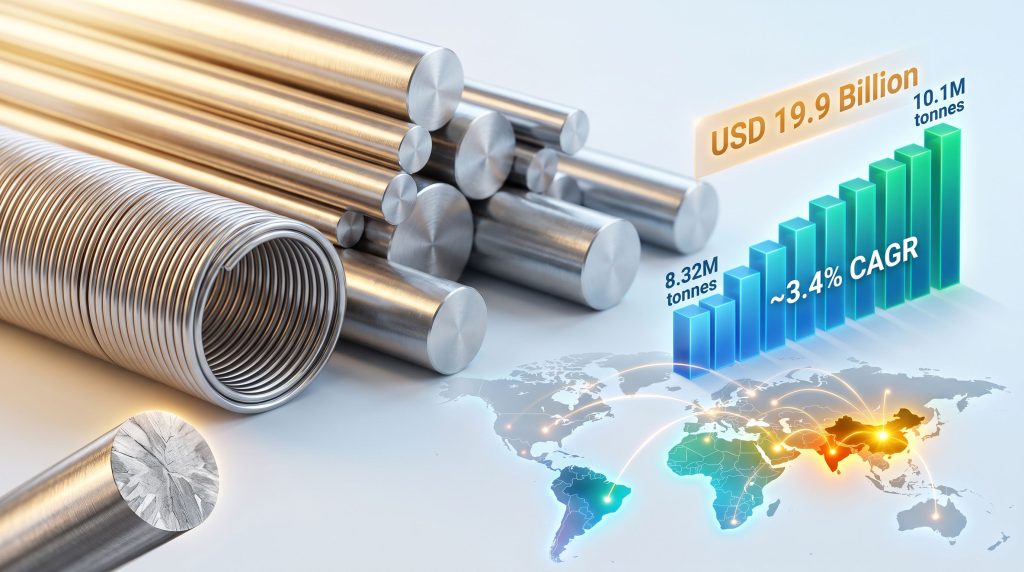
According to industry analysis covering the aluminium wires and cables sector, global aluminium wire rod consumption is forecast to grow from approximately 8.32 million tonnes in 2025 to more than 10.1 million tonnes by 2030, representing a volume compound annual growth rate (CAGR) of approximately 3.4%. The market value trajectory is steeper, with the global sector projected to expand from roughly USD 14.8 billion to approximately USD 19.9 billion over the same period, implying a value CAGR of around 5.1%.
The divergence between volume growth (3.4% CAGR) and value growth (5.1% CAGR) is a meaningful signal. It suggests that pricing dynamics, driven by alloy premiums, product mix shifts toward higher-grade conductors, and tightening supply in key regional markets, are expected to outpace raw volume expansion. For producers, this is a margin story as much as a volume story.
Global Volume and Value Projections at a Glance
| Metric | 2024/25 Baseline | 2030 Forecast | CAGR |
|---|---|---|---|
| Global Volume (tonnes) | ~8.16–8.32 million | >10.1 million | ~3.4% |
| Market Value (USD) | ~USD 14.8 billion | ~USD 19.9 billion | ~5.1% |
| India Regional Volume | 1.41 million tonnes | 2.11 million tonnes | ~5.93% |
| China Regional Volume | 4.00 million tonnes | 4.79 million tonnes | ~2.6% |
Crossing the 10 million tonne threshold is more than a round number milestone. It represents the point at which aluminium wire rod consumption achieves a scale comparable to several major refined metals markets, with corresponding implications for upstream aluminium smelting capacity requirements and downstream processing investment.
The Three Forces Reshaping Demand Through 2030
Force 1: Power Grid Expansion as the Primary Demand Engine
Grid infrastructure investment is the single largest driver of aluminium wire rod consumption globally, and the scale of the requirement is difficult to overstate. Electricity consumption worldwide continues to grow faster than existing transmission and distribution networks were designed to accommodate, driven by industrial electrification, data centre proliferation, and the shift away from direct fossil fuel combustion in heating and transport.
Aluminium has become the dominant material for overhead transmission conductors for three interconnected reasons:
- Its conductivity-to-weight ratio is superior to copper for long-distance, high-voltage applications
- Its raw material cost is substantially lower, making large-scale grid projects economically viable
- Modern alloy development has progressively expanded its performance envelope to meet increasingly demanding electrical specifications
A particularly important technological development in this space is the emergence of High-Temperature Low Sag (HTLS) conductor technology. HTLS conductors allow utilities to transmit significantly higher electrical loads through existing transmission corridors without requiring new tower structures or right-of-way acquisition. This is a critical capability for grid operators managing constrained planning environments and compressed timelines. HTLS conductors use specialised aluminium alloy wire rod as their primary input, creating incremental demand for higher-grade product beyond conventional ACSR (Aluminium Conductor Steel Reinforced) specifications.
The scale of new transmission infrastructure required globally is substantial. The World Bank has estimated that Sub-Saharan Africa alone will require approximately 100,000 kilometres of new transmission lines by 2030 to meet projected electricity demand, representing one of the largest single regional grid development programmes in history. This scale of greenfield transmission development has direct, quantifiable implications for aluminium wire rod consumption across the Middle East and Africa region.
Force 2: Renewable Energy Integration Creating Parallel Transmission Investment Cycles
Solar and wind energy installations share a structural characteristic that distinguishes them from conventional thermal generation: they are typically located far from existing demand centres. Desert solar farms, offshore wind arrays, and high-altitude wind corridors require dedicated transmission infrastructure to connect generation capacity to load. Furthermore, every gigawatt of renewable capacity commissioned creates incremental demand for aluminium conductors, independent of base grid modernisation programmes.
This creates a compounding dynamic. Grid operators must simultaneously:
- Replace and upgrade ageing conventional transmission infrastructure
- Build new transmission corridors to connect renewable generation sites
- Develop smart grid interconnections to manage variable generation profiles
- Expand cross-border power trade infrastructure to balance regional supply and demand
Each of these programmes draws on aluminium wire rod supply. The result is a demand environment where multiple distinct procurement cycles overlap, reducing the cyclicality that has historically characterised industrial metals markets. In addition, energy transition minerals are increasingly central to how policymakers and investors frame the materials challenge underpinning decarbonisation.
How a Renewable Energy Project Creates Aluminium Wire Rod Demand: Step by Step
- Government or private developer awards renewable energy capacity through tender or direct investment commitment
- Engineering design phase identifies transmission infrastructure requirement to connect generation site to grid
- Aluminium conductor specification is selected based on distance, load requirements, terrain, and regulatory standards
- Wire rod procurement is initiated, typically 12 to 18 months ahead of planned installation
- Conductor manufacturing and cable assembly uses aluminium wire rod as the primary material input
- Installation, commissioning, and grid connection — at which point wire rod demand is fully realised in consumption data
Force 3: Electric Vehicles and the Lightweighting Imperative
The electrification of transport is the fastest-growing demand channel for aluminium wire rod, though it remains smaller in absolute volume terms than grid infrastructure applications. The physics of EV design create a structural preference for aluminium over copper in wiring systems: reducing the mass of wiring harnesses directly extends battery range, and in an industry where range anxiety remains a primary consumer concern, every kilogram of weight reduction has measurable commercial value.
High-conductivity aluminium alloy rods are used in EV battery tab connections, main cable assemblies, and motor winding applications. The demand is expanding beyond passenger vehicles into commercial trucks, city buses, and aerospace platforms, where weight reduction translates directly into lower operating costs and emissions. Consequently, the battery raw materials market is increasingly intersecting with aluminium supply chain planning as EV manufacturers seek to secure diversified, lightweight conductor inputs.
What makes the EV demand channel strategically distinct from grid infrastructure demand is its alloy specificity. EV applications require tight conductivity and mechanical performance tolerances that conventional wire rod grades cannot always meet, creating a premium product segment that supports higher fabrication margins for producers with the appropriate technical capability.
Regional Demand Architecture: Where Growth Will Be Concentrated
Regional Volume Forecast Summary (2023 to 2030)
| Region | 2023 Volume | 2030 Forecast | Key Growth Driver |
|---|---|---|---|
| China | 4.00 million tonnes | 4.79 million tonnes | T&D networks, renewables, manufacturing |
| India | 1.41 million tonnes | 2.11 million tonnes | Urbanisation, power expansion, renewables |
| Europe | 0.80 million tonnes | 0.96 million tonnes | Grid modernisation, energy transition |
| North America | 0.38 million tonnes | 0.47 million tonnes | Ageing grid replacement, federal incentives |
| Middle East and Africa | 0.56 million tonnes | 0.75 million tonnes | Electrification, industrialisation |
| South America | 0.49 million tonnes | 0.62 million tonnes | Infrastructure investment, generation growth |
| Rest of Asia Pacific | 0.37 million tonnes | 0.44 million tonnes | Electricity access expansion |
China: Structural Leadership With Deepening Complexity
China commands approximately 47% of global aluminium wire rod consumption, a dominance that reflects the country's position as both the world's largest aluminium producer and the most ambitious deployer of transmission infrastructure and renewable energy capacity. Demand is forecast to grow from 4.00 million tonnes in 2023 to 4.79 million tonnes by 2030.
What is less widely appreciated is that Chinese demand is becoming more technically sophisticated. As the State Grid Corporation and China Southern Power Grid accelerate ultra-high-voltage direct current (UHVDC) transmission projects connecting inland renewable generation to coastal demand centres, the specification requirements for conductor-grade aluminium wire rod are tightening. This creates a quality upgrade cycle within China's existing volume base that has implications for both domestic rod producers and global aluminium alloy supply chains.
India: The Defining Regional Growth Story of the Decade
India is the market that commands the most strategic attention through 2030. Demand is projected to grow from 1.41 million tonnes in 2023 to 2.11 million tonnes by 2030, a volume increase of approximately 50% that lifts India's share of global consumption from 17% to approximately 21%. This implies an India-specific CAGR of approximately 5.93%, nearly double the global average.
Three structural catalysts are converging simultaneously in India:
- Accelerating urbanisation, with hundreds of millions of people entering cities that require electrified housing, commercial buildings, and transport systems
- National electrification programmes expanding grid connectivity to previously underserved rural and peri-urban populations
- Ambitious renewable energy capacity targets requiring entirely new transmission corridors across a geographically complex country
Critically, India's infrastructure investment cycle is still in an early-to-mid stage relative to China's more mature grid build-out. This means the growth trajectory is likely to remain steep rather than decelerating, as the capital stock of transmission infrastructure remains far below the level required to support India's economic development pathway.
For wire rod producers, cable manufacturers, and infrastructure investors, India represents the highest-conviction regional growth opportunity in the global aluminium wire rod demand to 2030 outlook.
Europe and North America: Replacement Cycles Driving Steady Demand
European demand is forecast to grow from 0.80 to 0.96 million tonnes, driven primarily by grid modernisation investment tied to the EU's clean energy framework, offshore wind connectivity requirements, and EV adoption rates feeding into automotive sector demand for aluminium wiring systems. Growth is characterised by upgrade and replacement cycles rather than greenfield expansion, which supports more predictable procurement patterns.
North America presents a similar dynamic. Demand is expected to expand from 0.38 to 0.47 million tonnes, with the United States and Canada both facing substantial ageing transmission infrastructure that requires capital-intensive replacement programmes. Federal infrastructure and clean energy legislation has accelerated the pace of grid investment commitments, creating multi-year demand visibility for aluminium conductor manufacturers. For investors, copper investment strategies provide a useful parallel framework for thinking about how to position in industrial metals benefiting from similar electrification tailwinds.
Emerging Regions: Electrification Deficits as Long-Cycle Demand Generators
The Middle East and Africa, South America, and the Rest of Asia Pacific collectively represent a demand pool growing from approximately 1.42 million tonnes in 2023 to approximately 1.81 million tonnes by 2030. However, while modest in absolute terms relative to China and India, these regions carry significant long-cycle demand potential as electrification programmes progress.
Sub-Saharan Africa's transmission infrastructure deficit is particularly notable. The World Bank's estimate of 100,000 kilometres of required new transmission lines by 2030 in this region alone represents a structural demand pipeline that extends well beyond the current forecast period. South America's demand growth is anchored in hydropower integration and renewable energy grid connectivity, while Southeast Asian demand reflects gradual electricity access expansion across archipelagic geographies that present unique transmission engineering challenges.
Aluminium vs. Copper in Wire and Cable Applications
The Case for Substitution
| Attribute | Aluminium | Copper |
|---|---|---|
| Conductivity-to-Weight Ratio | Superior for overhead and long-distance applications | Lower per unit weight |
| Raw Material Cost | Significantly lower | Significantly higher |
| Weight per Unit Volume | Approximately 3x lighter | Heavier |
| Primary Application Fit | Grid transmission, EV wiring, large-scale cables | Precision electronics, short-run, high-density wiring |
| Infrastructure Suitability | Grid-scale, long-distance transmission | Building wiring, high-precision systems |
The cost differential between aluminium and copper is not merely a procurement consideration — it is a project viability factor at scale. For a 500-kilometre transmission corridor, the difference in conductor material cost between copper and aluminium can determine whether a project achieves a bankable financial return. This economic reality is structurally accelerating aluminium substitution in grid applications.
Copper retains competitive advantages in applications where high current density in confined spaces, superior corrosion resistance, or ease of jointing is required. Building wiring, precision electronics, and some automotive high-voltage applications continue to favour copper. However, the trend line in large-scale infrastructure consistently favours aluminium, and alloy development is progressively narrowing the performance gap in remaining copper strongholds.
The next major ASX story will hit our subscribers first
End-Use Sector Demand Framework
The five primary end-use sectors generating aluminium wire rod demand through 2030, ranked by current consumption volume, are:
- Power transmission and distribution — the dominant sector, encompassing grid expansion, HTLS conductor deployment, and cross-border interconnection projects
- Renewable energy infrastructure — solar farm collection networks, wind farm export cables, and grid-tie transmission lines
- Electric vehicles and transportation — internal wiring harnesses, battery tab connections, and commercial vehicle electrification
- Construction and urban infrastructure — building wiring systems and underground cable networks in high-density urban environments
- Industrial and manufacturing — motor windings, transformer windings, and industrial cable assemblies
A less commonly appreciated demand channel is the data centre buildout currently underway globally. Hyperscale data centres require substantial dedicated power infrastructure, including high-capacity aluminium cable connections to transmission networks. As artificial intelligence workloads drive electricity consumption in data centres to unprecedented levels, this sector is becoming a measurable incremental source of demand that sits outside traditional grid infrastructure accounting. Furthermore, green steel production trends offer a comparable case study in how industrial decarbonisation reshapes materials demand at scale.
Strategic Implications for Industry Participants
What Wire Rod Producers and Smelters Should Consider
- Regional capacity alignment: India and Southeast Asia represent priority investment geographies based on demand growth trajectories
- Product grade mix: Shifting toward high-conductivity alloy grades for HTLS conductor and EV applications supports margin expansion alongside volume growth
- Long-cycle offtake positioning: Aligning supply agreements with grid infrastructure developers and renewable energy project pipelines provides demand visibility that reduces price cycle risk
What Cable Manufacturers and Downstream Processors Face
- Securing reliable aluminium wire rod supply in markets with the highest demand growth trajectories requires early procurement commitments and supplier relationship investment
- Technology investment in aluminium alloy processing capabilities is increasingly necessary to meet evolving conductor performance specifications, particularly for HTLS and EV applications
- EV supply chain integration represents a structurally growing demand channel with distinct alloy requirements that differ from conventional transmission conductor grades
What Infrastructure Investors and Policy Analysts Should Track
- Aluminium wire rod consumption growth rates function as a leading indicator of real grid investment activity, providing a cross-check on announced infrastructure spending commitments
- Regional demand divergence between India, China, Europe, and emerging markets reflects different stages of infrastructure development maturity, with material implications for project development pipelines
- The 10 million tonne threshold crossing expected by 2030 provides a benchmark against which to measure the actual pace of global electrification progress
Frequently Asked Questions on Aluminium Wire Rod Demand to 2030
What is the projected global demand for aluminium wire rod by 2030?
Global aluminium wire rod demand to 2030 is forecast to exceed 10.1 million tonnes, rising from approximately 8.32 million tonnes in 2025, at a volume CAGR of approximately 3.4%.
Which country will consume the most aluminium wire rod by 2030?
China will remain the world's largest consumer at approximately 4.79 million tonnes, though India is the fastest-growing major market with demand rising nearly 50% from its 2023 base.
Why is the value CAGR higher than the volume CAGR?
Product mix upgrading toward higher-conductivity alloys, pricing premiums in tightening regional markets, and the growing share of technically demanding applications in the demand mix are all contributing to value growth outpacing volume growth.
What is driving aluminium wire rod demand globally?
The three primary structural drivers are power grid expansion and modernisation, renewable energy transmission infrastructure requirements, and the electrification of vehicles and transport systems.
Why is aluminium preferred over copper in transmission applications?
Aluminium offers a superior conductivity-to-weight ratio and significantly lower material cost, making it the economically and technically preferred choice for overhead transmission conductors and large-scale cable applications.
Which emerging regions represent the strongest long-term growth opportunity?
India is the highest-conviction growth market through 2030. Beyond India, the Middle East and Africa, South America, and Southeast Asia represent significant longer-cycle opportunities driven by electrification deficits and infrastructure development programmes.
Disclaimer: Market volume and value projections cited in this article are drawn from industry research covering the aluminium wires and cables sector. Forecasts involve inherent uncertainty and should not be relied upon as the sole basis for commercial or investment decisions. Readers are encouraged to consult primary industry sources and independent analysis before making strategic commitments.
Want to Capitalise on the Metals Powering the Global Energy Transition?
Discovery Alert's proprietary Discovery IQ model delivers real-time alerts on significant ASX mineral discoveries — including the critical metals underpinning grid expansion, renewable energy infrastructure, and EV adoption — turning complex market data into actionable investment insights for both short-term traders and long-term investors. Explore Discovery Alert's discoveries page to see how historic mineral discoveries have generated substantial returns, and begin a 14-day free trial to position ahead of the market.