July 15, 2026
The Hidden Mineral Inside Every Alumina Refinery That the World Suddenly Needs
For most of the past century, the alumina refining industry measured its success in tonnes of white powder destined for aluminium smelters. The caustic liquors, the Bayer circuits, the precipitation tanks — all of it optimised around a single output. But buried within those same process streams, at concentrations so low they were long considered uneconomical to recover, sits one of the most strategically sensitive metals on the planet.
Gallium has existed as a recoverable byproduct of bauxite refining since the early twentieth century. The Alcoa gallium plant in Western Australia represents the most significant attempt by allied nations to commercialise that recovery potential. What changed is not the chemistry. What changed is the world around it.
When big ASX news breaks, our subscribers know first
Why Gallium's Strategic Value Cannot Be Understood Without Understanding Its Supply Chain
Most industrial metals have a primary ore body. You find the deposit, you mine it, you process it. Gallium does not work that way. It exists as a trace constituent within bauxite ore, concentrated naturally into the caustic aluminate liquor generated during the Bayer refining process. Consequently, gallium supply dynamics are structurally tethered to alumina production capacity, creating an unusual dynamic: expanding gallium output requires either building new alumina refineries or retrofitting existing ones with recovery circuits.
That dependency has profound implications for supply chain resilience. It means gallium cannot be unlocked by simply discovering a new deposit or sinking a new shaft. The infrastructure must already exist. And for decades, that infrastructure was almost entirely located in China.
China's dominance in gallium refining is not accidental. The country built its position through decades of investment in both alumina processing capacity and gallium recovery technology, eventually capturing an estimated 80 to 90 percent of global refined gallium output. Western nations, focused on cost-efficient sourcing, allowed that concentration to deepen without developing meaningful alternative supply.
The consequences became unavoidable in mid-2023, when Beijing introduced export licensing controls on gallium and germanium. China's export controls moved from a niche procurement concern to a headline geopolitical risk. Defence contractors, semiconductor fabricators, and solar panel manufacturers across the United States, European Union, Japan, and Australia were forced to confront a single uncomfortable reality: they had no credible domestic or allied-nation alternative.
The export controls did not create the vulnerability. They simply illuminated it.
What Is Gallium Actually Used For, and Why Does It Command Strategic Attention?
Gallium's industrial relevance spans three high-growth sectors, each with distinct demand dynamics:
- Semiconductor manufacturing — Gallium is a foundational input for gallium arsenide (GaAs) and gallium nitride (GaN) compound semiconductors, which outperform silicon in high-frequency, high-power, and high-temperature applications. GaN devices are now standard in military radar, electronic warfare systems, satellite communications, and next-generation power electronics.
- 5G telecommunications infrastructure — GaN-based power amplifiers are critical components in 5G base station hardware, where their efficiency and power density advantages over silicon make them effectively irreplaceable at scale.
- Photovoltaic solar technology — CIGS (copper indium gallium selenide) thin-film solar panels incorporate gallium as a core active layer material. As utility-scale solar deployment accelerates globally through 2030 and beyond, CIGS demand is expected to grow alongside it.
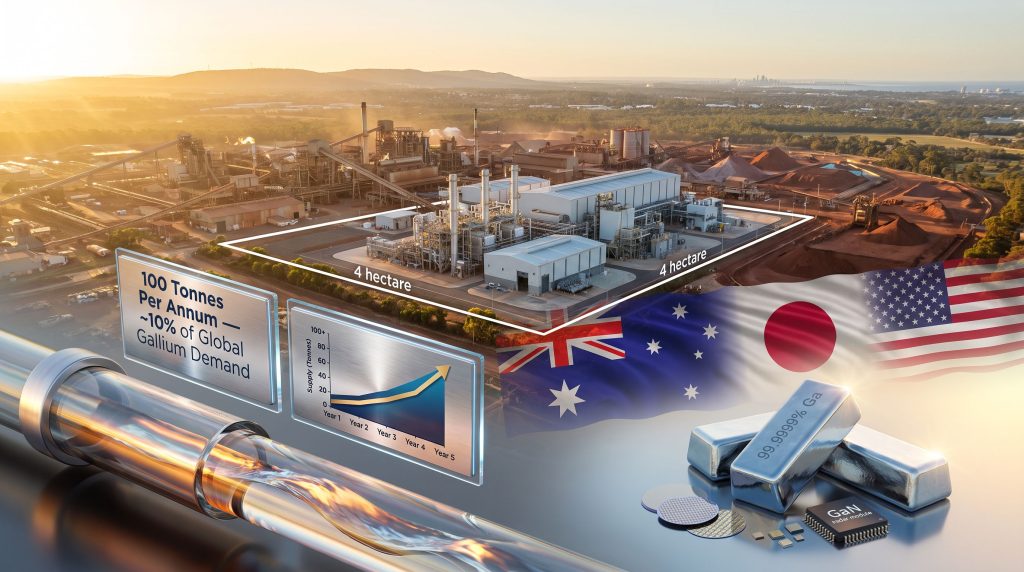
Furthermore, the critical minerals demand surge makes gallium uniquely sensitive from a supply chain perspective due to the ratio between its strategic importance and its production volume. Global annual demand is estimated in the range of 800 to 1,000 tonnes per year depending on the measurement period and source. A single facility capable of producing 100 tonnes per annum can therefore represent roughly 10 percent of total global consumption — a concentration of supply significance that would be unthinkable in iron ore, copper, or even lithium markets.
This is why the Alcoa gallium plant in Western Australia matters at a scale that far exceeds its physical footprint.
The Wagerup Facility: Engineering Logic Behind the Site Selection
The decision to locate the gallium recovery plant within the boundary of Alcoa's Wagerup Alumina Refinery, approximately 120 kilometres south-east of Perth, reflects a precise understanding of the technical and economic prerequisites for gallium co-recovery.
Gallium concentrations in bauxite liquor are typically measured in the range of 100 to 300 milligrams per litre, depending on the specific bauxite ore composition being processed. At those concentrations, the economics of standalone gallium extraction are marginal at best. Co-location with an existing Bayer circuit eliminates the capital-intensive ore processing infrastructure that would otherwise be required, transforms a trace-element recovery operation into a viable industrial proposition, and allows the gallium plant to draw on existing site utilities, workforce, and environmental approvals frameworks.
Wagerup was selected over alternative Alcoa refinery sites, including the Pinjarra facility, based on a combination of liquor stream characteristics, available land within the refinery boundary, and the practical mechanics of integrating a new extraction circuit without disrupting primary alumina output. The plant will occupy approximately 4 hectares in the south-eastern section of the site, processing up to 10 percent of the refinery's total bauxite liquor flow.
| Project Metric | Detail |
|---|---|
| Location | Wagerup Alumina Refinery, ~120km south-east of Perth, WA |
| Site Footprint | ~4 hectares within existing refinery boundary |
| Planned Annual Output | 100 tonnes of gallium |
| Share of Estimated Global Demand | ~10% |
| Feed Input | Up to 10% of total bauxite liquor flow |
| Works Approval Lodged | December 2025 |
| Final Investment Decision | 2026 |
| Target Production Start | Late 2026 |
| Construction Employment | ~150 jobs |
| Permanent Operational Roles | 15 to 20 ongoing positions |
From Liquor Stream to Refined Metal: The Recovery Process Explained
Understanding how gallium moves from a bauxite liquor stream to a refined metal product helps explain both the facility's technical design and its operational risk profile.
The Bayer Process dissolves bauxite ore in hot caustic soda, producing a sodium aluminate liquor from which alumina hydrate is subsequently precipitated. Gallium, chemically similar to aluminium in several respects, follows aluminium through this liquor and naturally concentrates as the process cycles. The recovery circuit at Wagerup intercepts this enriched liquor stream and routes it through a dedicated extraction sequence:
- Liquor Diversion — A controlled proportion of the Bayer circuit liquor, up to 10% of total refinery flow, is extracted at a point where gallium concentration is highest.
- Concentration and Selective Separation — The diverted liquor passes through a chemical separation stage, typically involving solvent extraction or ion exchange technology, which selectively captures gallium ions while allowing the bulk aluminate solution to be returned to the main circuit.
- Electrowinning or Chemical Reduction — The gallium-enriched solution is converted to crude liquid gallium metal through electrochemical deposition or chemical reduction processes. Gallium's low melting point of 29.76 degrees Celsius means it exists as a liquid at only slightly above room temperature, which simplifies certain handling steps compared to other recovered metals.
- Zone Refining to Semiconductor Grade — Crude gallium is further purified through zone refining or equivalent techniques to achieve the 99.9999% purity (known as six-nines or 6N grade) required by semiconductor and optoelectronics manufacturers. This final refining step is where significant value is added and where product specification directly determines end-market access.
- Packaging and Offtake Dispatch — Refined gallium is typically stored and transported in polyethylene containers or stainless steel vessels, dispatched against offtake commitments to allied-nation industrial customers.
One technically important but rarely discussed characteristic of gallium is its tendency to supercool, meaning it can remain liquid well below its freezing point under certain conditions. This property, combined with its extremely low vapour pressure, influences storage and handling protocols at refinery scale in ways that differ meaningfully from more conventional refined metals.
The Three-Nation Partnership: Who Built This Project and Why
The Alcoa gallium plant in Western Australia is not a purely commercial venture. Its ownership and funding structure reflects deliberate allied-nation coordination to address a shared geopolitical vulnerability.
The project operates as a joint venture between Alcoa and Japan Australia Gallium Associates (JAGA), a purpose-built entity comprising Sojitz Corporation, a diversified Japanese trading house with significant experience in resource project financing and execution, and JOGMEC (Japan Organisation for Metals and Energy Security), a Japanese government instrumentality whose mandate explicitly includes securing offshore supply of critical and strategic minerals for Japanese industrial consumers.
JOGMEC's participation is not passive. As a state-backed entity operating under Japan's Ministry of Economy, Trade and Industry, its involvement signals that the Japanese government views secured gallium supply as a national industrial policy priority, not merely a commercial investment opportunity. Japan's semiconductor and electronics industries, among the world's most advanced, are deeply exposed to gallium supply disruption and have been pushing for diversified sourcing since China's 2023 export licensing measures took effect.
Both the Australian Government and the United States Government have provided capital support and offtake-related backing for the project. Australia's critical minerals strategy identifies gallium as a priority mineral for domestic value-add processing given the country's existing bauxite and alumina production base. The U.S. dimension aligns with defence procurement frameworks and allied-nation sourcing initiatives, including those operating under the Minerals Security Partnership (MSP), the multilateral framework designed to coordinate Western investment in critical mineral supply chains outside Chinese jurisdiction.
In addition, Alcoa's gallium project factsheet outlines the technical scope and strategic rationale behind the facility in considerable detail, underscoring the multi-sovereign seriousness with which the project has been developed.
The three-nation structure of this joint venture is genuinely unusual. Multi-sovereign capital convergence in a single mineral processing facility at this scale reflects the severity of the strategic problem being addressed, not simply the commercial opportunity being pursued.
The next major ASX story will hit our subscribers first
What This Project Reveals About the Future of Critical Mineral Co-Recovery
The Wagerup gallium facility carries significance beyond its own production numbers. It demonstrates, at industrial scale, that existing alumina refinery infrastructure can be retrofitted to recover critical mineral byproducts without disrupting primary operations, at capital costs and construction timelines substantially more compressed than greenfield alternatives.
This proof-of-concept logic has considerable implications for Alcoa's broader Western Australian refinery network, which includes operations at Pinjarra and Kwinana in addition to Wagerup. If the Wagerup facility achieves its production and commercial targets, it establishes both the technical template and the regulatory precedent for replication across these other sites, potentially multiplying Australia's contribution to non-Chinese gallium supply without requiring additional bauxite mining infrastructure.
More broadly, the co-recovery model challenges the conventional assumption that critical mineral production requires dedicated mines and standalone processing plants. For elements like gallium, scandium, vanadium, and others that concentrate within industrial process streams, the most economical production pathway may run directly through existing industrial operations that have historically treated these elements as process noise rather than recoverable value.
The market dynamics reinforce this logic. Projected growth in global gallium demand through 2030, driven by accelerating 5G infrastructure rollout, expanded GaN power electronics adoption in electric vehicles and industrial applications, and continued growth in CIGS solar deployment, is expected to exert sustained upward pressure on prices for responsibly sourced, allied-nation gallium. Facilities like Wagerup, with multi-government offtake backing and guaranteed access to a continuous bauxite liquor feed stream, are structurally positioned to benefit from that demand trajectory.
Western Australia's Role in the Allied Critical Minerals Architecture
Western Australia's selection as the site for this project is not coincidental. The state hosts one of the world's most substantial integrated bauxite-to-alumina production systems, with Alcoa's Darling Range mining operations feeding multiple refineries that collectively represent enormous latent gallium recovery potential. Furthermore, the state's established regulatory environment, skilled workforce pipeline, and proximity to Asian export markets via Fremantle Port create a logistical and operational context that few jurisdictions globally can match for this type of project.
The global bauxite supply advantages concentrated in Western Australia, combined with the state's participation in the Minerals Security Partnership and the broader architecture of allied critical mineral coordination, mean Western Australia is increasingly positioned not just as a raw material exporter, but as a downstream processing hub for minerals of strategic significance to partner nations.
The Wagerup gallium project is among the earliest concrete expressions of that positioning in the processing sector. Notably, government support for Alcoa's gallium development from both Australian and U.S. authorities further underlines the strategic weight that allied governments have placed behind this initiative.
Investors and industry observers should note that forecasts regarding demand growth, price trajectories, and project timelines involve inherent uncertainty. All production targets and financial assumptions referenced in this article reflect publicly available project documentation and independent industry analysis, and should not be treated as guarantees of future performance.
Frequently Asked Questions About the Alcoa Gallium Plant in Western Australia
Where exactly will the gallium plant be built?
The facility will be constructed within the operational boundary of Alcoa's Wagerup Alumina Refinery, located approximately 120 kilometres south-east of Perth in Western Australia's South West region. The plant will occupy around 4 hectares in the south-eastern portion of the existing refinery site.
When is production expected to begin?
Production is targeted to commence in late 2026, following a Final Investment Decision reached in 2026 and a Works Approval application lodged with the Western Australian Department of Water and Environmental Regulation in December 2025.
Who are the joint venture partners?
The project is a joint venture between Alcoa and Japan Australia Gallium Associates (JAGA), a partnership between Sojitz Corporation and JOGMEC (Japan Organisation for Metals and Energy Security). Both the Australian and U.S. governments have provided capital and offtake support for the project.
How much gallium will the plant produce?
The facility is designed to produce 100 tonnes of gallium per annum, representing approximately 10 percent of estimated global gallium demand at current consumption levels.
How many jobs will the project create?
The construction phase is expected to support approximately 150 jobs, with 15 to 20 permanent operational positions sustained over the life of the facility.
How is gallium recovered from the bauxite liquor?
A portion of the Bayer circuit liquor, up to 10% of total refinery flow, is diverted through a selective extraction circuit that captures gallium ions from the aluminate solution. The recovered gallium is then processed through electrowinning and zone refining stages to produce 6N purity (99.9999%) refined metal suitable for semiconductor-grade applications.
Want to Track the Next Major Critical Minerals Development Before the Market Does?
Discovery Alert's proprietary Discovery IQ model delivers real-time alerts on significant ASX mineral discoveries — including the critical minerals reshaping global supply chains — instantly converting complex geological data into actionable investment insights. Explore how historic discoveries have generated substantial returns on Discovery Alert's dedicated discoveries page, and begin your 14-day free trial today to position yourself ahead of the broader market.