June 30, 2026
The Global Race to Build Aluminum Capacity Outside China Has Found a New Frontrunner
Decades of industrial underinvestment, compounded by a decade-long drawdown in global aluminum stockpiles, have created one of the most pressing supply-side challenges in base metals markets. Primary aluminum production capacity outside of China has not kept pace with downstream demand growth, and the consequences are now rippling through commodity supply chains. In this environment, Egypt has quietly positioned itself as one of the most compelling destinations for new smelting infrastructure in the world.
The announcement of the Trafigura Egyptalum aluminum smelter in Egypt represents far more than a bilateral industrial agreement. It signals a structural reorientation of where non-Chinese aluminum capacity will be built, by whom, and under what commercial models. Understanding the full significance of this project requires examining both the global forces that made it inevitable and the institutional architecture that makes it viable.
When big ASX news breaks, our subscribers know first
Why Global Aluminum Supply Dynamics Are Forcing New Investment Decisions
Aluminum is not a commodity facing a shortage of ore. The global bauxite supply is abundant and geographically distributed. The bottleneck lies in primary smelting capacity, specifically the ability to convert alumina into refined metal at scale. Smelting is energy-intensive, capital-heavy, and operationally complex. Building a greenfield smelter takes years and requires a convergence of cheap, reliable power, skilled industrial labour, established logistics infrastructure, and long-term offtake certainty.
These preconditions have historically favoured a narrow group of nations, and China has dominated capacity additions for the past two decades. The consequence is a structural imbalance that has been quietly worsening: according to data cited by Trafigura, aluminum inventories held outside China have declined by approximately 6 million tonnes over the past decade, reaching historically compressed levels. This is not a cyclical inventory correction. It reflects a sustained failure to develop primary smelting capacity in markets that actually consume the metal.
The urgency of this supply gap has been further sharpened by geopolitical disruption across the Middle East. Conflict-related impacts on smelting operations in the UAE and Bahrain have removed meaningful capacity from regional markets, creating a supply vacuum in the very geography best placed to serve European and African demand. Estimates suggest these disruptions have affected approximately 9% of world aluminum supply, an extraordinary figure that has reshaped trader positioning and long-term procurement strategies.
"The aluminum market is not simply facing a price problem. It is facing a geography problem: too much production concentration in a single country, combined with acute disruptions in the secondary supply belt of the Middle East."
This is the backdrop against which the Trafigura Egyptalum aluminum smelter in Egypt must be understood. The project is not an opportunistic bet. It is a calculated response to a structural market failure.
Project Specifications: What Is Being Built and Where
The term sheet for the Trafigura Egyptalum aluminum smelter in Egypt was executed on May 6, 2026, establishing the framework for exclusive negotiations between Trafigura, the Egyptian Aluminium Company (Egyptalum), and the Metallurgical Industries Holding Company (MIH). The deal's specifications are substantial by any measure.
| Parameter | Detail |
|---|---|
| Primary Smelter Capacity | 300,000 tonnes per annum |
| Anode Plant Capacity | 150,000 tonnes per annum |
| Project Location | Nag Hammadi complex, Upper Egypt |
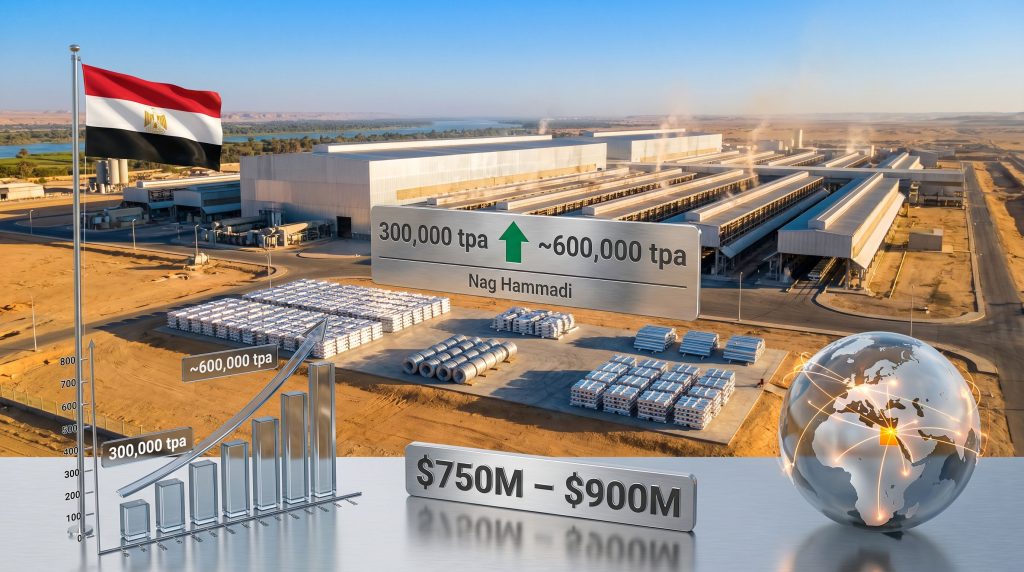
| Total Estimated Investment | $750 million to $900 million |
| Post-Project Site Capacity | Approximately 600,000 tpa |
| Negotiation Status | Exclusive, under term sheet |
The chosen location at the Nag Hammadi industrial complex is significant for reasons that extend beyond available land. The existing site spans 6.3 million square metres and already houses a primary aluminum smelter, cast house, rolling mill, anode plant, and full support infrastructure. Egyptalum's current product range includes ingots, wire rods, billets, slabs, T-bars, foundry alloys, hot- and cold-rolled flat products, and aluminum extrusion profiles. This is not a blank industrial canvas. The new facility is being layered onto an operational base that already possesses technical workforce capability, established utilities, and regulatory familiarity.
The near-doubling of total site capacity, from approximately 300,000 tpa to around 600,000 tpa, would elevate Egypt to a position of genuine continental significance in primary aluminum production. Furthermore, this scale would position Egypt alongside the leading aluminium producers globally in terms of production footprint.
The Strategic Importance of the Anode Plant Addition
The 150,000 tpa anode plant component of this project deserves specific attention because it is frequently underappreciated in commodity market commentary. Prebaked carbon anodes are consumable inputs used directly in the Hall-Heroult electrolytic reduction process that converts alumina into primary aluminum. Each tonne of aluminum produced consumes roughly 400 to 500 kilograms of carbon anode material.
Smelters that lack domestic anode supply must either import at market prices or depend on third-party suppliers, both of which introduce cost volatility and supply chain fragility. Building a dedicated 150,000 tpa anode plant alongside the smelter eliminates this upstream vulnerability and reduces production costs on a per-tonne basis. It is a technically sophisticated decision that suggests the project's engineers and commercial architects are designing for long-run operational resilience, not just headline capacity.
How Trafigura Is Structuring Its Participation
The commercial architecture of the Trafigura Egyptalum aluminum smelter in Egypt is one of its most analytically interesting features. Trafigura will not participate simply as a passive equity investor. Its role encompasses four distinct but interconnected commercial functions:
- Minority equity stake in the newly created joint venture company responsible for building, owning, and operating the smelter
- Debt provider, contributing to the project financing structure alongside equity capital
- Long-term offtake partner, committing to purchase the facility's aluminum output over an extended time horizon
- Raw materials supply counterparty, providing alumina and other feedstocks required for smelting operations
This vertically integrated commercial structure is a deliberate risk management mechanism. Trafigura's financial returns are not dependent solely on aluminum price appreciation or equity dividend flows. They are anchored across multiple revenue streams: financing margins on debt, commercial margins on raw material supply, and trading spreads on offtake volumes. Each layer provides a degree of downside protection that a pure equity investment model would not.
"This type of fully integrated commodity house involvement, spanning capital, supply, and offtake simultaneously, has become a defining feature of large-scale industrial infrastructure investment in emerging markets. It transfers significant commercial risk away from the host industrial partner while giving the trading house captive deal flow across the project's entire operating life."
The choice of a minority equity position, rather than a controlling stake, also reflects both Trafigura's strategic preferences and Egyptian industrial policy. Trafigura generates returns through commercial throughput rather than operational control, making minority positioning commercially rational. Simultaneously, MIH's institutional majority ownership preserves national sovereignty over a strategically critical industrial asset, which is a consistent feature of Egyptian state industrial policy across its metals and energy sectors.
The exclusive negotiation framework, rather than a competitive tender process, further signals high commercial alignment between parties. Exclusive deals in project finance typically indicate that the counterparties have already resolved the major commercial variables and are working toward contractual formalisation rather than price discovery.
Who Are the Parties and Why Does Their Track Record Matter
Understanding each counterparty's institutional background is essential for assessing project execution credibility.
Trafigura is a Singapore-headquartered global commodity trading group that has maintained commercial operations in Egypt for more than two decades. The company has supplied alumina to Egyptian industry since 2005 and is currently among Egypt's largest providers of metals and liquefied natural gas. This is not a company entering an unfamiliar jurisdiction. Its regulatory relationships, banking connections, and commercial networks within Egypt are deeply established, reducing the execution risk that has historically plagued large foreign-led industrial projects in emerging markets.
Egyptalum (Egyptian Aluminium Company) is the state-owned operator of the Nag Hammadi complex and Egypt's primary aluminum production backbone. Its operational experience with large-scale smelting, its existing workforce, and its product diversification into downstream rolled and extruded products give it a technical credibility that pure greenfield operators cannot match.
MIH (Metallurgical Industries Holding Company) serves as the Egyptian state's institutional anchor for the joint venture. MIH oversees multiple industrial subsidiaries spanning aluminum production, steel, and mineral processing, making it the appropriate counterpart for a project that bridges commodity trading and heavy industrial manufacturing. Its involvement provides political stability and regulatory certainty, two factors that have historically deterred large-scale industrial foreign direct investment in emerging markets.
Egypt's Converging Aluminum Investment Wave
The Trafigura Egyptalum deal does not exist in isolation. It is part of an emerging pattern of aluminum investment concentration in Egypt that has developed rapidly in early 2026.
On April 11, 2026, less than four weeks before the Trafigura term sheet was signed, Chinese industrial group Henan Zhongfu Industrial announced a $2 billion aluminum production investment within the East Port Said Special Economic Zone in the Suez Canal Economic Zone. That project targets premium aluminum alloys for food packaging, battery manufacturing, electronics, aviation, and rail applications.
| Project | Investor Origin | Location | Investment | Product Focus |
|---|---|---|---|---|
| Trafigura-Egyptalum Smelter | Western (Singapore-HQ) | Nag Hammadi, Upper Egypt | $750M-$900M | Primary aluminum, smelter + anode |
| Henan Zhongfu Industrial | Chinese | East Port Said, Suez Canal Zone | $2 billion | Premium aluminum alloys |
| Existing Egyptalum Complex | Egyptian state | Nag Hammadi, Upper Egypt | Established | Full product range |
The convergence of Western-aligned and Chinese capital into Egyptian aluminum infrastructure within weeks of each other is a geopolitically notable dynamic. It suggests that Egypt's appeal as an aluminum manufacturing destination transcends specific geopolitical investment blocs. Both investor camps are arriving at the same conclusion through different analytical frameworks: Egypt offers a combination of established industrial infrastructure, strategic geographic access, a stable energy supply base, and a government committed to metals manufacturing as a pillar of economic diversification.
This dual-track investment pattern also reduces the country-specific concentration risk for Egypt's aluminum sector. A manufacturing base that attracts capital from multiple geopolitical sources is structurally more resilient than one dependent on a single foreign investor relationship.
The next major ASX story will hit our subscribers first
The Global Supply Chain Case for Egyptian Aluminum Capacity
From a supply chain perspective, the strategic rationale for building primary aluminum capacity in Egypt extends well beyond domestic industrial policy. Egypt's location provides logistical access to European, Middle Eastern, and African markets through the Suez Canal corridor, one of the world's most critical maritime trade routes. Primary aluminum produced at Nag Hammadi can reach Mediterranean ports efficiently, providing a competitive freight advantage over Asian-origin supply for European buyers.
This matters because aluminum's demand outlook is structurally positive across multiple high-growth sectors:
- Electric vehicle manufacturing requires aluminum for battery enclosures, structural components, and thermal management systems
- Solar panel framing and mounting structures rely heavily on aluminum extrusions
- Grid-scale energy storage and transmission infrastructure use aluminum conductors
- Aerospace and defence applications demand high-specification aluminum alloys
- Construction and packaging sectors maintain base demand across economic cycles
The combination of constrained non-Chinese supply and rising clean energy demand creates a price and availability tension that new primary capacity directly addresses. A smelter producing 300,000 tpa in Egypt is not just serving Egyptian industrial demand. It is supplying a global deficit that commodity traders and manufacturers are actively seeking to resolve.
Why Non-Chinese Aluminum Capacity Commands a Premium Consideration
A less commonly discussed dimension of this investment is the carbon accounting and supply chain traceability pressures now bearing on aluminum buyers in Europe and North America. Regulatory frameworks such as the EU Carbon Border Adjustment Mechanism (CBAM) are beginning to impose cost differentials on aluminum imports based on embedded carbon intensity. This dynamic intersects directly with the EU metals action plan and broader policy efforts to restructure European supply chains around lower-carbon sources.
Chinese aluminum produced with coal-fired electricity carries a substantially higher carbon footprint than aluminum produced in jurisdictions with cleaner energy mixes. Furthermore, the European raw materials strategy increasingly favours sourcing from geographically proximate, lower-carbon producers — a positioning that Egypt is well placed to exploit. Considerations around low-carbon metals pricing are also beginning to shape long-term offtake negotiations across the sector.
Egypt's aluminum production at Nag Hammadi has historically benefited from access to domestic natural gas-based power infrastructure. As Egypt expands renewable energy capacity, smelters built today may have access to progressively lower-carbon electricity over their operational lifetimes. This creates a potential long-run competitive advantage for Egyptian aluminum in carbon-sensitive European markets, a consideration that is likely embedded in Trafigura's long-term offtake calculus even if not explicitly articulated in early-stage deal announcements.
What This Deal Signals for Commodity Trading House Strategy
The structural model underpinning the Trafigura Egyptalum aluminum smelter in Egypt reflects a broader evolution in how major commodity trading houses deploy capital. Rather than limiting themselves to pure intermediation, transporting and financing commodities as they flow between producers and consumers, trading houses like Trafigura are increasingly taking integrated positions across the industrial value chain.
This evolution is driven by several converging pressures:
- Margin compression in pure commodity trading as electronic markets and increased competition reduce arbitrage opportunities
- Captive deal flow creation by anchoring both supply inputs and offtake arrangements around owned or co-owned production assets
- Balance sheet deployment at scale in a low-yield environment where physical infrastructure generates better risk-adjusted returns than financial instruments
- Supply chain control in critical materials where securing long-term volumes is more valuable than spot trading flexibility
For investors and market participants monitoring commodity trading sector dynamics, the Trafigura-Egyptalum structure represents a mature expression of this strategic pivot: a trading house that has converted a 20-year commercial relationship into a multi-layered industrial co-investment spanning debt, equity, supply, and offtake.
Disclaimer: This article contains forward-looking statements and analysis based on publicly available information as of May 2026. The Trafigura-Egyptalum project remains in exclusive negotiation phase under a signed term sheet. Final investment decisions, project timelines, equity structures, financing terms, and capacity outcomes have not been formally announced. Nothing in this article constitutes financial or investment advice. Readers should conduct independent due diligence before making investment decisions related to any company or sector discussed herein. All financial figures and projections cited reflect publicly reported estimates and are subject to change.
Want to Stay Ahead of the Next Major Commodity Discovery?
While large-scale projects like the Trafigura-Egyptalum smelter reshape global aluminium supply chains, the most significant early-stage opportunities often emerge from ASX mineral discoveries — and Discovery Alert's proprietary Discovery IQ model delivers real-time alerts the moment they're announced, turning complex data across 30-plus commodities into clear, actionable insights. Explore how historic discoveries have generated extraordinary returns on Discovery Alert's dedicated discoveries page, and begin your 14-day free trial today to position yourself ahead of the broader market.