July 31, 2026
European Aluminium's Quiet Transformation: Why Integrated Producers Are Winning the Margin Game
Across the global aluminium value chain, a structural realignment has been quietly underway for several years. The producers capturing the most durable profitability are no longer those with the lowest smelting costs alone, but those that combine upstream access to primary metal with downstream capability in high-specification rolled and cast products. This integrated model creates natural internal hedges, absorbs commodity volatility at multiple points, and allows producers to participate in value-added growth markets such as aerospace, automotive lightweighting, and data centre thermal management. Austria's AMAG Austria Metall AG represents one of the clearest illustrations of this thesis in action, and its H1 2026 results provide a compelling case study in how structural positioning amplifies the benefit of market tailwinds.
When big ASX news breaks, our subscribers know first
What the Numbers Actually Reveal About AMAG's H1 2026 Momentum
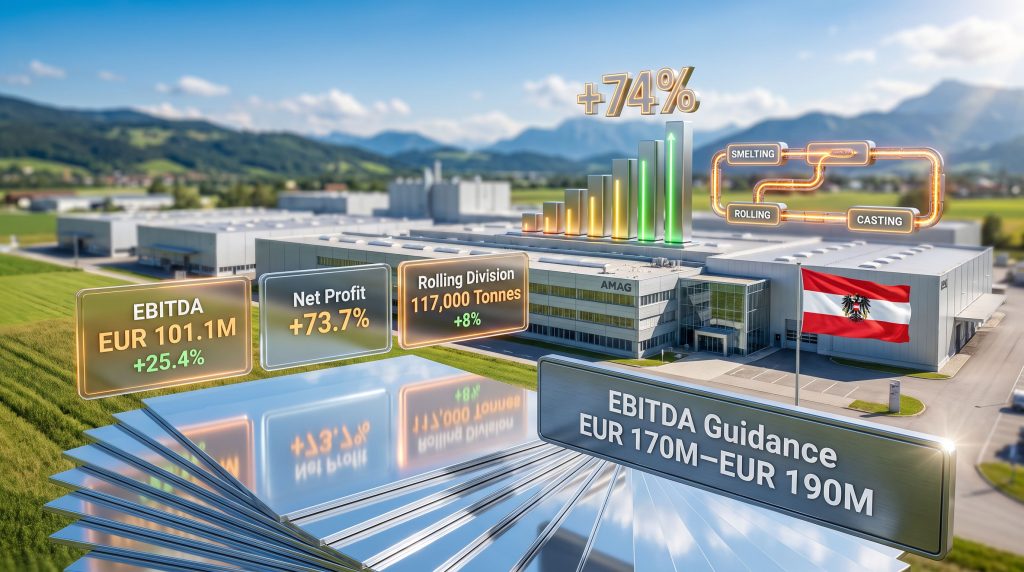
When AMAG raises EBITDA guidance after H1 profit jumps 74%, the headline figure alone does not capture the full strategic significance. To understand why this result matters beyond a single reporting period, it is worth examining the underlying mechanics that drove each financial metric. Furthermore, comparing these results against broader industrial demand trends helps contextualise the scale of AMAG's outperformance.
| Financial Metric | H1 2026 Result | Year-on-Year Change |
|---|---|---|
| Revenue | EUR 850.7M (USD 978.3M) | +8.2% |
| EBITDA | EUR 101.1M (USD 116.3M) | +25.4% |
| EBITDA Margin | 11.8% | Up from 10.2% |
| Net Income After Tax | EUR 40.7M (USD 46.8M) | +73.7% |
| Free Cash Flow | -EUR 76M (USD -87.4M) | Deteriorated vs -EUR 37M in H1 2025 |
| Net Financial Debt | EUR 186M (USD 213.9M) | Down from EUR 265M |
| Rolling Division Shipments | 117,000 tonnes | +8% |
| Group Shipments | ~220,000 tonnes | Maintained across all divisions |
The divergence between net income growth of 73.7% and revenue growth of 8.2% is the most analytically important feature of these results. Revenue growth of that magnitude reflects volume and price improvement, but it does not automatically produce profit at that rate unless margin expansion is occurring simultaneously. AMAG achieved both, with the EBITDA margin widening from 10.2% to 11.8% in a single half-year period. That combination of top-line growth and margin expansion is relatively uncommon in capital-intensive manufacturing, and it signals genuine operational leverage rather than a simple commodity price pass-through.
Three Converging Forces Behind AMAG's Earnings Acceleration
LME Pricing, Alumina Cost Dynamics, and the Widening Spread
The relationship between LME aluminium prices and alumina input costs is fundamental to understanding smelter economics. Alumina, the intermediate oxide refined from bauxite before electrolytic smelting converts it to primary aluminium, typically represents between 30% and 40% of the total cash cost of producing primary aluminium. When LME prices rise while alumina costs simultaneously decline, the margin per tonne of metal produced expands from both directions at once.
This is precisely what occurred during the first half of 2026. Favourable LME aluminium pricing, combined with softer alumina market conditions, created an unusually wide cost-price spread for smelters with access to competitively priced feedstock. AMAG's partial stake in the Canadian Alouette smelter, one of the largest aluminium smelters in the Americas, positioned the company to capture this dynamic without the energy cost burden that constrains European-based smelting operations.
The simultaneous expansion of the aluminium-alumina price spread and the record Rolling Division output created a rare condition where all three of AMAG's operating divisions contributed positively to earnings in the same half-year period, a combination that management described as a milestone for the business.
The Ranshofen Ramp-Up: Operational Leverage in Practice
Ranshofen, AMAG's primary rolling facility in Upper Austria, is the operational heart of the company's downstream business. The facility produces flat-rolled aluminium products across a wide range of gauges and alloy specifications, serving markets that include automotive body sheet, aerospace structural components, heat exchanger strip, and industrial plate. This approach mirrors the broader strategy of aluminium downstream integration that leading producers across Europe have been pursuing.
The production ramp-up at Ranshofen was a multi-year capital investment programme designed to increase annual rolling capacity and improve throughput efficiency. In H1 2026, this ramp-up reached a level of maturity that translated directly into financial results. The Rolling Division delivered 117,000 tonnes over the six-month period, an 8% increase year on year, with Q2 2026 alone producing 62,000 tonnes, a single-quarter shipment record for the division.
This is not simply a volume story. A key insight often missed in headline coverage of rolling mill operations is that throughput efficiency in aluminium rolling is non-linear. As a facility approaches optimal utilisation of its installed capacity, fixed cost absorption improves dramatically. The depreciation, maintenance, and fixed overhead that was previously spread across lower volumes now supports a larger output base, reducing cost per tonne and expanding margins even without any change in selling prices. This is the operational leverage effect, and it was a material driver of AMAG's H1 2026 margin improvement.
Product Mix Optimisation: The Hidden Margin Engine
Less visible in the headline financial metrics, but critically important to sustained profitability, is AMAG's deliberate strategy of concentrating its rolling capacity on premium-value end markets. The company has systematically increased its exposure to applications that command above-LME pricing, including:
- Automotive aluminium sheet for body-in-white and structural applications in vehicle platforms with high aluminium intensity
- Aerospace aluminium plate and sheet for airframe structural components, where material specifications are tightly controlled and switching costs for customers are high
- Heat exchanger strip for automotive thermal management and, increasingly, data centre cooling infrastructure, where demand growth has been structurally driven by hyperscale compute expansion
- Industrial plate and tread plate for general engineering applications, where AMAG competes on quality, lead time, and technical service capability
Each of these product categories carries a premium over standard-grade LME aluminium pricing. The automotive and aerospace segments in particular involve long-term qualification processes, where AMAG must be certified as an approved supplier for specific alloys and product forms before any commercial volume can flow. Once qualified, these relationships are inherently sticky, creating revenue visibility and pricing power that commodity-grade producers cannot access.
Understanding the Guidance Upgrade and What It Signals
Full-Year 2026 EBITDA Guidance: Before and After
| Guidance Parameter | Previous Range | Revised Range | Midpoint Change |
|---|---|---|---|
| Full-Year EBITDA | EUR 150M to EUR 180M | EUR 170M to EUR 190M | +EUR 15M at midpoint |
| USD Equivalent | USD 172.5M to USD 207.0M | USD 195.5M to USD 218.5M | Significant uplift |
There is an important analytical distinction between raising the ceiling of a guidance range and raising the floor. Raising the ceiling simply reflects optimism about the best-case scenario, which is relatively easy for management to justify in a positive environment. Raising the floor, however, is a more credible signal. It implies that management has sufficient confidence in the base level of earnings to commit publicly to a higher minimum outcome.
According to AMAG's official press release, AMAG moved the guidance floor from EUR 150 million to EUR 170 million, a EUR 20 million uplift in the downside protection embedded in its own forecast. That is a meaningful expression of operational conviction.
Conditions Required to Reach the Top of the Range
- Sustained LME aluminium prices at or above the average levels seen through H1 2026
- Continued productivity improvements at Ranshofen rolling mills without unplanned downtime
- Stable and uninterrupted operations at the Alouette smelter in Canada
- No material deterioration in European automotive order volumes from existing OEM customers
- Broadly stable energy costs across AMAG's European operational footprint
The Cash Flow Paradox: Profitable But Cash-Consumptive
One of the most commonly misunderstood dynamics in commodity manufacturing is the relationship between accounting profit and cash generation during periods of rising input prices. AMAG's H1 2026 results provide a textbook illustration of this phenomenon. However, understanding this paradox is essential for investors evaluating the company's balance sheet trajectory.
Why does a profitable company consume cash? When the price of aluminium rises, a producer must hold more cash in its working capital base to finance the same physical quantity of inventory. A warehouse holding 10,000 tonnes of aluminium requires more financing when aluminium trades at USD 2,800 per tonne than when it trades at USD 2,400 per tonne, even though the physical volume has not changed. This inventory valuation effect is a structural feature of commodity businesses during price upcycles.
Breaking Down the Cash Flow Gap
| Cash Flow Item | H1 2026 | H1 2025 | Change |
|---|---|---|---|
| Free Cash Flow | -EUR 76M | -EUR 37M | Deteriorated by EUR 39M |
| Operating Cash Flow | -EUR 57M | Not disclosed | Negative |
| Primary Driver | Working capital absorption from rising LME prices | Smaller working capital movement | Inventory valuation effect |
| Secondary Driver | Ranshofen ramp-up capital deployment | Lower capital phase | Transitional investment period |
Critically, AMAG's net financial debt declined from EUR 265 million to EUR 186 million year on year despite the negative free cash flow. This apparent contradiction is explained by the timing of debt repayments made from prior-period cash generation, and it confirms that the balance sheet trajectory remains improving even as short-term cash flow reflects the working capital mechanics of a price upcycle.
The company's CFO indicated in the earnings call transcript that the cash flow impact had been modelled and anticipated in advance, characterising it as a planned dynamic rather than an unexpected deterioration. This kind of pre-emptive disclosure is an important signal to investors that management has a sophisticated understanding of its own financial mechanics.
End-Market Demand: Where Volume Growth Is Actually Coming From
| End Market | Primary Demand Driver | Near-Term Outlook |
|---|---|---|
| Automotive | Aluminium-intensive platform adoption, lightweighting | Moderate; selective OEM weakness in Europe |
| Aerospace | Aircraft manufacturer production rate recovery | Improving; build rate increases underway |
| Heat Exchangers | Data centre cooling infrastructure expansion | Strong; structural growth in hyperscale segment |
| Industrial | Early-stage European manufacturing recovery | Cautious; uneven across geographies |
One of the less-discussed dynamics in AMAG's volume growth story is the role of North American supply constraints. Rolling capacity in North America has faced bottlenecks at certain specifications and gauges, creating situations where customers seeking specific product forms have been unable to source adequate supply domestically. This opened market share opportunities for European producers with the right capability profile, and AMAG's combination of technical breadth and premium qualification status positioned it to capture incremental volume without needing to compete solely on price.
The data centre heat exchanger segment deserves particular attention. The hyperscale computing expansion driven by artificial intelligence infrastructure investment has created structurally elevated demand for high-efficiency thermal management components, many of which use precision aluminium strip produced to tight dimensional and metallurgical tolerances. This is a growth segment where AMAG's technical capabilities align well with customer requirements. In addition, broader European aluminium casthouse investment trends are reinforcing downstream capacity across the continent, supporting the structural case for premium producers.
The next major ASX story will hit our subscribers first
Key Risks Facing AMAG Through the Remainder of 2026
Geopolitical and Trade Policy Exposure
- Global trade policy uncertainty, including tariff dynamics affecting aluminium flows between major trading blocs, remains a live risk for both pricing and supply chain configuration
- Currency movements, particularly the EUR/USD exchange rate, affect the translation of Alouette smelter earnings back into euros, creating revenue sensitivity that is difficult to fully hedge
- Energy price volatility in Europe represents a persistent cost risk for rolling and casting operations, even if AMAG's Canadian smelting interests provide a partial geographic offset
Consequently, the impact of US aluminium tariffs on global metal flows warrants close monitoring, as policy shifts can redirect supply chains in ways that affect European producers both positively and negatively depending on the specific product segment.
European Automotive Market Weakness
The ongoing softness in European vehicle production volumes is the most direct demand-side risk to AMAG's Rolling Division performance. European original equipment manufacturers have been managing through a complex environment of slowing electric vehicle adoption curves, competitive pressure from lower-cost Asian producers, and tepid consumer demand in several key markets. AMAG's mitigation approach involves concentrating its automotive exposure on aluminium-intensive platforms and maintaining deep, long-standing relationships with OEM customers, which provides some insulation from spot market demand swings but cannot fully offset a broad volume contraction if it materialises.
Divisional Outlook: Where H2 2026 Earnings Will Be Generated
Rolling Division
The Rolling Division enters the second half with a solid order book and the operational momentum generated by the Ranshofen ramp-up. Continued productivity improvements are expected to support volume growth, while the premium end-market mix is anticipated to maintain above-average realisations relative to LME reference pricing.
Metal Division
The Alouette smelter in Canada provides the Metal Division with a stable primary aluminium production base at competitive operating costs. Ongoing favourable alumina pricing conditions and constructive LME aluminium markets are expected to maintain strong divisional unit economics through H2 2026. This positions AMAG favourably among top aluminium producers pursuing integrated downstream strategies globally.
Casting Division
The Casting Division faces the most challenging near-term environment, with European manufacturing headwinds continuing to constrain volume growth. However, the long-term structural case for aluminium castings in vehicle electrification and platform lightweighting applications remains intact, and management anticipates gradual improvement as the European industrial cycle stabilises.
Five Strategic Insights From AMAG's H1 2026 Results
- Premium product positioning creates durable margin resilience – AMAG's concentration on aerospace, automotive, and heat exchanger applications delivered EBITDA margin expansion even in a period of macroeconomic uncertainty, demonstrating that specialisation compounds over time.
- Operational execution amplifies market tailwinds – The Ranshofen ramp-up was not simply a capacity expansion; it was a fixed-cost leverage event that magnified the earnings impact of favourable pricing conditions.
- Working capital management is the hidden discipline in commodity upcycles – Rising aluminium prices improve reported profit while simultaneously absorbing cash, a dynamic that investors must understand to correctly interpret cash flow statements in this sector.
- Integrated business models provide natural risk diversification – The combination of Canadian primary smelting, Austrian rolling, and European casting operations creates internal offsets that smooth earnings volatility across the business cycle.
- North American supply constraints are creating European market share opportunities – Structural bottlenecks in competing rolling capacity have opened volume pathways for technically qualified European producers, a dynamic that may persist beyond the near term.
Frequently Asked Questions: AMAG's H1 2026 Results
What drove the 74% increase in AMAG's net profit in H1 2026?
The net income increase reflected a convergence of higher LME aluminium prices, lower alumina input costs, record Rolling Division shipment volumes, and improved operational efficiency at Ranshofen. The simultaneous improvement across pricing, cost, and volume metrics created an unusually strong profit outcome relative to revenue growth.
Why did AMAG raise its 2026 EBITDA guidance?
Following first-half EBITDA of EUR 101.1 million that exceeded expectations, management revised its full-year 2026 forecast upward to EUR 170 million to EUR 190 million from a prior range of EUR 150 million to EUR 180 million. This is why AMAG raises EBITDA guidance after H1 profit jumps 74% — reflecting sustained momentum in rolling operations and continued favourable primary aluminium market conditions.
Why is AMAG's free cash flow negative if profits are so strong?
Negative free cash flow of -EUR 76 million resulted from working capital requirements inflated by rising aluminium prices, which increase the financing needed to hold inventory at the same physical volume. Capital deployed to support the Ranshofen ramp-up was an additional contributing factor. Management characterised this as a planned and temporary dynamic.
What is the Alouette smelter and why does it matter to AMAG?
The Alouette smelter in Sept-Iles, Quebec, is one of the largest aluminium smelters in the Americas. AMAG holds a partial ownership stake in the facility, giving it access to primary aluminium production at competitive operating costs outside Europe's high-energy-cost environment. This geographic diversification is a significant structural advantage for the company.
What are the main risks to AMAG's H2 2026 guidance?
Key risks include LME aluminium price weakness, European automotive demand softness, geopolitical and trade policy uncertainty affecting metal flows, energy cost volatility in Europe, and potential operational disruptions at either Ranshofen or the Alouette smelter.
This article is intended for informational purposes only and does not constitute financial advice. Forward-looking statements, including guidance figures and outlook commentary, involve inherent uncertainty and actual results may differ materially from forecasts. Readers should conduct their own due diligence before making any investment decisions.
Want to Spot the Next Major Mineral Discovery Before the Broader Market Does?
While AMAG's integrated model demonstrates how structural positioning amplifies returns across commodity cycles, Discovery Alert's proprietary Discovery IQ model applies the same principle to ASX mineral discoveries — instantly alerting subscribers to significant announcements the moment they hit the exchange, turning complex exploration data into actionable opportunities. Explore historic discoveries and their exceptional returns, then begin your 14-day free trial to position yourself ahead of the market.