
July 31, 2026
Deepwater Mexico at an Inflection Point: What Farm-In Deals Reveal About Offshore Capital Flows
The geology beneath Mexico's southern offshore waters has long been understood to hold world-class hydrocarbon potential. What has remained stubbornly uncertain is the commercial and regulatory architecture capable of converting that potential into production at scale. Across the past decade, the upstream investment story in Mexico has repeatedly defied prediction, with anticipated flows of international major capital failing to materialise, state production declining, and a new class of transaction structures quietly filling the gap. The farm-in deal, once considered a secondary mechanism in frontier markets, has emerged as the instrument of choice for private operators seeking calibrated exposure to Mexican offshore resources. Furthermore, understanding global commodity capital flows helps contextualise why these structured transactions have become so prevalent in deepwater Latin America.
It is within this context that the news of Talos acquires 50% stake in Repsol's Block 29 carries significance well beyond the specifics of a single transaction.
When big ASX news breaks, our subscribers know first
The Block 29 Transaction: Structure, Terms, and Strategic Logic
What the Farm-In Agreement Actually Entails
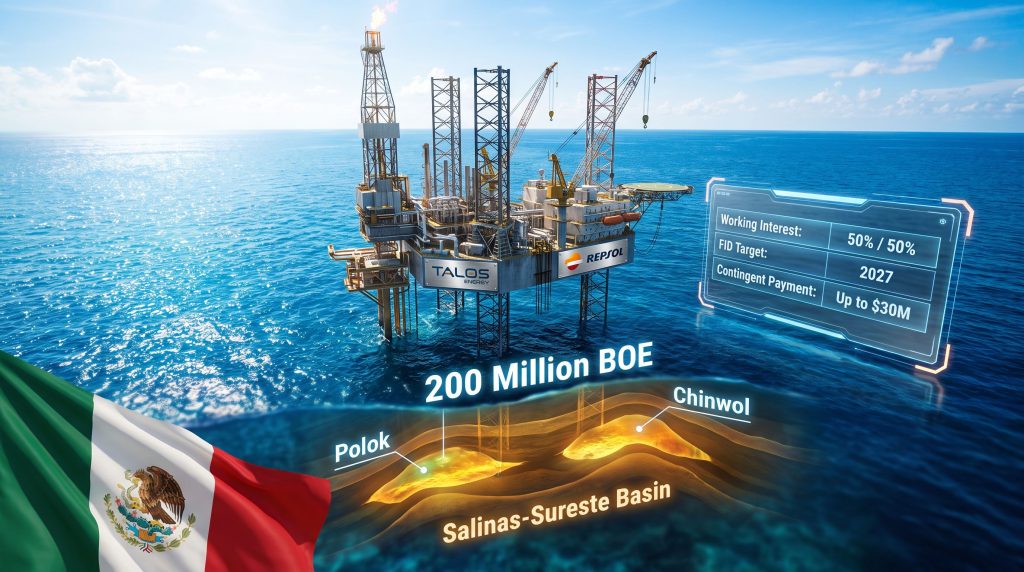
Talos Energy has executed a definitive farm-in agreement with Repsol to acquire a 50% working interest in Block 29, an offshore development block situated within the Salinas-Sureste Basin in southern Mexico. Repsol retains operatorship of the block, and upon closing, the partnership will consist solely of these two companies, each holding equal stakes. The simplified two-party structure is itself strategically significant, as it removes the coordination friction that frequently delays decision-making in multi-partner deepwater ventures.
The financial architecture of the deal reflects the risk-sharing logic central to modern farm-in transactions:
| Financial Component | Detail |
|---|---|
| Contingent Payment | Up to US$30 million, triggered upon reaching Final Investment Decision (FID) |
| Cash Carry (Exploration Phase) | Up to US$20 million toward the cost of the next exploration well |
| Pre-Closing Cost Reimbursement | Certain historical exploration expenditures reimbursed to Repsol at closing |
| Target FID Timeline | 2027 |
| Post-Close Working Interest Split | Talos 50% / Repsol 50% |
The contingent payment mechanism is particularly notable. By tying the US$30 million obligation to FID rather than deal close, Talos preserves capital flexibility through the exploration and delineation phases, only crystallising the larger payment once the commercial case for full development has been established. This structuring approach has become increasingly common in deepwater Latin America, where pre-FID attrition rates remain elevated.
The Polok and Chinwol Discoveries: What the Resource Base Looks Like
Block 29 is not a greenfield exploration play. The Polok and Chinwol discoveries, both located within the block, carry estimated gross recoverable resources exceeding 200 million barrels of oil equivalent (BOE). This positions Block 29 firmly within the upper tier of pre-development deepwater assets in the region.
The Salinas-Sureste Basin, where the block sits, is part of Mexico's southern Gulf deepwater province. This basin shares geological affinities with prolific carbonate and clastic hydrocarbon systems found elsewhere along the Gulf of Mexico margin, though its specific trap architectures and reservoir characteristics remain subjects of active delineation. The 200 million BOE estimate reflects gross recoverable resources across both discoveries, meaning the figure represents the total resource base before working interest allocations, not Talos's net entitlement share.
Resource estimates at this stage of development carry inherent uncertainty. The 200 million BOE figure represents current estimates of gross recoverable resources and should not be interpreted as a guarantee of production volumes. Actual recoveries will depend on exploration well results, reservoir quality, and development economics confirmed through the FID process.
From Farm-In Close to Final Investment Decision: The Sequencing
Step-by-Step: The Development Pathway Through 2027
Understanding how this transaction progresses from executed agreement to potential first oil requires following a structured sequence of technical and commercial milestones:
-
Regulatory Approval – Mexican upstream regulatory authorities must formally confirm the working interest transfer to Talos before the deal can close. This represents the transaction's primary near-term gating event.
-
Pre-Closing Cost Settlement – Upon deal close, Talos reimburses Repsol for certain historical exploration costs already incurred on the block.
-
Exploration Well Execution – The US$20 million cash carry funds the next exploration well, which will provide the subsurface data needed to confirm or refine the existing 200 million BOE resource estimate.
-
Resource Delineation Assessment – Partners evaluate drilling results against existing geological models, with outcomes potentially unlocking upside or requiring revised development concepts.
-
Commercial Alignment and FID – If resource confirmation supports development economics, both partners reach FID, triggering the US$30 million contingent payment.
-
Development Phase Commencement – Target commencement aligned with the 2027 FID horizon.
Why the Exploration Well Is the Critical Risk Event
The US$20 million carry for the next exploration well is more than a financing convenience. It serves as the primary risk-sharing mechanism between the two partners through the highest-uncertainty phase of the project. In deepwater Mexico, exploration wells routinely exceed US$50 to US$100 million in total cost depending on water depth, well complexity, and rig day rates. The carry therefore covers a meaningful portion of Talos's economic exposure during this phase, while Repsol's retained operatorship ensures continuity of technical management through the drilling program.
Mexico's Upstream Investment Environment: Why Farm-Ins Are Winning
The Structural Shift Since the 2013 Energy Reform
Mexico's 2013 constitutional energy reform opened the upstream sector to private participation for the first time in decades, introducing a licensing round framework and mixed contract structures intended to attract international majors alongside domestic operators. The actual investment pattern that followed has diverged substantially from those original projections.
International oil majors have largely stepped back from direct upstream licensing exposure in Mexico. In their place, a combination of domestically capitalised conglomerates acquiring minority positions in production-sharing contracts and internationally focused independents executing targeted farm-in transactions has defined the post-reform investment landscape. Consequently, commodity price sensitivity has become an increasingly important variable in how operators structure entry terms and contingent payment mechanisms. Four of the ten awarded upstream contracts under the mixed contract framework were cancelled in July, underscoring the structural revision underway in the contracting environment.
Farm-in transactions have become the preferred mechanism for private capital to access production-sharing opportunities without assuming full operational risk or the reputational exposure associated with direct licensing in Mexico's current political environment.
PEMEX's Diminishing Upstream Capacity and the Space It Creates
The broader context for private farm-in activity in Mexico cannot be separated from PEMEX's fiscal trajectory. Mexico's state oil company has faced sustained production decline, with output having dropped from peak levels above 3.3 million barrels per day in the mid-2000s to well below 2 million barrels per day in recent years. Capital allocation constraints, debt service obligations, and operational efficiency challenges have collectively limited PEMEX's capacity to develop frontier deepwater acreage at pace.
Fitch Ratings recently affirmed Mexico's BBB- sovereign credit rating while explicitly identifying PEMEX as a key risk to the fiscal outlook. This assessment reflects a structural reality: the state cannot fund the deepwater development pipeline that Mexico's resource base requires, and the capital gap is increasingly being filled through private transactions like the Block 29 farm-in.
Comparing Block 29 to the Broader Mexican Deepwater Landscape
| Comparison Dimension | Block 29 (Talos and Repsol) | Typical Mexico Deepwater Block |
|---|---|---|
| Estimated Gross Resources | 200M+ BOE | Varies: 50M to 500M BOE |
| Operator | Repsol (retained post-transaction) | Varies by license holder |
| Partnership Structure | Two-party, 50/50 | Often three to five partners |
| FID Target | 2027 | 2026 to 2030 range |
| Entry Mechanism | Farm-in | Direct license or farm-in |
| Pre-FID Resource Confirmation | Planned exploration well | Varies by block maturity |
Global Oil Market Variables and Their Impact on Block 29 Economics
The Price Floor Question for Deepwater Development
No deepwater development project exists in a macroeconomic vacuum, and Block 29's path to FID is directly sensitive to global crude price dynamics. Deepwater Mexico projects typically require sustained crude prices above a project-specific breakeven threshold to justify the capital commitments associated with subsea infrastructure, floating production systems, and long-lead procurement. These thresholds vary by project architecture but generally require multi-year price visibility rather than spot price levels.
Global crude prices fell sharply on June 27, 2026, declining below US$90 per barrel following signals that a pause in US-Iran military strikes was creating space for diplomatic negotiations. For operators assessing development timelines in deepwater Latin America, crude oil volatility trends of this nature introduce FID timing risk, particularly when the 2027 decision window is still 12 to 18 months away.
The Hormuz Variable: Geopolitical Risk and Crude Benchmarks
The situation in the Strait of Hormuz has added a layer of structural uncertainty to global crude pricing that directly affects investment confidence in projects like Block 29. On July 13, 2026, US forces resumed strikes against Iran following the collapse of a ceasefire, with the United States declaring itself the Guardian of the Hormuz Strait and reinstating a naval blockade on Iranian shipping. A 20% transit toll on all cargo shipped through the waterway was announced simultaneously but dropped less than 24 hours later on July 14, with the blockade remaining in place.
The sequence of events illustrates the speed at which geopolitical developments can move crude price benchmarks in either direction. Moreover, the broader geopolitical risk landscape facing energy investors has rarely been more complex, requiring operators to price structural uncertainty into long-horizon investment models. For a deepwater development project with a 2027 FID target and a multi-decade production horizon, this volatility matters less as a spot price concern and more as a signal of conditions that must be factored into capital planning.
Three Scenarios for Block 29 Through 2030
The transaction's ultimate significance will be determined by how the following scenarios unfold over the next several years:
Scenario A: Accelerated Development
Regulatory approval clears within six months, the exploration well delivers results confirming resource volumes above the current 200 million BOE estimate, and commercial alignment between Talos and Repsol enables FID ahead of the 2027 target. In this scenario, Block 29 becomes an early proof-of-concept for the post-reform farm-in model.
Scenario B: Base Case Execution
Approval timelines run nine to twelve months, exploration results confirm existing resource estimates without material upside surprise, and FID proceeds on schedule in 2027. The US$30 million contingent payment is triggered, and development moves into engineering and procurement phases.
Scenario C: Delayed Development
Regulatory complexity, sustained crude price weakness below project breakeven thresholds, or exploration well results requiring revised development concepts push FID beyond 2027. The contingent payment timeline extends accordingly, and project economics are reassessed under updated price deck assumptions.
The next major ASX story will hit our subscribers first
Regulatory Approval: The Near-Term Critical Path
How Mexican Upstream Permitting Works for Farm-In Transactions
The transaction's closing is conditional on approval from Mexican regulatory authorities overseeing upstream contract transfers. In Mexico's post-reform framework, working interest transfers in licensed blocks require formal regulatory confirmation that the incoming party meets technical, financial, and operational qualification thresholds established under the relevant contract terms.
Approval timelines for upstream farm-in transactions in Mexico have historically ranged from several months to over a year, depending on the regulatory load at the relevant agencies and the completeness of the documentation package submitted at filing. The Block 29 deal's relatively clean two-party structure, with no change in operatorship, may simplify the approval pathway compared to transactions involving operator changes or multiple transferees.
The Salinas-Sureste Basin has been the site of prior private sector activity, and there are precedents for farm-in approvals in this geography, which provides a degree of regulatory process familiarity for both Talos and Repsol. For further context on how oil market disruptions can affect the pace of regulatory decisions and investment commitments, the broader Latin American upstream environment offers instructive comparisons.
What This Transaction Signals for Mexico's Offshore Future
The Talos and Repsol Block 29 farm-in is not simply a bilateral asset transaction. It functions as a data point in a larger pattern of how private capital is accessing Mexico's deepwater resource base at a moment when the conventional pathways — direct licensing by international majors and PEMEX-led development — have both contracted.
The deal's financial architecture, its 50/50 two-party structure, the carry mechanism de-risking Talos's exploration phase exposure, and the contingent payment tying the larger obligation to FID rather than entry, reflects the kind of structured risk-sharing that makes deepwater investment viable when price certainty and regulatory predictability are both limited. According to the U.S. Energy Information Administration, deepwater production costs and breakeven thresholds have evolved considerably over the past decade, making structured entry mechanisms increasingly important for managing capital risk.
If Block 29 moves successfully through exploration well execution and reaches FID in 2027, it will demonstrate that the farm-in mechanism can function effectively as a template for unlocking the broader inventory of undeveloped deepwater resources in Mexican waters. The 200 million BOE resource base at Polok and Chinwol makes this particular transaction one of the more consequential tests of that proposition. Industry bodies such as the International Energy Agency have noted that structured private participation models in state-dominated upstream environments are increasingly central to meeting long-term supply targets.
Frequently Asked Questions
What is Block 29 offshore Mexico?
Block 29 is an offshore hydrocarbon block in the Salinas-Sureste Basin in southern Mexico. It contains the Polok and Chinwol discoveries, which together hold estimated gross recoverable resources exceeding 200 million BOE.
What does it mean when Talos acquires 50% stake in Repsol's Block 29?
It means Talos Energy has acquired an equal working interest in the block through a farm-in agreement, entitling it to 50% of the production economics while Repsol retains the operatorship role.
What is the difference between a working interest and operatorship?
A working interest confers the right to a proportionate share of production revenues and the obligation to fund a proportionate share of costs. Operatorship is a separate designation covering day-to-day technical and commercial management of the block, which Repsol retains entirely.
When is FID expected for Block 29?
The partners are targeting a Final Investment Decision in 2027, subject to successful exploration well results and commercial alignment.
Is this deal already closed?
No. As of the time of reporting, the transaction remains subject to Mexican regulatory approval before formal closing can occur.
What happens to the US$30 million contingent payment if FID is delayed?
The payment is triggered by FID, not by a fixed calendar date. If FID is delayed beyond 2027, the payment obligation is deferred until the decision is formally reached, assuming the project continues to advance.
Want to Stay Ahead of the Next Major Resource Discovery?
Discovery Alert's proprietary Discovery IQ model scans ASX announcements in real time, transforming complex mineral and energy data into actionable investment insights — the same kind of structural shifts driving capital into deepwater assets like Block 29 are also reshaping ASX commodity markets. Explore historic discoveries and their returns to understand the scale of opportunity, then begin your 14-day free trial to position yourself ahead of the market.