July 31, 2026
India's Steel Supercycle: Why the Next Decade Belongs to Domestic Producers
The global steel industry has spent the better part of two decades consolidating, rationalising overcapacity, and managing structurally weak margins in developed markets. Against that backdrop, emerging market producers with access to growing domestic demand pools have quietly accumulated a durable competitive advantage. India stands out as perhaps the clearest example of this divergence, and no company illustrates the asymmetry more vividly than Tata Steel, which has now committed to a Tata Steel $3.5 billion expansion in India that represents one of the largest single steelmaking investment decisions made anywhere in the world during 2026.
Understanding why this capital is flowing into eastern India, and what it reveals about the company's longer-term architecture, requires looking well beyond the headline numbers. Furthermore, contextualising this move within broader shifts in the global crude steel outlook helps explain why the timing carries strategic weight.
When big ASX news breaks, our subscribers know first
The Financial Divergence That Made the Investment Inevitable
Before examining the expansion itself, it is worth dwelling on the financial logic that made Kalinganagar Phase II not just attractive but strategically necessary. Tata Steel's Q1 FY2026 results, covering the three months through June, present a business operating in two fundamentally different realities simultaneously.
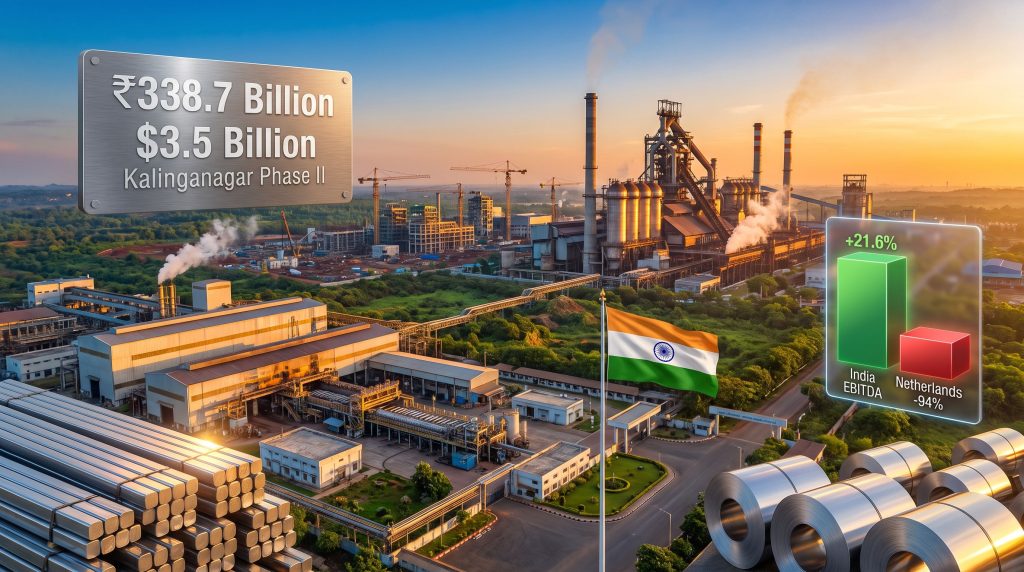
The India segment delivered EBITDA growth of 21.6%, reaching ₹191.6 billion, driven by strong domestic demand, firmer steel prices, and the compounding benefit of a three-year import tariff extension enacted in December 2024. Revenue from Indian operations climbed 19% to ₹369 billion, and domestic steel production volumes rose 11% year-on-year, even accounting for planned maintenance shutdowns at the Meramandali and Kalinganagar facilities.
The overseas picture was starkly different. The Netherlands unit saw EBITDA collapse by 94%, while UK operations continued to report operating losses. These European assets face a combination of structurally elevated energy costs, weaker regional steel demand, and an industrial cost base that is difficult to compress without significant workforce restructuring. In addition, Europe's steel action plan signals that policy intervention is increasingly needed to stabilise the continent's steelmaking base.
| Segment | Q1 FY2026 EBITDA | Direction |
|---|---|---|
| India Operations | ₹191.6 billion (+21.6%) | Strong growth |
| Netherlands Unit | Approximately -94% | Near-total collapse |
| UK Operations | Operating loss | Ongoing structural drag |
"The margin gap between Tata Steel's Indian and European operations is not a temporary dislocation. It reflects structural differences in input cost access, demand growth trajectories, and pricing power that are unlikely to reverse within the current investment cycle."
Despite these divergences, group-level net income of ₹23.2 billion ($242 million) represented 11% growth year-on-year, though it fell approximately 16% below Bloomberg analyst consensus of ₹27.6 billion. Raw material costs rising 12% to ₹202 billion, combined with Middle East-related supply chain disruptions that elevated logistics and input expenses, were the primary drag on net margins.
Total revenue still rose 14% to ₹607.9 billion, with total expenses up 13% to ₹569.4 billion, indicating that the revenue growth story remains intact even if margin compression is a near-term challenge.
CEO T.V. Narendran noted publicly that the quarter's global operating environment was characterised by heightened complexity, with Middle East developments creating more pronounced supply chain and input cost pressures than had been anticipated, while overseas operations faced additional operational disruptions on top of existing structural headwinds.
Kalinganagar Phase II: What ₹338.7 Billion Actually Buys
The board-approved capital commitment of ₹338.7 billion (approximately $3.5 billion USD) targets the Neelachal Ispat Nigam (NINL) facility at Kalinganagar in Odisha state, an asset Tata Steel acquired in 2022. The process of fully merging NINL into the Tata Steel parent structure remains ongoing as of mid-2026.
The expansion adds 4.8 million tonnes per annum (MTPA) of new steelmaking capacity, bringing the total Kalinganagar footprint to approximately 8 MTPA upon completion, up from roughly 3 MTPA prior to the Phase II program.
What the Investment Covers Across the Production Chain
The capital allocation spans the full integrated steelmaking value chain rather than targeting a single bottleneck:
- Upstream: New pellet plant capacity and coke oven battery additions to reduce dependence on external raw material suppliers and improve feedstock cost control
- Midstream: Expanded blast furnace and primary steelmaking capacity to support the higher output target
- Downstream: A cold rolling mill complex specifically oriented toward high-value branded product categories, particularly long steel products serving infrastructure and construction end-markets
The downstream component is particularly significant from a margin perspective. Integrated steelmakers that can sell branded, value-added products directly into construction and infrastructure supply chains command meaningful premiums over commodity hot-rolled coil benchmarks. This is precisely the commercial rationale T.V. Narendran has publicly articulated, describing the Kalinganagar expansion as central to the company's strategy of deepening its presence in high-margin, branded long steel product categories.
The Brownfield Advantage: Why NINL Was the Right Site
A detail that tends to be underappreciated in coverage of this expansion is the cost efficiency delivered by expanding an existing acquired brownfield site rather than developing new greenfield capacity.
At an implied cost of approximately $729 per tonne of new capacity (calculated from the $3.5 billion commitment against 4.8 MTPA of added output), Kalinganagar Phase II is broadly consistent with integrated steelmaking construction benchmarks in emerging markets. However, this figure benefits substantially from:
- Existing land, utilities, water access, and rail connectivity already embedded in the site's infrastructure base
- The 2022 NINL acquisition cost already absorbed into Tata Steel's balance sheet, meaning Phase II capex does not include site establishment costs
- Odisha's proximity to India's iron ore-rich mineral belts in the eastern part of the country, structurally reducing raw material logistics costs on a permanent basis
This brownfield logic is a critical element of the investment's return profile that headline capital figures alone do not convey.
The 2030 Roadmap: Reaching 35 to 40 MTPA Across India
Kalinganagar Phase II does not exist in isolation. It is one component of a multi-site capacity build-out that Tata Steel has publicly aligned with an ambition to reach 35 to 40 MTPA of total India steelmaking capacity by 2030, up from an estimated 21 MTPA currently. The Indian steel price outlook suggests that domestic pricing conditions remain sufficiently supportive to underpin this scale of commitment.
Multi-Site Expansion Architecture
| Facility | Location | Strategic Focus |
|---|---|---|
| Kalinganagar (NINL) | Odisha, Eastern India | Branded long products, Phase II expansion |
| Meramandali / Angul | Odisha, Eastern India | Flat products, blast furnace upgrades |
| Ludhiana | Punjab, Northern India | Electric arc furnace, scrap-based steelmaking |
The Ludhiana electric arc furnace (EAF) project deserves particular attention as an indicator of strategic foresight. Unlike blast furnace-based integrated steelmaking, EAF technology uses electrical energy and scrap steel as its primary inputs rather than coking coal and iron ore. This significantly reduces carbon dioxide emissions intensity per tonne of steel produced, positioning Tata Steel ahead of anticipated tightening in emissions-related regulatory frameworks that are expected to become increasingly relevant to Indian industrial producers over the next decade.
"The inclusion of an EAF facility in the expansion portfolio suggests Tata Steel is not simply building for current demand, but deliberately diversifying its production technology mix to remain competitive across multiple future regulatory and cost scenarios."
Reaching 35 to 40 MTPA from roughly 21 MTPA requires adding approximately 15 to 19 MTPA of new capacity within four years. Kalinganagar's 4.8 MTPA contribution addresses roughly a quarter of the lower end of that gap, meaning the pace of capital deployment at Meramandali and Ludhiana will be closely watched by analysts tracking the 2030 target's credibility.
Four Demand Engines Sustaining India's Steel Consumption Growth
The investment thesis behind the Tata Steel $3.5 billion expansion in India rests on the durability of domestic demand growth across multiple converging consumption verticals. Unlike single-sector-driven commodity cycles, India's steel demand is being generated simultaneously across four structurally distinct end-markets:
- Infrastructure: National highway expansion programs, railway network modernisation, port capacity upgrades, and urban metro system development are driving sustained demand for long steel products including rebar, wire rod, and structural sections
- Automotive: India's passenger and commercial vehicle market continues to expand, and the emerging domestic electric vehicle manufacturing supply chain is creating new demand for high-specification flat steel products including advanced high-strength steels used in battery enclosures and vehicle structures
- Real Estate and Construction: Urban population growth and housing policy programs are generating construction steel demand across both premium residential and affordable housing segments
- Defence Manufacturing: India's strategic push to indigenise defence procurement is creating a growing domestic market for specialty and alloy steels used in platforms ranging from armoured vehicles to naval vessels
The Import Tariff Shield: A Time-Bound but Significant Pricing Advantage
India's December 2024 extension of steel import tariffs for a three-year period creates a protected pricing environment for domestic producers through approximately 2027. This policy context directly improves the economics of domestic capacity investment by maintaining a price premium over landed import costs.
It is important to note, however, that this tariff protection is time-bound rather than permanent. The investment return modelling for Kalinganagar Phase II must therefore account for a scenario where tariff protection is not renewed post-2027, requiring the project to be competitive on underlying production cost grounds without the pricing premium that currently supports domestic margins.
This is precisely why the upstream raw material self-sufficiency components of the expansion, including the new pellet plant and coke oven batteries, are strategically important. Reducing input cost exposure structurally is the hedge against a potential future erosion of the tariff-supported pricing advantage. Consequently, monitoring iron ore price trends will remain critical to assessing the project's long-run cost competitiveness.
Key Risk Factors Investors Should Monitor
While the strategic rationale for this expansion is well-grounded in demand fundamentals, several risk factors could materially affect the project's financial outcomes:
- Raw material cost volatility: Iron ore and coking coal prices are globally traded commodities subject to significant cycle swings. Q1 FY2026's 12% increase in raw material costs to ₹202 billion demonstrated the direct earnings sensitivity, even in a quarter of strong revenue growth
- European operational drag: Continued losses at UK and Netherlands operations constrain group-level free cash flow and could create pressure on India capex deployment timelines if European performance deteriorates further
- NINL merger complexity: The ongoing integration of Neelachal Ispat Nigam into the Tata Steel parent structure introduces execution risk and potential regulatory complexity that could affect project timelines
- Post-2027 tariff uncertainty: If import tariff protection is not extended beyond the current three-year window, domestic steel price premiums could compress, affecting return projections for capacity that comes online near or after that date
- Geopolitical supply chain exposure: As demonstrated in Q1 FY2026, Middle East developments can create unexpected input cost and logistics pressures for Indian steelmakers operating integrated global supply chains
Furthermore, the broader competitive dynamics in the region bear watching. The China steel and iron ore market remains a key variable, given that Chinese export volumes can materially affect regional steel pricing benchmarks and, by extension, the economics of Indian domestic capacity additions. Analysts at SteelOrbis have noted that Tata Steel's capacity expansion in India is being driven by one of the most robust domestic demand outlooks in the global industry.
The next major ASX story will hit our subscribers first
Milestone Timeline: From Acquisition to 8 MTPA Capacity
| Milestone | Year | Key Detail |
|---|---|---|
| NINL Acquisition Completed | 2022 | Tata Steel acquires Neelachal Ispat Nigam through step-down subsidiary |
| Phase II Board Approval | 2026 | ₹338.7 billion expansion formally sanctioned |
| NINL Merger with Parent | Ongoing | Integration into Tata Steel structure continuing as of mid-2026 |
| Target Kalinganagar Capacity | Post-expansion | 8 MTPA total from approximately 3 MTPA pre-expansion |
| India Group Capacity Target | 2030 | 35 to 40 MTPA total |
Frequently Asked Questions
What is the Tata Steel $3.5 billion expansion in India?
It refers to a board-approved capital commitment of ₹338.7 billion (~$3.5 billion USD) to add 4.8 MTPA of new steelmaking capacity at the Kalinganagar plant in Odisha, operated through the Neelachal Ispat Nigam subsidiary acquired in 2022.
Why did Tata Steel's Q1 FY2026 profit miss analyst estimates?
Net income of ₹23.2 billion came in approximately 16% below the Bloomberg analyst consensus of ₹27.6 billion, due primarily to a 12% increase in raw material costs, a near-total collapse in Netherlands EBITDA, ongoing UK operating losses, and elevated supply chain costs linked to Middle East developments.
What will Kalinganagar's total capacity be after the expansion?
Upon completion of Phase II, total steelmaking capacity at Kalinganagar is expected to reach approximately 8 million tonnes per annum, nearly tripling the site's pre-expansion output.
What is Tata Steel's India capacity target for 2030?
The company has publicly outlined an ambition to reach 35 to 40 MTPA of total India steelmaking capacity by 2030, through simultaneous expansion programs at Kalinganagar, Meramandali/Angul, and Ludhiana.
What types of steel will the Kalinganagar expansion produce?
The expansion is strategically focused on high-margin, branded long steel products targeting India's infrastructure, construction, and defence end-markets, with a cold rolling mill complex forming the downstream anchor of the new capacity.
Disclaimer: This article contains forward-looking statements and financial projections derived from company reporting and publicly available analysis. These do not constitute investment advice. Past financial performance and management guidance are not guarantees of future outcomes. Readers should conduct independent due diligence before making any investment decisions related to Tata Steel or the Indian steel sector.
Want to Identify the Next Major Resource Discovery Before the Market Moves?
While Tata Steel's $3.5 billion expansion signals the enormous scale of demand building across India's steel and minerals supply chain, the real asymmetric opportunity for investors often lies in identifying the upstream discoveries that feed these mega-cycles early. Discovery Alert's proprietary Discovery IQ model delivers real-time ASX mineral discovery alerts, turning complex resource data into actionable insights the moment announcements hit the exchange — explore historic discovery returns to see what early positioning has meant for investors, and begin your 14-day free trial today to stay ahead of the market.