July 31, 2026
The Binding Constraint: Why Administrative Throughput Now Decides Mexico's Critical Mineral Future
Across the global race to build alternative supply chains for critical minerals, a counterintuitive truth has emerged from the data: the bottleneck is rarely geological. Orebodies of exceptional quality sit undeveloped not because capital is unavailable or technology insufficient, but because the administrative systems required to authorise extraction cannot keep pace with demand. Nowhere is this dynamic more consequential, or more measurable, than in Mexico, where SEMARNAT mining permit delays have quietly displaced orebody quality as the primary investment screening criterion for one of the world's most mineral-rich jurisdictions.
Mexico's geological credentials are not in dispute. The country ranks among the world's top 15 producers across 19 minerals, 12 of which are classified as critical by Washington. Identified development potential extends across at least 13 strategically sought minerals, including copper, graphite, fluorite, antimony, and rare earths. The problem is not what lies underground. The problem is what happens between the discovery of a deposit and the first day of legally authorised extraction.
When big ASX news breaks, our subscribers know first
The Quantified Cost of Permitting Friction
The numbers that frame Mexico's permitting challenge are not projections or estimates. They are documented outcomes from a system that has been under active remediation since late 2024.
| Metric | Data Point |
|---|---|
| Stalled projects inherited by current administration (Oct 2024) | 176 |
| Projects resolved by early 2026 (Ministry of Economy) | 110 |
| Remaining backlog (late 2025 estimate) | 66 cases |
| Industry count of stalled projects (Chihuahua Mining Conference) | ~160 |
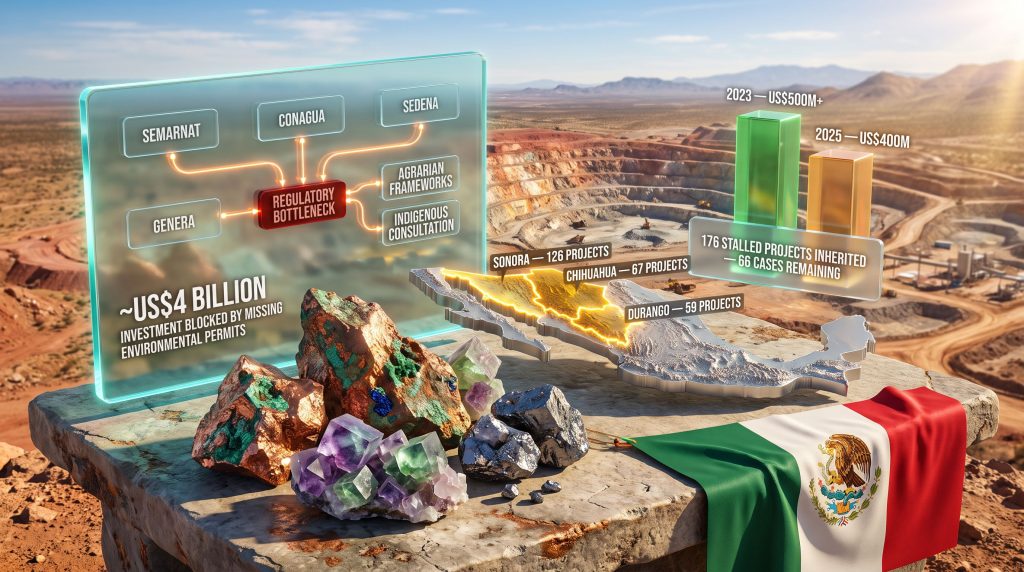
| Investment blocked by missing environmental permits | ~US$4 billion |
| Mineral exploration spending (2023) | US$500 million+ |
| Projected exploration spending (2025) | US$400 million |
| Total mining investment growth (2024) | 2.1%, reaching US$5.063 billion |
| Projects on hold across CAMIMEX portfolio | 85 of 574 tracked projects |
The decline in annual exploration spending from over US$500 million in 2023 to a projected US$400 million in 2025 is not a rounding error. It represents a deliberate capital reallocation by investors who are not waiting for reform to materialise. When total mining investment grows by only 2.1% in a year of elevated global critical mineral demand, the suppression effect of permitting friction becomes statistically visible.
Furthermore, the roughly US$4 billion in investment awaiting environmental authorisation is the most direct measure of what Mexico's permitting architecture is costing the country in real time — not potential future value, but capital already committed and currently immobilised.
CAMIMEX tracks 574 projects across 30 states, with the highest concentrations in Sonora (126 projects), Chihuahua (67 projects), and Durango (59 projects). Of those, 85 are currently on hold, split roughly evenly between exploration and production-stage assets. The geographic clustering of stalled projects in these three northern states matters because they collectively represent the backbone of Mexico's established mining infrastructure.
How Mexico's Multi-Agency Architecture Compounds Delay
Understanding why SEMARNAT mining permit delays are so persistent requires understanding the system's structural design, which distributes veto authority across multiple agencies rather than concentrating it within a single review process.
A project seeking full authorisation in Mexico must navigate at minimum five distinct approval streams:
- SEMARNAT issues the environmental impact authorisation, known as a manifestacion de impacto ambiental (MIA), without which no construction or operation can legally proceed.
- CONAGUA controls water concessions, increasingly identified as a parallel source of delay running alongside environmental review rather than after it.
- SEDENA administers explosives permits, representing a federal security clearance layer with its own processing timeline entirely independent of environmental review.
- Agrarian and land-use frameworks govern access to ejido lands and private holdings under a distinct legal regime that operates separately from public property law.
- Indigenous consultation obligations, formalised under the 2023 Federal Mining Law reform, run concurrently with the environmental impact assessment consultation process, adding a parallel procedural track.
The critical design flaw is that each of these streams carries independent suspension authority. A deficiency in any one can freeze progress across all others simultaneously. Unlike the United States, where permitting delays are primarily concentrated within a single statute administered slowly, Mexico's architecture means that resolving the SEMARNAT component does not guarantee forward momentum if CONAGUA, agrarian negotiations, or community consultation remain unresolved.
Fernando Aboitiz, Head of the Extractive Activities Coordination Unit at Mexico's Ministry of Economy, has publicly characterised the 176-project backlog inherited in October 2024 as a structural coordination failure rather than a substantive technical review problem. That framing carries practical implications: coordination failures are in principle correctable without legislative change, whereas substantive opposition to mining would require a different category of political response entirely.
SEMARNAT's Internal Capacity Constraints
Beyond the architectural design problem, SEMARNAT has faced operational constraints that have compounded processing slowdowns. Industry sources have cited staffing reductions as a contributing factor, while SEMARNAT's official position attributes delays to pandemic-era backlogs combined with elevated review standards.
What makes this particularly consequential for operators is that SEMARNAT has been applying updated water regulations and revised forestry standards to applications that were originally lodged under prior regulatory criteria. A file submitted years ago may be assessed against standards that did not exist when the application was prepared, effectively shifting the goalposts without notification.
What the 2023 Federal Mining Law Actually Changed
The 2023 reform to the Federal Mining Law introduced structural changes that extend well beyond permit processing timelines, reshaping the fundamental terms of mineral development in Mexico.
| Reform Element | Pre-2023 | Post-2023 |
|---|---|---|
| Concession term | 50 years | 30 years |
| New concession mechanism | Direct application | Public tender process |
| Environmental compliance | Advisory | Formal validity condition |
| Concession cancellation | Limited grounds | Explicit legal grounds codified |
| Indigenous consultation | Informal practice | Mandatory pre-concession requirement |
Enforcement of the new framework has been active rather than theoretical. More than 1,200 concessions were recovered in February 2026 for fiscal or reporting non-compliance, with 713 of those recovered concessions located inside protected natural areas. This enforcement activity signals that concession recovery is functioning as an active regulatory instrument, not merely a compliance backstop applied in exceptional circumstances.
The rare earths and lithium categories present a separate challenge entirely. Rare earth exploration remains fully reserved to the state, with no pathway for private or foreign participation under current legislation. Raul Garcia, President of the College of Mining Engineers, Metallurgists and Geologists of Mexico, has warned that without legislative reform, Mexico risks importing minerals it has the geological capacity to produce domestically.
The Supreme Court has upheld the 2022 lithium nationalisation, with PEMEX now pursuing extraction from oilfield brines across five states on an annual budget of approximately US$805,000 — a figure that raises substantive questions about execution capacity relative to the scale of the resource being targeted.
The combination of state reservation for rare earths and lithium alongside a permitting system that routinely delays private-sector projects in other mineral categories creates a dual constraint that geological endowment alone cannot overcome.
Mexico's Permitting Timelines in Global Context
The international comparison is instructive precisely because it reframes Mexico's challenge as a competitive positioning problem rather than simply a bureaucratic inconvenience.
| Jurisdiction | Typical Permitting Timeline | Key Structural Feature |
|---|---|---|
| Mexico | Multi-year; backlog documented | Multi-agency architecture with independent veto points |
| Chile | ~3 years (typical resolution) | More consolidated review process |
| United States | Often 10+ years under NEPA | Single statute, chronically understaffed agencies |
| G7 Target Framework | 60% supplier ceiling by 2030 | Treats extraction, processing, and transport as integrated chain |
The G7 framework agreed in June established a ceiling of 60% on any single supplier's share of members' rare earth imports by 2030. Its design explicitly treats extraction as one link in a chain that also requires processing capacity, transport infrastructure, and regulatory throughput. China currently extracts roughly 69% of global rare earths, refines more than 90% of them, controls around 85% of cathode production, and holds approximately 85% of lithium battery cell manufacturing capacity.
In addition, Beijing demonstrated its active management of this position by placing US rare earth producers under export controls within days of the G7 announcement, underscoring that supply chain competition is being managed at the state level by at least one major participant. This broader context of critical minerals energy security is reshaping how governments and investors evaluate jurisdiction risk globally.
Mexico's permitting velocity is therefore a direct input into whether the country can participate meaningfully in G7 supply chain diversification before the 2030 deadline. Countries with streamlined permitting systems are structurally better positioned to absorb the redirected investment flows that geopolitical supply chain reorientation is generating. The metals and mining geopolitics driving these shifts are creating both opportunity and urgency for jurisdictions with proven mineral endowments.
Scot Anderson, Managing Partner at Womble Bond Dickinson, who works extensively on mining permitting in North America, has articulated the principle clearly in public commentary: a six-week review would be insufficient for a serious environmental assessment, but a twenty-year process does not improve the quality of the review, it only delays the outcome. He points to Chile's three-year resolution window as a practical benchmark, arguing that a three-to-five-year review period is ample for a rigorous process. The implication for Mexico is that timeline compression and environmental rigour are not in conflict — they are separable policy variables.
The Backlog Clearance Effort: Progress and Gaps
Government and industry data on backlog resolution tell partially different stories that are worth examining in parallel rather than treating either as definitive.
The Ministry of Economy reported that 110 of the 176 inherited stalled projects had been resolved by early 2026, leaving 66 outstanding with normalisation targeted for mid-2026. Separate intersecretarial reporting indicated that 155 of 185 monitored environmental procedures had been resolved by mid-2026, representing an 83.8% resolution rate. At the International Mining Conference in Chihuahua, industry representatives put the number of stalled projects at approximately 160, with roughly 60% approved and the remainder distributed across all stages of review.
The gap between government and industry counts most likely reflects differences in project classification methodology, scope definitions, and reporting dates rather than factual contradiction. Both datasets confirm that a material backlog remains despite measurable progress.
On the institutional side, some structural groundwork is being established. Water management has been elevated within SEMARNAT under new legislation. A national forestry plan has raised the environmental commitment baseline for new applications. FIFOMI has been revived as a state financing vehicle for supply chain development, drawing documented interest from Canadian companies.
However, mining industry consolidation trends suggest that some operators are pursuing joint ventures and asset restructuring as a parallel response to permitting uncertainty, rather than waiting solely on regulatory reform. Economy Minister Marcelo Ebrard has publicly committed to compressing approval timelines and reviving large-scale exploration in 2026. Industry veterans have noted, however, that ministerial commitments to the mining sector have been reversed in prior administrations, and that institutional reform credibility requires demonstrated procedural change rather than political commitment alone.
The next major ASX story will hit our subscribers first
Operational Strategies for Navigating SEMARNAT Delays
Legal practitioners working active permitting files in Mexico have converged on a consistent set of recommendations. Joel Gonzalez, Senior Partner at ALN Abogados, has identified five pillars now organising federal mining policy that applications must demonstrably address:
- Water management documentation aligned to updated CONAGUA standards
- Forestry compliance with land-use change justification under revised national forestry requirements
- Education and community development commitments tied to the project footprint
- Project financing and economic viability with demonstrated capital structure and timeline
- Responsible protocols covering environmental, social, and governance documentation
Gonzalez has also noted that the past 18 months have produced a genuine opening for dialogue with the Ministry of Economy and SEMARNAT, and that companies arriving with documentation aligned to these pillars encounter a more receptive regulatory counterpart than companies arriving with a permit application in isolation.
Proactive Technical File Updating
Because SEMARNAT is now applying updated water and forestry standards to applications originally lodged under prior regulatory criteria, operators with aging files face a binary choice: proactively update technical annexes to reflect current standards, or wait for a formal information request that resets the review clock. The proactive path is structurally faster even though it requires immediate investment of resources, because a regulatory information request typically suspends the entire review process until a compliant response is filed.
Interdisciplinary Team Architecture
Projects that treat permitting as a single department's responsibility consistently experience stalls at the intersection of regulatory streams. Effective permitting teams integrate environmental scientists, hydrologists, agrarian law specialists, and community engagement professionals as core functions rather than support roles.
Government relations has emerged as a dedicated executive function at companies advancing large-scale projects, reflecting the relationship-intensive nature of multi-agency navigation in Mexico's current environment. The mining claims framework challenges observed in other jurisdictions reinforce that multi-stakeholder engagement is increasingly non-negotiable regardless of geography.
Community Engagement as Evidentiary Asset
The 2023 Mining Law requires Indigenous and agrarian community consultation before a concession is granted, running concurrently with the environmental impact assessment consultation process. Community support must be documented and submitted as formal evidence within the application. The volume and quality of that documentation directly influences the regulatory position a company holds with authorities reviewing the application.
Starcore's social licence agreement for the La Tortilla project in Queretaro serves as a practical template, having required navigation of agrarian law governing ejidos and agrarian communities as a distinct legal regime from public or private property. The lesson is generalisable: community engagement executed as a compliance exercise produces thin documentation, while engagement executed as an evidentiary strategy produces material that strengthens the regulatory application itself.
Fernando Aboitiz's official characterisation of the inherited backlog as a coordination failure rather than substantive opposition to mining reinforces this point. The practical implication is that individual companies can address much of their permitting risk through procedural quality rather than waiting for systemic legislative reform.
How Investors Are Pricing Mexico's Permitting Risk
The market has already adjusted its valuation framework to reflect permitting friction as a primary variable in Mexican mining asset pricing. Operators holding fully permitted assets now command what executives describe as a permit moat — a valuation premium that reflects administrative position rather than orebody quality. This represents a structural inversion of traditional mining asset valuation, where geological merit historically served as the primary determinant of project value.
The permit moat concept has direct implications for capital allocation decisions. According to detailed analysis of Mexican mining permit challenges, these dynamics are fundamentally restructuring how investors approach the sector:
- Exploration-stage assets without environmental authorisation are being discounted relative to their geological merit
- Fully permitted assets attract acquisition interest that is only partially explained by resource quality
- M&A transaction structures now price environmental and social permitting liabilities alongside geological risk
- The US$100 million annual decline in exploration spending signals that capital migration to competing jurisdictions is already occurring, not anticipated
Furthermore, the broader permitting investment landscape across Mexico continues to evolve rapidly, with industry groups closely monitoring whether backlog clearance translates into sustained capital recovery. If the backlog clearance trajectory continues and timeline compression commitments are implemented, CAMIMEX projections suggest total mining investment could reach US$7 billion once the permit pipeline normalises.
Recovery of the exploration spending gap would require sustained regulatory predictability over multiple years, not a single reform cycle. As administrative readiness becomes less scarce through genuine reform, the permit moat premium would compress, returning asset valuation to a greater dependence on geological fundamentals. It is also worth noting that trump mining permits policy shifts in the United States are adding further competitive pressure on jurisdictions like Mexico to accelerate their own regulatory modernisation.
Frequently Asked Questions: SEMARNAT Mining Permit Delays in Mexico
What is SEMARNAT and why does it control mining permits?
SEMARNAT, Mexico's federal environmental authority, issues the environmental impact authorisation that is a legal prerequisite for mining project construction and operation. Without this authorisation, no mining activity can proceed regardless of concession status, making it the single most consequential agency in the Mexican permitting chain.
Which states have the highest concentration of stalled mining projects?
CAMIMEX data identifies Sonora with 126 tracked projects, Chihuahua with 67, and Durango with 59 as the states with the highest project concentrations. These three northern states also account for a disproportionate share of the 85 projects currently on hold within CAMIMEX's 574-project portfolio.
Can foreign companies obtain mining permits in Mexico despite current delays?
Foreign companies face the same multi-agency permitting architecture as domestic operators across most mineral categories. The important exception is that rare earth exploration and lithium development remain reserved to the state under current legislation, closing those categories entirely to private and foreign participation.
What does the 2023 Federal Mining Law mean for permit applications?
The reform introduced shorter concession terms, public tender requirements for new concessions, formalised environmental and social compliance conditions, and explicit grounds for cancellation. For permit applications specifically, it means documentation requirements are more extensive and Indigenous and agrarian consultation obligations now run concurrently with the environmental impact review process.
Disclaimer: This article is intended for informational and analytical purposes only. It does not constitute financial, legal, or investment advice. Forward-looking statements, projections, and references to investment scenarios involve inherent uncertainty and should not be relied upon as predictions of future outcomes. Readers should conduct independent due diligence and seek qualified professional advice before making investment or business decisions related to the Mexican mining sector.
Want to Know Which ASX Mineral Discoveries Are Happening Right Now?
While Mexico's permitting bottlenecks reshape global critical mineral supply chains, savvy investors are already positioning themselves in jurisdictions where discoveries are being made today — Discovery Alert's proprietary Discovery IQ model scans ASX announcements in real time, instantly translating complex mineral data across 30+ commodities into actionable opportunities, just as it did for early investors in landmark discoveries like De Grey Mining and WA1 Resources. Explore historic discovery returns on Discovery Alert's dedicated discoveries page and begin your 14-day free trial to ensure you're positioned ahead of the market.