
July 31, 2026
Mexico's Mining Sector at a Crossroads: What the SEMARNAT Protected Areas Ban Means for Investors
Few forces reshape investment landscapes as decisively as regulatory discontinuity. When a government closes off entire categories of future authorisations, the ripple effects extend far beyond the immediately affected projects, touching capital allocation decisions, arbitration pipelines, and corporate strategy across an entire sector. SEMARNAT blocks mining in protected areas as Mexico's mining industry navigates precisely this kind of structural shift, as a cascade of regulatory actions, court rulings, and corporate repositioning moves redefine what is possible — and what is permanently off the table — for operators working inside one of the world's most mineral-rich countries.
When big ASX news breaks, our subscribers know first
The SEMARNAT Directive: Scope, Mechanics, and Immediate Consequences
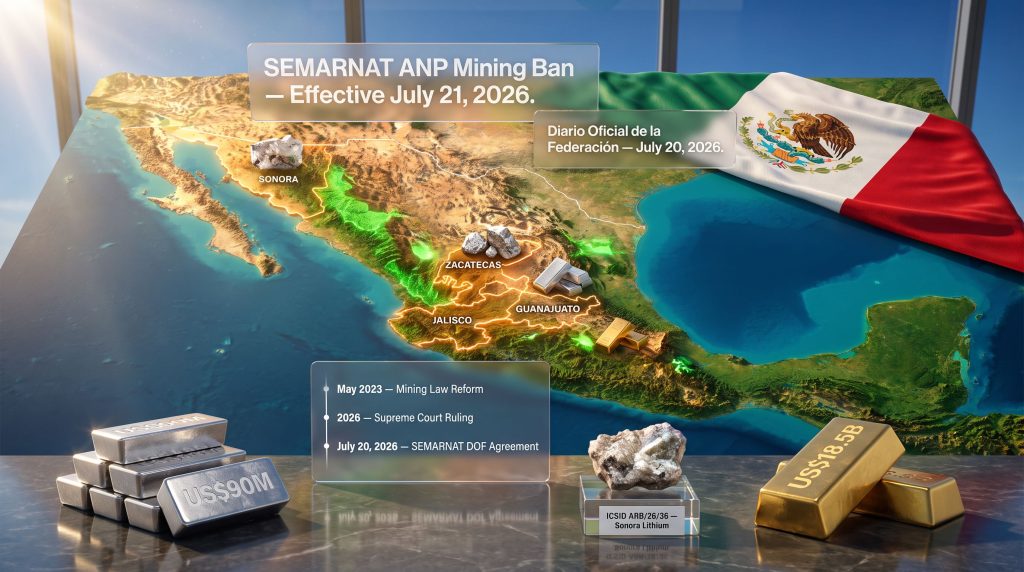
On July 20, 2026, Mexico's Secretaría de Medio Ambiente y Recursos Naturales published an agreement in the Diario Oficial de la Federación that fundamentally altered the permitting architecture for the mining sector. The directive instructs SEMARNAT officials to refuse issuance of any environmental permit, licence, registration, or authorisation related to mineral exploration, exploitation, or processing inside federally administered Áreas Naturales Protegidas (ANPs). The prohibition took effect on the next business day following publication.
The practical scope of the ban extends across five distinct authorisation categories, and critically, it also covers mining waste disposal activities in protected areas, wetlands, riverbeds, and federal water zones. This breadth signals that the directive was designed not merely to block new mine openings, but to foreclose the full lifecycle of mining activity within these zones.
One of the most consequential and least widely understood aspects of the rule is its treatment of legacy concessions. The directive applies to new environmental authorisations, meaning that concessions granted before the May 2023 mining law reform carry no immunity. A pre-reform concession holder inside an ANP cannot simply argue historical precedent to secure a new environmental permit.
SEMARNAT is also required to notify the Comisión Nacional de Áreas Naturales Protegidas (CONANP) within 15 business days regarding all pending environmental impact assessment (EIA) applications, signalling that the bureaucratic machinery is being actively realigned around the new prohibition.
Key Distinction: Existing, currently operating mines inside ANPs are not automatically ordered to close. However, any expansion of authorised works, surface areas, extraction capacities, or operational timeframes is now blocked. The directive eliminates the pathway forward, not the present position.
For investors, the no-expansion rule is arguably more damaging than an outright shutdown order in many cases. Mining projects depend on the ability to grow reserves, increase throughput, and extend mine life. Freezing those parameters at currently approved levels effectively converts a producing asset into a wasting asset with a fixed terminal date and no avenue for value extension.
The Regulatory Timeline That Led Here
The July 2026 directive did not emerge in isolation. It represents the operational culmination of a multi-year legislative and judicial process that began with the sweeping mining law reform enacted in May 2023.
| Year | Development | Significance |
|---|---|---|
| May 2023 | Mining Law Reform enacted | Introduced environmental and social restrictions on new concession issuance |
| 2023–2025 | Industry legal challenges filed | Mining sector contested constitutionality of key reform provisions |
| 2026 | Supreme Court upholds 2023 reform | Closes the primary constitutional challenge pathway for operators |
| July 20, 2026 | SEMARNAT ANP permit ban published | Translates legislative intent into operational permit-level prohibition |
The Supreme Court's 2026 decision is a pivot point that is easy to underestimate. By upholding the 2023 reform's framework, the court effectively stripped the mining sector of its most powerful legal instrument for seeking exemptions through Mexican domestic courts. Amparo proceedings and administrative reviews remain technically available, but the constitutional foundation for broad challenges has been substantially narrowed.
Furthermore, the institutional architecture of the ban is worth understanding in detail. SEMARNAT targets the environmental authorisation stage rather than the concession stage itself. This is deliberate: concession administration sits with the Ministry of Economy, while environmental permitting sits with SEMARNAT. By acting at the permit level, the regulator can block activity without formally cancelling a concession — a distinction that has significant implications for how investors assess stranded asset risk versus outright expropriation claims. These dynamics also connect to broader mining geopolitics shaping resource governance decisions globally.
Which Projects Face the Highest Exposure?
Not all mining operations in Mexico carry equal regulatory risk under the new framework. The following project categories face the most material exposure:
- Greenfield exploration projects located inside or adjacent to ANP boundaries that have not yet secured environmental authorisation
- Expansion-phase operations that require capacity increase filings to remain economically viable
- Projects with EIA applications already submitted but not yet resolved, which must now be processed under the prohibition
- Lithium, silver, and gold concessions situated in ecologically sensitive corridors, where ANP boundaries frequently overlap with mineral-bearing geological formations
- Operations planning mine life extensions, which now face hard limits on timeframe approvals
Mexico's ANP network covers a substantial portion of national territory across diverse ecosystem types, including biosphere reserves, national parks, and wildlife refuges. The geographic concentration of risk is not uniform, with certain states exhibiting particularly high overlap between ANP coverage and active mining concession density.
Investor Alert: Any company holding concessions inside ANPs without full environmental authorisation in place should be treated as carrying material regulatory risk under Mexican law as of July 2026. Pending EIA applications no longer represent a clear path to authorisation.
The Vulcan/Calica Ruling: A New Standard for Environmental Arbitration
Simultaneously with the regulatory tightening, Mexico secured a landmark legal victory that substantially strengthens its hand in future investor-state disputes. The International Centre for Settlement of Investment Disputes tribunal largely dismissed the claims filed by Vulcan Legacy LLC, a subsidiary of Vulcan Materials Company, which had sought multimillion-dollar compensation following the shutdown of its limestone extraction operations on Quintana Roo's coastline.
Mexico's Ministry of Economy characterised the outcome as a validation of the government's authority to enforce environmental regulations without incurring international arbitration liability. The significance of this framing should not be underestimated. Arbitration tribunals assess whether state action constitutes legitimate regulatory exercise or compensable expropriation, and the threshold test applied in the Vulcan case appears to have favoured environmental sovereignty arguments.
The case reveals several critical dynamics about Mexico's evolving arbitration defence strategy:
- Environmental enforcement framed as non-discriminatory and coherent policy carries substantially greater weight with tribunals than ad hoc regulatory action targeting specific investors
- The "fair and equitable treatment" standard under investment treaties does not shield investors from good-faith environmental regulation, even when enforcement results in significant economic loss
- Mexico's legal teams have developed a sophisticated playbook for demonstrating that regulatory action falls within the police powers doctrine rather than constituting indirect expropriation
Precedent Watch: The Vulcan/Calica outcome signals that international arbitration panels may be increasingly receptive to environmental sovereignty arguments when host states demonstrate a coherent, non-discriminatory regulatory framework. This raises the evidentiary bar for mining companies seeking ICSID remedies against Mexico.
Cadence Minerals vs. Mexico: Lithium Raises the Stakes
While Mexico consolidates its arbitration defence posture, a new and potentially more consequential ICSID case has formally opened. Cadence Minerals, the London-listed miner, confirmed registration of its arbitration claim as ICSID Case No. ARB/26/36, centred on the 2023 cancellation of concessions associated with the Sonora Lithium Project.
The contrast between this case and the Vulcan precedent illustrates why the geopolitical weight of the Cadence dispute is substantially higher:
| Dimension | Vulcan Materials (Resolved) | Cadence Minerals (Active) |
|---|---|---|
| Resource type | Limestone (construction aggregate) | Lithium (critical mineral) |
| Legal basis | Coastal environmental enforcement | 2023 mining law concession cancellation |
| Outcome | Largely dismissed in Mexico's favour | Pending |
| Geopolitical weight | Moderate | High, critical minerals context |
| Treaty framework | NAFTA/USMCA investment chapter | Bilateral investment treaty |
Sonora State hosts one of the largest lithium clay deposits in the world, positioning it at the intersection of energy transition demand and the resource nationalism policies embedded in the 2023 reform. Unlike the Vulcan case, which involved a commodity with limited strategic significance, the Cadence dispute directly implicates the global competition for lithium supply — a factor closely tied to critical minerals demand accelerating across the energy transition.
The outcome of the Cadence case could establish how future lithium concession disputes are adjudicated internationally, making it a reference point not just for Mexico but for other lithium-producing jurisdictions weighing similar reform frameworks. In addition, the Latin American lithium strategy pursued by neighbouring countries adds further regional context to these unfolding disputes.
The next major ASX story will hit our subscribers first
Latin America's Processing Gap: The Structural Problem Beneath the Headlines
Understanding the full investment implications of Mexico's regulatory tightening requires situating it within the broader challenge facing Latin American mineral economies. Moody's Ratings has identified downstream expansion and refining capacity as the primary pathway to higher operating margins and credit differentiation for the region's extraction sector.
The structural reality is stark: Latin America extracts a disproportionate share of the world's critical minerals but captures a comparatively small portion of the value created in processing, refining, and manufacturing those materials into battery-grade or industrial inputs. Legal and infrastructure gaps continue to constrain the development of localised critical minerals value chains across most of the region.
Mexico faces a particular version of this tension. Its stated ambition to capture more downstream value from its mineral endowment sits in complex relationship with regulatory tightening at the extraction stage. Restricting access to raw material concessions while simultaneously trying to build processing capacity creates a sequencing problem that investors are watching closely.
The competing policy objectives shaping Mexico's mining regulatory environment can be summarised as follows:
- Environmental protection of ANPs and biodiversity corridors, reflected in the July 2026 directive
- Fulfilment of energy transition commitments that require lithium, copper, and silver from domestic sources
- Attracting foreign direct investment in the mining and processing sectors
- Asserting resource sovereignty under the 2023 reform framework
- Maintaining compliance with USMCA investment protection obligations
These objectives are not inherently contradictory, but managing their interaction requires policy precision that has so far remained elusive.
Corporate Responses: Three Distinct Strategic Postures
Mexico's regulatory evolution is producing differentiated corporate responses, with major operators adopting strategies that reflect their individual asset profiles and risk tolerances.
Portfolio Rationalization: First Majestic's Exit Pattern
First Majestic Silver signed a definitive agreement on July 6, 2026, to divest its dormant San Martin silver-gold mine in Jalisco to Mexican private company Flextronics Supply and Service, S. de R.L. de C.V., for US$90 million in cash. This transaction represents the company's second major non-core asset sale in Mexico within a single year, following the June 2026 closing of its Del Toro divestiture in Zacatecas.
The pattern is instructive. Dormant asset sales at meaningful valuations suggest that First Majestic views the opportunity cost of holding non-producing Mexican assets as exceeding the speculative upside of eventual reactivation in a tightening regulatory environment. Two divestiture events in rapid succession constitute a deliberate portfolio repositioning rather than opportunistic deal-making.
Strategic Conviction: Fresnillo's Counter-Directional Bet
In direct contrast, Fresnillo plc executed a US$95.3 million purchase of 7,939,544 shares in Sinda on July 27, 2026, paying exactly the US$12 IPO price with no discount negotiated and accepting a 180-day lock-up period barring resale until late January 2027. Sinda's projects are located in Guanajuato, outside the most heavily regulated ANP corridors.
Paying full IPO price with no discount carries a specific signal: Fresnillo assessed the Guanajuato exploration opportunity as sufficiently compelling that it required no price concession to justify the commitment. The lock-up acceptance further underscores long-term conviction rather than opportunistic positioning. This stands as a meaningful data point about how sophisticated operators are distinguishing between high-risk ANP-adjacent concessions and lower-risk projects in less regulated geographic corridors.
Scale as Defence: The Equinox-Orla Consolidation
Shareholders of Equinox Gold and Orla Mining approved their US$18.5 billion combination, creating Canada's second-largest gold producer. The deal extends a pattern of accelerating mining consolidation trends among Mexico-active gold miners in 2026. In a tightening regulatory environment, scale provides diversification across jurisdictions and regulatory regimes, stronger balance sheets to absorb permitting delays, and greater legal resources for navigating arbitration proceedings. Consolidation, in this context, functions as a structural hedge against country-specific regulatory risk. Furthermore, majors and juniors partnerships represent another avenue through which companies are managing exposure in challenging permitting environments.
Three Scenarios for Mexico's Mining Sector Through 2028
The trajectory of Mexico's mining regulatory environment remains genuinely uncertain. Three plausible scenarios frame the range of outcomes:
Scenario 1: Regulatory Consolidation. The SEMARNAT blocks mining in protected areas directive holds, further restrictions follow, and Mexico's ANP network expands. Investment flows shift toward processing and downstream facilities. ICSID arbitration caseload grows as concession holders pursue international remedies.
Scenario 2: Negotiated Accommodation. Industry and government reach sector-specific agreements allowing critical minerals projects to proceed under enhanced environmental monitoring frameworks. Lithium and copper projects receive differentiated treatment. The Cadence Minerals ICSID case resolves through settlement, reducing arbitration risk signals.
Scenario 3: Judicial Reversal. New legal challenges succeed in carving out exceptions for pre-2023 concessions. SEMARNAT's directive is modified through administrative or judicial action. Investment confidence partially recovers, but regulatory uncertainty persists as a structural feature.
Strategic Takeaway: Regardless of which scenario materialises, companies operating in Mexico's mining sector should treat regulatory risk as a permanent structural feature of their operating environment, not a transitional phase that will resolve itself.
Key Developments Summary: July 2026
| Development | Effective Date | Primary Impact |
|---|---|---|
| SEMARNAT ANP permit ban | July 21, 2026 | Blocks new environmental authorisations in all federally protected areas |
| Supreme Court upholds 2023 reform | 2026 | Closes constitutional challenge pathways for mining operators |
| Vulcan/Calica ICSID dismissal | 2026 | Strengthens Mexico's arbitration defence posture |
| Cadence Minerals ICSID registration (ARB/26/36) | 2026 | Opens new front on lithium concession cancellations |
| First Majestic San Martin divestiture | July 6, 2026 | Signals portfolio rationalisation in response to permitting environment |
| Fresnillo Sinda stake acquisition | July 27, 2026 | Demonstrates selective conviction in lower-risk geographic corridors |
| Equinox-Orla merger approval | July 2026 | Accelerates sector consolidation as a regulatory risk hedge |
Disclaimer: This article is intended for informational purposes only and does not constitute financial or investment advice. All forecasts, scenario analyses, and strategic assessments involve inherent uncertainty. Investors should conduct independent due diligence before making any investment decisions related to Mexico's mining sector.
Want To Track The Next Major Mineral Discovery Before The Market Does?
While Mexico's regulatory environment reshapes capital flows and forces operators to rethink their exposure, Discovery Alert's proprietary Discovery IQ model delivers real-time alerts on significant ASX mineral discoveries — instantly translating complex data across 30-plus commodities into actionable insights for both short-term traders and long-term investors. Explore how historic discoveries have generated substantial returns on Discovery Alert's dedicated discoveries page, and begin your 14-day free trial today to position yourself ahead of the market.