July 30, 2026
The Invisible Variable Driving Gold and Silver in 2026
Precious metals markets have always been sensitive to central bank communication, but rarely has the gap between a decision and its explanation mattered as much as it does right now. When monetary policymakers choose deliberate ambiguity over clear forward guidance, the uncertainty itself becomes a pricing input. That dynamic is exactly what is playing out across gold and silver markets as of late July 2026, and understanding what the Fed hold means for gold and silver requires looking well beyond the headline rate decision.
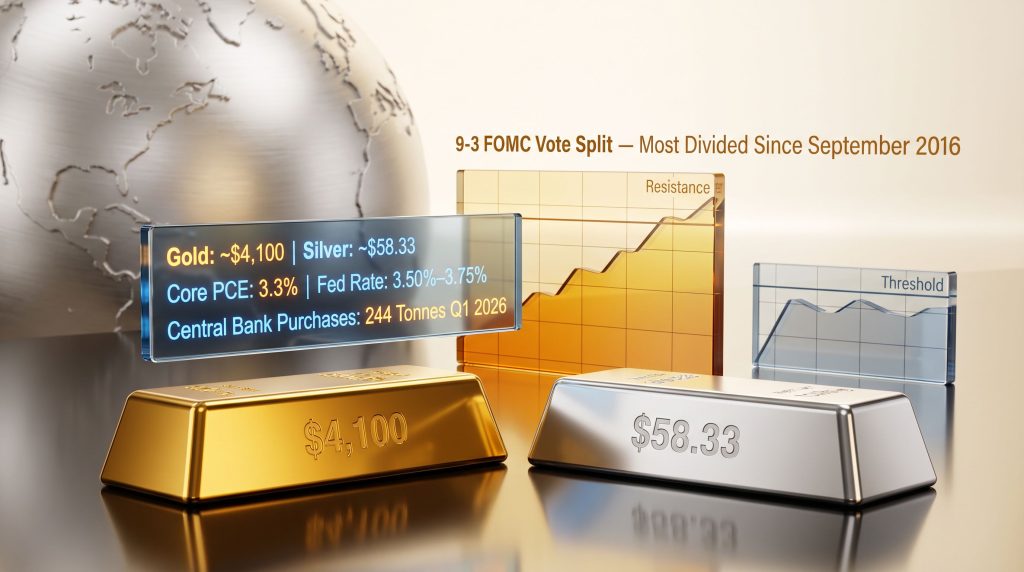
The Federal Reserve's fifth consecutive hold at 3.50%–3.75% was widely anticipated. What was not anticipated was the degree to which the accompanying communication would leave the September policy path entirely unresolved. That deliberate ambiguity has set the stage for a critical six-week window leading into the Jackson Hole Economic Symposium, with gold trading near $4,100 and silver struggling to sustain levels above $58.33.
When big ASX news breaks, our subscribers know first
How the Rate Hold Transmission Mechanism Actually Works
Opportunity Cost Is Only Half the Equation
The textbook explanation for why rate holds benefit gold centres on opportunity cost: when rates stay flat, the penalty for holding a non-yielding asset like gold does not increase. That logic is accurate but incomplete.
The more powerful variable is not the hold itself but the forward signalling that frames it. A hold delivered with hawkish language about future hikes functions almost identically to an actual rate increase in market pricing terms, because institutional capital allocates based on expected policy trajectories, not current ones. When the Fed holds but telegraphs future tightening, real yield expectations remain elevated, the dollar stays firm, and precious metals face a constrained upside.
Conversely, when the Fed holds and deliberately withholds directional commitment, a policy vacuum forms. Historically, gold tends to fill that vacuum with upward price pressure, not because the monetary environment has improved, but because the range of possible outcomes has widened. Furthermore, precious metals carry a structural premium when outcome distributions widen, as explored in detail by kinesis.money's analysis of how the fed funds rate impacts gold and silver prices.
The Real Yield Compression Dynamic
Real yields, calculated as nominal interest rates minus prevailing inflation, represent one of the most reliable leading indicators for gold price direction. When the Bureau of Economic Analysis reported June 2026 PCE inflation at 3.7% year-over-year against a Fed funds rate of 3.50%–3.75%, the implied real yield environment remained deeply compressed on an inflation-adjusted basis.
Core PCE, the Federal Reserve's preferred inflation gauge stripping out food and energy, printed at 3.3% annually for the fourth consecutive month, with a monthly gain of just 0.1% against a 0.2% consensus forecast. The Fed's stated inflation target remains 2.0%, meaning core inflation is running 130 basis points above target with no rate increase to address the gap. That structural overshoot, sustained across multiple months, is a quietly powerful tailwind for gold even in a hold environment.
RSM chief economist Joe Brusuelas assessed underlying inflation as running at approximately 3%, a level he characterised as offering no meaningful comfort to households or investors. Critically, the June headline improvement was driven almost entirely by falling energy prices, historically the most volatile and mean-reverting component of the inflation basket. Should oil prices recover partially in July, the headline PCE figure could re-accelerate, reinforcing the inflation erosion case for physical precious metals.
Why Gold and Silver Are Responding Differently
Gold's Structural Demand Floor
Understanding what the Fed hold means for gold and silver requires recognising that these two metals are not governed by the same demand architecture. Gold benefits from two independent price engines that silver cannot equally claim.
The first is monetary uncertainty, which the current policy environment supplies in abundance. The second is sovereign reserve accumulation, a structural demand layer that operates entirely outside the short-term rate cycle. Central bank gold demand has proven particularly robust, with the World Gold Council's Q1 2026 Gold Demand Trends report confirming global central banks purchased a net 244 tonnes of gold during the first quarter of 2026 alone, extending seventeen consecutive months of net buying across the global official sector.
The WGC's 2026 Central Bank Gold Reserves Survey found that 89% of central bank reserve managers expect global official gold holdings to increase over the next 12 months. These are institutions operating on decade-long mandates. Their motivation is not price appreciation in the conventional sense but rather reserve diversification, specifically the reduction of exposure to foreign-jurisdiction risk and counterparty dependencies embedded in dollar-denominated sovereign bonds. This buying does not pause because September hike odds move from 64% to 75%. It represents a structurally committed demand floor that retail and institutional traders cannot easily dislodge.
Silver's Dual-Mandate Sensitivity
Silver's dual nature as both a monetary metal and an industrial commodity means its price behaviour is governed by a fundamentally different logic. Consequently, silver requires two simultaneous catalysts to sustain a meaningful breakout: rate path clarity on the monetary side and expanding industrial demand on the commodity side.
As of July 30, 2026, silver had not opened above $60 since July 8, despite the Fed holding rates. The reason is straightforward: with September rate-hike probability sitting at approximately 64% per CME FedWatch (morning ET reading, July 30), markets are not pricing rate relief. They are pricing a credible tightening threat. That monetary ceiling constrains silver more acutely than gold because silver lacks the sovereign reserve buying floor that insulates gold from downside pressure.
Silver's industrial demand component, which spans electronics manufacturing, photovoltaic solar panel production, and electric vehicle components, introduces a second variable that can either amplify or neutralise the monetary signal. Without confirmation of industrial demand expansion, silver remains structurally capped below the psychologically significant $60 threshold.
Comparative Market Structure: Gold vs. Silver
| Metric | Gold | Silver |
|---|---|---|
| Spot Price (July 30, 2026) | ~$4,100 | ~$58.33 |
| Key Resistance Level | $4,200 | $60.00 |
| Primary Price Driver | Uncertainty premium + central bank demand | Rate path clarity + industrial demand |
| September Hike Sensitivity | Moderate | High |
| Structural Floor Mechanism | Sovereign reserve accumulation | Industrial demand baseline |
| Post-Hold Directional Bias | Range-bound bullish ($4,000–$4,200) | Constrained below $60 |
Sources: CME FedWatch; World Gold Council Q1 2026 Gold Demand Trends; BEA Personal Income and Outlays June 2026; Federal Reserve FOMC Statement July 29, 2026
The FOMC Dissent and What a 9-3 Vote Signals
Internal Fed Disagreement as a Pricing Variable
The July 29, 2026 decision to hold rates was not unanimous. Three regional Federal Reserve presidents voted to hike immediately: Cleveland's Beth Hammack, Minneapolis's Neel Kashkari, and Dallas's Lorie Logan, each citing ongoing inflation persistence as justification for immediate action. A 9-3 split represents the most internally divided FOMC decision since September 2016 and carries significant implications for precious metals that extend well beyond the headline hold.
When FOMC consensus is high, markets can construct a clear directional path and price accordingly. When consensus fractures, as it has now, markets are forced to price a distribution of possible September outcomes rather than a single trajectory. Gold's safe-haven demand benefits structurally from distributional uncertainty: the $4,000–$4,200 trading range is a direct expression of this dynamic, with the floor anchored by the current hold and the ceiling constrained by the credible threat of a September hike that three voting members already wanted to implement immediately.
Fed Chair Kevin Warsh reinforced this uncertainty by explicitly stating during the July 29 press conference that the Fed would not be constrained by market prices, a statement that removes one of the conventional anchors investors rely on to predict policy direction. When asked about his keynote speech at the August 27–29 Jackson Hole Economic Symposium in Wyoming, Warsh described his prepared remarks as uncommitted and without predetermined direction, a characterisation that moved markets immediately. Within hours, JPMorgan economists revised their rate hike timeline forward to December 2026, noting that Warsh had again declined to specify how he planned to deliver on his stated inflation resolve.
Key Insight: The practical consequence of deliberate forward guidance abandonment is that every inflation data point released between now and August 27 carries amplified market-moving weight. In that environment, gold's uncertainty premium is not a speculative overlay. It is a rational pricing response to a genuinely unresolved policy distribution.
Three Scenarios for Gold and Silver Through Jackson Hole
Scenario A: Hawkish Pivot at Jackson Hole
Trigger: Warsh uses the August 27–29 symposium to explicitly pre-commit to a September rate hike, citing core PCE persistence and the three dissenting votes as justification for accelerated action.
- Gold: Likely retreat toward the $4,000 support level as real yield expectations rise and the dollar strengthens
- Silver: Sharper downside risk, potentially testing the $55–$56 range as the dual-catalyst requirement goes unmet
- Signal to monitor: CME FedWatch September hike odds recovering above 75%
Scenario B: Continued Deliberate Ambiguity
Trigger: Warsh delivers a speech that acknowledges inflation persistence without committing to a specific September action, extending the current communication pattern.
- Gold: Consolidation within the $4,000–$4,200 band, with central bank buying providing a floor and rate uncertainty capping the ceiling
- Silver: Continued constraint below $60, with price action driven more by manufacturing and industrial data than monetary policy signals
- Signal to monitor: September hike odds remaining in the 55–70% range through mid-August
Scenario C: Dovish Surprise or Meaningful Inflation Deceleration
Trigger: July PCE or CPI data shows a genuine deceleration in core inflation, prompting a shift in Warsh's communication toward a pause rather than an acceleration in the hiking cycle.
- Gold: Potential breakout above $4,200 as real yields compress and the uncertainty premium expands beyond the current range
- Silver: The most asymmetrically positive scenario. A simultaneous reduction in monetary headwinds combined with any positive industrial demand catalyst could drive silver through $60 and toward the $65+ range
- Signal to monitor: Core PCE monthly reading falling to 0.1% or below for a second consecutive month
The Five Signals Defining the Outlook Through August 27
Investors navigating what the Fed hold means for gold and silver in practical terms should track five specific data streams over the six-week window before Jackson Hole. In addition, understanding the interplay between gold and silver central banks adds crucial context when interpreting how sovereign demand may respond to each scenario.
-
July PCE and CPI releases — The next core inflation readings will either validate the June cooling narrative or reignite the hawkish case. A re-acceleration above 0.2% monthly would reinforce the September hike probability and maintain silver's ceiling below $60.
-
CME FedWatch September hike probability — Movement above 75% would likely trigger gold selling toward $4,000. Compression below 50% would open the path toward $4,200 and above.
-
Jackson Hole speech tone — Whether the Fed chair shifts from deliberate ambiguity to explicit policy direction is the single highest-impact event in the six-week window, with the capacity to rapidly reprice both metals.
-
Central bank gold purchase data — Any acceleration or deceleration in sovereign accumulation through Q2 2026 data will recalibrate the structural demand floor assessment that currently underpins gold's $4,000 support.
-
Industrial demand signals for silver — Manufacturing PMI readings, solar installation data, and electric vehicle production figures will determine whether silver's commodity demand component can provide the second catalyst needed to sustain a move above $60.
The next major ASX story will hit our subscribers first
Key Data Summary: The Macro Backdrop as of July 30, 2026
| Indicator | Current Reading | Context |
|---|---|---|
| Gold Spot Price | ~$4,100 | Trading within $4,000–$4,200 range |
| Silver Spot Price | ~$58.33 | Below $60 since July 8, 2026 |
| Fed Funds Rate | 3.50%–3.75% | Fifth consecutive hold |
| June PCE (YoY) | 3.7% | Down from 4.1% in May |
| Core PCE (YoY) | 3.3% | At or above this level for 4 consecutive months |
| Core PCE (Monthly) | 0.1% | Below 0.2% consensus |
| Fed Inflation Target | 2.0% | 130bps above target on core basis |
| September Hike Odds | ~64% | Down from ~81% pre-FOMC (CME FedWatch) |
| FOMC Vote Split | 9-3 (hold vs. hike) | Most divided since September 2016 |
| Central Bank Gold Purchases Q1 2026 | 244 tonnes net | 17 consecutive months of net buying |
| CB Managers Expecting Higher Holdings | 89% | WGC 2026 Central Bank Gold Reserves Survey |
Sources: BEA Personal Income and Outlays June 2026; CME FedWatch July 30, 2026; World Gold Council Q1 2026 Gold Demand Trends; World Gold Council Central Bank Gold Reserves Survey 2026; Federal Reserve FOMC Statement July 29, 2026
Frequently Asked Questions
Does a Fed rate hold automatically push gold prices higher?
Not automatically. A hold removes the immediate pressure of rising opportunity costs, but directional impact on gold depends almost entirely on whether the hold is accompanied by hawkish, neutral, or dovish forward guidance. A hawkish hold where the Fed signals future hikes remain likely can be as bearish for gold as an actual rate increase, because institutional capital allocates based on expected future policy rather than current rates.
Why is silver more sensitive to Fed decisions than gold?
Silver operates under a dual-demand structure simultaneously as a monetary metal and an industrial commodity. Gold's price is governed primarily by monetary and geopolitical factors, giving it a more direct and predictable relationship with real yields and dollar strength. Silver's industrial demand component across electronics, solar panels, and electric vehicle manufacturing introduces a second variable that can either amplify or offset the monetary signal, making silver more volatile and less predictable around FOMC announcements. Furthermore, the gold-silver ratio insights available from historical data underscore just how dramatically these two metals can diverge during periods of monetary uncertainty.
What does real yield mean and why does it matter for gold?
Real yield is the return on a fixed-income investment after adjusting for inflation. When nominal interest rates are held steady but inflation remains elevated, real yields compress. Falling real yields reduce the relative attractiveness of interest-bearing assets compared to non-yielding ones like gold, which historically supports gold prices even in a rate-hold environment.
Why are central banks buying gold at these price levels?
Sovereign institutions operating on decade-long reserve mandates are not making entry-point calculations the way retail investors do. The structural motivation is reserve diversification, specifically reducing concentration risk in dollar-denominated assets and eliminating the counterparty and foreign-jurisdiction exposure inherent in sovereign bond holdings. The 244 tonnes of net central bank purchases in Q1 2026 and the 89% forward commitment rate among reserve managers represent demand that is structurally committed rather than price-sensitive.
What core PCE level would trigger a gold breakout above $4,200?
There is no single threshold, but the market's current pricing suggests a sustained move below 3.0% on a year-over-year basis combined with a second consecutive monthly reading of 0.1% or lower would materially reduce September hike probability and compress real yield expectations enough to support a breakout above $4,200. As of June 2026, core PCE has held at or above 3.3% for four consecutive months, meaning a single data point is unlikely to be sufficient without a corresponding shift in Fed communication at Jackson Hole. However, gold and silver market reactions to rate holds demonstrate how quickly sentiment can shift when inflation data surprises to the downside.
Disclaimer: This article is for informational and educational purposes only and does not constitute financial or investment advice. All references to price levels, probability estimates, and scenario projections involve inherent uncertainty and should not be relied upon as forecasts of future performance. Precious metals involve risk and may result in partial or total loss of capital. Always consult a qualified financial adviser before making investment decisions. CME FedWatch probability figures are intraday-volatile and subject to rapid change.
Want to Track the Next Major Mineral Discovery Before the Market Does?
While gold and silver navigate the Fed's deliberate ambiguity, significant ASX mineral discoveries are being announced daily — and timing is everything. Discovery Alert's proprietary Discovery IQ model delivers real-time alerts the moment high-potential discoveries hit the ASX, turning complex data across 30+ commodities into a single, actionable gold-equivalent metric. Explore historic discovery returns on Discovery Alert's dedicated discoveries page or start your 14-day free trial today to position yourself ahead of the broader market.