July 31, 2026

Mexico's Mining M&A Boom and Permitting Reforms: What the Deal Surge Is Really Telling Investors
When capital concentrates faster than it creates, the distinction matters enormously. Across commodity cycles, rising deal counts in a mining jurisdiction have historically signalled two very different things: genuine investor confidence in building new productive capacity, or a defensive scramble to secure the shrinking inventory of assets that already work. Mexico's current Mexico mining M&A boom and permitting reforms cycle belongs firmly in the second category, and understanding why requires examining the structural forces reshaping the country's mining landscape from the ground up.
When big ASX news breaks, our subscribers know first
The Regulatory Transformation That Redefined Mexican Mining
The 2023 overhaul of Mexico's Federal Mining Law did not simply raise the bar for new entrants. It restructured the entire economic life cycle of every concession in existence. The free-entry model that had defined Mexican mining origination for decades was abolished outright, replaced by competitive public tender processes with no guarantee of outcome or timeline. Maximum concession tenure dropped from 50 years to 30 years, with a single 25-year extension permitted.
Environmental and water-linked authorisations were decoupled from the concession title itself, creating separate approval layers that operate on independent bureaucratic schedules. Furthermore, the mining permits reform conversation has taken on new international dimensions as jurisdictions globally recalibrate origination frameworks.
The reform's other structural changes are equally consequential for deal-makers:
- Mandatory prior consultation with Indigenous and Afro-Mexican communities is now embedded in the approval framework, not treated as an optional downstream step
- Transfer and assignment rules require government approval, adding a new layer of transactional complexity to every deal involving a concession change of hands
- Cancellation grounds were formalised, with fiscal non-compliance and reporting failures explicitly codified as bases for revocation
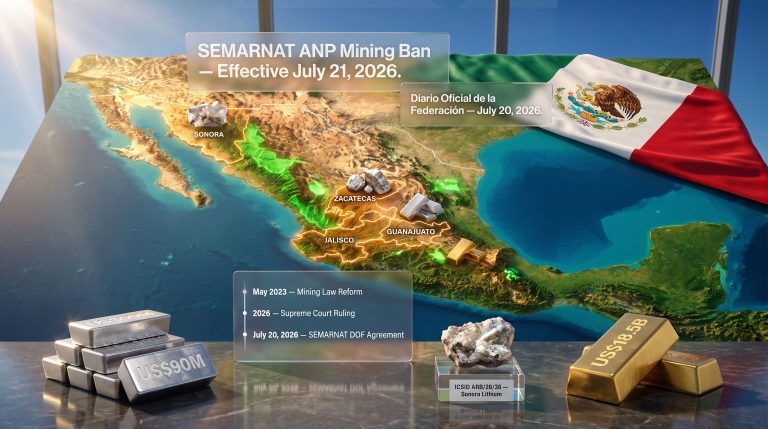
- SEMARNAT has moved to block new mining authorisations within federally protected natural areas entirely, creating a permanent exclusion zone for future origination
The critical insight that practitioners have begun to internalise is this: finite tenure converts permitted ground into a depreciating asset with a hard expiry. The clock runs from the moment of grant, regardless of whether production has commenced. That single mechanic is the engine driving the current M&A cycle.
The 1,200 Concession Recovery Event and Its Enforcement Signal
In February 2026, Mexican federal authorities recovered more than 1,200 concessions across six states, with 713 of those located inside protected natural areas. Cancellation grounds included fiscal non-compliance, reporting failures, and unauthorised operations in restricted zones. This was not an isolated administrative exercise. It reflected a sustained institutional posture toward compliance-based tenure that industry participants can no longer treat as background noise.
The practical consequence is a permanent reduction in the theoretical supply of authorised ground. Combined with SEMARNAT's exclusion of protected areas from future origination, the universe of acquirable, fully permitted Mexican mining assets is structurally smaller than it was three years ago, and shrinking further as the 30-year tenure clock advances on existing concessions.
The Permitting Backlog as a Multi-Agency Coordination Problem
Federal authorities inherited 176 stalled mining projects in October 2024, a backlog that senior officials characterised as a structural coordination failure across agencies rather than a technical review problem. Water approvals, forestry clearances, and environmental impact assessments operate on entirely separate bureaucratic timelines with no unified resolution pathway connecting them.
Partial backlog clearance began in 2025 and 2026, with an estimated US$11 billion pipeline of projects partially revived by improved permit processing velocity. Normalisation of permitting operations has been targeted for 2026. However, the systemic cause of that backlog — fragmented multi-agency architecture — has not been structurally resolved, and the risk of future accumulation remains embedded in the system.
What Is Actually Driving Mexico's Mining M&A Surge
Metals Prices as the Timing Mechanism
Gold trading above US$4,670 per ounce and silver above US$94 per ounce have created simultaneous favourable conditions for both sides of a transaction. For acquirers, elevated prices generate free cash flow at producing operations, improving debt service capacity and making larger deal structures serviceable. For sellers, the rise in in-ground asset value means that all-share deal structures stop being punitively dilutive, because the issuing company's own shares are worth proportionally more.
The observation from Chihuahua's mining directorate that production value is rising on price and exchange rate performance rather than on volume is analytically important. It means that asset revaluation is occurring across the sector without new output being created. The wealth effect is paper-based, accruing to in-ground inventories rather than to incremental production decisions.
| Metal | Price Level (2025-2026) | Deal Mechanism Activated |
|---|---|---|
| Gold | Above US$4,670/oz | Free cash flow funds acquisitions; improves acquirer debt capacity |
| Silver | Above US$94/oz | Raises in-ground target value; reduces dilution in share-based deals |
The Permit Moat: When Authorisation Becomes the Asset
Joel González, Partner at ALN Abogados, has identified verifying the status of every mineral and surface rights concession as a critical component of due diligence in major acquisitions. He has noted that assessing a project's long-term value has become materially harder since the 2023 reform replaced open-ended tenure with a 30-year concession carrying a single 25-year extension.
That assessment reflects a structural pricing shift. Practitioners in the current cycle describe the resulting dynamic as a permit moat: fully authorised projects now deliver faster economic returns than exploration-stage competitors because they skip the origination queue entirely. The valuation mechanics are specific. An asset with current environmental authorisations, current water approvals, and clean prior consultation records is scarcer than an equivalent orebody without those attributes, commanding a disproportionate premium relative to its geological characteristics alone.
Strategic Insight: Acquirers in 2025-2026 are purchasing regulatory certainty as much as they are purchasing mineral reserves. The permit is no longer just a prerequisite for mining. It is the asset itself, with a finite and depreciating tenure window that must be explicitly modelled in acquisition economics.
Mexico Within the Global Deal Context
Mexico's broader M&A market recorded aggregate deal value up 21% to US$10.91 billion in H1 2026, even as transaction volume contracted 19%. Fewer deals, larger tickets, concentrated capital. Global mining M&A reached nearly US$30 billion in the first three quarters of 2025, with Latin America capturing approximately 75% of total global mining deal value during that period.
Notable transactions illustrating the structural logic include Coeur Mining's US$1.58 billion acquisition of SilverCrest Metals and Goldgroup's arrangement with Gold Resource Corporation, both structured as all-share deals made viable by elevated metals prices and both targeting assets with existing permitting and production histories.
The Junior Financing Crisis Accelerating Consolidation
Exploration Spending Collapse and Its Consequences
Mineral exploration spending in Mexico declined from more than US$500 million in 2023 to a projected US$400 million in 2025, a contraction of approximately 20% in two years. CAMIMEX reports that 85 of 574 tracked projects are currently on hold, representing a significant share of the development pipeline in suspension.
The junior mining investment drought is not a temporary liquidity problem. It reflects a structural recalibration by capital markets away from early-stage exploration in jurisdictions perceived as having elevated regulatory uncertainty. Junior companies unable to fund drill programmes face a narrow set of options:
- Merge with a better-capitalised operator to preserve project exposure
- Sell the asset to a mid-tier producer seeking permitted ground
- Exit the jurisdiction and redeploy capital elsewhere
All three outcomes are visible in the current cycle, and all three reduce the forward inventory of new Mexican mining projects.
Three Structural Responses Shaping the Cycle
Acquisition for Immediate Cash Flow Access
Silverco Mining's acquisition of Nuevo Silver illustrates this model directly. The transaction delivered immediate access to the producing La Negra mine in Queretaro, operating at roughly 55% of capacity, converting a development-stage company into a cash-generating operator in a single step. No new productive capacity was created. Existing capacity was reattributed.
Full Market Exit
Mustang Minerals offloaded its El Cobre copper-gold project and exited Mexico entirely, representing capital permanently leaving the exploration pipeline rather than being redeployed within it. As enforcement tightened and compliance costs rose, some junior operators concluded that the risk-adjusted return from remaining in Mexico no longer justified the cost of staying current.
District Consolidation
Platauro Metals, formerly Mexican Gold Mining, spent 2025 assembling the Tatatila concessions around Las Minas in Veracruz before closing its arrangement with Alcon Silver. The logic of consolidation is operationally specific: assembling contiguous ground under single ownership reduces parallel regulatory relationships, simplifies community engagement timelines, and creates unified drill-targeting flexibility that neither party held independently.
Structural Warning: Every transaction in the current cycle transfers ownership of assets that already exist. None of these deals creates new productive capacity. The M&A boom is a symptom of origination difficulty, not evidence of renewed confidence in Mexico as a place to build new mining operations.
The Macro Disconnect: Rising Deal Value, Falling Investment
The macro context makes the interpretation of Mexico's mining M&A boom and permitting reforms more complicated, and more honest. Gross fixed investment has posted 19 consecutive months of annual declines, led by a 4.6% drop in private investment. Martín Castellano, Head of Latin America Research at the Institute of International Finance, has assessed that weak capital formation is costing Mexico at least half a percentage point of potential growth, with regulatory and institutional changes identified as the primary confidence-eroding factors.
The mining industry consolidation underway mirrors this macro dynamic in miniature, and the mining industry consolidation trends visible elsewhere reinforce that this is a global pattern accelerated by local conditions.
| Indicator | Direction | What It Measures |
|---|---|---|
| Mining M&A deal value | Rising (+21% YoY) | Attractiveness of existing Mexican assets |
| Mineral exploration spending | Falling (-20% in two years) | Willingness to create new Mexican assets |
| Gross fixed investment | Declining 19 consecutive months | Broad-based capital formation weakness |
| Private investment | Down 4.6% | Business confidence in Mexico's institutional environment |
Rising deal value measures how attractive existing Mexican assets are. It does not measure how attractive Mexico is as a destination for building something new. That distinction is the analytical core of what the current cycle is communicating.
What Has Changed in the M&A Execution Environment
Merger Control Under the National Antimonopoly Commission
COFECE, Mexico's former competition authority, was abolished in July 2025 and its powers transferred to the newly established National Antimonopoly Commission, seated under the Ministry of Economy with a reduced five-commissioner board. The institutional restructuring was accompanied by substantive rule changes with direct implications for mining transactions:
- Notification thresholds were reduced by 17%, expanding the universe of reportable transactions
- Two filing exemptions were eliminated, capturing mid-market deals that previously fell below the line
- 184 merger notifications were filed in the subsequent period, the highest in Mexican competition law history and approximately 20% above the 10-year average
- A party was fined approximately US$97,000 in Q1 2026 for failure to notify, signalling active enforcement intent
González has noted that structuring large mining acquisitions now requires navigating this additional approval layer alongside concession verification. Consequently, deal timelines in 2026 are materially longer than equivalent transactions two years prior.
The 2026 Customs Law Overhaul and Mining Diligence
Mexico's new customs law, published in November 2025 and effective January 2026, represents the most significant customs reform since 1995. Its implications for mining transactions flow directly into deal valuations and closing conditions:
- Expanded importer liability for customs compliance failures shifts exposure from brokers to the importing entity
- Mandatory electronic valuation declarations for all import and export activity create a new documentary compliance layer
- Removal of customs broker liability exemptions transfers historical exposure directly to transaction targets
- A parallel tariff decree raised duties across approximately 1,463 tariff classifications
Combined with the 2026 economic package and the SAT fiscal regularisation programme, these reforms create overlapping compliance exposures that bear directly on deal valuations, indemnity structures, and closing conditionality. Pre-2023 diligence checklists are no longer adequate for Mexican mining transactions.
The Five Contingency Categories That Surface in Mining Diligence
Practitioners advising on Mexican mining transactions consistently identify the following as the categories most likely to be priced into escrow arrangements or to affect closing conditions:
- Unpaid mining duties — arrears exceeding two years can trigger cancellation proceedings against the concession itself, converting a tax liability directly into an asset-level risk
- Restricted digital seal certificates (EFOS/EDOS status) — suppliers listed under Article 69-B of Mexico's tax code
- Missing REPSE registrations — required for specialised services contractors operating at mine sites
- Incomplete or lapsed environmental authorisations — particularly water use permits and forestry clearances that operate on independent renewal timelines
- Absent prior consultation records — documentation now required for both concession validity and transfer approval under the reformed law
The next major ASX story will hit our subscribers first
The Five Federal Policy Pillars Governing Project Advancement
Legal practitioners advising on Mexican mining transactions have identified five organising pillars of current federal mining policy that determine whether a project advances or stalls. González describes these as the framework through which regulatory counterparts evaluate project applications:
- Water — availability, usage rights, and hydrological impact assessment
- Forestry — land use change permits and vegetation impact clearances
- Education — community benefit and local workforce development commitments
- Financing — demonstration of capital adequacy and project viability
- Responsible Protocols — social impact assessment, prior consultation compliance, and environmental management plans
Projects structurally aligned to all five pillars encounter a receptive regulatory counterpart. Projects that treat any pillar as optional face extended review timelines or outright rejection. The mining claims framework in other jurisdictions offers instructive contrast, where community consultation is similarly embedded as a formal pillar rather than a downstream consideration.
Strategic Positioning for Operators, Acquirers, and Junior Companies
For Asset Holders Considering a Sale or Partnership
The most actionable insight from the current cycle is that regulatory standing has become a balance sheet item. Every unresolved permit, unpaid duty, or lapsed filing represents a direct discount applied to enterprise value at the moment of transaction. Self-auditing concession status, duty payments, digital seal standing, and supplier compliance before entering a process is structurally cheaper than negotiating indemnity provisions around issues a counterparty's advisors have already found.
Authorised ground with current environmental approvals and clean community agreements is scarcer than an equivalent orebody without those attributes. The pricing differential should be reflected in any sale or partnership process.
For Acquirers and Mid-Tier Operators
- Prioritise district consolidation as the most capital-efficient growth strategy available, assembling contiguous ground under single ownership to reduce parallel regulatory relationships and create operational flexibility
- Build interdisciplinary compliance capability before entering a transaction process, not during it. The complexity of current Mexican mining diligence exceeds what legal counsel alone can evaluate
- Model concession tenure explicitly in acquisition economics. A 30-year term with a single 25-year extension creates a finite NPV window that must be reflected in offer pricing and project scheduling. In addition, commissioning a definitive feasibility study early in the process ensures that tenure windows are properly incorporated into project economics
For Junior Operators Evaluating Strategic Options
The window for voluntary consolidation on favourable terms is open while metals prices remain elevated. Waiting for price deterioration before seeking a partner removes the primary negotiating leverage junior operators currently hold. District-level assembly of contiguous ground before approaching a larger acquirer materially improves both negotiating position and deal certainty.
Market Psychology Note: The acquirers moving decisively in 2025-2026 are not simply buying reserves. They are purchasing regulatory certainty in a jurisdiction where that certainty has become genuinely scarce. Junior operators who understand that dynamic can position their assets accordingly rather than accepting the default valuation that exploration-stage comparables would otherwise imply.
Key Data Summary: Mexico Mining M&A and Permitting at a Glance
| Metric | Value | Significance |
|---|---|---|
| Mexico M&A aggregate value H1 2026 | US$10.91 billion (+21% YoY) | Concentrated capital in fewer, larger deals |
| Transaction volume change H1 2026 | -19% | Fewer deals, higher average ticket size |
| Global mining M&A Q1-Q3 2025 | ~US$30 billion | Latin America captured ~75% of total value |
| Concessions recovered February 2026 | 1,200+ (713 in protected areas) | Active enforcement of compliance-based tenure |
| Stalled projects inherited October 2024 | 176 | Multi-agency coordination backlog |
| Estimated revived project pipeline | US$11 billion | Partial backlog clearance improving deal sentiment |
| Exploration spending 2023 | >US$500 million | Baseline before reform impact |
| Exploration spending 2025 (projected) | ~US$400 million | ~20% decline in two years |
| Projects on hold (CAMIMEX) | 85 of 574 | ~15% of tracked pipeline suspended |
| New merger notifications (post-reform) | 184 | Highest in Mexican competition law history |
| Notification threshold reduction | 17% | Expanded reportable deal universe |
| Tariff classifications affected (2026) | ~1,463 | Customs law overhaul scope |
| Private investment decline | -4.6% | Broad-based capital formation weakness |
| Consecutive months of investment decline | 19 months | Structural, not cyclical, signal |
The regulatory clarity reforms being tracked by international legal observers confirm that Mexico's permitting environment, whilst improving incrementally, remains structurally complex enough to sustain the premium placed on already-authorised assets well into the medium term. That premium is the defining feature of the current Mexico mining M&A boom and permitting reforms cycle, and it shows no sign of unwinding while the supply of fully permitted ground continues to contract.
Disclaimer: This article contains forward-looking assessments, deal analysis, and projections based on publicly available information. It does not constitute financial or investment advice. Readers should conduct their own due diligence and consult qualified advisors before making investment or business decisions related to Mexican mining assets or transactions.
Want to Capitalise on the Next Major Mineral Discovery Before the Broader Market Reacts?
While Mexico's M&A cycle rewards those who secured permitted ground early, Discovery Alert's proprietary Discovery IQ model delivers real-time alerts the moment significant ASX mineral discoveries are announced, transforming complex mineral data into actionable insights for both short-term traders and long-term investors — explore historic discovery returns to understand what early positioning can mean, then begin your 14-day free trial at Discovery Alert and secure your market-leading edge.