June 18, 2026
The Structural Flaw at the Heart of U.S. Battery Policy
For decades, energy storage policy in the United States has been built almost entirely around a single chemistry. Lithium-ion dominated the conversation, captured the incentive frameworks, and shaped the eligibility criteria of every major federal financing programme that followed. Alternative chemistries were largely left to navigate a regulatory architecture that was never designed with them in mind. That structural blind spot is now colliding with an urgent new reality, one affecting the entire battery metals landscape.
Into this landscape, the American Battery Leadership Coalition (ABLC) arrived in 2026 as the first chemistry-specific federal advocacy coalition dedicated entirely to sodium-ion battery technology. Its formation marks something more significant than a lobbying exercise. It signals that the domestic American Battery Leadership Coalition sodium-ion battery industry has reached sufficient commercial maturity to pursue coordinated industrial strategy rather than relying on individual companies to navigate policy barriers in isolation.
When big ASX news breaks, our subscribers know first
Why U.S. Battery Policy Left Sodium-Ion Without a Roadmap
The federal policy architecture governing battery storage was constructed incrementally, with each new incentive layer typically drafted in response to the dominant technology of the moment. When lithium-ion scaled rapidly through the electric vehicle sector, the tax credit frameworks, loan programme eligibility criteria, and procurement preference structures that followed were all calibrated to its specific material inputs, manufacturing processes, and performance characteristics.
The consequence for sodium-ion developers has been tangible and costly. Without explicit inclusion in federal battery investment tax credit language, without clear DOE loan programme eligibility, and without procurement frameworks that recognise alternative chemistries, sodium-ion companies have faced a policy vacuum that lithium-ion incumbents never encountered at the same stage of their development.
This is not merely a competitive disadvantage. It represents a systemic failure in industrial policy design. The U.S. battery supply chain's heavy concentration in lithium-ion technologies and its dependence on foreign-controlled supply networks creates both an economic exposure point and a geopolitical vulnerability. Furthermore, the critical minerals demand picture makes this dependence even more concerning. Alternative chemistries like sodium-ion are structurally positioned to address that vulnerability, but only if policy frameworks are updated to recognise them as distinct and strategically valuable technology categories.
The National Security Angle That Rarely Gets Discussed
The critical mineral dependency embedded in conventional lithium-ion supply chains is widely acknowledged. What receives less attention is the compounding nature of that dependency. Cobalt supply is heavily concentrated in the Democratic Republic of Congo, with processing dominated by Chinese-owned operations. Nickel supply chains run through Indonesia and the Philippines, again with significant Chinese processing involvement.
Lithium itself is geographically concentrated in a small number of countries, with refining capacity skewed heavily toward China. Sodium-ion batteries require none of these materials. Sodium is among the most abundant elements on the planet, available domestically at scale. The chemistry's complete independence from cobalt and nickel removes two of the most geopolitically sensitive critical mineral choke points in modern battery manufacturing.
From a defence industrial base perspective, this is not a minor technical footnote. It is a fundamental strategic differentiator that positions sodium-ion as a genuine national security asset.
What the American Battery Leadership Coalition Actually Is
The ABLC is organised and managed by Founders Policy Group, a Washington, D.C.-based advisory firm specialising in industrial policy. Graeme Grant, Chief Operating Officer of Massachusetts-based Alsym Energy, chairs the coalition. Edward McGlone, Vice President of Denver-based Peak Energy, serves as Vice Chair.
What distinguishes the ABLC from broader clean energy advocacy groups is its deliberate value chain architecture. Membership spans every layer of the sodium-ion ecosystem, from upstream materials producers through to downstream system integrators and long-duration storage providers. This is not accidental. A coalition that can present policymakers with a complete domestic supply chain narrative carries fundamentally different policy credibility than one representing only cell developers or only system deployers.
The ABLC's Four-Pillar Federal Policy Agenda
| Policy Pillar | Core Objective |
|---|---|
| Tax Credit Inclusion | Ensure sodium-ion qualifies explicitly under federal battery investment incentive frameworks |
| DOE Loan Programme Access | Expand eligibility under Title XVII and ATVM loan programmes to cover sodium-ion projects |
| Federal Procurement Preference | Advocate for government procurement priority for domestically manufactured sodium-ion systems |
| Trade Policy Alignment | Protect U.S. producers from subsidised foreign competition during the scale-up phase |
The tax credit pillar is particularly significant. Existing federal battery investment tax credit structures were designed around lithium-ion chemistry assumptions. Sodium-ion's distinct material inputs and manufacturing processes may not automatically satisfy current eligibility definitions without explicit regulatory clarification or statutory amendment. The ABLC's advocacy seeks to close that gap before it becomes a financing barrier at scale.
Founding Members: A Value Chain Built for Policy Credibility
The nine founding members of the ABLC collectively represent a deliberate cross-section of the domestic sodium-ion ecosystem.
| Company | Role in Ecosystem | U.S. Location |
|---|---|---|
| Alsym Energy | Large-scale sodium-ion cell development for data centres, utilities, and critical infrastructure | Massachusetts |
| Peak Energy | Grid-scale sodium-ion battery energy storage systems | California |
| Batri | Hard carbon anode materials and cell manufacturing | West Virginia (establishing) |
| ESS Tech | Long-duration energy storage systems and manufacturing | Wilsonville, Oregon |
| Ingevity | Specialty chemicals and carbon materials for battery applications | Multiple U.S. facilities |
| Mana | Fire-extinguishing sodium-ion electrolytes and battery cells | Boulder, Colorado |
| Microporous | Battery separators and related components | Multiple U.S. locations |
| NAION | Cell development, commercialisation, and gigafactory development | North America |
| Re:Build Manufacturing | Domestic industrial production scaling | Massachusetts |
Several aspects of this membership structure deserve closer examination from an industrial policy perspective.
-
Batri's West Virginia establishment directly addresses one of the most import-dependent components in conventional battery manufacturing: hard carbon anode materials. Domestic anode supply is a critical gap in the U.S. battery supply chain that the lithium-ion sector has never fully resolved.
-
Mana's fire-extinguishing electrolyte technology represents a sodium-ion innovation that directly addresses the thermal runaway concerns associated with liquid lithium electrolytes in conventional cells. This is a technically meaningful differentiation for grid-connected and critical infrastructure applications where fire risk is a primary deployment concern.
-
NAION's planned gigafactory signals that the coalition is not purely an advocacy vehicle. It represents active industrial capacity development in parallel with policy engagement, which significantly strengthens its credibility with federal agencies evaluating commercial readiness.
-
Microporous's U.S.-based separator manufacturing fills a component category that has been almost entirely ceded to foreign suppliers in the lithium-ion supply chain, making its inclusion strategically important for domestic content narratives.
The Technical Case for Policy Priority
Understanding why sodium-ion warrants dedicated policy attention requires a clear-eyed comparison with the incumbent technology it seeks to complement.
| Characteristic | Lithium-Ion (NMC) | Sodium-Ion |
|---|---|---|
| Primary Active Material | Lithium (geographically concentrated) | Sodium (globally abundant) |
| Critical Minerals Required | Lithium, Cobalt, Nickel | None of the above |
| Thermal Runaway Risk | Higher (volatile liquid electrolytes) | Lower (more thermally stable chemistry) |
| Projected Cost at Scale | Higher (driven by critical mineral pricing) | Lower at commercial manufacturing scale |
| Domestic Material Availability | Limited U.S. processing capacity | Strong domestic resource base potential |
| Fire Safety Profile | Documented grid-scale fire incidents on record | Improved inherent safety characteristics |
One frequently overlooked technical nuance is the cathode chemistry landscape within sodium-ion itself. Unlike lithium-ion, which is dominated by a small number of established cathode chemistries, sodium-ion development is pursuing multiple cathode pathways simultaneously, including layered oxide cathodes, Prussian white frameworks, and NASICON-type structures. Each carries different energy density, cycle life, and manufacturing scalability profiles.
This diversity is both a strength and a commercialisation challenge. It expands the addressable application space but complicates standardisation efforts that would benefit from coordinated policy support. In addition, the global lithium market context reinforces why sodium-ion's mineral independence is so strategically compelling.
The Data Centre Demand Catalyst
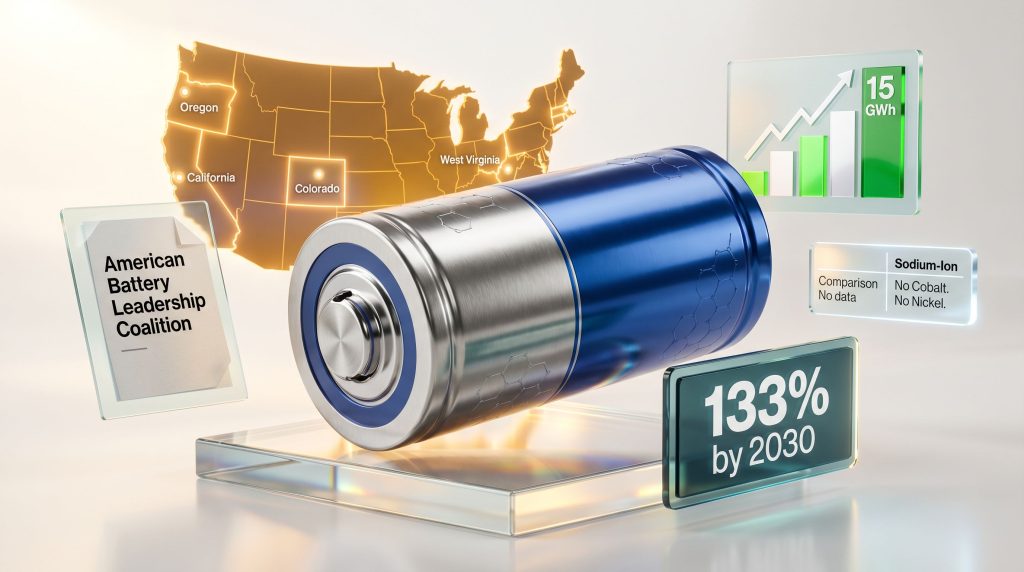
The urgency behind the ABLC's formation cannot be separated from one of the most significant structural shifts in U.S. electricity demand in a generation. According to International Energy Agency estimates, U.S. data centres consumed 183 TWh of electricity in 2024. Pew Research Centre analysis projects that figure to grow by 133% by 2030, making data centre load growth one of the fastest-expanding electricity demand segments in the domestic economy.
Grid-scale energy storage requirements scale in direct proportion to this load growth, as utilities and grid operators require dispatchable storage capacity to manage increasingly non-uniform demand patterns. Sodium-ion's cost trajectory at scale, combined with its improved safety profile, positions it as a technically and economically competitive option for this application specifically.
The domestic sodium-ion sector had already reached a point in 2026 where developers, utilities, data centre operators, system integrators, and other end users had announced procurement plans totalling more than 15 GWh of sodium-ion energy storage capacity in the United States, according to ABLC Chair Graeme Grant. That figure illustrates that commercial demand is forming ahead of domestic supply capacity, creating a genuine urgency for the policy interventions the coalition is seeking.
The Competitive Threat the ABLC Was Formed to Counter
China's acceleration into sodium-ion commercialisation represents one of the most significant near-term competitive threats to the domestic U.S. industry. Major Chinese battery manufacturers have moved aggressively from R&D into scaled production of sodium-ion cells, with shipment volumes growing rapidly in domestic Chinese markets. The trajectory now observable in sodium-ion mirrors the pattern seen with lithium-ion. Furthermore, China battery recycling infrastructure is similarly maturing in parallel, reinforcing China's end-to-end battery dominance.
U.S. producers currently lack a comparable domestic manufacturing base at scale. Without proactive trade policy measures, domestic sodium-ion companies face the risk of being undercut on cost before they achieve the manufacturing volumes necessary to reach cost parity. This is precisely the dynamic the ABLC's trade policy pillar is designed to address, mirroring the policy interventions used to protect other emerging domestic clean energy manufacturing sectors during their scale-up phases.
The broader competitive context was underscored in June 2026 when the U.S. Department of Defence moved to restrict trade with several prominent Chinese battery and clean energy manufacturers, including CATL and BYD, effective from 2027. That regulatory development independently validates the strategic logic behind the ABLC's trade policy advocacy, even though it was not a direct product of the coalition's work.
Automotive Industry Validation
Two developments in early 2026 provided significant external validation for the sodium-ion investment thesis. General Motors announced in June 2026 a sodium-ion research and development programme alongside its entry into the grid-scale battery energy storage market. Ford Motor Company had earlier in 2026 announced its decision to repurpose electric vehicle manufacturing capacity for battery energy storage system production.
Both moves indicate that legacy industrial manufacturers with deep supply chain expertise and substantial political capital are taking sodium-ion seriously as a commercial opportunity. The American Battery Leadership Coalition has been quick to note how this automotive validation strengthens the coalition's federal policy credibility. Automotive manufacturers bring established relationships with federal procurement agencies and the organisational scale to participate meaningfully in regulatory comment processes that individual sodium-ion startups cannot match alone.
The next major ASX story will hit our subscribers first
Challenges the Coalition Must Confront Honestly
Policy advocacy without commercial credibility is fragile. The ABLC faces three structural challenges that will determine whether its federal policy agenda translates into durable industrial outcomes.
-
Technology maturity gap: Sodium-ion remains at an earlier commercialisation stage than lithium-ion, with a smaller pool of deployed projects and limited long-term operational performance data. Bankability, which requires demonstrable cycle life, warranty coverage, and insurance underwriting support, remains an open question for many applications.
-
Crowded policy environment: The ABLC must differentiate sodium-ion's policy case from a broader energy storage advocacy ecosystem that includes flow batteries, iron-air systems, second-life lithium-ion applications, and long-duration storage technologies. Policymakers face competing claims from multiple technology advocates, each with legitimate arguments.
-
Timing misalignment: Federal policy windows, particularly around tax credit reauthorisation and appropriations cycles, operate on timelines that may not align with the manufacturing readiness of coalition members. The coalition must balance near-term policy positioning with the realistic reality that several members are still establishing commercial-scale U.S. production.
These challenges are not disqualifying. They are navigable with a credible strategy. However, they require the ABLC to be as rigorous in its commercial evidence base as it is in its policy positioning if it is to secure durable federal support rather than temporary political attention.
What the ABLC's Formation Signals for Investors and Industry Observers
The establishment of a chemistry-specific, full-value-chain policy coalition is a recognised inflection point in the development trajectory of emerging technology industries. It typically signals that the sector has moved beyond the proof-of-concept phase and into the early commercial scaling phase, where policy barriers rather than fundamental technology limitations become the primary constraint on growth. Consequently, Australia's own critical minerals strategy is increasingly relevant to how allied nations position themselves around these same supply chain opportunities.
For investors and industry participants, several signals from the ABLC's formation are worth monitoring closely:
-
The 15 GWh procurement pipeline is a demand-side signal that the market is moving, regardless of policy outcomes. Policy success would accelerate that trajectory; policy failure would not necessarily eliminate it.
-
The value chain completeness of founding membership, including anode materials, separators, electrolytes, cells, and systems, suggests the coalition is building toward a domestic content narrative that would strengthen both procurement preference and trade protection arguments.
-
The coalition's planned membership expansion across additional value chain segments, including cathode materials, recycling, and grid software, will serve as an indicator of whether the broader industry is rallying around a unified strategy or remaining fragmented.
-
The automotive sector's entry into sodium-ion and stationary storage creates a powerful new set of political allies for the coalition's federal advocacy, with implications that extend beyond the ABLC's current membership.
Furthermore, Alsym Energy's published analysis of the case for American battery leadership provides additional technical context for understanding why the American Battery Leadership Coalition sodium-ion battery industry views this moment as strategically decisive.
Disclaimer: This article is intended for informational purposes only and does not constitute financial advice. Forward-looking projections regarding energy demand, manufacturing scale-up timelines, and policy outcomes are inherently uncertain and should not be relied upon as the basis for investment decisions. Readers should conduct independent research and consult qualified financial advisers before making investment decisions.
Want to Track the Next Major Battery Metals Discovery Before the Market Does?
Discovery Alert's proprietary Discovery IQ model scans ASX announcements in real time, instantly identifying significant mineral discoveries across the battery metals and critical minerals sector — including the commodities driving the sodium-ion and broader energy storage revolution — so subscribers can act on opportunities ahead of the broader market. Explore historic discoveries and their returns to understand what early positioning can mean, then begin your 14-day free trial at Discovery Alert to gain a genuine market-leading edge.