June 18, 2026
The Battery Chemistry Reshaping Global Mineral Trade
The global transition to lithium iron phosphate battery technology has quietly exposed one of the most consequential supply chain blind spots in the clean energy economy: the near-total concentration of battery-grade phosphate production within a handful of non-G7 jurisdictions. Unlike the better-publicised scramble for lithium and cobalt, the phosphate precursor gap has received comparatively little attention from mainstream investors, even as LFP battery chemistry has moved from a niche format to the dominant choice in stationary storage and commercial electric vehicles.
This structural vulnerability is now attracting coordinated multilateral capital in ways that would have been difficult to imagine even three years ago. The formalisation of First Phosphate Quebec offtake deals at G7 Summit proceedings in Évian, France during June 2026 represents a concrete expression of that capital coordination, and it carries implications that extend well beyond a single junior mining company.
When big ASX news breaks, our subscribers know first
Why Igneous Phosphate Is Not the Same as Conventional Rock Phosphate
Most investors and even many mining professionals encounter phosphate primarily through the lens of sedimentary deposits, which account for the overwhelming majority of global production. Morocco's OCP Group, the world's largest phosphate producer, draws from vast sedimentary reserves. So do major operations across Jordan, Egypt, and China. Sedimentary phosphate forms through the slow accumulation of marine organic material over geological timescales, producing deposits that are typically large but mineralogically complex, often containing elevated levels of cadmium, uranium, and other trace contaminants.
Igneous phosphate is geologically distinct. It forms through magmatic processes, crystallising from cooling molten rock rather than sedimentary accumulation. This origin produces phosphate minerals, primarily apatite, with a different impurity profile. The lower baseline contamination in igneous sources is commercially significant because the battery precursor supply chain requires exceptionally high purity thresholds. Downstream LFP cathode manufacturers operate with tight tolerances on impurities that can degrade electrochemical performance, and the cost of purification scales with the contamination burden in the feedstock.
Battery-grade phosphoric acid derived from igneous rock sources is considered by LFP battery manufacturers to deliver superior purity profiles compared to conventional sedimentary phosphate feedstocks, a distinction that underpins the commercial logic of the Bégin-Lamarche development pathway.
This is not simply a marketing distinction. The mineralogical difference between igneous and sedimentary phosphate feedstocks has genuine downstream processing implications, and it is one reason why igneous deposits capable of supporting battery-grade acid production are described internally by industry participants as rarer than their sedimentary counterparts.
Bégin-Lamarche: A Resource Profile Built for Bankability
What the Deposit Numbers Actually Mean
The Bégin-Lamarche resource in Quebec's Saguenay-Lac-Saint-Jean region holds 41.5 million indicated pit-constrained tonnes grading 6.49% P₂O₅ alongside 214 million inferred pit-constrained tonnes at 6.01% P₂O₅. For investors less familiar with resource geology, the pit-constrained classification is a critical detail. It means the resource estimate has been filtered through a conceptual open-pit shell, confirming that the material is economically extractable under realistic mining parameters rather than simply present in the ground.
| Resource Category | Tonnes | Grade (P₂O₅) |
|---|---|---|
| Indicated (pit-constrained) | 41.5 million tonnes | 6.49% |
| Inferred (pit-constrained) | 214 million tonnes | 6.01% |
The 214 million inferred tonne figure is particularly significant for long-term offtake structuring. Offtake counterparties signing minimum annual volume commitments of 200,000 tonnes of phosphate concentrate need confidence in multi-decade mine life, and a deposit with this scale of inferred resource provides the geological foundation for that confidence, contingent on eventual resource conversion through further drilling.
The Two-Stage Value Chain: Mine to Battery Precursor
The commercial architecture First Phosphate has assembled operates across two distinct processing stages:
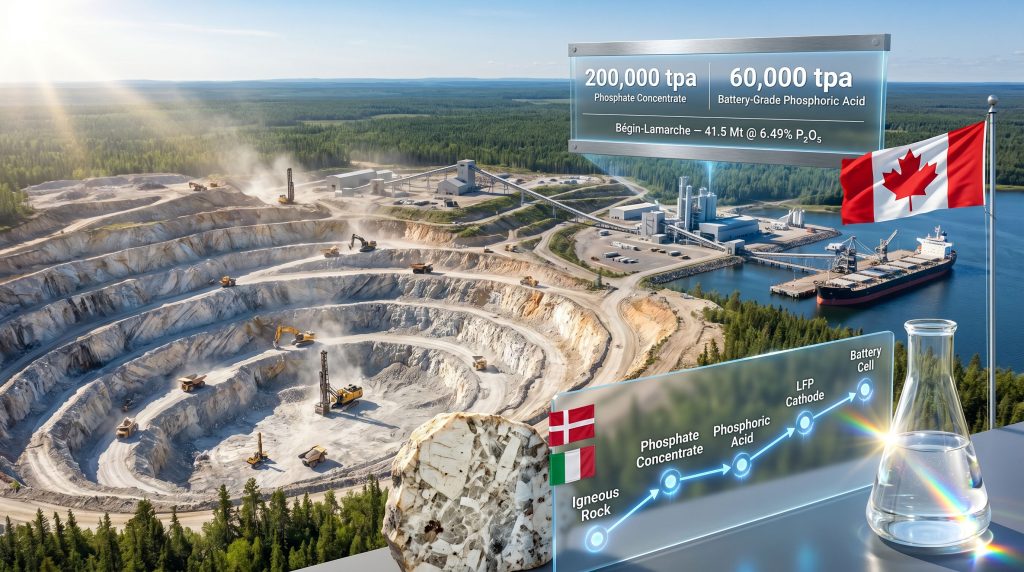
- Bégin-Lamarche mine: Open-pit extraction and concentration of igneous phosphate rock into phosphate concentrate, targeting a minimum of 200,000 tonnes per annum under the definitive offtake agreement.
- Port Saguenay processing plant: Conversion of phosphate concentrate into battery-grade phosphoric acid using Ballestra technology, targeting a minimum of 60,000 tonnes per annum of acid under a separate definitive offtake agreement.
Port Saguenay offers logistical advantages that are not incidental to the project's economics. The site combines deep-water port access with proximity to Quebec's hydroelectric grid, a combination that addresses two of the most significant cost variables in energy-intensive phosphoric acid production: shipping costs and electricity pricing. Quebec's industrial electricity tariffs, derived from its extensive hydroelectric capacity, are among the most competitive in North America for energy-intensive processing operations.
Ballestra, the Italian engineering group whose technology is specified for the Port Saguenay plant, is a well-established name in phosphoric acid processing. Furthermore, the company's wet-process acid technology has been deployed at commercial scale across multiple jurisdictions, providing a level of technical risk mitigation that greenfield processing projects often lack.
The G7 Summit Deal Architecture: Definitive Agreements vs. Letters of Intent
Understanding the Legal Distinction That Matters for Project Finance
A critical distinction within the First Phosphate Quebec offtake deals at G7 Summit announcements is the difference between the two definitive offtake agreements and the five letters of intent from European institutional partners. These are legally and commercially different instruments, and conflating them misrepresents the project's financing maturity.
The definitive offtake agreements are binding commercial commitments establishing minimum annual supply obligations. Both the concentrate offtake (200,000 tpa) and the phosphoric acid offtake (60,000 tpa) fall into this category. The counterparties to these agreements have not been publicly disclosed, which is standard practice in critical minerals supply chain structuring where commercial sensitivity around pricing and volume terms is high.
The letters of intent represent expressions of institutional interest subject to further due diligence, credit assessment, and formal agreement execution. The five LOI partners are:
| Institution | Country | Role |
|---|---|---|
| Export and Investment Fund of Denmark (EIFO) | Denmark | Guarantee support up to C$275 million (~US$195M) for Bégin-Lamarche |
| SACE | Italy | Export credit agency support for Port Saguenay plant |
| Cassa Depositi e Prestiti (CDP) | Italy | National promotional institution financing |
| SIMEST | Italy | International growth capital deployment |
| MAIRE Engineering Group | Italy | Technical and engineering partnership |
The convergence of Danish guarantee capital and multiple Italian industrial financing entities under a single G7 Alliance framework reflects a coordinated European approach to securing non-Chinese phosphate supply for the continent's LFP battery manufacturing buildout.
The EIFO commitment is the most quantified at up to C$275 million (approximately US$195 million) in guarantee support. Nordic export credit agencies have a well-established track record in resource project guarantees across allied jurisdictions, typically requiring comprehensive technical, environmental, and commercial due diligence before converting LOIs into binding guarantee instruments. That conversion process represents the next critical execution milestone for the Bégin-Lamarche development timeline. Understanding these project finance milestones is essential for assessing the true pace of development.
The Critical Minerals Resilience and Production Alliance as Deal Infrastructure
The G7 Critical Minerals Resilience and Production Alliance provides the institutional scaffolding that made this deal cluster possible. Unlike bilateral trade agreements, the Alliance creates a multilateral framework through which export credit agencies and national promotional institutions from multiple G7 member nations can coordinate investment into critical minerals projects within allied jurisdictions.
This framework matters because it resolves a coordination problem that has historically slowed allied capital deployment into critical minerals. Without a common institutional umbrella, each potential financing partner would need to independently conduct country-level due diligence, negotiate bilateral arrangements, and assess political risk. The Alliance pre-establishes the trust architecture, consequently accelerating deal flow.
Canada's Minister of Energy and Natural Resources Tim Hodgson articulated the strategic framing at the Summit, describing Canada as a trusted allied supplier positioned to deliver materials that G7 partners need for the clean energy transition while simultaneously creating domestic employment and strengthening international supply chain resilience.
Why European Capital Is Specifically Targeting Quebec Phosphate
European institutional interest in Canadian phosphate is not coincidental. It reflects several converging pressures, with European critical raw materials policy sitting at the heart of this shift:
- The European Union's Critical Raw Materials Act identifies phosphate as a strategic raw material and sets explicit dependency-reduction targets for materials sourced from high-risk jurisdictions.
- China's intermittent export controls on critical minerals and processed battery materials have raised the cost of supply chain concentration for European battery manufacturers.
- The Russia-Ukraine conflict has accelerated European thinking about allied-jurisdiction sourcing for energy transition inputs, applying lessons from the natural gas dependency experience to critical minerals.
- Italy's industrial interest is specifically tied to the Ballestra technology deployment pathway, giving Italian engineering and financial institutions a direct commercial stake in the Port Saguenay plant's success.
Scenario Pathways: How This Unfolds From Here
Three Plausible Trajectories for Investors to Consider
Disclaimer: The following scenarios involve forward-looking assumptions and speculative projections. They do not constitute financial advice, and actual outcomes may differ materially from any scenario described below.
Scenario 1: Execution on Schedule
Both the definitive offtake agreements activate as Bégin-Lamarche advances through permitting and construction. EIFO converts its LOI into a binding guarantee following due diligence. Italian LOIs progress toward formal financing structures. The Port Saguenay plant reaches nameplate capacity. First Phosphate establishes a recurring revenue base as a vertically integrated battery materials supplier.
Scenario 2: Demand Acceleration
LFP battery adoption in European stationary storage and commercial transport exceeds current forecasts, creating pressure on the limited pool of non-Chinese battery-grade phosphoric acid. Offtake partners seek volume expansion above contracted minimums, incentivising accelerated inferred resource conversion at Bégin-Lamarche and potentially triggering additional offtake tranches from the 214 million inferred tonne base.
Scenario 3: Financing or Permitting Delay
EIFO due diligence extends beyond anticipated timelines, or Quebec's environmental assessment process for the mine introduces delays. Italian LOIs remain at the expression-of-interest stage rather than progressing to binding commitments. Offtake partners retain contractual flexibility. The market reassesses execution risk, and the stock's premium valuation is partially unwound.
The next major ASX story will hit our subscribers first
The Broader Competitive Landscape: Where Canada Sits
Canada vs. Competing Phosphate Supply Sources
Morocco's OCP Group currently dominates European phosphate supply through scale and established logistics. However, OCP's sedimentary phosphate requires more intensive processing to achieve battery-grade acid purity, and Morocco's geopolitical classification as a non-G7, non-allied jurisdiction introduces procurement risk under increasingly stringent European battery regulations.
Australia hosts some igneous phosphate occurrences but lacks the combination of established processing infrastructure, hydroelectric power access, and G7 institutional alignment that Quebec offers. Emerging African producers face longer development timelines and infrastructure constraints. In addition, the evolving battery raw materials market continues to reward jurisdictions offering both supply security and regulatory transparency.
The EU Battery Regulation, which came into force progressively from 2024, introduces due diligence and traceability requirements for battery materials entering the European market. Canadian-origin phosphate, produced under Quebec's regulatory framework with full chain-of-custody documentation, is structurally positioned to meet these requirements more readily than material from jurisdictions with less transparent governance frameworks.
The shift from Canada as a raw materials exporter to Canada as a vertically integrated battery materials supplier, producing battery-grade phosphoric acid rather than phosphate rock, represents a fundamental repositioning of value capture within the critical minerals supply chain.
Broader considerations around critical minerals security are increasingly shaping how institutional investors evaluate projects of this type, particularly those with allied-nation backing.
Key Metrics at a Glance
| Metric | Detail |
|---|---|
| Phosphate concentrate offtake (definitive) | 200,000 tpa minimum |
| Phosphoric acid offtake (definitive) | 60,000 tpa minimum |
| EIFO guarantee LOI | Up to C$275M (~US$195M) |
| Indicated resource (pit-constrained) | 41.5 Mt at 6.49% P₂O₅ |
| Inferred resource (pit-constrained) | 214 Mt at 6.01% P₂O₅ |
| Processing technology | Ballestra (Italy) |
| Processing location | Port Saguenay, Quebec |
| Summit venue | G7 Évian, France, June 2026 |
| Market capitalisation (at announcement) | C$306.1M (~US$217.1M) |
| Stock movement on announcement day | +8.5% |
What Execution Milestones Should Be Monitored
For those tracking the First Phosphate Quebec offtake deals at G7 Summit story beyond the headline announcements, the milestones that carry the most informational weight are:
- EIFO LOI conversion: The progression from letter of intent to binding guarantee agreement is the most consequential near-term financing milestone. Nordic export credit agencies typically require 12 to 24 months for full due diligence on resource project guarantees of this scale.
- Italian LOI progression: Whether SACE, CDP, SIMEST, and MAIRE advance from expressions of interest to formal financing structures will signal the depth of European institutional commitment to the Port Saguenay plant.
- Quebec environmental assessment: The provincial assessment process for the Bégin-Lamarche open-pit operation will determine the mine's permitting timeline and any conditional requirements that could affect capital cost estimates.
- Ballestra licensing and engineering: The advancement of the Port Saguenay plant through front-end engineering and design will provide the technical validation that underpins the definitive offtake agreements.
- Inferred resource conversion: Additional drilling at Bégin-Lamarche to upgrade the 214 million inferred tonne base toward indicated status will directly support the long-term bankability of contracted offtake volumes.
The announcements formalised at the 2026 G7 Summit represent a meaningful structural advance for a project that, until recently, was largely known only to specialist critical minerals investors. The combination of binding offtake commitments and multilateral institutional backing creates a deal architecture that is qualitatively different from the letters of intent and memoranda of understanding that frequently circulate in the junior mining sector without ever progressing to commercial execution. Whether the execution follows the optimistic trajectory depends on milestones that remain ahead, not behind.
Want to Track the Next Major Critical Minerals Discovery Before the Market Does?
Discovery Alert's proprietary Discovery IQ model delivers real-time alerts on significant ASX mineral discoveries — cutting through the noise across 30+ commodities to surface actionable opportunities the moment they hit the exchange. Explore how historic mineral discoveries have generated extraordinary returns and begin your 14-day free trial at Discovery Alert to position yourself ahead of the broader market.