June 18, 2026
The Forecasting Fault Line: Why Long-Run Oil Demand Models Diverge So Dramatically
Every major energy transition debate ultimately collides with a single, foundational question: how much oil will the world still be consuming in 2050? The answer determines investment horizons, infrastructure timelines, and the strategic posture of every significant energy producer on the planet. Yet the two most authoritative bodies in global energy analysis currently sit roughly 20 million barrels per day apart in their answers, and that gap is widening rather than narrowing.
This is not a rounding difference. It is a structural disagreement about the pace of demand destruction, the depth of the energy transition in emerging economies, and whether energy security concerns will consistently override decarbonisation ambitions in policy settings across the Global South. Understanding why OPEC revises its 2050 oil demand forecast higher with each successive annual publication is therefore far more valuable than reading the headline revision in isolation.
When big ASX news breaks, our subscribers know first
How Does OPEC's 2050 Forecast Compare to Other Major Energy Outlooks?
The Forecasting Landscape: A Structural Comparison
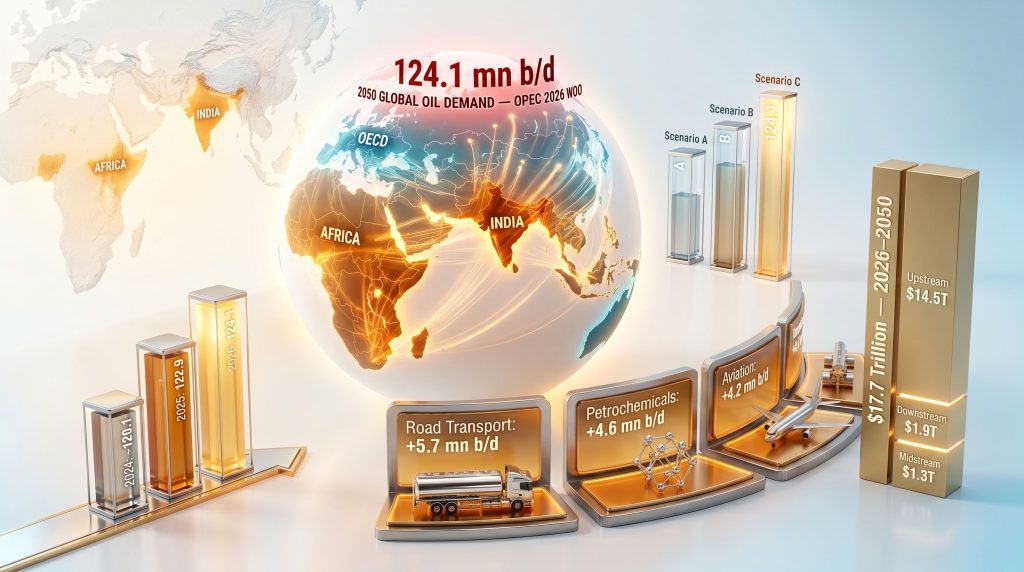
The 2026 World Oil Outlook (WOO) places global oil demand at 124.1 million barrels per day (mn b/d) by 2050, continuing a pattern of consecutive upward revisions that has now persisted across three annual editions. Furthermore, understanding the opec influence on oil markets provides essential context for interpreting why these revisions consistently trend upward.
| Forecasting Body | 2050 Oil Demand Projection | Peak Demand View | Primary Demand Driver |
|---|---|---|---|
| OPEC (2026 WOO) | 124.1 mn b/d | No imminent peak | Non-OECD growth, petrochemicals |
| OPEC (2025 WOO) | 122.9 mn b/d | No imminent peak | India, Africa, Middle East |
| OPEC (2024 WOO) | ~120.1 mn b/d | No imminent peak | Emerging market urbanisation |
| IEA (2026 OMR) | 103.3 mn b/d (2026 estimate) | Peak before 2030 | EV adoption, efficiency gains |
The progression from approximately 120.1 mn b/d in 2024 to 122.9 mn b/d in 2025 to 124.1 mn b/d in 2026 is not statistical noise. It represents a deliberate and consistent reframing of the energy transition timeline, reflecting systematic changes in OPEC's assumptions about policy durability, emerging market demand trajectories, and the pace at which alternative technologies will displace liquid fuels. The opec demand forecast revisions across recent years reveal a clear institutional conviction that prior models underestimated structural demand resilience.
Key Insight: Three consecutive upward revisions to the same long-horizon data point suggest a systematic shift in modelling assumptions rather than incremental data refinements. The direction of revision matters as much as the magnitude.
The IEA's 2026 Oil Market Report, by contrast, projects current demand at just 103.3 mn b/d and anticipates a structural peak in global consumption well before 2030. According to analysis from the Baker Institute, the two institutions begin from fundamentally different premises: OPEC models demand from a supply-continuity perspective weighted toward non-OECD industrialisation, while the IEA applies scenario architectures that assign greater probability to accelerated technology adoption and policy enforcement.
Scenario Architecture: Three Plausible 2050 Demand Worlds
Analytical frameworks for long-run energy demand typically converge around three broad scenario pathways:
- Scenario A: Accelerated Transition — Demand peaks before 2030, consistent with IEA net-zero pathway assumptions, driven by rapid EV deployment and aggressive policy enforcement across major economies
- Scenario B: Managed Plateau — Demand stabilises in the 105 to 115 mn b/d range through the 2030s before entering gradual structural decline, reflecting partial technology adoption alongside continued emerging market growth
- Scenario C: OPEC's Base Case — Demand continues rising to 124.1 mn b/d by 2050, underpinned by non-OECD consumption expansion and structural resilience in road transport, aviation, and petrochemical feedstocks
Callout: The spread between Scenario A and Scenario C equals approximately 20 million barrels per day at mid-century. That volume is roughly equivalent to the combined daily output of the United States and Saudi Arabia. The capital allocation and infrastructure implications of being positioned in the wrong scenario are enormous.
What Is Driving the Upward Revision? Unpacking the Regional Demand Architecture
Non-OECD Growth as the Structural Engine
The arithmetic of OPEC's 2026 WOO is straightforward: non-OECD demand is projected to increase by 26.9 mn b/d between 2025 and 2050, while OECD demand falls by 7.9 mn b/d over the same period, producing net growth of roughly 19 mn b/d. This dynamic reflects the structural divergence between two fundamentally different demand environments.
In OECD economies, oil demand decline is driven by fleet electrification, improved efficiency standards, and demographic stability. In non-OECD markets, the dynamic is inverted: rising per-capita income, rapid urbanisation, industrial expansion, and infrastructure buildout all generate sustained demand growth that efficiency improvements struggle to offset at the aggregate level. The urbanisation-industrialisation nexus in sub-Saharan Africa and South Asia is particularly powerful because it drives oil consumption across multiple vectors simultaneously.
India: The Single Largest Incremental Demand Source
OPEC's projection for Indian oil demand is among the most consequential single-country forecasts in the entire WOO. The 2026 edition sees Indian consumption rising from 5.6 mn b/d in 2025 to 13.8 mn b/d by 2050, an increase of 8.2 mn b/d over 25 years. For context, that incremental volume is larger than the current total oil consumption of Germany, France, and the United Kingdom combined.
The 2025 WOO had placed India's 2050 demand at 13.7 mn b/d, so the revision is marginal in numerical terms but meaningful in directional confidence. Several structural factors underpin this trajectory:
- India's population will likely remain the world's largest throughout the forecast window, providing a massive latent consumer base
- Per-capita income growth is expected to continue elevating middle-class consumption patterns, including vehicle ownership
- EV infrastructure penetration in India lags China by a significant margin, and grid reliability constraints limit the pace of electrification in many states
- Commercial vehicle and two- and three-wheeler segments represent enormous liquid fuel markets that electrification will address more slowly than passenger cars
Africa's Accelerating Demand Trajectory
Africa's 2050 demand forecast has been revised upward to 9.2 mn b/d from 8.8 mn b/d in the prior WOO. This upgrade reflects the continent's extraordinary demographic trajectory: Africa is projected to account for a disproportionate share of global population growth through 2050, with its working-age population expanding faster than any other major region.
What makes Africa's demand profile particularly significant from an analytical standpoint is that energy access expansion itself becomes a demand catalyst. Regions currently characterised by low per-capita energy consumption have asymmetric upside as electrification, industrialisation, and motorisation proceed. Infrastructure gaps, in this context, are not a constraint on demand, but a reservoir of latent consumption awaiting capital investment to unlock it.
China's Revised Trajectory: A Modest Downgrade
China's 2050 forecast has been trimmed to 18.0 mn b/d from 18.4 mn b/d in the 2025 WOO, reflecting a convergence of structural headwinds. EV adoption in China has proceeded at a pace that consistently surprises external analysts, with battery electric vehicles reaching mass-market price points faster than most forecasting bodies anticipated. Simultaneously, China's economic growth trajectory has moderated from the high-single-digit rates that characterised its industrialisation peak.
China's trajectory functions as the most important swing variable in any long-run global demand model. If Chinese EV penetration accelerates beyond current assumptions, or if the country's GDP growth undershoots OPEC's baseline, the 2050 demand picture shifts materially downward. Conversely, any structural rebound in Chinese industrial activity would provide demand upside that offsets forecast conservatism elsewhere.
OECD Demand Decline: Slower Than Previously Modelled
One of the less-discussed aspects of the 2026 WOO revision is the upward adjustment to OECD demand. The 2050 projection for OECD consumption now stands at 38.0 mn b/d, revised up from 37.2 mn b/d in the 2025 edition. While OECD demand is still expected to fall by 7.9 mn b/d between 2025 and 2050, the pace of that decline has moderated in OPEC's modelling.
Several factors contribute to this revised assessment. Energy security policy recalibration across multiple OECD governments, particularly following geopolitical supply shocks, has introduced greater caution around accelerating fossil fuel phase-out timelines. EV adoption curves have slowed in several major OECD markets due to charging infrastructure constraints and consumer affordability pressures. Industrial demand resilience, particularly in sectors with limited electrification pathways, has also contributed to a slower projected decline.
Which Sectors Are Sustaining Long-Term Oil Demand Growth?
The Three Structural Pillars of Incremental Demand
Road transport, petrochemicals, and aviation together account for the dominant share of OPEC's projected incremental demand growth through 2050. The table below summarises the revised sectoral contributions:
| Sector | 2026 WOO Incremental Demand (to 2050) | 2025 WOO Comparable Estimate |
|---|---|---|
| Road Transport | +5.7 mn b/d | +5.3 mn b/d |
| Petrochemicals | +4.6 mn b/d | +4.7 mn b/d |
| Aviation | +4.2 mn b/d | +4.2 mn b/d |
Road transport demand growth has been revised upward despite rapid EV deployment in OECD markets. This counterintuitive outcome reflects a fundamental asymmetry in global fleet composition: hundreds of millions of new internal combustion engine vehicles are expected to enter service in emerging markets over the next two decades, particularly in Southeast Asia, Africa, and South Asia. The aggregate size of those markets numerically overwhelms efficiency gains achieved in OECD fleets.
Petrochemicals represent a structurally distinct demand category because electrification cannot displace it. Plastics, synthetic fibres, fertilisers, and industrial chemicals derived from crude oil and natural gas liquids have no direct electrical substitutes. As Asia-Pacific continues to build out petrochemical processing capacity, feedstock demand for naphtha and liquefied petroleum gas will continue growing regardless of what happens to transport fuel markets.
Aviation demand growth of 4.2 mn b/d by 2050 reflects both structural air travel growth in non-OECD markets and the slow commercial scaling of sustainable aviation fuels (SAF). SAF faces compounding constraints including limited feedstock availability, high production costs relative to conventional jet fuel, and processing infrastructure gaps. Long-haul international aviation remains extraordinarily difficult to decarbonise within any commercially realistic timeframe, making it a structurally persistent source of liquid fuel demand.
How Is OPEC Framing the Energy Transition Policy Shift?
From Broad Energy Portfolio to Core Oil and Gas: The Corporate Recalibration
The 2026 WOO contains an observation that extends well beyond conventional demand forecasting. OPEC notes that major international energy companies are redirecting strategic focus back toward their core oil and gas operations, reversing a multi-year strategic drift toward broader energy solution positioning. This represents a commercially significant signal about where senior management teams and capital allocation committees believe long-run value creation resides.
The policy narrative has shifted in parallel. However, energy transition pressures continue to influence the policy frameworks of major consuming nations, even as governments increasingly reweight energy security and affordability alongside emissions reduction objectives. This does not represent an abandonment of decarbonisation goals in most cases, but it does mean that the pace of fossil fuel phase-out is being calibrated against supply availability and price stability in ways that earlier frameworks did not fully accommodate.
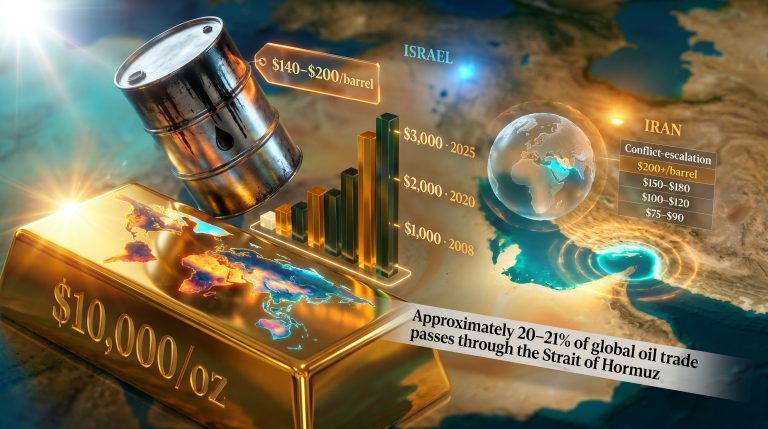
Analytical Note: The geopolitical context is directly relevant here. The US-Iran conflict and associated Strait of Hormuz tensions created supply shocks and price volatility that prompted major energy-consuming nations to reassess the risk of accelerating their dependence on technologies and supply chains that are not yet commercially mature at scale. Energy security is no longer a secondary consideration in these frameworks.
What Are the Supply-Side Implications of OPEC's Long-Term Demand Outlook?
Global Liquids Supply Trajectory to 2050
OPEC projects global liquids supply reaching 124.2 mn b/d by 2050, marginally above demand, suggesting a broadly balanced long-run market. Supply from non-OPEC+ producers is expected to plateau at approximately 60 mn b/d during the 2030s, after which OPEC+ producers absorb the incremental demand growth. The consequence is a structural market share shift, with OPEC+ producers' share of global liquids supply rising from 48% in 2025 to 52% by 2050.
The $17.7 Trillion Investment Imperative
OPEC estimates cumulative oil-sector investment requirements of $17.7 trillion over 2026 to 2050. The breakdown reveals where capital pressure is most acute:
| Segment | Investment Required (2026-2050) |
|---|---|
| Upstream | $14.5 trillion |
| Downstream | $1.9 trillion |
| Midstream | $1.3 trillion |
| Total | $17.7 trillion |
The upstream share is dominant at $14.5 trillion, reflecting the capital intensity of sustaining production capacity in the face of natural decline rates. Global oil fields collectively decline at between 5% and 8% per year on average without reinvestment, meaning the industry must perpetually invest simply to maintain existing output levels, before addressing growth. In an environment of energy transition uncertainty, securing long-cycle project sanctioning at the volumes required represents a significant capital mobilisation challenge.
The prior year's WOO estimated $18.2 trillion over 2025-2050, but direct comparison is complicated by the different forecast window and dollar basis. The directional signal is consistent: the capital requirement is enormous and sustained.
The Refining Capacity Crunch: A 2030 Pressure Point
Perhaps the most actionable near-term signal in the 2026 WOO involves the downstream sector. OPEC projects a refining capacity deficit exceeding 1.5 mn b/d by 2030, driven by demand growth outpacing net capacity additions. The report identifies only 4.9 mn b/d of refining capacity additions planned for 2026 to 2030, down from 5.8 mn b/d identified for 2025 to 2030 in the prior WOO. Global refinery utilisation is forecast to tighten from 80.8% to 82.7% over 2025 to 2030, eroding the system's buffer against supply disruptions.
Asia-Pacific sits at the epicentre of this structural shortfall. Regional demand growth in South and Southeast Asia is outpacing new refinery build timelines, creating a window in which product availability constraints could translate into price spikes even if crude markets remain adequately supplied.
The next major ASX story will hit our subscribers first
Scenario Planning for Energy Investors: Key Variables to Monitor
For investors and strategists tracking the evolution of OPEC's 2050 oil demand forecast, the following indicator variables carry the most diagnostic weight:
- India's EV adoption rate — the single most important variable for long-run non-OECD demand trajectory
- Africa's energy infrastructure investment pace — determines whether the continent's demographic demand growth translates into sustained oil consumption
- China's economic growth trajectory — the primary swing factor in the 2030s demand outlook
- SAF and synthetic fuel cost curves — the key technology risk to long-run aviation demand projections
- OECD energy security policy settings — determines the pace and durability of fossil fuel phase-out across the largest consuming economies
- Asia-Pacific refining capacity additions — near-term indicator of downstream market tightness risk ahead of 2030
The capital allocation implication is significant. If OPEC's demand trajectory is even partially correct, systematic under-investment in new upstream supply capacity creates substantial oil price volatility trends and price upside risk in the 2030s. Furthermore, the divergence between OPEC and IEA forecasts creates a binary decision framework for national oil companies and major producers: capital budgets calibrated to IEA assumptions leave producers structurally undersupplied if demand follows an OPEC trajectory, while capital deployed against OPEC assumptions creates stranded asset risk in an accelerated transition scenario.
In addition, oil market trade-war risks introduce a further layer of uncertainty for producers attempting to calibrate long-cycle investment decisions. Many sophisticated producers are consequently responding with a regret-minimisation approach, hedging capital allocation across both transition and continuity scenarios rather than committing fully to either. This strategic hedging behaviour is visible in the simultaneous maintenance of long-cycle upstream investment programmes alongside selective renewable energy portfolio positions across several major national oil companies. The EIA's global oil outlook provides a further independent reference point for analysts seeking to triangulate between OPEC and IEA projections when constructing scenario-weighted investment frameworks.
Disclaimer: This article contains forward-looking projections and long-run forecasts sourced from OPEC's 2026 World Oil Outlook and the IEA's 2026 Oil Market Report. These forecasts involve significant uncertainty and should not be construed as investment advice. Long-run energy demand scenarios are subject to material revision as technology costs, policy settings, and geopolitical conditions evolve. Readers should conduct independent analysis before making investment decisions.
Want to Identify the Next Major Resource Discovery Before the Market Moves?
The structural supply-demand tensions outlined in OPEC's 2026 World Oil Outlook underscore just how consequential early-mover advantage can be in resource markets — and Discovery Alert's proprietary Discovery IQ model delivers real-time ASX mineral discovery alerts, turning complex geological announcements into actionable investment insights the moment they hit the exchange. Explore historic discoveries and their market returns, then begin your 14-day free trial to position yourself ahead of the broader market.