June 18, 2026
The Commodity Supercycle No One Is Ready For
History rarely announces structural turning points in advance. The shifts that reorder global capital flows, reshape military hierarchies, and redislocate economic power tend to arrive disguised as temporary disruptions. The current tension between Iran and Israel is being processed by mainstream financial markets as a regional conflict with manageable spillover risk. That framing may prove to be one of the most costly misreadings of geopolitical reality in a generation.
Colonel Douglas MacGregor, a decorated combat veteran, former senior military advisor, and widely cited strategic analyst, has articulated a framework that cuts sharply against the prevailing consensus. His central argument regarding the Douglas Macgregor Iran Israel war oil prices and gold nexus is that this conflict is not a contained regional flare-up but an inflection point in a decades-long structural reset. Understanding his reasoning requires examining three interconnected domains: energy markets, monetary systems, and the declining arc of American military hegemony.
When big ASX news breaks, our subscribers know first
Why Energy Markets Are Structurally Mispricing This Conflict
The Strait of Hormuz Is Not a Background Risk
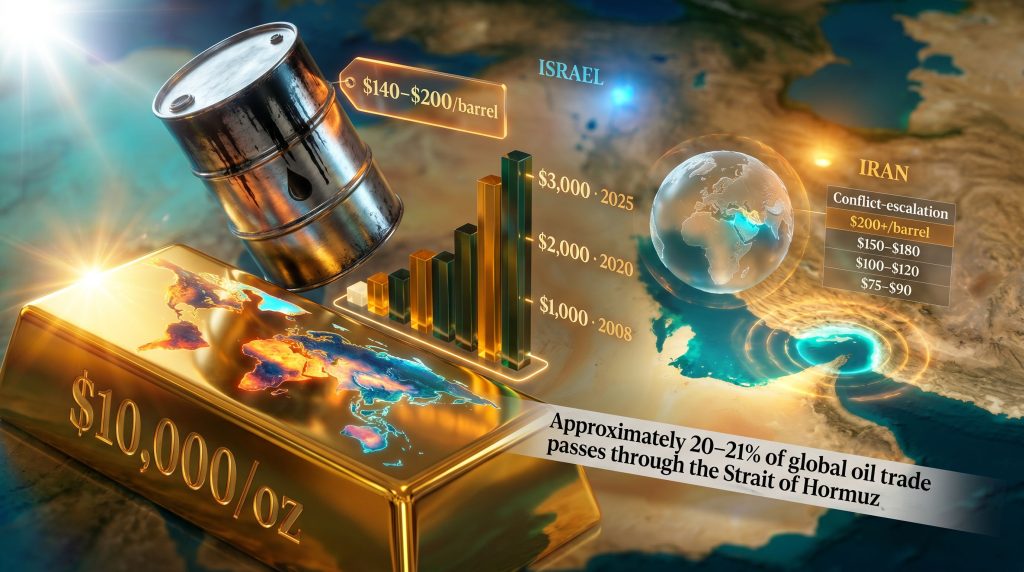
Approximately 20 to 21 percent of all globally traded oil passes through the Strait of Hormuz. This single navigational chokepoint handles the daily movement of energy supplies that power entire industrial economies across Asia and Europe. When financial markets price oil at $75 to $78 per barrel, they are implicitly assuming that the Strait remains open, that current diplomatic frameworks hold, and that no further escalation occurs.
MacGregor's assessment is that each of those assumptions is fragile. His view, expressed in a recent wide-ranging strategic briefing, is that any ceasefire agreement currently being negotiated is unlikely to hold because Israeli strategic objectives remain fundamentally incompatible with Iranian survival as a regional power. In his framing, the temporary de-escalation narrative that has suppressed oil prices is exactly that: temporary.
The structural constraints on oil supply are compounding this risk. No new oil refinery has been constructed in the United States in more than 25 years. Existing refinery infrastructure is already operating at or near peak capacity. This means that even if additional crude volumes were available, the domestic processing ceiling is fixed. Any renewed disruption to Persian Gulf supply corridors would immediately translate into constrained availability, with no domestic buffer to absorb the shock. Furthermore, understanding the broader context of crude oil trade geopolitics helps illustrate why these vulnerabilities are so deeply entrenched.
Oil Price Scenarios: What Escalation Actually Looks Like
The range of plausible oil price outcomes is far wider than current futures markets suggest. MacGregor's analysis points to oil returning above $100 per barrel in the near term as the base case, with significantly higher trajectories if the conflict re-escalates.
| Conflict Scenario | Estimated Oil Price Range | Key Trigger |
|---|---|---|
| Sustained ceasefire holds | $75–$90/barrel | Hormuz remains open, MOU implemented |
| Partial re-escalation | $100–$120/barrel | Renewed Israeli offensive, Iranian response |
| Full regional escalation | $140–$200/barrel | Hormuz closure, SPR critically depleted |
| Ground conflict involvement | $200+/barrel | Multi-front war, global supply disruption |
The Strategic Petroleum Reserve Is Approaching Its Limits
The United States has been drawing down its Strategic Petroleum Reserve at an accelerated pace to manage politically sensitive energy prices during the conflict period. MacGregor's assessment, consistent with analysis from bond market strategists and institutional macro researchers, is that the SPR could approach minimum operational levels by late summer or early autumn 2025, possibly sooner.
This matters enormously because the SPR was designed as an emergency buffer, not a routine price management instrument. Once it is exhausted as a policy lever, the government loses its primary tool for non-market price suppression. At that point, oil prices become fully exposed to supply-demand fundamentals and geopolitical risk premiums, with no administrative offset available.
MacGregor raises a scenario that energy futures markets are not currently pricing: the possibility of a presidential order banning U.S. oil exports. If domestic refinery capacity is fully utilised and the SPR reaches critical minimum levels simultaneously, restricting exports becomes a logical, if market-disrupting, policy response. The downstream consequences for allied energy relationships and global crude pricing would be substantial. For a broader view of how these dynamics connect, this analysis on regional oil shocks provides additional context.
Shadow Fleets and Alternative Pipelines: Partial Solutions at Best
The trans-Arabian pipeline infrastructure running from east to west across Saudi Arabia to the port of Yanbu offers partial redundancy for Hormuz-dependent volumes. Shadow fleet operations provide additional marginal flexibility. MacGregor, however, describes these mechanisms as fragile and finite rather than structural alternatives. They can partially mitigate, but not replace, the volumes that would be disrupted by a sustained Hormuz closure.
The Investment Case for Hard Assets: MacGregor's Core Framework
Five Sectors That Outperform During Geopolitical Commodity Shocks
MacGregor's investment framework, delivered to a private gathering of business leaders in Washington DC and subsequently discussed publicly, is built around a single organising principle: energy, metals, minerals, fertilisers, and food are the only sectors that matter in this environment. Everything else, in his assessment, is speculative noise.
The five sectors with the strongest structural case are:
-
Energy (oil, gas, coal, nuclear): Liquid natural gas demand is rising across Asia as nations accelerate strategic reserve-building. Coal remains a critical baseload energy source for India, Japan, and China regardless of green policy frameworks. Nuclear power is experiencing a structural renaissance in nations that maintained their reactor infrastructure. MacGregor notes pointedly that Germany's decision to dismantle its nuclear capacity represents a multi-decade competitive disadvantage.
-
Metals and mining (gold, silver, copper, critical minerals): Gold producers are generating exceptional free cash flow at current price levels. Copper and critical minerals face supply constraints driven by years of underinvestment. Exploration capital is beginning to return to junior mining companies for the first time in years, signalling a potential sector re-rating. In addition, the broader geopolitical mining landscape is increasingly shaping where and how capital flows into resource extraction.
-
Fertilisers and agricultural inputs: Sulfur is trading at historically elevated levels, directly impacting mineral processing costs and fertiliser production economics. Nitrogen-based fertiliser availability is constrained by energy input costs. Nations holding exportable fertiliser surpluses carry significant and underappreciated geopolitical leverage.
-
Food production and agricultural land: Record bankruptcy rates in the agricultural sector are signalling a coming consolidation and price reset. Countries with productive agricultural land and reliable water access hold structural advantages that are not yet fully reflected in asset valuations.
-
Coal and liquefied energy infrastructure: Coal liquefaction technology is being revisited as a practical bridge fuel strategy. Infrastructure investment in liquefaction, storage, and transport capacity is accelerating across Asia.
Furthermore, the accelerating energy transition is amplifying the importance of critical minerals demand across all of these sectors simultaneously.
Why AI and High-Growth Technology Are Considered Bubble Categories
MacGregor's framing on technology valuations is direct. Artificial intelligence and companies like SpaceX are described as bubbles, a position that cuts against the dominant investment narrative of the past several years. The reasoning is structural: technology valuations are built on the assumptions of cheap capital, stable supply chains, and predictable energy costs. All three of those assumptions are now under sustained pressure. Speculative growth assets have historically underperformed during inflationary commodity supercycles, and capital rotation from growth equities into hard assets is a well-documented historical pattern during periods of geopolitical stress.
Gold, Currency Debasement, and the $10,000 Thesis
Three Converging Forces Driving Gold to New Highs
Gold at $3,000 per ounce, reached in early 2025, continues to set new all-time highs after crossing $2,000 per ounce in 2023. MacGregor's view is unambiguous: the trajectory toward $10,000 per ounce is not a speculative extreme but a logical destination given the convergence of three structural forces.
1. Accelerating currency debasement: War-driven fiscal expansion widens deficits and pressures sovereign credit ratings. Fitch's 2025 assessment of U.S. creditworthiness reflected a deteriorating fiscal trajectory. Rising bond yields combined with eroding central bank credibility create a classic gold-positive environment. MacGregor explicitly states that he believes the Federal Reserve has lost effective control over inflation, and that artificially suppressing interest rates indefinitely is no longer feasible.
2. Structural de-dollarisation: Gulf state sovereign wealth funds and Asian central banks are actively diversifying reserves away from U.S. Treasuries. Physical gold vaulting infrastructure is being established in financial hubs outside the Western system, with China having set up gold vaults in Riyadh and Hong Kong specifically to facilitate gold-denominated settlement. Consequently, central bank gold demand is becoming one of the most consequential structural forces in global monetary markets.
3. Sustained geopolitical uncertainty: Investors rotate toward hard assets during periods of prolonged military conflict and institutional instability. The simultaneous presence of energy shocks, agricultural disruption, and military uncertainty creates durable demand for gold as a store of value. This is central to understanding the Douglas Macgregor Iran Israel war oil prices and gold framework as it applies to portfolio positioning.
| Gold Price Level | Year Reached | Dominant Macro Driver |
|---|---|---|
| $1,000/oz | 2008 | Global financial crisis, dollar weakness |
| $2,000/oz | 2020 | COVID monetary expansion, zero interest rates |
| $3,000/oz | 2025 | Geopolitical conflict, de-dollarisation momentum |
| $5,000/oz (projected) | 2026–2027 | SPR depletion, inflation spiral, dollar credibility loss |
| $10,000/oz (projected) | 2028–2030 | Full monetary reset, gold re-emerges as reserve anchor |
Important Disclaimer: Projected price targets involve significant uncertainty and should not be treated as investment advice. These figures represent one analytical framework among many and may not reflect actual market outcomes. Past price performance does not guarantee future results. Readers should consult a licensed financial advisor before making any investment decisions.
Bitcoin as a Transactional Layer, Not a Reserve Asset
MacGregor's monetary framework distinguishes clearly between gold and Bitcoin. Gold is positioned as the reserve asset, the coin of the realm in any genuine monetary reset scenario. Bitcoin and digital assets serve a distinct and complementary function: enabling private credit creation and cross-border transactions outside the dollar settlement system.
The two are not competing assets. They operate at different layers of what MacGregor describes as an emerging post-dollar monetary architecture. Gold retains primacy as a sovereign reserve holding; Bitcoin serves transactional and private credit functions that physical gold cannot easily fulfil given the logistical challenges of moving large gold volumes across borders.
The Geopolitical Map That Is Being Redrawn
The Post-World War I Architecture Is Dissolving
The modern state structure of the Arabian Peninsula was largely constructed by British and French powers after 1918 and subsequently reaffirmed under American leadership after 1945. MacGregor's argument is that these arrangements assumed a permanent Western military guarantee that has now been conclusively undermined. Gulf states that relied on U.S. security guarantees must recalibrate their strategic alignments toward regional powers capable of providing credible protection.
Iran's demonstrated capacity to integrate space-based surveillance with ballistic missile and drone strike platforms represents what MacGregor calls the real revolution in military affairs. This capability links terrestrial and orbital intelligence platforms directly to thousands of precision strike systems. The asymmetric principle that captures this dynamic is the old military maxim: a ship is a fool to fight a fort. Expeditionary naval power faces fundamental disadvantages against dispersed, hardened land-based missile systems operating on home terrain.
Turkey's Strategic Opportunity in a Post-American Region
Turkey holds the largest conventional military force in the region outside of Iran and possesses substantial scientific, industrial, and energy infrastructure. MacGregor identifies a convergence of Turkish and Iranian strategic interests, particularly regarding the Kurdish question, that creates the foundation for a new regional power axis as U.S. influence recedes.
The Agricultural Shock Wave That Has Not Yet Arrived
One of the most underappreciated dimensions of MacGregor's analysis concerns the lag between upstream supply disruption and downstream agricultural price impact. Drawing on direct connections within India's policy and agricultural community, he notes that the full economic impact of Gulf supply disruptions on global fertiliser availability has not yet materialised in consumer prices.
The mechanism is the absence of sulfuric acid, critical for mineral processing and phosphate fertiliser production, and reduced nitrogen availability driven by elevated energy input costs. The typical lag between upstream supply disruption and downstream agricultural price impact in global food systems runs between six and eighteen months. MacGregor describes the current situation using the metaphor of a tsunami: the water has pulled back, the wave is building, but it has not yet struck. India, which holds no meaningful fertiliser strategic reserve, faces particularly acute exposure. For a deeper understanding of how conflict reshapes these supply chains, this discussion on the next phase of the Iran conflict is worth consulting.
Asset Class Outlook: A Framework for Positioning
| Asset Class | Short-Term Outlook | Long-Term Structural Case | Key Risk Factor |
|---|---|---|---|
| Crude Oil | Bullish | Strongly bullish | Ceasefire durability |
| Gold | Strongly bullish | Extremely bullish | Short-term corrections |
| Silver | Bullish | Bullish with leverage to gold | Industrial demand volatility |
| Coal | Bullish | Moderate bridge fuel case | Energy policy shifts |
| Fertilisers | Bullish | Strongly bullish | Lag in price discovery |
| Agricultural Land | Bullish | Strongly bullish | Policy intervention risk |
| Critical Minerals | Bullish | Strongly bullish | Permitting timelines |
| U.S. Broad Equities | Bearish | Uncertain | Stagflation scenario |
| High-Growth Tech / AI | Bearish | Uncertain | Energy cost inflation |
| Bitcoin | Neutral to bullish | Bullish as transactional layer | Regulatory and liquidity risk |
The next major ASX story will hit our subscribers first
FAQ: Douglas MacGregor on Iran, Israel, Oil Prices, and Gold
What is Douglas MacGregor's forecast for oil prices during the Iran-Israel conflict?
MacGregor's analysis indicates oil prices are likely to return above $100 per barrel in the near term, with potential to reach $140 to $200 per barrel if the Strait of Hormuz faces renewed disruption or the conflict broadens into a wider regional war. The critical variable is whether the ceasefire architecture holds or whether Israeli military objectives trigger renewed hostilities.
Why does MacGregor believe gold could reach $10,000 per ounce?
The case rests on three converging forces: war-driven fiscal expansion accelerating currency debasement, structural de-dollarisation as sovereign wealth funds and central banks diversify away from U.S. Treasuries, and sustained geopolitical uncertainty driving capital toward hard assets over an extended period. MacGregor views gold as re-emerging as the primary global reserve asset in a post-dollar monetary architecture. This thesis sits at the heart of the broader Douglas Macgregor Iran Israel war oil prices and gold analytical framework.
What sectors does MacGregor recommend during a geopolitical energy crisis?
Energy across all forms including oil, gas, coal, and nuclear; precious and industrial metals; fertilisers and agricultural input supply chains; food production infrastructure and agricultural land; and critical minerals. High-growth technology and speculative AI-adjacent assets are categorised as vulnerable to capital rotation and are described as bubble categories in the current macro environment.
What is the agricultural risk that markets have not priced?
The disruption to fertiliser supply chains, particularly sulfur and nitrogen-based inputs, has not yet fully transmitted into food production costs and retail consumer prices. The lag between upstream supply disruption and downstream agricultural price impact typically spans six to eighteen months. MacGregor's assessment is that the first wave of agricultural impact has not yet arrived, and a second wave depends entirely on whether the conflict resumes.
How does Strategic Petroleum Reserve depletion affect oil markets?
The SPR has functioned as an administrative price management instrument during the conflict period rather than as the emergency buffer it was designed to be. As reserves approach minimum operational thresholds, potentially before the end of 2025, the government loses its primary lever for non-market price suppression. This creates a structural floor under oil prices and materially increases market vulnerability to any new supply disruption, including the possibility of export restrictions being imposed on U.S. refined products.
Ready to Position Yourself Ahead of the Next Major Commodity Discovery?
As geopolitical pressures reshape energy and metals markets, Discovery Alert's proprietary Discovery IQ model delivers real-time ASX mineral discovery alerts — instantly translating complex data across 30+ commodities into actionable insights for both traders and long-term investors. Explore historic discoveries and their exceptional market returns, then begin your 14-day free trial to secure your edge before the next major discovery is announced.