June 18, 2026
When Future Oil Becomes a Legal Liability: Understanding the South Sudan Court Ruling
Across sub-Saharan Africa, a quiet financing model has become central to how oil-dependent governments bridge the gap between production cycles and immediate budget needs. Rather than waiting for crude to be extracted, lifted, and sold on the open market, governments pre-sell future barrels to commodity traders in exchange for cash today. It is a mechanism that functions like a mortgage on a nation's geological inheritance, and like any mortgage, it carries consequences when the underlying asset underperforms or the debtor cannot deliver.
The South Sudan oil-backed loans court ruling, handed down by London's High Court, represents precisely this kind of consequence made visible. It is not simply a commercial dispute between a government and a trading house. It is a diagnostic moment that reveals the compounding fragility embedded in a sovereign financing model stretched to its structural limits.
When big ASX news breaks, our subscribers know first
What Oil Prepayment Financing Actually Means in Practice
To understand why the ruling carries such weight, it helps to first understand the mechanics of how oil prepayment agreements work and why resource-dependent governments find them attractive.
In a standard prepayment facility, a commodity trader or specialised energy financier advances a lump sum to a government or state oil company. In exchange, the borrower commits to delivering a specified volume of crude oil over a defined future period. The lender recovers its advance through physical oil deliveries rather than conventional cash repayments.
There are no bonds issued, no interest rate benchmarks to negotiate in the traditional sense, and no requirement to access international capital markets where governance concerns might trigger prohibitive risk premiums. Furthermore, commodity trading giants have increasingly structured these instruments to suit high-risk sovereign environments.
The structural characteristics of these instruments include:
- Collateral type: Future crude production volumes rather than fixed physical assets
- Governing law: Typically structured under English law, with London courts serving as the primary dispute resolution forum
- Counterparty profile: Commodity trading houses, specialised energy lenders, or state-linked entities with direct market access to crude offtake
- Core vulnerability: Entirely dependent on production continuity, pipeline operability, and price conditions remaining adequate across the delivery window
For South Sudan, these instruments have represented one of the only viable short-term liquidity mechanisms available. Conventional sovereign bond issuance remains practically inaccessible given the country's credit risk profile and governance perceptions. Multilateral development finance comes attached to conditionalities that can delay disbursement. Domestic non-oil revenue is structurally underdeveloped. Prepayment deals, by contrast, convert a barrel still underground into a budget line today.
The BB Energy Dispute and What the London High Court Decided
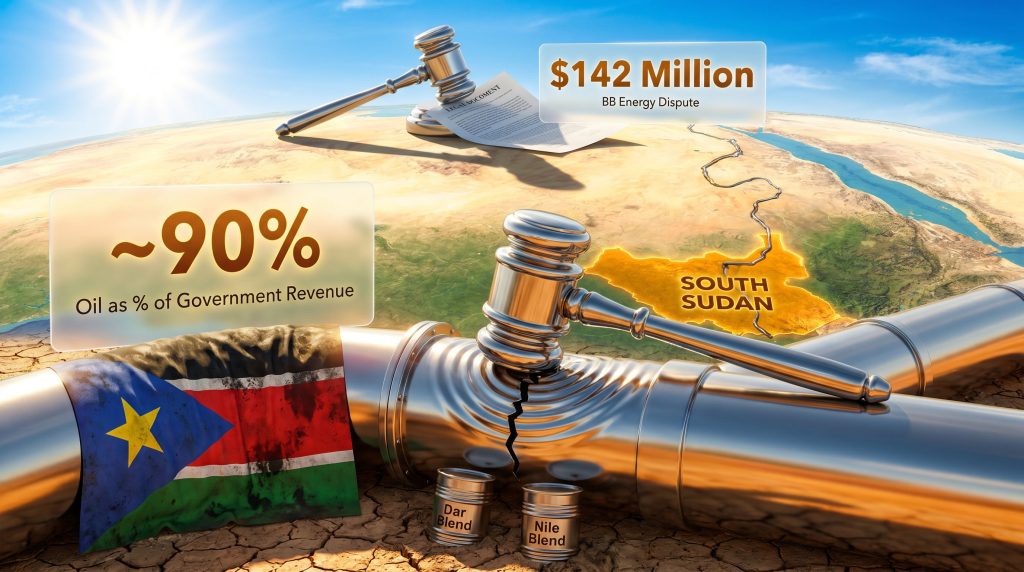
The legal action at the centre of the South Sudan oil-backed loans court ruling involves allegations that South Sudan failed to honour prepayment contracts covering crude deliveries scheduled across 2024 and 2025. The commodity trader BB Energy initiated proceedings after claiming contracted shipments of Dar Blend and Nile Blend crude were not fully delivered against funds already advanced. The total quantum of the dispute is reported at approximately $142 million. For further context, Africa Business Insider provides additional reporting on the specifics of this case.
London's High Court upheld an injunction with the following practical scope:
What the ruling restricts:
- New advance oil sale agreements using Dar Blend or Nile Blend as collateral
- Third-party facilitation of equivalent financing vehicles that replicate prepayment mechanics
- The government's ability to monetise future production as upfront liquidity while proceedings remain unresolved
What the ruling does not restrict:
- Ongoing crude oil exports under existing arrangements
- General government oil sales at prevailing market terms
- South Sudan's physical production and pipeline operations
The distinction matters enormously. The injunction is not an embargo on South Sudan's oil. It is a targeted constraint on a specific financing mechanism, but that mechanism happens to be the one the government has relied upon most heavily when conventional alternatives are unavailable.
The practical effect of the ruling is to close a financing door precisely at the moment when multiple other pressures are simultaneously narrowing the government's options. It is the legal expression of accumulated operational, geopolitical, and fiscal vulnerabilities converging at once.
Dar Blend and Nile Blend: Understanding South Sudan's Export Crude Grades
A detail that receives insufficient attention in broader coverage is the specific character of the crude grades at the centre of this dispute. Dar Blend and Nile Blend are not interchangeable commodities. Each has distinct properties that affect their marketability, the logistical requirements of their delivery, and ultimately the financial viability of the prepayment contracts built around them.
Dar Blend is produced primarily from the Dar petroleum operating area spanning the border region and is characterised as a heavy, sour crude with relatively high sulphur content and elevated density. This grade requires specific refinery configurations to process efficiently, which concentrates the buyer universe among refiners with complex downstream infrastructure, particularly in Asia.
Nile Blend originates from the greater Nile petroleum operating area and is comparatively lighter and sweeter, making it more broadly marketable. However, both grades share a fundamental logistical constraint: they must transit the same pipeline network running through Sudan before reaching Port Sudan on the Red Sea for export.
This pipeline dependency is not a temporary arrangement. It is the structural architecture of South Sudan's entire export system, built during a period when Sudan and South Sudan were a single country. When South Sudan gained independence in 2011, it inherited a geography that placed its only viable export route inside a foreign sovereign state. That vulnerability has never been resolved, and it underpins every aspect of the current crisis.
The Sudan Conflict as a Force Multiplier for Financial Risk
Since armed conflict escalated in Sudan in April 2023, South Sudan's export infrastructure has experienced repeated operational disruptions. The consequences cascade through the entire financing architecture in a sequence that illustrates why the London ruling cannot be understood in isolation from the broader geopolitical risk landscape.
The transmission mechanism operates as follows:
- Pipeline disruptions reduce the volume of crude physically available for export
- Reduced export volumes create shortfalls against pre-committed delivery schedules under prepayment contracts
- Delivery shortfalls trigger contractual breach allegations from trading counterparties
- Legal proceedings result in injunctions restricting future financing access
- Constrained financing capacity compresses government liquidity and public spending
- Reduced public spending further weakens the government's capacity to address the underlying operational challenges
This is a feedback loop, not a linear sequence of isolated events. The BB Energy dispute did not originate in a vacuum. It originated in a production and logistics environment made materially more difficult by an external conflict that South Sudan has no capacity to resolve. In addition, oil market disruptions of this nature tend to amplify the financial stress on governments already operating at the margins of fiscal viability.
Revenue Concentration: The Core Structural Vulnerability
No analysis of the South Sudan oil-backed loans court ruling is complete without confronting the underlying fiscal architecture that makes this dispute so consequential. Consider the comparative profile:
| Revenue Dependency Metric | South Sudan | Sub-Saharan Africa Average (oil producers) |
|---|---|---|
| Oil as % of government revenue | ~90% | ~30-45% |
| Export earnings concentration | Dominant crude share | Varies significantly |
| Fiscal buffer adequacy | Critically low | Moderate |
| Non-oil revenue development | Early-stage | Moderate |
| Export route diversification | Single corridor | Generally multiple routes |
At approximately 90% of total government revenue, South Sudan's oil dependency is not simply high by regional standards. It is in a category of its own. Most oil-producing economies that analysts classify as heavily dependent on crude revenues still maintain meaningful alternative income streams from taxation, mining royalties, or agricultural exports. South Sudan's non-oil revenue base remains critically underdeveloped, a structural condition that successive budget cycles have failed to meaningfully change.
This concentration means that any constraint on oil revenue monetisation, whether from production disruption, price decline, pipeline failure, or now judicial restriction, transmits almost immediately into a government liquidity crisis. Consequently, commodity market volatility has an outsized impact on South Sudan's fiscal position compared to more diversified economies.
The next major ASX story will hit our subscribers first
A Pattern of Legal Exposure, Not an Isolated Event
The BB Energy case represents the most recent but not the first adverse legal outcome for South Sudan in relation to oil financing obligations. A prior ruling involving Afreximbank has previously added pressure to the government's oil-backed borrowing framework. The accumulation of multiple adverse judicial outcomes is analytically significant because it shifts the interpretation from isolated contractual dispute to systemic pattern.
International commodity traders and specialised energy financiers price sovereign risk through exactly this kind of pattern recognition. Each additional adverse ruling incrementally raises the perceived risk premium associated with structuring prepayment facilities with South Sudan as counterparty. Over time, this can shift the economics of new deals beyond what the government can viably offer in terms of crude volume commitments, particularly when pipeline reliability remains uncertain.
Furthermore, the broader issue of sanctions on oil trade in other jurisdictions has demonstrated how quickly legal and regulatory constraints can reshape the landscape for sovereign energy financing, providing a cautionary parallel for South Sudan's creditors.
The Odious Debt Dimension: A Parallel Legal Front
What Is the Odious Debt Doctrine?
Running alongside the London commercial proceedings, civil society groups and regional activists have filed a separate challenge before the East African Court of Justice. The petition invokes the legal doctrine of odious debt, which holds that sovereign obligations incurred without genuine public benefit or popular consent should not be legally binding on the affected population. The Lawyers of Africa organisation has published detailed commentary on this challenge and its implications for governance across the region.
Why This Matters Beyond South Sudan
If successful, this challenge would not simply resolve one dispute. It could establish a regional precedent for how oil-backed sovereign financing arrangements are scrutinised across East Africa and beyond. The doctrine of odious debt remains contested in international law, with no universal treaty framework governing its application.
However, its invocation in this context signals a growing political and civil society appetite for challenging the legitimacy of commodity-collateralised sovereign borrowing as a class of instrument. This is a dimension that purely commercial analyses of the ruling tend to underweight. The legal and reputational risk associated with odious debt claims can deter future financing partners even before any court delivers a judgment.
Broader Implications for Oil-Backed Sovereign Financing Across Africa
South Sudan's situation sits at an extreme end of a spectrum that encompasses multiple African oil producers. The core risks associated with commodity-collateralised sovereign borrowing are not unique to South Sudan. They include:
- Pre-allocated revenue: Future oil income committed under prepayment contracts is unavailable for discretionary spending, reducing fiscal flexibility across the delivery window
- Production amplification risk: Any shortfall in output directly converts into contractual default exposure rather than simply reduced revenue
- Transparency deficits: Prepayment arrangements are frequently structured with limited public disclosure, making it difficult for parliaments, citizens, or multilateral creditors to assess the true extent of forward revenue commitments
- Debt sustainability erosion: Cumulative prepayment obligations can progressively crowd out conventional development financing by consuming the collateral base
Several other African oil-producing nations have responded to these risks by introducing legislative caps on the proportion of future production that can be pre-committed, or by establishing sovereign wealth fund mechanisms to build buffers against revenue volatility. South Sudan has made limited documented progress in either direction.
Despite the legal pressure, BB Energy has confirmed receipt of irrevocable letters of award from the South Sudanese government for two crude cargoes scheduled for delivery before November, and the company has expressed openness to continued commercial discussions. This dual posture of simultaneous legal action and commercial engagement reflects a pragmatic calculation common among commodity traders operating in high-risk sovereign environments. It also suggests that commercial appetite for South Sudan's crude has not entirely collapsed, which provides a narrow but real basis for near-term stabilisation.
The Path Forward: Three Overlapping Imperatives
Resolving the current crisis requires progress across three distinct but interconnected dimensions:
1. Near-term legal resolution: Settlement or judicial resolution of the BB Energy dispute would lift the injunction on new prepayment contracts, restoring a critical financing option. The irrevocable letters of award and signals of continued commercial dialogue suggest this pathway is not foreclosed.
2. Export route stabilisation: Restoration of reliable pipeline operations through Sudan is a precondition for South Sudan's ability to honour any future delivery commitments. This depends on developments entirely outside South Sudan's direct control, which is itself a structural problem that no domestic policy response can fully address.
3. Fiscal architecture reform: The medium and long-term challenge is to reduce the government's existential dependence on advance oil sales. This requires meaningful progress on non-oil revenue development, greater transparency around the cumulative scope of existing prepayment commitments, and institutional frameworks that prevent future over-commitment of forward production.
The South Sudan oil-backed loans court ruling is ultimately a symptom rather than a cause. The underlying condition is a sovereign financing architecture constructed almost entirely around the forward sale of a single exhaustible resource, exported through a single conflict-vulnerable route, with minimal fiscal diversification or institutional buffers to absorb the inevitable shocks. Legal disputes are the visible expression of that architecture reaching its limits.
Disclaimer: This article is intended for informational and analytical purposes only. It does not constitute financial, legal, or investment advice. Forecasts, projections, and analytical assessments are inherently uncertain and should not be relied upon as predictions of future outcomes. Readers should conduct independent research before making any investment or policy-related decisions.
Want to Track the Next Major ASX Mineral Discovery Before the Market Does?
Discovery Alert's proprietary Discovery IQ model scans ASX announcements in real time, delivering instant alerts on significant mineral discoveries across more than 30 commodities — turning complex data into clear, actionable insights for investors at every level. Explore historic discoveries and the substantial returns they generated, then start your 14-day free trial at Discovery Alert to position yourself ahead of the broader market.