
June 18, 2026
The Hidden Complexity Inside a Stranded Smelter: Why Aluminium Shutdowns Are Never Simple
Most industrial assets can be idled and reactivated with relative ease. A warehouse can sit empty. A quarry can pause blasting. Even a copper mine can be placed on care and maintenance and returned to production within a manageable timeframe. Aluminium smelters are a fundamentally different category of industrial asset, and understanding why they are so difficult to restart is central to understanding the strategic pressure now bearing down on South32 as it weighs its South32 Mozal stake options.
At the heart of every aluminium smelter are electrochemical reduction cells, commonly called pots, which use continuous high-amperage electrical current to reduce aluminium oxide into liquid metal through the Hall-Héroult process. These cells operate at temperatures exceeding 950 degrees Celsius and must run without interruption. A controlled shutdown degrades the carbon lining of each pot, and an extended cold shutdown effectively destroys it.
Before any recommissioning, every pot must be completely relined — a process involving the removal of spent carbon cathode material, installation of new lining blocks, and a carefully managed prebaking sequence that alone can span many months.
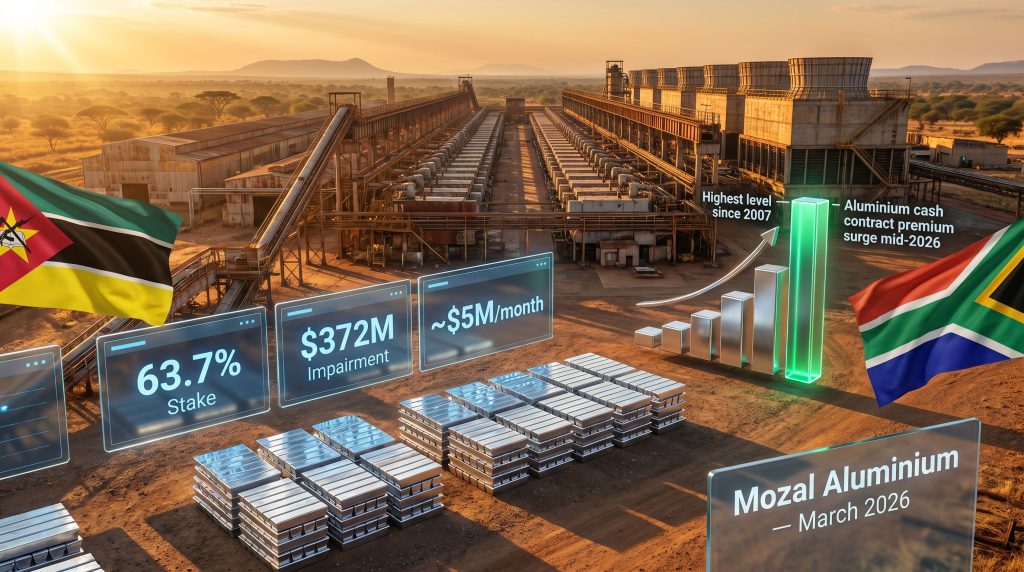
At a facility of Mozal's scale, this is not a minor capital outlay. It represents a commitment measured in hundreds of millions of dollars, undertaken before a single tonne of aluminium is produced. This technical reality is the foundational context for every strategic decision South32 now faces with its 63.7% controlling interest in the shuttered Mozambique facility.
When big ASX news breaks, our subscribers know first
Why Power Was Always the Load-Bearing Wall of Mozal's Business Model
Aluminium smelting consumes roughly 13 to 15 megawatt-hours of electricity per tonne of aluminium produced, making energy the dominant variable cost in smelter economics — typically representing 30 to 40 percent of total production costs. Mozal was designed and located specifically to access competitively priced hydroelectric power from the Cahora Bassa dam system via Hidroeléctrica de Cahora Bassa (HCB), supplemented by power from South Africa's Eskom.
When negotiated power supply agreements with both counterparties could not be renewed on commercially viable terms, the operational foundation of the entire enterprise dissolved. Furthermore, the alumina market pressures affecting broader alumina market pressures compounded the challenge. The smelter was placed on care and maintenance in March 2026, triggering:
- The loss of up to 4,000 direct and contractor jobs
- An estimated 3% contraction in Mozambique's GDP
- A $372 million impairment recorded by South32 against its Mozal investment in the prior financial year
- One-time transition costs of approximately $60 million, covering employee separation and contract termination
- Ongoing monthly care and maintenance costs across the partnership of approximately $5 million
The monthly cost burden breaks down by ownership interest as follows:
| Partner | Ownership Stake | Attributable Monthly Cost | Annualised Carrying Cost |
|---|---|---|---|
| South32 | 63.7% | ~$3.18 million | ~$38.2 million |
| IDC | ~31.4% | ~R300 million | |
| Other | ~4.9% | ~$0.24 million | ~$2.9 million |
Every month of inaction adds approximately $5 million in collective carrying costs with zero production offset. At that run rate, the partnership collectively spends over $60 million per year simply to keep a dormant facility from deteriorating further.
The Four Strategic Pathways Now Open to South32
With the care and maintenance clock ticking, the range of credible outcomes for the South32 Mozal stake has narrowed to four distinct scenarios, each carrying its own risk profile and value implications.
Pathway One: Full Divestiture of South32's 63.7% Interest
The cleanest outcome from a portfolio management perspective would be an outright sale of South32's controlling stake. This would eliminate the company's attributable monthly cost burden of roughly $3.18 million, remove the already-impaired asset from the balance sheet, and free capital allocation toward South32's stated strategic focus on base and battery metals with stronger long-term demand profiles.
The challenge is pricing. A care-and-maintenance aluminium smelter with an unresolved power supply situation and a $372 million prior impairment is not an asset that attracts competitive bidding. The universe of realistic acquirers is narrow:
- The IDC, through pre-emptive rights already embedded in the shareholder agreement
- Sovereign wealth or development finance vehicles with an African industrial development mandate
- Industrial aluminium producers seeking capacity at distressed-cycle pricing
- Regional infrastructure or energy consortia with strategic interest in Mozambique's industrial base
Any of these buyers would likely price in the full cost of pot relining, power agreement uncertainty, and jurisdictional risk — compressing the recoverable value relative to the investment already made.
Pathway Two: IDC Pre-Emptive Rights Acquisition
The scenario attracting the most immediate market attention involves the IDC exercising its pre-emptive rights to acquire South32's stake, potentially consolidating majority control within a development finance framework. South Africa's IDC currently holds approximately 31.4% of Mozal and has confirmed through its head of corporate affairs, Tshepo Ramodibe, that it is assessing a range of options, including the pre-emptive rights pathway, the introduction of new partners, and the possible reduction of its own exposure.
The IDC exercising pre-emptive rights would theoretically position the facility within a South African and Mozambican development finance ownership structure. However, the financial arithmetic is demanding. The IDC is already absorbing approximately R25 million per month in attributable care and maintenance costs. Acquiring a controlling stake would multiply that exposure while adding restart capital requirements potentially running into hundreds of millions of dollars — all before a single unit of aluminium is produced or sold.
Pathway Three: Recapitalisation With New Strategic Partners
A more structurally sophisticated outcome would involve neither a clean exit by South32 nor an IDC buyout, but rather a restructured ownership consortium that introduces new capital alongside a renegotiated power agreement. This pathway preserves optionality for both existing shareholders while potentially attracting:
- Industrial partners with aluminium offtake requirements seeking captive supply
- Multilateral development finance institutions such as the African Development Bank or IFC, whose mandates align with Mozambique's industrial employment objectives
- Private infrastructure funds with appetite for long-duration African industrial assets at distressed entry valuations
The structural appeal of this route lies in distributing restart risk across multiple parties rather than concentrating it. The practical challenge is execution speed — multi-party restructuring negotiations in a distressed context, across multiple jurisdictions, with competing commercial interests, rarely move quickly. For context, consider how even well-resourced arrangements such as an aluminium joint venture deal between established players can take considerable time to finalise.
Pathway Four: Continued Care and Maintenance Pending Market Improvement
The fourth option is deliberate patience. With aluminium cash contract premiums surging to their highest level since 2007 in early June 2026, driven partly by supply disruptions in the Middle East — a region accounting for approximately 10% of global aluminium output — the market backdrop is becoming incrementally more supportive of a restart economics case.
Former South32 CEO Graham Kerr was explicit about why care and maintenance was chosen over full closure: the company wanted to preserve optionality while monitoring whether the power supply situation with HCB could be resolved. His reasoning centred on a specific market dynamic — once HCB's power comes back to the market without existing offtakers, the economics of a new power agreement could improve substantially. That structural argument has not disappeared, even if the timeline remains uncertain.
The cost of this patience, however, is measurable and accumulating.
What the Aluminium Market Signals Mean for Restart Economics
The aluminium price environment as of mid-2026 introduces a genuinely interesting strategic dimension. According to Bloomberg News reporting in early June 2026, cash aluminium contracts reached premium levels not seen since 2007, with Middle East supply disruptions tightening the global supply-demand balance in ways that are difficult to reverse quickly.
This matters for Mozal's economics in a specific way. The feasibility threshold for a smelter restart is not a single aluminium price — it is the spread between the aluminium price and the delivered cost of power. A sustained price recovery widens that spread and makes a commercially viable power agreement more achievable to negotiate. It also improves the net present value calculation for any prospective new partner evaluating whether to commit restart capital.
In addition, the broader aluminium tariff impact on global trade flows, including shifts driven by the aluminium tariff impact of recent US policy changes, has created further supply-side disruption that indirectly supports higher aluminium pricing. Consequently, a favourable aluminium price environment creates a window of opportunity — but that window is only actionable if the power supply question is resolved concurrently with any ownership restructuring. Price alone cannot underwrite a restart commitment.
The Sovereign Dimension: Why Mozambique's Interests Shape Every Option
The Mozal situation cannot be analysed purely as a corporate transaction. The facility's closure removed an estimated 3% from Mozambique's GDP and eliminated up to 4,000 jobs in one of the country's largest industrial employment hubs. These are numbers that create structured political pressure on every party at the negotiating table.
The Mozambican government has an inherent interest in any resolution pathway that prioritises employment restoration and fiscal contribution — which implicitly favours restart scenarios over pure divestiture followed by indefinite dormancy. Development finance institutions, including the IDC, may face institutional expectations to act as stabilising forces rather than purely commercial actors optimising for exit value.
This sovereign dimension does not dictate an outcome, but it meaningfully constrains the range of politically feasible options and may influence the timeline, structure, and pricing of any deal that ultimately emerges. Furthermore, broader energy-intensive industrial projects across southern Africa — such as Gladstone aluminium repowering initiatives undertaken by other major producers — demonstrate that power renegotiation at scale is achievable, even if the process is rarely swift.
Key Metrics Investors Should Monitor
For investors tracking South32 Mozal stake options and their implications for South32's portfolio, the following variables represent the most material leading indicators:
| Metric | Current Status | Why It Matters |
|---|---|---|
| HCB power agreement negotiations | Unresolved | Prerequisite for any restart commitment |
| Eskom cross-border supply terms | Unresolved | Secondary power dependency |
| IDC financial advisory mandate | In progress | Signals IDC's credible intent to act |
| LME aluminium cash premium | Highest since 2007 (June 2026) | Improves restart NPV |
| Monthly care and maintenance cost | ~$5M total | Measures cost of continued inaction |
| South32 portfolio strategy under new leadership | Evolving | Shapes capital allocation priorities |
The next major ASX story will hit our subscribers first
The Compounding Risk of Strategic Delay
The longer Mozal remains on care and maintenance without a clear resolution pathway, the more challenging each remaining option becomes. Pot lining degradation advances. Skilled workforce dispersal accelerates. The institutional knowledge required to execute a complex restart becomes harder to reassemble. And the cumulative carrying cost erodes whatever residual value might be recovered through a sale or recapitalisation.
South32 Mozal stake options are simultaneously a financial liability, a geopolitical asset, and a market timing instrument. The scenario most likely to maximise value for all stakeholders — South32 shareholders, the IDC, Mozambique's economy, and any incoming capital partner — involves a structured ownership transition aligned with a credible restart plan, underpinned by a commercially viable long-term power agreement.
Compared to how the top aluminium producers globally have navigated similar smelter restructurings, the Mozal situation is complex but not without precedent. What remains uncertain is whether the convergence of power negotiations, ownership restructuring, and market conditions will align within a timeframe that makes restart economics viable rather than theoretical.
Disclaimer: This article is intended for informational purposes only and does not constitute financial advice. Forward-looking statements, scenario projections, and market analysis involve inherent uncertainty and should not be relied upon as predictions of future outcomes. Investors should conduct their own due diligence before making any investment decisions.
Want to Stay Ahead of the Next Major ASX Mineral Discovery?
Discovery Alert's proprietary Discovery IQ model delivers real-time alerts on significant ASX mineral discoveries, transforming complex market data into actionable investment insights for both short-term traders and long-term investors — explore historic discovery returns to understand the scale of opportunity, then begin your 14-day free trial at Discovery Alert to position yourself ahead of the broader market.