
June 18, 2026
The Capital Efficiency Imperative Reshaping Big Mining's Balance Sheets
Across the global mining industry, a quiet but consequential restructuring is underway. The world's largest diversified miners are systematically separating the infrastructure that delivers energy to their operations from the mining activities themselves. This is not a cost-cutting exercise driven by commodity price weakness. It is a deliberate capital allocation strategy built on a simple but powerful insight: grid infrastructure and copper mining are fundamentally different businesses, and bundling them together destroys value for shareholders in both asset classes.
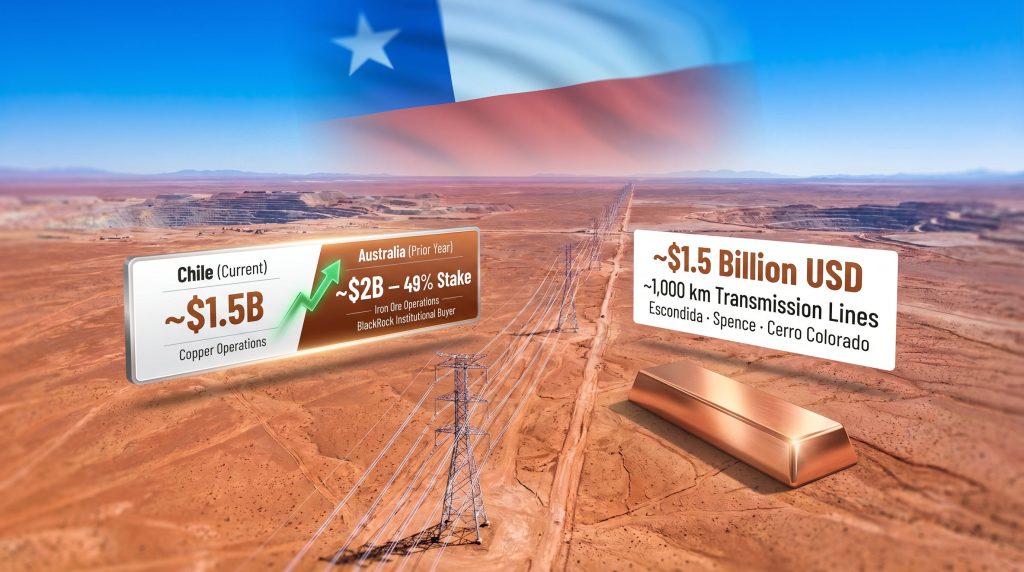
When a major miner's internal rate of return on copper development consistently exceeds the yield generated by holding transmission lines, divestiture stops being optional. It becomes a capital efficiency imperative. This logic sits at the centre of BHP's reported plan to execute a BHP Chile power transmission line sale valued at approximately $1.5 billion USD, a transaction that would strip away roughly 1,000 km of high-voltage grid infrastructure from its Chilean copper operations and redirect that capital toward the assets it increasingly views as core to its future.
When big ASX news breaks, our subscribers know first
Understanding the Asset: What BHP Is Actually Selling in Chile
The transmission network in question is not a peripheral or easily replaceable asset. It forms the backbone of the electricity supply chain for some of BHP's most strategically significant copper operations in northern Chile. Furthermore, the lines serve three distinct sites:
- Escondida – the world's largest copper mine by production volume, located in the Atacama Desert at an elevation of approximately 3,100 metres above sea level
- Spence – a large-scale open-pit copper and cathode producer that underwent a major expansion in recent years to extend its operational life
- Cerro Colorado – a copper mine that is currently non-operational, adding a layer of complexity to buyer due diligence
The geographic span of these transmission lines across northern Chile's copper belt is substantial. At approximately 1,000 km (621 miles), the network represents a significant piece of dedicated industrial energy infrastructure serving one of the planet's most copper-rich jurisdictions. Notably, the Chile copper price outlook for 2025 and beyond makes this region increasingly strategic for global miners.
Asset Parameters at a Glance
| Asset Detail | Reported Figure |
|---|---|
| Estimated Asset Value | ~$1.5 billion USD |
| Total Transmission Coverage | ~1,000 km (621 miles) |
| Connected Mining Operations | Escondida, Spence, Cerro Colorado |
| Expected Transaction Timeline | Within 2026 (subject to review) |
| Potential Buyer Categories | Transmission companies, energy firms, institutional investors |
The Cerro Colorado Complication
The inclusion of Cerro Colorado in this sale package introduces a dimension that sophisticated infrastructure buyers will scrutinise carefully. Cerro Colorado has been idled, meaning a portion of the transmission network BHP is selling currently lacks an active mining end-user. In infrastructure investment terminology, this creates what analysts sometimes call stranded capacity risk, where a portion of the asset's revenue-generating potential depends on either the eventual restart of mining activity, a renegotiated grid access arrangement, or the identification of alternative power offtake customers.
Buyers with experience in Chile's electricity market will likely model this variable carefully. Chile's northern grid, historically part of the SING (Sistema Interconectado del Norte Grande) before its integration into the national SEN grid system, has seen increasing complexity as renewable energy generation expands. A buyer could theoretically repurpose dormant transmission capacity toward solar or other industrial users in the region, however this involves regulatory engagement and commercial risk that will be reflected in pricing negotiations.
The Australian Blueprint: BHP's Proven Transmission Divestiture Template
This Chilean transaction does not emerge in isolation. In the prior year, BHP completed a $2 billion sale of a 49% stake in transmission infrastructure linked to its iron ore operations in Western Australia. The buyer was an infrastructure investment unit of BlackRock, one of the world's largest asset managers, with an enormous and growing allocation to infrastructure as a distinct investment category.
That Australian transaction established several important precedents:
- Institutional capital at the largest scale is actively willing to own mining-linked transmission assets
- Partial stake structures are viable, allowing BHP to retain operational continuity while monetising latent balance sheet value
- Mining grid infrastructure commands genuine premium valuations from yield-seeking infrastructure investors
- BHP has the organisational capability and appetite to execute these transactions across different commodity divisions
Australia vs. Chile: A Comparative Framework
| Comparison Factor | Chile (Current) | Australia (Prior Year) |
|---|---|---|
| Estimated Value | ~$1.5 billion | ~$2 billion (49% stake) |
| Asset Type | Power transmission lines | Transmission infrastructure |
| Connected Commodity | Copper | Iron ore |
| Stake Structure | Full sale (structure under review) | Partial 49% stake |
| Buyer Profile | TBC | BlackRock infrastructure unit |
| Geographic Region | Northern Chile | Western Australia |
| Complicating Factor | Cerro Colorado closure | None reported |
The sequential nature of these divestitures — first Australian iron ore infrastructure, now Chilean copper infrastructure — points toward a deliberate and repeatable capital recycling strategy rather than a one-off balance sheet clean-up. In addition, according to Reuters, the transaction timeline remains subject to ongoing commercial review, underscoring the complexity involved.
Who Are the Most Credible Buyers for Chilean Transmission Assets?
Three distinct buyer archetypes exist for an asset of this type, each with different motivations and risk tolerances.
Transmission and Utility Operators
Established grid operators in Chile represent the most natural strategic fit. Companies already operating within Chile's national electricity transmission framework, regulated under the country's Electricity Transmission Law (Ley de Transmisión Eléctrica), would benefit from regulatory familiarity, existing operational infrastructure, and the ability to integrate BHP's lines into broader national grid management. Chile's Comisión Nacional de Energía (CNE) provides long-term tariff certainty for transmission assets, which creates a stable regulatory foundation that utility-style buyers typically prize above all else.
Renewable Energy Developers and Independent Energy Firms
Northern Chile's Atacama region hosts some of the highest solar irradiance levels on Earth, making it a globally significant zone for large-scale photovoltaic development. Independent energy firms and renewable developers might view BHP's transmission corridors as strategically valuable infrastructure for routing solar generation toward Chile's growing industrial and urban load centres. The long-term optionality of repurposing mining transmission capacity toward green hydrogen export infrastructure — an area where Chile has articulated national ambitions — could also feature in buyer valuations, though this remains speculative and commercially unproven at scale.
Institutional and Infrastructure Capital
Sovereign wealth funds, pension funds, and infrastructure-focused asset managers represent the third buyer category. The BlackRock precedent in Australia demonstrated that this capital is not merely theoretically interested in mining-linked grid assets. It actively competed for and acquired one.
Infrastructure investors are drawn to transmission assets because of their long asset lives, inflation-linked revenue structures, and regulated return frameworks. The Chile assets, despite the Cerro Colorado complication, offer exactly this profile across the majority of the network.
Capital Reallocation: Where Does $1.5 Billion Go Next?
The strategic rationale for the BHP Chile power transmission line sale becomes clearest when examined through the lens of where the proceeds are likely to flow. Chile holds the world's largest copper reserves, estimated by the United States Geological Survey (USGS) at approximately 190 million metric tonnes, representing roughly 23% of global identified reserves. Consequently, for a company that has articulated copper as its primary growth commodity in the context of accelerating global electrification demand, the logic of redeploying $1.5 billion from grid infrastructure into copper development capacity is straightforward.
Escondida alone requires continuous and substantial capital investment to sustain production from ore bodies that, while vast, are progressively deeper and lower in grade than historical mining faces. The copper grade challenge is real: Escondida's ore grades have declined over decades as the highest-grade surface material has been extracted, requiring ongoing investment in concentrating technology, water management, and throughput capacity to maintain output volumes. Understanding broader copper market trends makes the case for this capital reallocation even more compelling.
Spence, meanwhile, completed a major hypogene expansion to access deeper sulphide ore beneath its oxide deposit, extending the mine's productive life significantly but requiring continued capital to optimise that processing infrastructure.
Scenario Modelling: Three Post-Sale Outcomes
| Scenario | Description | Probability Assessment |
|---|---|---|
| Full Sale Completed in 2026 | BHP closes transaction, ~$1.5B recycled into copper capex | Moderate-High |
| Partial Stake Sale (Australia Model) | BHP retains operational control, monetises minority interest | Possible |
| Sale Delayed or Restructured | Cerro Colorado due diligence complications extend timeline | Lower probability, non-trivial risk |
Disclaimer: The above scenario assessments are analytical frameworks based on publicly available information and do not constitute investment advice. Investors should conduct independent due diligence before making any investment decisions.
The Broader Industry Shift: Mining Is Getting Out of the Grid Business
BHP's Chilean transmission divestiture is best understood not as a standalone corporate event but as a signal of a structural shift across the global mining sector. The operating logic of large-cap miners is increasingly converging on a simple principle: own the ore, not the wires. Furthermore, this asset-light orientation reflects several simultaneous pressures:
- Shareholder demands for higher returns on invested capital, which non-core infrastructure tends to dilute
- The availability of specialist infrastructure capital willing to pay premium valuations for stable, regulated cash flows
- Increasing capital demands from the energy transition, as miners face pressure to decarbonise operations while simultaneously investing in the metals that decarbonisation requires
- Portfolio simplification strategies that improve operational focus and management bandwidth
If BHP's playbook continues along this trajectory, the logical question for investors is whether similar infrastructure monetisation opportunities exist elsewhere in BHP's global asset base, or indeed across peer companies. For instance, Rio Tinto copper expansion activity in 2025 raises similar questions about how large-cap miners manage non-core infrastructure alongside core mining assets.
Chile's copper sector, underpinned by the world's largest reserve base, ensures that BHP's strategic commitment to the country is not diminishing. If anything, this divestiture signals the opposite: by freeing capital tied up in transmission infrastructure, BHP is intensifying its focus on the mining activity itself, at precisely the moment when global copper demand trajectories are most compelling. Those exploring copper investment strategies will find that understanding these structural capital shifts is essential context. Meanwhile, commodity price impacts on mining company performance further reinforce why BHP is prioritising this kind of balance sheet optimisation now. According to Mining.com, this move represents a clear "copper-first pivot" for the company.
The next major ASX story will hit our subscribers first
Frequently Asked Questions: BHP Chile Transmission Line Sale
What assets is BHP selling in Chile?
Approximately 1,000 km of power transmission lines supplying electricity to the Escondida, Spence, and Cerro Colorado copper mining operations in northern Chile, with a reported valuation of around $1.5 billion USD.
Why is Cerro Colorado included if the mine is shut down?
The transmission lines physically connect to the Cerro Colorado site regardless of its operational status. Buyers must assess how to value and manage that dormant capacity as part of their due diligence process.
Has BHP executed a similar transaction before?
Yes. In the prior year, BHP sold a 49% stake in transmission infrastructure serving its Australian iron ore operations to a BlackRock infrastructure unit for approximately $2 billion.
Who are the likely buyers?
Potential acquirers include Chilean and international transmission operators, independent energy and renewable energy firms, and institutional infrastructure investors such as sovereign wealth funds and pension capital allocators.
When could the deal close?
Reports citing Chilean financial newspaper Diario Financiero indicate the BHP Chile power transmission line sale could be executed within 2026, though the timeline remains subject to buyer selection and due diligence completion.
What does this mean for BHP's copper strategy?
The divestiture reinforces BHP's strategic focus on copper mining as its primary growth pillar, with proceeds expected to support capital investment across its Chilean copper portfolio in a market where long-term demand fundamentals remain structurally positive.
Want to Identify the Next Major Copper Discovery Before the Broader Market Does?
As BHP doubles down on copper by recycling capital from non-core infrastructure, the race to find and act on significant new discoveries is intensifying — and Discovery Alert's proprietary Discovery IQ model delivers real-time ASX mineral discovery alerts straight to subscribers, transforming complex commodity data into actionable opportunities the moment they are announced. Explore historic discovery returns that demonstrate just how significant early positioning can be, and begin your 14-day free trial at Discovery Alert to gain a market-leading edge in copper and beyond.