
June 8, 2026
American energy policy has entered a transformative phase where technological innovation, regulatory reform, and strategic resource allocation converge to reshape global competitive dynamics. The intersection of artificial intelligence capabilities, nuclear modernisation programs, and traditional energy resource optimisation creates unprecedented opportunities for sustained economic and security advantages. Understanding these interconnected systems requires examining how domestic production capabilities, export strategies, and infrastructure investments align with broader American energy dominance objectives.
How is America Achieving Energy Independence Through Domestic Resource Optimisation?
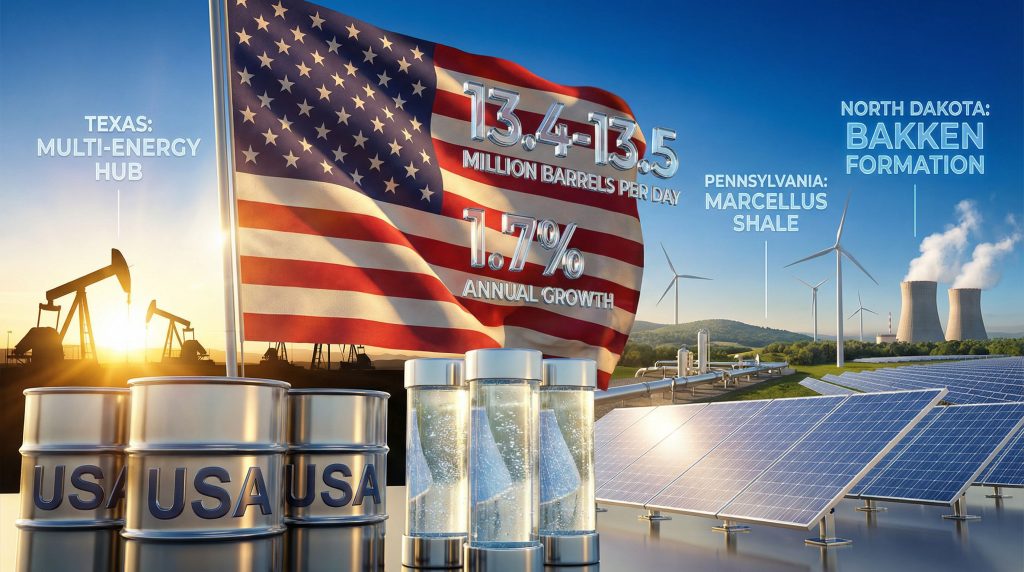
The foundation of American energy leadership rests on a comprehensive multi-resource portfolio that leverages both conventional and renewable sources across diverse geographic regions. Current production metrics demonstrate the scale of this approach, with crude oil output maintaining levels between 13.4-13.5 million barrels per day while natural gas production continues expanding at approximately 1.7% annually. These figures reflect sustained investment in extraction technologies and operational efficiency improvements across key production zones.
Furthermore, Secretary Wright emphasised the abundance of domestic resources, stating that the United States possesses significant reserves of coal, oil, and natural gas, all unlocked through American innovation capabilities. This multi-resource strategy provides resilience against global oil futures volatility while supporting diverse regional economies through specialised energy production centres.
Regional Production Centres Driving National Output:
• Texas: Serves as the nation's primary multi-energy hub, integrating oil and gas production with rapidly expanding solar and wind capacity
• Pennsylvania: Functions as the epicentre of Marcellus shale gas production, contributing substantially to national natural gas output
• North Dakota: Maintains significant Bakken formation oil production, supporting crude oil export capabilities
• California: Leads in solar capacity deployment and battery storage technology development
The renewable energy sector demonstrates remarkable growth trajectories, with solar installations comprising 55-74% of new generation capacity additions and wind energy accounting for 18% of new capacity. This expansion occurs alongside continued optimisation of conventional resource extraction, creating a balanced energy portfolio that supports both reliability and environmental objectives.
Geographic diversification across these production regions reduces single-point failure risks while enabling specialised expertise development in different energy technologies. Consequently, Texas exemplifies this diversification strategy, hosting major oil refineries, natural gas processing facilities, and some of the largest solar installations in the United States.
Production Metrics Defining Current Energy Leadership:
| Energy Source | Current Output | Growth Rate | Key Regions |
|---|---|---|---|
| Crude Oil | 13.4-13.5 million barrels/day | Stable | Texas, North Dakota, New Mexico |
| Natural Gas | Expanding capacity | 1.7% annually | Pennsylvania, Texas, Oklahoma |
| Solar Capacity | Major additions | 55-74% of new generation | California, Texas, North Carolina |
| Wind Energy | Steady growth | 18% of new capacity | Texas, Iowa, Kansas |
Cost competitiveness remains a critical factor in maintaining domestic production leadership. Advanced extraction techniques, including horizontal drilling and enhanced oil recovery methods, continue reducing per-unit production costs while extending the operational lifecycles of existing fields. These efficiency gains support sustained profitability even during periods of commodity price volatility.
When big ASX news breaks, our subscribers know first
What Role Does Technology Innovation Play in Sustaining Energy Dominance?
Technology innovation serves as the primary catalyst for maintaining American energy sector competitiveness, with artificial intelligence and high-performance computing emerging as transformational forces. Secretary Wright highlighted that DOE operates four of the world's top ten supercomputers, positioning the agency as a leader in computational capabilities that support both energy development and national security objectives.
The integration of AI systems across energy operations creates opportunities for optimisation that extend from geological modelling to grid management. These computational advances enable more precise resource exploration, improved extraction efficiency, and enhanced predictive maintenance protocols that reduce operational downtime and costs.
Breakthrough Technologies Reshaping Resource Access:
• Horizontal Drilling Advancements: Extended lateral reach capabilities and improved directional control systems increase recovery rates from existing formations
• Enhanced Oil Recovery Techniques: Advanced injection methods and chemical treatments extend field lifecycles by accessing previously unrecoverable resources
• Digital Optimisation Systems: Real-time monitoring and predictive analytics reduce operational costs through improved equipment performance and maintenance scheduling
Secretary Wright characterised the current technological moment as pivotal, stating that while America's nuclear innovation began with the Manhattan Project, the next equivalent technological leap clearly involves artificial intelligence development. This perspective positions AI advancement as essential for maintaining global competitiveness across multiple sectors.
Next-Generation Energy Infrastructure Development:
Smart grid integration represents a critical technological frontier that enables efficient management of renewable energy intermittency while maintaining grid reliability. Advanced battery storage systems, combined with alternative storage technologies, provide the flexibility needed to accommodate variable renewable generation whilst ensuring consistent power delivery.
Energy storage capacity expansion involves multiple technology pathways beyond traditional lithium-ion batteries. These include compressed air energy storage, pumped hydroelectric systems, and emerging technologies like hydrogen storage that can provide long-duration backup power for grid stability.
Nuclear technology advancement focuses on small modular reactors (SMRs) and Generation IV reactor designs that promise improved safety profiles, reduced construction costs, and enhanced operational flexibility. In addition, Secretary Wright confirmed that DOE prioritises advancing rapid deployment of next-generation nuclear technology, including small modular reactors that can support both civilian power generation and specialised applications.
AI and Computing Integration in Energy Operations:
The Department of Energy's world-class high-performance computing capabilities support multiple critical functions that extend beyond traditional energy applications. These systems enable complex geological modelling for resource exploration, materials science research for advanced reactor development, and climate modelling for long-term energy planning.
Machine learning applications in energy operations include supply chain optimisation, predictive maintenance systems, and automated grid management protocols. These technologies reduce operational costs while improving system reliability and response times during grid disturbances or supply disruptions.
Technology Development Priorities:
| Technology Category | Application | Expected Impact |
|---|---|---|
| AI/Machine Learning | Predictive maintenance, grid optimisation | 15-25% cost reduction |
| Small Modular Reactors | Distributed nuclear power | Enhanced grid reliability |
| Advanced Materials | Reactor components, solar panels | Improved durability, efficiency |
| Energy Storage | Grid stabilisation, renewable integration | Reduced intermittency challenges |
Research and development priorities emphasise technologies that provide measurable returns on investment while supporting national security objectives. This approach ensures that innovation efforts align with both commercial viability and strategic national interests.
How Are Market Dynamics Influencing America's Energy Strategy?
Market dynamics profoundly shape American energy strategy through regulatory reform initiatives, investment flow patterns, and competitive positioning against international producers. The most significant recent development involves the elimination or reduction of 47 regulations, representing the largest deregulatory effort in U.S. history with projected savings of approximately $11 billion for American consumers.
This regulatory streamlining initiative addresses longstanding concerns about administrative burden and compliance costs that have constrained energy development projects. The reforms target home efficiency standards, appliance regulations, and permitting processes that previously created barriers to innovation and competition.
Secretary Wright announced the official end to the previous administration's pause on LNG export permits, signalling a return to regular order for reviewing and approving new export applications. This policy shift enables American natural gas producers to access global markets while providing diplomatic leverage through energy exports to allied nations. Moreover, such tariff policy impacts continue to influence energy trade dynamics globally.
Global Competitive Positioning Analysis:
| Factor | U.S. Position | Competitive Advantage |
|---|---|---|
| Production Volume | Leading crude oil, top 3 natural gas | Domestic resource abundance |
| Technology Innovation | Advanced extraction, AI integration | Superior R&D capabilities |
| Export Capacity | Expanding LNG, stable crude exports | Geographic positioning |
| Cost Structure | Competitive wellhead prices | Operational efficiency |
Price volatility management involves strategic coordination between market mechanisms and government reserves. The Strategic Petroleum Reserve replenishment programme provides both market stabilisation capabilities and emergency supply security, though specific replenishment targets and timelines require further clarification through detailed budget documentation.
Investment Flow Patterns and Capital Allocation:
Private sector drilling activity demonstrates strong correlation with commodity prices, creating cyclical investment patterns that influence production capacity. When crude oil prices exceed operational break-even thresholds, typically around $40-50 per barrel for most U.S. formations, drilling activity increases substantially. However, US drilling trends show recent declines despite favourable market conditions.
Federal funding priorities reflect a reorientation toward research and development activities that support commercial competitiveness rather than direct market intervention. This approach emphasises technology advancement, infrastructure modernisation, and national security applications that provide broad economic benefits.
The redirection of more than $15 billion away from previous administration programmes toward energy dominance initiatives represents a significant shift in federal resource allocation. These funds support nuclear modernisation, AI development for energy applications, and critical infrastructure improvements.
Market Risk Assessment:
• Commodity Price Volatility: Oil and gas price fluctuations directly impact drilling investment and production decisions
• International Competition: Global producers compete on cost, technology, and market access
• Infrastructure Constraints: Pipeline, refining, and export terminal capacity limitations affect market reach
• Regulatory Uncertainty: Policy changes influence long-term investment confidence
Investment risk mitigation strategies include diversified portfolio approaches that balance conventional and renewable resources, geographic distribution of assets, and technology advancement that reduces operational costs regardless of commodity price environments.
What Are the National Security Implications of Energy Leadership?
Energy leadership provides fundamental national security advantages through reduced dependence on potentially unstable regions, enhanced diplomatic leverage via energy exports, and robust domestic supply chains for critical materials. The modernisation of America's nuclear weapons stockpile represents a core national security function that requires sustained investment and technological advancement.
Secretary Wright emphasised that responsible stewardship and modernisation of nuclear weapons systems remains paramount for both the Department of Energy and the current administration. This includes addressing critical upgrades for the U.S. nuclear stockpile and maintaining propulsion systems for submarines and aircraft carriers, functions that become increasingly crucial in coming years. Additionally, nuclear supply concerns highlight the importance of domestic nuclear fuel security.
Geopolitical Leverage Through Energy Exports:
LNG diplomacy creates opportunities for alliance strengthening by providing reliable energy supplies to partner nations while reducing their dependence on potentially hostile exporters. The resumption of LNG export permit approvals enables expanded market access and enhanced diplomatic influence through energy partnerships.
American crude oil and refined product exports provide additional diplomatic tools, particularly during international crises when energy supply disruptions threaten allied nations. The ability to rapidly increase export volumes during emergencies strengthens alliance relationships and demonstrates American reliability as an energy partner.
Reduced dependence on energy imports from volatile regions eliminates potential leverage that hostile nations might exercise through supply disruptions or price manipulation. This independence allows American foreign policy greater flexibility in responding to international crises without concerns about energy supply retaliation.
Critical Infrastructure Protection Frameworks:
Cybersecurity protocols for energy systems address growing threats from state and non-state actors who target critical infrastructure as potential attack vectors. The Department of Energy's cybersecurity capabilities must evolve continuously to address emerging threats against grid operations, nuclear facilities, and energy production sites.
Physical security enhancements for key facilities include perimeter defence improvements, access control systems, and rapid response protocols for potential threats. These measures protect against both terrorist attacks and sabotage attempts that could disrupt energy supplies during national emergencies.
Supply chain resilience against disruption involves diversifying critical component sources, maintaining strategic reserves of essential materials, and developing domestic production capabilities for components previously sourced from potentially unreliable international suppliers.
Nuclear Deterrence and Weapons Stockpile Modernisation:
| Component | Function | Modernisation Priority |
|---|---|---|
| Tritium Production | Nuclear warhead maintenance | High – aging stockpile |
| Weapons-Grade Materials | Stockpile sustainment | Critical – purity standards |
| Naval Reactor Fuel | Submarine/carrier propulsion | Essential – fleet operations |
| Research Facilities | Deterrence credibility | Important – scientific base |
Naval reactor fuel supply for submarines and aircraft carriers requires specialised uranium enrichment capabilities and secure supply chains that operate independently from commercial nuclear fuel markets. This separation ensures military operations remain unaffected by civilian market disruptions or international supply constraints.
Scientific research supporting deterrence credibility involves advanced materials research, computer modelling of nuclear systems, and testing protocols that verify weapons effectiveness without underground testing. These programmes require significant computational resources and specialised facilities that few nations possess.
Intelligence and Monitoring Capabilities:
Energy infrastructure monitoring provides intelligence capabilities for tracking international energy flows, identifying potential supply disruptions, and assessing the energy security of both allies and adversaries. This information supports diplomatic negotiations and strategic planning for various international scenarios.
How Is Regulatory Reform Accelerating Energy Development?
Regulatory reform represents the most immediate mechanism for accelerating American energy development through reduced compliance burdens, streamlined permitting processes, and enhanced operational flexibility. The proposed elimination or reduction of 47 regulations constitutes an unprecedented deregulatory initiative that addresses decades of accumulated administrative constraints on energy production and distribution.
These regulatory modifications target multiple aspects of energy development, from home efficiency standards that increased consumer costs without proportional benefits to complex permitting requirements that delayed critical infrastructure projects. The projected $11 billion in consumer savings reflects both direct cost reductions and improved market efficiency through reduced regulatory compliance expenses.
Deregulation Impact Assessment:
The scope of regulatory elimination encompasses various energy-related functions that previously created barriers to innovation and competition. Home efficiency standards receive particular attention as regulations that imposed disproportionate costs on consumers while limiting product choices and innovation opportunities.
Permitting streamlining for energy projects addresses longstanding concerns about project delays that increase development costs and discourage investment in new energy infrastructure. Simplified approval processes enable faster deployment of both conventional and renewable energy projects while maintaining necessary environmental and safety protections.
Environmental review process optimisation reduces duplicative assessments and conflicting agency requirements that previously extended project timelines without corresponding environmental benefits. This streamlining maintains environmental protection standards while eliminating bureaucratic delays that hindered energy development.
Consumer Cost Reduction Initiatives:
• Home Efficiency Standards Rightsizing: Adjusting regulations to balance energy efficiency with consumer choice and affordability
• Appliance Regulation Modifications: Reducing regulatory burden while maintaining safety and performance standards
• Energy Choice Expansion: Enabling greater consumer flexibility in energy options and service providers
Appliance regulation modifications focus on eliminating requirements that forced consumers toward more expensive products without providing proportional utility or environmental benefits. This approach restores consumer choice while maintaining essential safety and performance standards.
Energy choice expansion programmes enable consumers to select energy sources, service providers, and efficiency options that align with their priorities and budgets rather than government-mandated preferences. This market-based approach typically results in lower costs and improved customer satisfaction.
Federal Agency Coordination Improvements:
Inter-agency approval process acceleration eliminates duplicative reviews and conflicting requirements that previously created unnecessary delays in energy project development. Coordinated review processes maintain thorough evaluation standards while reducing total approval timeframes.
Duplicative oversight elimination addresses situations where multiple agencies conducted essentially identical reviews of the same project components, creating administrative burden without improving outcomes. Streamlined oversight assigns primary responsibility to the most appropriate agency while maintaining necessary coordination.
State-federal cooperation enhancement improves coordination between federal agencies and state regulators to reduce conflicts and inconsistencies that previously created compliance challenges for energy developers. This cooperation maintains appropriate regulatory authority while reducing administrative complexity.
Regulatory Reform Timeline and Implementation:
| Reform Category | Timeline | Expected Impact |
|---|---|---|
| Home Efficiency Standards | 6-12 months | Reduced consumer costs |
| Permitting Streamlining | 12-18 months | Faster project approvals |
| Agency Coordination | Ongoing | Reduced administrative burden |
| Environmental Review | 18-24 months | Accelerated infrastructure development |
Implementation of regulatory reforms requires careful coordination to ensure that deregulation achieves intended cost reductions and efficiency improvements without compromising essential safety, environmental, or national security protections.
What Does the Future Energy Mix Look Like for America?
America's future energy mix reflects a strategic integration of renewable technologies, advanced nuclear systems, and optimised conventional resources that collectively provide reliable, affordable energy while maintaining environmental stewardship. This balanced approach recognises both the continued importance of traditional energy sources and the expanding role of innovative technologies in meeting growing energy demands.
Solar capacity expansion continues at unprecedented rates, with installations comprising the majority of new generation capacity additions. This growth reflects continued cost reductions, improved efficiency, and enhanced grid integration capabilities that make solar power economically competitive across diverse geographic regions.
Wind energy deployment focuses on optimal geographic positioning and technological advancement that maximises capacity factors while minimising environmental impacts. Offshore wind development represents a significant growth opportunity, particularly along coastal regions with favourable wind resources and proximity to major population centres.
Renewable Energy Integration Scenarios:
• Solar Capacity Trajectory: Grid-scale installations expanding across diverse climate zones with improved storage integration
• Wind Energy Geographic Expansion: Both onshore and offshore developments optimised for regional wind resources
• Storage Technology Cost Reduction: Battery systems and alternative storage technologies enabling higher renewable penetration
Energy storage technology advancement enables higher renewable energy penetration by addressing intermittency challenges that previously limited wind and solar deployment. Advanced battery systems, pumped hydro storage, and emerging technologies like compressed air energy storage provide the flexibility needed for reliable grid operations with variable renewable generation.
Grid modernisation supports renewable integration through smart grid technologies, improved transmission capacity, and advanced control systems that optimise energy flows across diverse generation sources. These infrastructure improvements enable efficient distribution of renewable energy from optimal production regions to major consumption centres.
Traditional Energy Sector Evolution:
Natural gas maintains a crucial role as both a transition fuel and industrial feedstock, providing grid reliability during renewable generation fluctuations while supporting chemical manufacturing and other industrial processes. Advanced extraction techniques continue improving recovery rates and reducing production costs for domestic natural gas supplies.
Coal utilisation focuses on specialised applications where alternative energy sources cannot provide equivalent functionality, such as metallurgical coal for steel production and certain industrial processes requiring specific thermal characteristics. Clean coal technologies continue development for remaining applications.
Oil production sustainability involves enhanced recovery techniques and operational efficiency improvements that extend field lifecycles while reducing environmental impacts. Advanced drilling technologies enable access to previously unrecoverable resources while minimising surface disturbance and water usage.
Nuclear Renaissance Potential:
| Technology Type | Deployment Timeline | Key Advantages |
|---|---|---|
| Small Modular Reactors | 2028-2032 | Reduced capital costs, enhanced safety |
| Generation IV Reactors | 2035-2040 | Higher efficiency, improved fuel utilisation |
| Advanced Fuels | 2030-2035 | Extended burn-up, reduced waste |
| Fusion Technology | 2040+ | Unlimited clean energy potential |
Small modular reactor commercial deployment represents the most immediate nuclear expansion opportunity, offering enhanced safety features, reduced capital requirements, and improved operational flexibility compared to traditional large reactor designs. Secretary Wright confirmed DOE's commitment to advancing rapid deployment of these next-generation nuclear technologies.
Advanced reactor technology development includes high-temperature gas reactors, molten salt reactors, and fast neutron reactors that offer improved efficiency, enhanced safety characteristics, and better fuel utilisation compared to current reactor designs. These technologies could significantly expand nuclear energy's role in future energy systems.
Uranium supply chain domestic development reduces dependence on international uranium sources while supporting nuclear fuel security for both civilian and military applications. Enhanced domestic uranium production capabilities ensure long-term nuclear energy sustainability regardless of international market conditions.
Integration Challenges and Solutions:
Grid stability management becomes increasingly complex as renewable energy penetration increases, requiring sophisticated control systems and storage capabilities to maintain frequency regulation and voltage stability. Advanced grid management technologies enable higher renewable integration while preserving power quality and reliability.
Seasonal energy storage addresses the challenge of matching renewable energy generation patterns with seasonal demand variations, particularly in regions with significant heating or cooling requirements. Long-duration storage technologies and seasonal fuel storage systems provide solutions for extended demand-generation mismatches.
The next major ASX story will hit our subscribers first
How Will Energy Dominance Drive Economic Growth?
Energy dominance creates multiplier effects throughout the American economy by providing cost-competitive inputs for manufacturing, supporting high-wage employment opportunities, and catalysing innovation ecosystems that generate technological spillovers across multiple sectors. Low-cost, reliable energy serves as a foundational competitive advantage that attracts energy-intensive industries and enables domestic manufacturing competitiveness against international competitors.
Manufacturing competitiveness through reduced energy costs enables American producers to compete effectively against international manufacturers who previously benefited from lower energy prices. Energy-intensive industries including steel production, aluminium smelting, chemical manufacturing, and data processing operations particularly benefit from reliable, affordable domestic energy supplies.
Industrial energy pricing advantages create opportunities for supply chain reshoring as American manufacturers can now compete on total cost rather than just labour expenses. This trend supports job creation in higher-wage manufacturing sectors while reducing dependence on potentially unreliable international supply chains.
Manufacturing Competitiveness Through Low Energy Costs:
• Industrial Energy Pricing: Competitive electricity and natural gas prices supporting energy-intensive manufacturing
• Supply Chain Reshoring: Domestic production becoming cost-competitive with international alternatives
• Export Manufacturing Capacity: American products gaining competitiveness in international markets
Export manufacturing capacity expansion benefits from both low domestic energy costs and advanced manufacturing technologies that improve productivity and quality. American manufacturers increasingly compete successfully in international markets, particularly in high-technology products that require reliable energy supplies and skilled workforces.
Energy export revenue provides additional economic benefits through trade balance improvements and foreign exchange earnings. LNG exports, crude oil exports, and refined product exports generate substantial revenue streams while creating employment opportunities in production, processing, and transportation sectors.
Workforce Development and Job Creation:
Energy sector employment encompasses diverse skill levels and geographic regions, from high-technology research positions at national laboratories to skilled trades work in oil fields, refineries, and power plants. This employment diversity provides economic opportunities across various educational backgrounds and geographic areas.
Skills training programmes for emerging technologies prepare workers for careers in advanced nuclear systems, renewable energy installation and maintenance, and energy storage technologies. These programmes address projected workforce needs while providing career advancement opportunities for existing energy workers.
Regional economic development through energy projects creates economic multiplier effects in areas with significant energy resources or infrastructure. These projects support local businesses, generate tax revenue for public services, and attract additional industries that benefit from proximity to energy production facilities.
Energy Employment by Sector:
| Sector | Employment Type | Growth Potential |
|---|---|---|
| Oil & Gas | Production, refining, transportation | Moderate – technology-driven efficiency |
| Renewable Energy | Manufacturing, installation, maintenance | High – capacity expansion |
| Nuclear | Operations, engineering, research | High – SMR deployment |
| Grid Infrastructure | Engineering, construction, operations | High – modernisation needs |
Innovation economy catalyst effects extend beyond direct energy employment through technology transfer, research partnerships, and startup development. Energy-related innovation often generates applications in other sectors, creating broader economic benefits through technological spillovers.
Innovation Economy Catalyst Effects:
Research and development spillover benefits occur when energy sector innovations find applications in other industries. Advanced materials developed for nuclear reactors may benefit aerospace applications, while grid management software may support telecommunications infrastructure optimisation.
Technology transfer to civilian applications enables commercialisation of energy research investments in broader markets. Technologies developed for energy storage, advanced computing, and materials science often find profitable applications in consumer products, medical devices, and transportation systems.
Startup ecosystem development in energy technology creates entrepreneurial opportunities and venture capital investment that supports innovation beyond large corporate research programmes. These startups often develop specialised solutions that complement larger energy companies' capabilities while creating new business opportunities.
Economic Impact Projections:
The economic benefits of energy dominance extend across multiple timeframes and sectors. Short-term benefits include direct employment in energy production and infrastructure development, while long-term benefits encompass manufacturing competitiveness, export revenue, and innovation-driven economic growth.
GDP impact estimates from energy sector growth indicate substantial economic contributions through direct production, supporting services, and multiplier effects. Energy sector productivity improvements also reduce costs for all other economic sectors, creating economy-wide efficiency gains.
What Challenges Could Threaten Long-Term Energy Leadership?
Sustained American energy dominance faces potential challenges from technological disruption, international competition, infrastructure limitations, and evolving environmental requirements that require proactive mitigation strategies. Understanding these risk factors enables development of adaptive approaches that maintain competitive advantages while addressing emerging constraints.
Commodity price volatility represents a persistent challenge that affects investment decisions, production planning, and long-term strategic positioning. While American producers have achieved significant cost reductions through technological advancement, extreme price fluctuations can still disrupt investment cycles and development timelines. Consequently, oil price movements require careful monitoring to maintain strategic advantages.
International competition intensifies as other nations develop advanced energy technologies and expand production capabilities. Countries with substantial energy resources continue investing in extraction technology, renewable energy deployment, and export infrastructure that could challenge American market leadership.
Market Risk Factors and Mitigation Strategies:
• Commodity Price Management: Strategic reserve utilisation and production flexibility to manage price volatility
• Technology Disruption Adaptation: Continuous innovation investment to maintain technological advantages
• International Competition Response: Competitive positioning through efficiency improvements and market diversification
Technology disruption adaptation requires sustained investment in research and development to maintain technological leadership as energy technologies evolve rapidly. Artificial intelligence, advanced materials, and energy storage technologies continue advancing at rates that could significantly alter competitive dynamics.
Market diversification reduces dependence on specific commodity prices or export markets by maintaining balanced portfolios of energy sources and customer bases. This approach provides resilience against disruptions in particular market segments while maintaining overall revenue stability.
Infrastructure Aging and Modernisation Needs:
Pipeline and transmission system upgrades require substantial investment to maintain reliable energy transportation capacity while accommodating changing production patterns and demand centres. Aging infrastructure faces increasing maintenance costs and reliability challenges that could constrain energy delivery capabilities.
Refinery capacity optimisation addresses changing product demand patterns and environmental requirements while maintaining adequate processing capability for domestic consumption and export markets. Modern refining technologies can improve efficiency while reducing environmental impacts.
Grid resilience enhancement priorities include cybersecurity improvements, physical hardening against extreme weather events, and capacity expansion to accommodate growing electricity demand from data centres, electric vehicle charging, and industrial electrification.
Infrastructure Investment Requirements:
| Infrastructure Category | Investment Need | Timeline | Priority Level |
|---|---|---|---|
| Pipeline Systems | $50-75 billion | 10-15 years | High – capacity constraints |
| Transmission Grid | $75-100 billion | 15-20 years | Critical – renewable integration |
| Refining Capacity | $25-40 billion | 5-10 years | Moderate – demand changes |
| Storage Infrastructure | $30-50 billion | 10-15 years | High – grid reliability |
Environmental and Social Considerations:
Climate adaptation strategies for energy infrastructure address potential impacts from extreme weather events, sea level rise, and changing precipitation patterns that could affect energy production and distribution systems. Resilient infrastructure design incorporates these considerations while maintaining operational effectiveness.
Community engagement in energy development ensures that local populations benefit from energy projects while addressing legitimate environmental and social concerns. Effective community engagement reduces project opposition while building long-term support for energy infrastructure development.
Water resource management for energy operations becomes increasingly important as water availability constraints affect energy production in various regions. Efficient water usage technologies and alternative cooling systems reduce water consumption while maintaining operational capabilities.
Risk Assessment and Response Planning:
Scenario planning for various challenge combinations enables preparation for multiple potential futures rather than assuming current trends will continue unchanged. These scenarios include different commodity price environments, technological advancement rates, and international competitive responses.
Adaptive management strategies provide flexibility to adjust approaches as conditions change while maintaining progress toward long-term energy leadership objectives. This approach recognises uncertainty in future developments while ensuring continued advancement in energy capabilities.
Emergency response capabilities address potential disruptions from natural disasters, cyberattacks, or geopolitical events that could threaten energy security. Robust emergency response systems enable rapid recovery from disruptions while maintaining essential energy services.
Sustaining America's Energy Advantage
American energy dominance requires sustained strategic focus across technological innovation, infrastructure investment, regulatory optimisation, and international engagement to maintain competitive advantages in an evolving global energy landscape. The integration of advanced nuclear systems, artificial intelligence capabilities, and optimised conventional resource development creates unprecedented opportunities for economic growth and national security enhancement.
Strategic priorities for continued leadership emphasise innovation investment that maintains technological edges across multiple energy sectors while supporting broader economic competitiveness through affordable, reliable energy supplies. The Energy Department's organisational realignment to strengthen efficiency and unleash American energy potential exemplifies the commitment to returning to core research and development missions.
Market diversification strategies reduce vulnerabilities to single-point dependencies while expanding opportunities for energy exports that provide diplomatic leverage and economic benefits. The resumption of LNG export permit approvals exemplifies how regulatory reform enables market access that supports both economic and strategic objectives.
Strategic Priorities for Continued Leadership:
• Innovation Investment: Sustained R&D funding for breakthrough technologies across nuclear, renewable, and conventional energy sectors
• Infrastructure Modernisation: Strategic upgrades to transmission, pipeline, and storage systems supporting reliable energy delivery
• International Partnerships: Alliance building through energy cooperation that strengthens diplomatic relationships while expanding market access
Alliance building through energy cooperation provides mutual benefits for the United States and partner nations while reducing global dependence on potentially hostile energy suppliers. These partnerships create stable, long-term markets for American energy exports while supporting allied energy security objectives.
Technology export leadership development enables American companies to compete effectively in global energy technology markets while spreading American innovations worldwide. This approach generates export revenue while establishing American technology standards in international markets.
Long-Term Vision Implementation:
Energy independence consolidation by 2030 requires sustained production growth, infrastructure development, and technology advancement that maintains American energy self-sufficiency regardless of international market conditions. This independence provides strategic flexibility for foreign policy while ensuring domestic energy security.
Global market share expansion targets leverage American technological advantages and production capabilities to capture larger portions of international energy markets. Success in these markets generates economic benefits while extending American influence in global energy systems. Furthermore, the Heritage Foundation's analysis emphasises why American energy dominance represents a strategic imperative for national security.
The convergence of artificial intelligence capabilities, advanced nuclear technologies, and optimised conventional resource development positions America for sustained energy leadership that supports broader economic competitiveness and national security objectives. Secretary Wright's characterisation of AI as the next Manhattan Project reflects the transformational potential of these technological convergences for energy sector advancement.
Implementation Success Factors:
| Factor | Importance | Timeline | Measurement |
|---|---|---|---|
| Technology Innovation | Critical | Ongoing | R&D investment, patent development |
| Regulatory Efficiency | High | 1-3 years | Permit processing times, compliance costs |
| Infrastructure Investment | Critical | 5-15 years | Capacity additions, reliability metrics |
| International Cooperation | Moderate | 2-5 years | Export volumes, partnership agreements |
Sustained American energy dominance ultimately depends on maintaining competitive advantages through continuous innovation, strategic investment, and adaptive management that responds effectively to changing global conditions while preserving core strengths in technology, production capability, and infrastructure resilience.
Seeking Investment Opportunities in American Energy Dominance?
Discovery Alert's proprietary Discovery IQ model delivers real-time notifications on significant ASX mineral discoveries, instantly empowering subscribers to identify actionable opportunities ahead of the broader market. With America's energy sector undergoing unprecedented transformation through technological innovation and regulatory reform, understanding how major mineral discoveries can generate substantial returns becomes crucial for positioning yourself strategically in the evolving energy landscape.