August 6, 2026
American nuclear energy strategy has reached a pivotal inflection point, driven by the convergence of geopolitical tensions, supply chain vulnerabilities, and accelerating domestic energy demands. The strategic imperative for energy independence has catalyzed an unprecedented renaissance in uranium enrichment capabilities, fundamentally reshaping how the United States approaches nuclear fuel security. This transformation represents more than industrial expansion; it embodies a comprehensive recalibration of national energy policy toward self-reliance in critical nuclear infrastructure, particularly as the US uranium import ban creates immediate demand for domestic uranium enrichment expansion alternatives.
The Strategic Imperative Behind U.S. Enrichment Revival
The foundation of America's domestic uranium enrichment expansion rests on addressing decades of strategic vulnerabilities that exposed critical gaps in energy security infrastructure. Following the closure of the Paducah gaseous diffusion plant in Kentucky in 2013, the United States lost its last domestically owned commercial uranium enrichment capacity, creating a 13-year dependency gap that threatened both commercial nuclear operations and national security missions.
Why National Security Demands Domestic Nuclear Fuel Control
The geopolitical landscape has fundamentally altered the calculus surrounding nuclear fuel independence. With a complete ban on Russian enriched uranium imports taking effect in 2028, the United States faces an immediate strategic imperative to develop alternative domestic sources. This timeline compression has elevated enrichment capacity from a commercial consideration to a national security priority.
Current vulnerability analysis reveals that Urenco USA's facility at Eunice, New Mexico, remains the only commercial enrichment capacity operating in the United States. This single-point dependency creates systemic risk across the entire nuclear fuel cycle, particularly concerning when considering the facility utilises European centrifuge design manufactured in the Netherlands.
The strategic implications extend beyond commercial reactor operations to encompass military applications requiring guaranteed domestic fuel sources. Furthermore, uranium market volatility has demonstrated the risks of foreign dependency in critical energy infrastructure.
The economic costs of foreign dependency in critical energy infrastructure compound beyond direct procurement expenses. Supply chain disruptions, geopolitical leverage, and technology transfer limitations create hidden costs that domestic capacity expansion seeks to mitigate. Military applications requiring guaranteed domestic fuel sources represent a separate strategic consideration that commercial imports cannot adequately address.
Market Forces Driving the Enrichment Renaissance
Economic analysis of the domestic uranium enrichment expansion reveals multiple converging market forces creating sustainable demand for increased capacity. The Russian import ban represents an immediate demand catalyst, but underlying nuclear capacity growth projections through 2035 provide the fundamental economic justification for multi-billion dollar infrastructure investments.
Advanced reactor deployment timelines require High-Assay Low-Enriched Uranium (HALEU) capabilities that existing foreign suppliers cannot readily provide. This creates a technical market gap that domestic enrichment expansion specifically targets through Low-Enriched Uranium Plus (LEU+) production at 8.5% enrichment levels, serving as both an intermediate fuel product and feedstock for HALEU production.
The cost-benefit analysis comparing domestic enrichment investment versus continued foreign dependency reveals long-term economic advantages beyond immediate procurement costs. Domestic capacity provides price stability, supply security, and technology control that foreign suppliers cannot guarantee, particularly in volatile geopolitical environments.
When big ASX news breaks, our subscribers know first
What Technologies Are Powering America's Enrichment Expansion?
The technological foundation of America's enrichment revival centres on advanced centrifuge manufacturing capabilities that represent significant improvements over previous gaseous diffusion technologies. This technological advancement enables both economic efficiency and strategic autonomy in nuclear fuel production, integrating seamlessly with US uranium production technology developments.
Centrifuge Manufacturing: The Foundation of Energy Security
Centrus Energy's AC100M centrifuge technology represents the cornerstone of domestic enrichment expansion, characterised as the only deployment-ready U.S.-origin enrichment technology currently capable of meeting national security requirements. The AC100M designation reflects a mature technology platform that has progressed beyond research and demonstration phases into commercial production readiness.
Manufacturing commenced at Centrus Energy's Oak Ridge, Tennessee facility on December 19, 2025, utilising a domestic manufacturing supply chain that reduces dependency on foreign components. This supply chain development represents a critical strategic achievement, ensuring that centrifuge production capabilities remain under U.S. control throughout the manufacturing process.
The deployment advantages of the AC100M centrifuge include:
• Domestic technology ownership eliminating foreign technology licensing dependencies
• Established manufacturing capabilities with proven industrial-scale production processes
• Supply chain control reducing vulnerability to foreign component restrictions
• Scalable production capacity supporting both commercial and strategic reserve requirements
Manufacturing scalability analysis indicates first new production capacity will come online in 2029, with modular expansion capabilities supporting sustained capacity growth through the 2030s. The production timeline reflects the complex precision requirements for nuclear-grade centrifuge components and quality control standards necessary for uranium enrichment operations.
LEU+ Production: Bridging Current and Future Reactor Needs
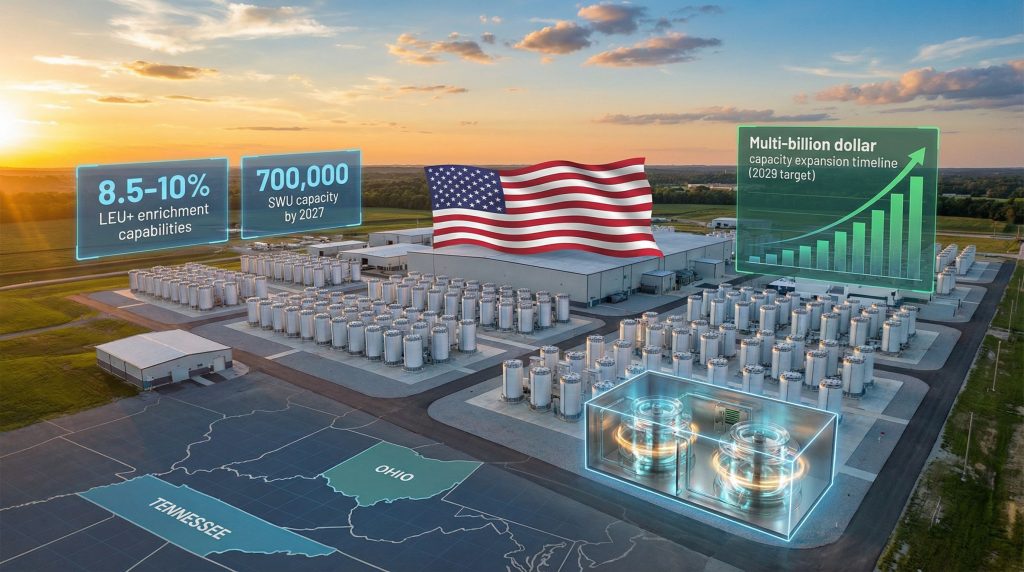
Low-Enriched Uranium Plus production at 8.5% enrichment in the fissile uranium-235 isotope represents a strategic intermediate capability that serves multiple market segments simultaneously. Urenco USA's completion of its first LEU+ production run demonstrates operational readiness for this enhanced enrichment level, coinciding with the startup of new centrifuge cascades as part of their 700,000 SWU capacity expansion programme.
The technical specifications of LEU+ production bridge the gap between standard commercial reactor fuel (typically 3-5% enrichment) and High-Assay Low-Enriched Uranium requirements (up to 19.75% enrichment). This positioning provides operational benefits for existing reactor fleet efficiency improvements while serving as feedstock for advanced reactor fuel preparation.
LEU+ operational advantages include:
• Extended fuel cycle lengths for existing light water reactor operations
• Improved thermal efficiency through higher fissile content
• HALEU feedstock preparation reducing conversion requirements for advanced reactors
• Supply chain flexibility supporting both current and future reactor technologies
The feedstock role in HALEU production represents a particularly strategic capability, as advanced reactor deployment depends on reliable HALEU supplies that current foreign suppliers cannot adequately provide. This creates a domestic competitive advantage for nuclear technology deployment and export opportunities.
Which Companies Are Leading America's Enrichment Revival?
The domestic uranium enrichment expansion involves two primary companies with complementary capabilities and expansion timelines. These organisations represent different approaches to achieving enrichment independence while addressing overlapping market segments and strategic requirements.
Centrus Energy's Oak Ridge-Piketon Manufacturing Hub
Centrus Energy's expansion programme represents the most comprehensive domestic enrichment initiative, encompassing both manufacturing and production capabilities across multiple geographic locations. The company's multi-billion dollar capacity expansion integrates centrifuge manufacturing at Oak Ridge, Tennessee with enrichment operations at Piketon, Ohio, creating a vertically integrated domestic supply chain.
The expansion timeline targets first new production capacity online in 2029, supported by funding from the Department of Energy via task orders for LEU and HALEU production, combined with private capital, commercial contracts, and third-party investments. This diversified funding structure indicates both government strategic priority and commercial market confidence in expansion economics.
Economic impact projections indicate the expansion programme will support thousands of direct and indirect jobs across Ohio, Tennessee, and nationally. Specific job creation numbers require further analysis, but the multi-state impact reflects the scale of infrastructure investment and operational requirements for industrial-scale enrichment capacity.
Key competitive advantages identified by Centrus Energy include:
• Significant progress in domestic supply chain development reducing foreign dependency
• Multiple avenues for low-cost capital acquisition supporting expansion financing
• Advanced internal manufacturing capabilities enabling technology control and scalability
• U.S.-origin technology ownership providing national security compliance and export opportunities
Urenco USA's New Mexico Operations Scaling
Urenco USA's expansion program focuses on capacity scaling at their existing Eunice, New Mexico facility, targeting 700,000 SWU capacity addition by 2027. This timeline provides earlier capacity availability compared to Centrus Energy's 2029 target, addressing immediate supply requirements following the Russian import ban implementation.
Economic contribution analysis from an Oxford Economics report reveals substantial regional impact metrics for 2024-2025 operations:
| Economic Impact Metric | Value |
|---|---|
| Total Economic Contribution | $360+ million |
| Total Jobs Supported | 1,700+ positions |
| U.S. Supplier Purchases | $68.6 million |
| Timeline for Capacity Addition | 2027 |
The economic multiplier effects demonstrate significant value creation beyond direct facility operations, encompassing supply chain spending and induced economic activity throughout the regional economy. Managing Director John Kirkpatridge emphasised the substantial local, regional, and national contributions spanning from electricity production support to educational community engagement.
European technology adaptation represents both an advantage and limitation for Urenco USA operations. While leveraging proven centrifuge technology provides operational reliability, the dependence on European design and Netherlands manufacturing creates potential supply chain vulnerabilities that contrast with Centrus Energy's domestic technology approach.
Production capabilities include both standard LEU and the recently achieved LEU+ production at 8.5% enrichment, demonstrating operational flexibility across enrichment levels. The successful completion of the first LEU+ production run coincided with new centrifuge cascade startup, indicating integrated capacity expansion and capability enhancement.
How Do Enrichment Economics Impact Nuclear Power Competitiveness?
The economic dynamics of the domestic uranium enrichment expansion create both opportunities and challenges for nuclear power competitiveness in the broader energy market. Understanding these economic implications requires analysis of separative work unit pricing, investment requirements, and long-term contract structures supporting expansion investments. Additionally, uranium market investment trends continue to influence the overall economic landscape.
Separative Work Unit (SWU) Market Dynamics
Separative Work Units represent the standard measurement for uranium enrichment services, providing a basis for economic analysis of domestic capacity expansion. Current U.S. demand for SWU services significantly exceeds domestic production capacity, creating a supply-demand imbalance that domestic expansion seeks to address.
The market dynamics analysis reveals several key factors:
• Current domestic capacity limitation to Urenco USA operations until 2027-2029 expansion completion
• Russian import elimination by 2028 creating immediate demand for alternative suppliers
• Growing nuclear capacity requirements driving long-term SWU demand growth
• Advanced reactor HALEU requirements creating premium pricing opportunities for specialised enrichment services
Price implications of reduced Russian import dependency remain speculative, but economic theory suggests domestic supply security commands premium pricing over foreign alternatives with geopolitical risk. Long-term contract structures supporting expansion investments indicate customers willing to pay stability premiums for supply security.
The SWU market transformation from foreign dependency to domestic supply represents a fundamental shift in nuclear fuel economics, with implications extending throughout the nuclear power value chain from fuel procurement to electricity generation costs.
Investment Flow Analysis: Public-Private Partnership Models
The financing structure for the domestic uranium enrichment expansion demonstrates sophisticated public-private partnership models that balance national security priorities with commercial market dynamics. Department of Energy funding mechanisms provide strategic support while private capital mobilisation ensures market-driven efficiency and scalability.
Investment flow analysis reveals multiple funding sources:
• Department of Energy task orders for LEU and HALEU production providing government demand certainty
• Private capital investments reflecting commercial market confidence in expansion economics
• Commercial contracts ensuring customer commitment and revenue predictability
• Third-party investments indicating broader financial market support for nuclear fuel security
This diversified funding approach reduces risk for individual investors while ensuring project completion aligns with both national security priorities and commercial market requirements. The imminence of DOE funding announcements referenced by Centrus Energy leadership suggests additional government support mechanisms under development.
Third-party investment patterns in the nuclear fuel cycle indicate growing financial market recognition of nuclear energy's role in decarbonisation strategies and energy security priorities. This broader investment context supports long-term viability of domestic enrichment capacity expansion beyond immediate Russian import replacement needs.
What Challenges Must Domestic Enrichment Overcome?
The successful implementation of domestic uranium enrichment expansion faces significant technical, regulatory, and economic challenges that require sustained focus and strategic problem-solving. Understanding these challenges provides insight into timeline risks and success factors for achieving enrichment independence.
Technical Hurdles in Scaling Production
Manufacturing precision requirements for centrifuge components represent perhaps the most critical technical challenge in domestic enrichment expansion. Nuclear-grade centrifuges require extraordinary precision in manufacturing tolerances, with component quality directly impacting enrichment efficiency and operational reliability.
The technical complexity involves several key areas:
• Component manufacturing precision requiring specialised tooling and quality control processes
• Supply chain coordination between multiple precision manufacturers and assembly facilities
• Quality assurance standards meeting nuclear regulatory requirements and operational reliability targets
• Process optimisation for industrial-scale production efficiency and cost competitiveness
Integration challenges between enrichment facilities and conversion operations create additional complexity, requiring coordination across multiple stages of the nuclear fuel cycle. The interdependence between uranium conversion, enrichment, and fuel fabrication necessitates supply chain synchronisation that extends beyond individual facility operations.
Technology scaling from demonstration to commercial production represents a classic challenge in nuclear technology deployment, where small-scale success does not automatically translate to industrial-scale efficiency. The AC100M centrifuge technology's progression to commercial manufacturing represents successful navigation of this scaling challenge, but continued optimisation remains ongoing.
Regulatory Framework Evolution
Nuclear Regulatory Commission licensing processes for expanded enrichment activities require navigation of complex regulatory requirements that balance safety priorities with commercial operational needs. These regulatory processes necessarily involve extended timelines and comprehensive documentation requirements that can impact expansion schedules.
Safety protocols for LEU+ production authorisation represent evolving regulatory territory, as 8.5% enrichment levels exceed traditional commercial reactor fuel specifications while remaining below weapons-grade thresholds. This intermediate enrichment level requires regulatory clarity on handling, storage, and transportation requirements.
Environmental compliance in facility expansion projects encompasses multiple regulatory jurisdictions and environmental assessment requirements. The Oak Ridge and Piketon facility locations involve coordination with federal, state, and local environmental regulations that could impact expansion timelines and costs.
Regulatory framework evolution must also address advanced reactor fuel requirements and HALEU production authorisation, anticipating future regulatory needs rather than simply addressing current operational requirements. This forward-looking regulatory development supports long-term market development while ensuring safety and security standards, including considerations for nuclear waste disposal safety.
How Does Enrichment Expansion Support Advanced Reactor Deployment?
The relationship between domestic enrichment expansion and advanced reactor deployment represents a strategic alignment that supports broader nuclear technology advancement and energy security objectives. This relationship creates synergistic benefits extending beyond immediate fuel supply requirements.
HALEU Production Pathway Development
High-Assay Low-Enriched Uranium production capabilities up to 19.75% enrichment represent the technical frontier for the domestic uranium enrichment expansion. HALEU requirements for advanced reactor technologies create a specialised market segment that foreign suppliers cannot readily address, providing domestic enrichment facilities with competitive advantages and premium pricing opportunities.
The technical pathway from LEU+ production at 8.5% to HALEU capabilities involves incremental enrichment process development that builds on existing operational experience. This staged approach reduces technical risk while providing intermediate products that serve existing market needs.
Timeline alignment between advanced reactor commercialisation and HALEU production capability represents critical strategic coordination. Advanced reactor developers require assured HALEU supplies for both testing and commercial operations, creating interdependence between reactor deployment and enrichment capacity expansion.
Supply chain coordination between enrichment and fuel fabrication facilities becomes increasingly complex for HALEU production, requiring specialised handling, transportation, and processing capabilities that extend throughout the nuclear fuel cycle.
Strategic Stockpile Considerations
Government reserve requirements for national security missions create additional demand for domestic enrichment capacity beyond commercial reactor needs. Strategic stockpile management requires both production capacity and inventory management capabilities that support emergency response scenarios.
Commercial inventory management for reactor fuel cycles must balance supply security with economic efficiency, requiring sophisticated demand forecasting and production scheduling capabilities. The complexity increases with multiple enrichment levels and specialised fuel products for different reactor technologies.
Emergency response capabilities in supply disruption scenarios represent a critical strategic consideration that domestic enrichment capacity specifically addresses. The ability to surge production or redirect capacity during supply crises provides national security benefits that foreign suppliers cannot guarantee.
Strategic stockpile considerations also encompass HALEU reserves for advanced reactor deployment, ensuring that emerging nuclear technologies have assured fuel supplies during critical commercialisation phases. This strategic support can accelerate advanced reactor deployment timelines and enhance U.S. nuclear technology competitiveness.
The next major ASX story will hit our subscribers first
What Regional Economic Benefits Emerge from Enrichment Hubs?
The geographic concentration of enrichment facilities creates regional economic hubs that generate significant multiplier effects throughout local and regional economies. These benefits extend beyond direct facility employment to encompass broader economic development and technological advancement opportunities.
Employment Multiplier Effects
Direct job creation in enrichment facility operations represents only the initial layer of employment impact, with indirect and induced employment effects creating substantial additional economic benefits. The skilled workforce requirements for nuclear operations command premium wages that generate significant regional economic impact.
Employment categories span multiple skill levels and specialisations:
• Nuclear operations specialists with advanced technical training and certification requirements
• Manufacturing technicians supporting centrifuge production and maintenance operations
• Engineering professionals providing design, optimisation, and safety analysis expertise
• Administrative and support personnel enabling facility operations and regulatory compliance
Indirect employment in supporting industries includes specialised suppliers, transportation services, security providers, and professional services that support nuclear operations. These indirect jobs often command wages above regional averages due to nuclear industry requirements and security clearance needs.
Skills development programmes for nuclear technology workforce create long-term regional advantages by establishing specialised educational and training capabilities that support broader nuclear industry development. These programmes often involve partnerships with universities and technical colleges that enhance regional educational infrastructure.
Supply Chain Localisation Benefits
Domestic procurement patterns emerging from enrichment expansion create opportunities for regional suppliers and manufacturers to develop specialised capabilities supporting nuclear operations. This supply chain localisation generates economic benefits while enhancing supply security for enrichment operations.
Regional manufacturing ecosystem strengthening occurs as suppliers invest in capabilities and certifications required for nuclear applications. These investments create sustained economic benefits and technological capabilities that extend beyond enrichment facility requirements.
Technology transfer opportunities to related industries develop as nuclear-qualified suppliers adapt their capabilities to serve additional markets. The precision manufacturing and quality control requirements for nuclear applications often translate to competitive advantages in aerospace, medical device, and other high-precision manufacturing sectors.
Supply chain development analysis indicates potential for significant import substitution as domestic suppliers develop capabilities previously sourced internationally. This import substitution creates additional economic benefits while enhancing supply chain resilience for nuclear operations.
How Will Enrichment Capacity Meet Future Nuclear Growth?
The alignment between domestic enrichment capacity expansion and projected nuclear growth requires sophisticated demand analysis and capacity planning that accounts for multiple market segments and technology evolution. This strategic planning ensures that enrichment capacity development supports broader nuclear energy objectives.
Demand Projection Analysis Through 2035
Existing reactor lifetime extensions create sustained demand for enrichment services as utilities extend plant operations beyond original design lifespans. These extensions often involve power uprates that increase fuel requirements and create additional SWU demand.
New reactor construction pipeline analysis indicates potential for significant capacity additions through 2035, though specific project timelines remain subject to regulatory approval, financing, and construction execution risks. Advanced reactor deployment adds complexity to demand projections due to different fuel specifications and enrichment requirements.
Export potential for U.S.-enriched uranium products creates additional demand opportunities, particularly for allies seeking supply diversification away from Russian sources. This export potential could significantly increase domestic enrichment capacity requirements whilst generating export revenue and strengthening alliance relationships.
Demand projection uncertainty requires flexible capacity planning that can adapt to different growth scenarios whilst avoiding overinvestment in capacity that exceeds market requirements. This balance between supply security and economic efficiency represents an ongoing strategic challenge.
Capacity Utilisation Optimisation Strategies
Production scheduling for varying enrichment levels requires sophisticated operational planning that maximises facility utilisation whilst meeting diverse customer requirements. The ability to produce standard LEU, LEU+, and potentially HALEU creates operational complexity but enhances market flexibility.
Facility expansion planning must consider modular growth approaches that align capacity additions with market demand development. Modular expansion reduces initial capital requirements whilst providing flexibility to scale capacity based on actual market evolution rather than projected demand.
Technology upgrade pathways for efficiency improvements create opportunities to enhance capacity without facility expansion, providing cost-effective capacity growth through operational optimisation. These upgrades often involve advanced process control systems and improved centrifuge designs.
The optimisation strategy must also consider market segmentation between commercial reactor fuel, advanced reactor fuel, and government strategic requirements, each with different quality specifications, delivery schedules, and pricing structures.
What Policy Framework Supports Enrichment Independence?
The policy environment supporting domestic uranium enrichment expansion encompasses multiple legislative, regulatory, and executive branch initiatives that create market conditions favouring domestic capacity development. Understanding this policy framework provides insight into sustainability and expansion potential for enrichment independence initiatives.
Legislative Drivers and Regulatory Support
The Russian uranium import ban implementation timeline creates immediate market demand for domestic alternatives whilst providing transition time for capacity development. This policy timing balances supply security concerns with realistic capacity development schedules.
Department of Energy funding authorisation and appropriation processes provide government demand certainty that supports private investment in enrichment capacity. These funding mechanisms include both direct procurement and domestic low-enriched uranium supply chain loan guarantee programmes that reduce investment risk for private capital.
Tax incentives and loan guarantee programmes for nuclear infrastructure create additional financial support for enrichment expansion projects. These programmes recognise the strategic importance of nuclear fuel cycle independence whilst leveraging private sector efficiency and innovation.
Legislative support extends beyond immediate funding to encompass long-term policy commitments that provide investment certainty for multi-decade facility operations. This policy stability enables private investment in capital-intensive nuclear infrastructure with extended payback periods.
International Cooperation and Competition Dynamics
Alliance partnerships in nuclear fuel cycle development create opportunities for technology sharing and market coordination with allied nations facing similar supply security challenges. These partnerships can enhance economies of scale whilst maintaining strategic autonomy for critical capabilities.
Technology sharing agreements with allied nations must balance cooperation benefits with technology control requirements, particularly for enrichment technologies with potential dual-use applications. The framework for such cooperation requires careful policy development and implementation.
Competitive positioning against global enrichment providers involves both cost competitiveness and supply reliability advantages. Domestic suppliers can offer supply security guarantees that foreign providers cannot match, creating competitive advantages beyond direct cost comparisons.
International cooperation dynamics also encompass export opportunities for U.S. enrichment services, particularly as allies seek supply diversification. These export opportunities could significantly enhance the economic viability of domestic enrichment expansion whilst strengthening alliance relationships.
America's Path to Nuclear Fuel Self-Sufficiency
The transformation of America's uranium enrichment capabilities represents a fundamental strategic shift toward energy independence and national security enhancement. This transition encompasses technological advancement, economic development, and policy coordination that extends far beyond immediate fuel supply requirements.
Timeline for Achieving Enrichment Independence
Critical milestones in domestic enrichment expansion create measurable progress indicators toward full supply independence. Urenco USA's 700,000 SWU capacity addition by 2027 provides immediate Russian import replacement capability, whilst Centrus Energy's 2029 production target establishes fully domestic U.S.-owned capacity.
The progression from foreign dependency to domestic self-sufficiency involves several key phases:
• 2027: Urenco USA capacity expansion providing immediate import replacement
• 2028: Russian uranium import ban implementation requiring domestic alternatives
• 2029: Centrus Energy production startup establishing U.S.-owned capacity
• 2030-2035: Capacity optimisation and expansion based on market demand evolution
Critical success factors for sustained domestic production include continued government policy support, private investment attraction, regulatory framework evolution, and workforce development. These factors require sustained attention and strategic coordination across multiple stakeholders and timeframes.
Integration with broader nuclear energy expansion goals ensures that enrichment capacity development supports overall nuclear power growth rather than simply replacing foreign imports. This integration requires coordination between enrichment capacity, reactor deployment, and fuel cycle infrastructure development.
Long-term Strategic Implications
Energy security enhancement through supply chain control represents the fundamental strategic benefit of domestic enrichment expansion. This security extends beyond commercial reactor operations to encompass national security missions and emergency response capabilities that foreign suppliers cannot guarantee.
Economic competitiveness in global nuclear markets emerges as domestic enrichment capabilities mature and achieve economies of scale. The combination of supply security and competitive costs positions U.S. nuclear technology for both domestic growth and export opportunities.
Technology leadership positioning for future innovations builds on domestic enrichment capabilities to support advanced reactor deployment, specialised fuel products, and potential breakthrough technologies that could emerge from continued nuclear research and development.
The strategic implications extend throughout the nuclear fuel cycle, from uranium conversion and enrichment to fuel fabrication and waste management. Domestic enrichment expansion creates a foundation for comprehensive fuel cycle independence that enhances long-term nuclear energy sustainability and competitiveness.
The domestic uranium enrichment expansion represents more than industrial capacity development; it embodies a comprehensive strategy for energy independence, economic development, and technological leadership that positions America for sustained nuclear energy growth whilst enhancing national security through supply chain control.
Disclaimer: This analysis involves forward-looking projections and market assessments that are subject to uncertainty. Actual capacity development, market conditions, and policy evolution may differ from current expectations. Investment and policy decisions should consider multiple scenarios and risk factors beyond those discussed in this analysis.
Ready to Capitalise on America's Nuclear Renaissance?
Discovery Alert's proprietary Discovery IQ model delivers real-time alerts on significant uranium and nuclear energy discoveries across the ASX, empowering subscribers to identify actionable investment opportunities as America's enrichment expansion creates unprecedented demand for uranium resources. Begin your 30-day free trial today and secure your market-leading advantage in this transformative energy sector.