May 15, 2026
When Periodic Sampling Is No Longer Enough: The Case for Continuous Process Intelligence
The mineral processing industry has long operated on a fundamental assumption: that periodic laboratory sampling provides sufficient insight to manage grinding and flotation circuit performance. For decades, that assumption held. Orebodies were relatively predictable, grades were higher, and the margin for error was wide enough to absorb the lag between sample collection and corrective action. However, the Molycop OreVia platform is now challenging this assumption entirely.
That assumption is now under serious pressure.
Across gold, copper, and polymetallic operations globally, the structural shift toward lower-grade, geologically complex deposits has fundamentally changed the tempo of process management. Ore hardness now varies dramatically within the same orebody, sometimes across distances measured in metres rather than kilometres. Feed characteristics that were stable for an entire shift a decade ago can now fluctuate meaningfully within minutes.
Furthermore, while ore complexity has increased, the operational expectations surrounding energy consumption, metal recovery, and ESG performance have tightened in parallel. This is the environment in which the Molycop OreVia platform was conceived, developed, and deployed. These broader mining industry innovation trends provide essential context for understanding why continuous process intelligence has become so critical.
When big ASX news breaks, our subscribers know first
The Structural Problem: Why Modern Comminution Circuits Need Real-Time Visibility
Variability Is the Core Challenge, Not Throughput
It is tempting to frame the challenges facing modern mineral processing purely in terms of throughput targets. But throughput is actually a downstream consequence of a more fundamental problem: the inability to detect, interpret, and respond to variability in feed conditions before that variability cascades into measurable production loss.
When rock hardness shifts unexpectedly on a conveyor, the consequences do not announce themselves immediately. They propagate. Mill loading changes. Power draw spikes or drops. Particle size distribution at the mill discharge drifts from target. Downstream flotation circuits receive feed that no longer matches the conditions under which reagent dosing and air rates were set. Froth stability degrades. Recovery falls.
By the time a laboratory sample confirms what happened, the circuit has already absorbed the loss. This cascading effect, where a single upstream variability event compounds through multiple circuit stages simultaneously, is what makes traditional reactive control structurally insufficient for modern ore complexity.
The challenge is no longer just throughput; it is managing variability in real time to protect stability, energy efficiency, and recovery, as Molycop's leadership has articulated in published commentary on the platform's development.
The Widening Gap Between Sampling and Reality
Conventional process monitoring relies on a collect-analyse-respond workflow. Samples are extracted from strategic points in the circuit, transported to the laboratory, analysed, and the results are communicated to metallurgists who then adjust operating parameters. In well-resourced operations, this cycle might complete in one to two hours. In many operations, the lag is considerably longer.
The fundamental problem is that the speed at which process conditions can change has outpaced the speed at which traditional sampling can detect and communicate those changes. A SAG mill experiencing hardness variability does not wait for a laboratory result before consuming excess energy or producing off-spec product.
Rising energy costs compound this problem further. Energy typically represents the largest single operating cost in comminution, and inefficient grinding driven by undetected feed variability directly inflates that cost without producing proportional recovery gains. In addition, data-driven mining operations are increasingly demonstrating how real-time data integration can close this gap decisively.
What the Molycop OreVia Platform Is and How It Functions
Defining OreVia as a Continuous Performance Layer
The Molycop OreVia platform is a real-time process characterisation and optimisation system that provides continuous visibility into rock, slurry, and froth behaviour across comminution and flotation circuits. Its defining characteristic is not any single measurement capability in isolation, but the integration of multiple measurement modules into a unified, continuous performance layer that spans the full processing circuit from feed conveyor to flotation bank.
Edgar King, Machine Vision Manager at Molycop, describes the platform's operational purpose as closing the visibility gap that causes plants to operate with limited insight into what is actually happening across their process. By continuously analysing rock, slurry, and froth conditions, OreVia enables plants to quantify variability in real time, stabilise performance, optimise grinding efficiency, and respond faster to changing ore conditions. (Source: GeoDrilling International, May 2026)
The strategic distinction that separates OreVia from conventional monitoring tools is its positioning as a proactive control mechanism rather than a reactive troubleshooting instrument. Traditional process monitoring captures what has already happened. OreVia is designed to detect what is about to happen, delivering decision-relevant information at the circuit points where intervention can prevent a disturbance from escalating.
The Three-Module Architecture
OreVia's modular structure allows operations to deploy measurement capability at the specific circuit points most relevant to their performance challenges. The three modules span the complete comminution-to-flotation pathway:
| Module | Primary Measurement Focus | Deployment Location | Core Output |
|---|---|---|---|
| OreVia Rock | Rock size distribution and hardness characterisation | Conveyors and feeders | Feed variability alerts and upstream ore profiling |
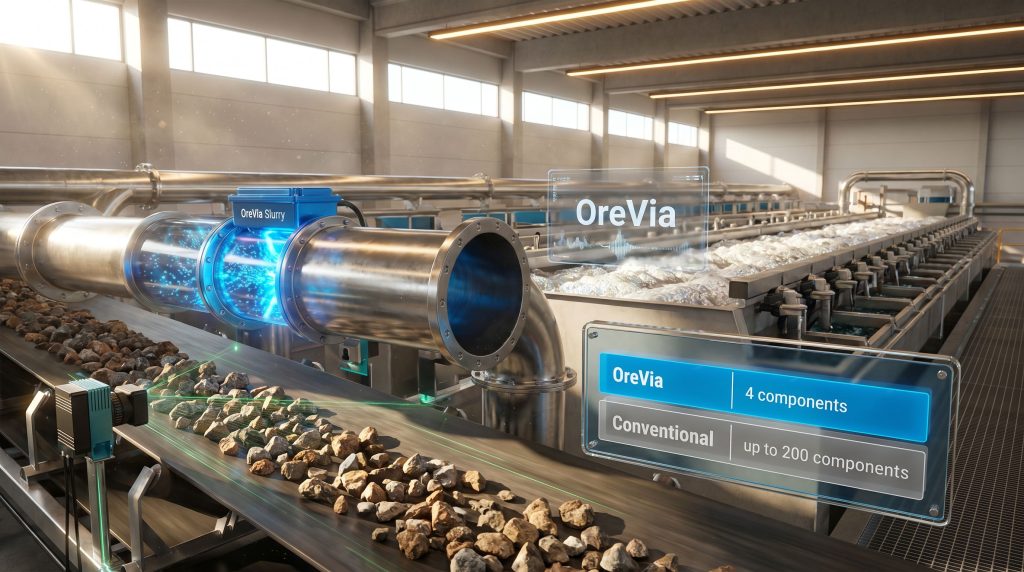
| OreVia Slurry | Particle size distribution, slurry density, flow rates | Inline, within pipe flow | Real-time PSA without sample extraction |
| OreVia Froth | Froth velocity, stability indicators, air rate balance | Flotation cells | Recovery optimisation signals |
This architecture reflects a deliberate design philosophy: instrumentation should track the ore as it flows through the comminution process, particularly at critical decision points where ore can either be returned for preprocessing or advanced to the next circuit stage. As Darren O'Connell, President Technology at Molycop, has explained, these decision points are precisely where efficiencies and cost reduction can be achieved. (Source: GeoDrilling International, May 2026)
The Technology Foundation: Machine Vision, Advanced Sensors, and Data Analytics
The Molycop OreVia platform integrates three technology layers to deliver its measurement capability:
- Camera-based machine vision systems that enable continuous, representative readings across rock and froth surfaces
- Advanced sensor arrays combined with multi-variable data analytics for signal interpretation and pattern recognition
- Integration architecture compatible with existing SCADA systems, DCS platforms, and historian databases
The camera-based approach is particularly significant. Conventional sampling provides a snapshot; camera-based measurement provides a continuous stream. This distinction directly improves the representativeness of the data, ensuring that process decisions are based on the full distribution of conditions present in the circuit rather than the characteristics of a single extracted sample.
Continuous readings produce outputs that are more representative of the entire process. The instruments generate process variables that feed directly into process control strategies, and the solutions are engineered to be low maintenance. (Darren O'Connell, President Technology, Molycop, as reported in GeoDrilling International, May 2026)
The Innovation Origin: From Chocolate Manufacturing to Mineral Processing
A Cross-Industry Technology Transfer That Changed Inline Measurement
One of the most distinctive and lesser-known aspects of the Molycop OreVia platform is the origin of its slurry measurement technology. The OreVia Slurry module's inline particle size measurement capability was not developed within a mining context at all. Its foundational methodology originated in food manufacturing, specifically the chocolate production industry, where fine particle analysis within pipes, without sample extraction, has been a validated and widely practised technique for years.
In food-grade processing environments, the ability to measure particle characteristics continuously within a closed pipe system is essential for quality control. Chocolate texture, for example, is directly governed by the particle size distribution of suspended cocoa solids. Extracting samples from food-grade lines introduces contamination risks and logistical complexity, making inline measurement not just preferable but operationally necessary.
Molycop's engineering team recognised that the core measurement principle underlying this food-industry application was transferable to mineral slurry environments. The adaptation required engineering the technology to withstand the harsh conditions of hard-rock processing, including abrasive slurries, elevated temperatures, and the physical demands of a processing plant environment. The result is a measurement capability that was previously unavailable in mining at this level of simplicity and durability.
The ability to measure particle size within a pipe without the need for sampling represents a fundamental shift in how mineral processing plants can access real-time particle size data. (Edgar King, Machine Vision Manager, Molycop, as reported in GeoDrilling International, May 2026)
The Engineering Simplification That Makes OreVia Slurry Distinctive
The practical significance of this cross-industry innovation becomes clear when comparing the OreVia Slurry module's design to conventional inline particle size analyser instruments. Traditional inline slurry PSA instruments are mechanically complex, involving sample extraction routines, dilution systems, and analytical components that collectively can number up to 200 individual parts.
These systems require regular recalibration, generate ongoing maintenance demands, and introduce their own process disruptions. The OreVia Slurry module, by contrast, contains only four components and requires no ongoing calibration after initial installation. This is not a marginal improvement; it represents a fundamental redesign of how inline particle size measurement is approached in a processing plant context.
The practical implications extend beyond maintenance cost savings. Lower component complexity means fewer failure modes, higher system availability, and greater operator confidence in the reliability of the data being generated.
Deployment, Integration, and Stakeholder Value
How OreVia Fits Into an Existing Plant Environment
A critical consideration for any process monitoring technology is whether it can integrate with existing plant infrastructure without requiring wholesale system replacement. The Molycop OreVia platform was specifically engineered to address this barrier. Its modular design allows staged deployment, enabling operations to begin with a single module targeted at their highest-priority measurement gap and expand circuit coverage progressively.
Integration with existing SCADA systems, DCS platforms, and historian databases means OreVia data flows into the operational workflows and dashboards that plant teams already use. There is no requirement for infrastructure replacement or parallel system management. This approach aligns closely with how mining automation technologies are being adopted more broadly across the sector.
Who Uses OreVia Data and How
The platform is designed to deliver relevant information to three distinct stakeholder groups within a processing operation, each with different data needs and decision timeframes:
| Stakeholder | Data Type Delivered | Operational Benefit |
|---|---|---|
| Plant Operators | Visual dashboards and real-time alerts | Faster corrective action and reduced manual monitoring burden |
| Metallurgists | High-resolution particle size, slurry density, froth metrics | Circuit optimisation and grinding media strategy refinement |
| Management Teams | KPI dashboards aligned to throughput, energy, recovery | Performance tracking against production and ESG targets |
Step-by-Step: How OreVia Supports a Typical Shift Decision
- OreVia Rock detects a change in feed hardness or size distribution on the conveyor
- An alert is generated and displayed on the operator dashboard before the material reaches the mill
- The operator or automated control system adjusts feed rate or grinding parameters proactively
- OreVia Slurry confirms downstream particle size targets are being maintained at the mill discharge
- OreVia Froth monitors flotation circuit response to the adjusted feed, flagging any froth instability
- The metallurgist reviews the session data post-shift to refine ongoing circuit optimisation strategy
This workflow illustrates the core value of continuous measurement: every stage of the response chain is compressed. The gap between a process change occurring and the corrective action being taken shrinks from hours to minutes, and in automated configurations, potentially to seconds.
Real-World Operational Outcomes
Documented Performance Benefits Across Deployments
Across deployments spanning gold and copper operations in the Americas and Africa, the Molycop OreVia platform has delivered measurable operational improvements across several performance dimensions:
- Throughput stability improvements achieved through earlier detection of feed variability before it impacts mill performance
- Reductions in unplanned downtime associated with circuit disturbances caused by undetected shifts in ore characteristics
- Energy efficiency gains delivered through tighter process control that reduces over-grinding and unnecessary power draw
- Informed grinding media and liner wear strategies developed through continuous circuit visibility and data accumulation
The platform featured in the March 2026 edition of International Mining, signalling growing industry recognition of its operational capabilities and deployment track record. Furthermore, the approaches enabled by OreVia mirror advances seen in AI in mining operations, where intelligent, sensor-driven systems are redefining operational efficiency.
Time to Value: What Operations Can Realistically Expect
One of the more practically significant characteristics of OreVia deployments is the speed at which operational value becomes measurable. In multiple deployments, circuit bottlenecks have been identified within weeks of commissioning, with Edgar King noting that tangible operational value, particularly in variability reduction and improved decision confidence, is typically realised within the first one to three months of installation. (Source: GeoDrilling International, May 2026)
The speed of value realisation is closely tied to how much variability existed in the circuit prior to deployment. Operations with high ore variability and limited existing process visibility tend to see the fastest measurable improvements.
This is an important nuance for operations evaluating the platform. The less visibility a site currently has, the more immediately impactful OreVia's continuous measurement capability will be. High-variability circuits with limited existing instrumentation represent the strongest candidates for rapid, measurable returns. This principle also applies to environments such as underground copper ore analysis, where real-time characterisation is similarly transforming decision-making.
The next major ASX story will hit our subscribers first
OreVia Within Molycop's Strategic Evolution
From Consumable Supplier to Comminution Performance Partner
Understanding the Molycop OreVia platform requires understanding the strategic context in which it sits. Molycop's historical identity was built on grinding media manufacturing, a consumable supply business with deep expertise in comminution metallurgy. OreVia represents a deliberate and significant strategic expansion beyond that identity.
Darren O'Connell has described this evolution as a transition from being solely a grinding media supplier to functioning as a full comminution performance partner. OreVia is central to that strategy because it creates a measurement layer that connects Molycop's physical products, technical services, and digital optimisation into a unified performance framework. (Source: GeoDrilling International, May 2026)
The competitive logic of this positioning is notable. By owning the measurement layer within a customer's comminution circuit, Molycop deepens the relationship well beyond transactional consumable supply. The company becomes accountable for circuit outcomes, not just product delivery, a fundamentally different value proposition that generates stickier, longer-term customer relationships.
This transition also reflects a broader industry trend in mining technology: the shift toward outcome-based service models, where technology providers assume greater responsibility for the performance results their tools are designed to enable.
The Roadmap Toward Autonomous Process Control
The long-term development vision for OreVia extends well beyond its current measurement and characterisation capabilities. The roadmap articulated by Molycop's leadership progresses through a logical sequence of increasing process intelligence:
- Near-term: Deeper integration with advanced process control systems for automated parameter adjustment based on OreVia's real-time measurement outputs
- Medium-term: Expanded analytics modules incorporating predictive wear modelling and reagent optimisation capabilities
- Long-term: OreVia functioning as a prescriptive and autonomous performance layer capable of semi-autonomous circuit management without continuous human intervention
This trajectory aligns with the broader direction of the minerals processing industry, which is moving along a progression from data collection, to process visibility, to predictive control, to autonomous optimisation. OreVia's architecture is designed to scale through each of these phases as the underlying analytics and control integration capabilities mature.
OreVia vs. Conventional Process Monitoring: A Direct Comparison
Where the Performance Gap Is Most Pronounced
| Capability Dimension | Conventional Monitoring | Molycop OreVia Platform |
|---|---|---|
| Measurement frequency | Periodic lab sampling (hours) | Continuous and real-time |
| Particle size analysis | Offline and sample-based | Inline with no sampling required |
| Froth monitoring | Manual observation | Automated velocity and stability analysis |
| Maintenance complexity | High (up to 200 components in PSA units) | Low (four-component slurry module) |
| Calibration requirement | Regular recalibration required | No ongoing calibration post-installation |
| Decision latency | Hours to days | Minutes to seconds |
| Integration approach | Often standalone systems | Native plant system integration |
Frequently Asked Questions About the Molycop OreVia Platform
What types of mining operations is OreVia best suited for?
OreVia is designed for operations running comminution and flotation circuits, making it most applicable to base metal and precious metal processing plants, particularly those processing gold, copper, and polymetallic ores where variability in feed hardness and particle size directly impacts recovery and energy consumption.
Does OreVia require significant infrastructure changes to deploy?
No. The platform integrates with existing plant control systems and historian databases. Its modular architecture means operations can deploy individual components without committing to a full-circuit overhaul, allowing staged investment aligned to the highest-priority measurement gaps.
How does OreVia Slurry measure particle size without extracting samples?
OreVia Slurry uses inline measurement technology adapted from precision industrial applications in food manufacturing, specifically the chocolate production industry. This approach allows particle size distribution to be characterised directly within the pipe flow, eliminating the need for sample extraction, dilution, and offline analysis.
What is the ongoing maintenance burden of the OreVia system?
The platform is engineered for operational durability and low maintenance overhead. The OreVia Slurry module contains only four components and requires no recalibration after initial installation, a significant reduction compared to conventional instruments that can contain up to 200 individual parts.
How does OreVia support ESG and energy reduction targets?
By enabling tighter process control and earlier detection of inefficiencies, OreVia supports reductions in energy consumption per tonne processed, lower reagent usage through optimised flotation control, and reduced waste through improved recovery rates. All of these outcomes contribute directly to measurable ESG performance improvements at the site level.
Is OreVia only relevant for large-scale operations?
No. The modular deployment model means OreVia can be scaled to suit operations of varying size. Both large-scale and mid-tier processing facilities have been included in global deployments across the Americas and Africa.
Key Takeaways: Why Real-Time Process Characterisation Is Becoming a Competitive Requirement
- Ore complexity is increasing structurally rather than cyclically, meaning the need for real-time characterisation will intensify over time, not diminish
- The gap between periodic sampling speed and the pace of process condition change is widening, making continuous measurement platforms an increasingly fundamental operational requirement rather than a performance enhancement
- OreVia's modular, low-maintenance design directly addresses the historical barriers that have prevented broader adoption of inline measurement technology in mineral processing
- The technology transfer from food manufacturing to mineral processing illustrates the value of looking beyond conventional mining research and development pipelines for breakthrough measurement solutions
- Molycop's strategic evolution from consumable supplier to performance partner reflects the broader industry shift toward outcome-based service models, where technology providers take accountability for circuit results rather than simply delivering products
- The roadmap toward semi-autonomous circuit management positions OreVia as a long-term platform investment rather than a point-in-time instrumentation upgrade
Readers seeking additional context on real-time mineral processing optimisation and comminution performance management can explore Molycop's OreVia platform feature published by GeoDrilling International and related coverage in International Mining.
This article contains forward-looking statements regarding platform capabilities, deployment outcomes, and strategic roadmaps. Actual performance results will vary based on site-specific conditions, ore characteristics, and operational factors. Readers should not rely solely on this article when making capital investment or technology procurement decisions.
Want to Know When Real Mineral Discoveries Hit the ASX Before the Market Moves?
While continuous process intelligence is transforming how operations extract value from known deposits, identifying the next major discovery at the moment it is announced is an entirely different edge — one that Discovery Alert delivers instantly through its proprietary Discovery IQ model, which scans ASX announcements in real time and converts complex data across 30+ commodities into clear, actionable insights. Explore the historic returns that significant mineral discoveries have generated and begin a 14-day free trial to position yourself ahead of the broader market.