August 21, 2026
The Quiet Revolution Reshaping How Mining Does Business
The most revealing moments in any industry's evolution rarely happen on a single drill core or in a single boardroom. They happen when hundreds of competing organisations voluntarily gather in one location to measure themselves against each other. That act of collective visibility, of showing what you have built and watching what others have built in return, is what separates a genuinely transformative industry forum from a marketing exercise dressed in a lanyard.
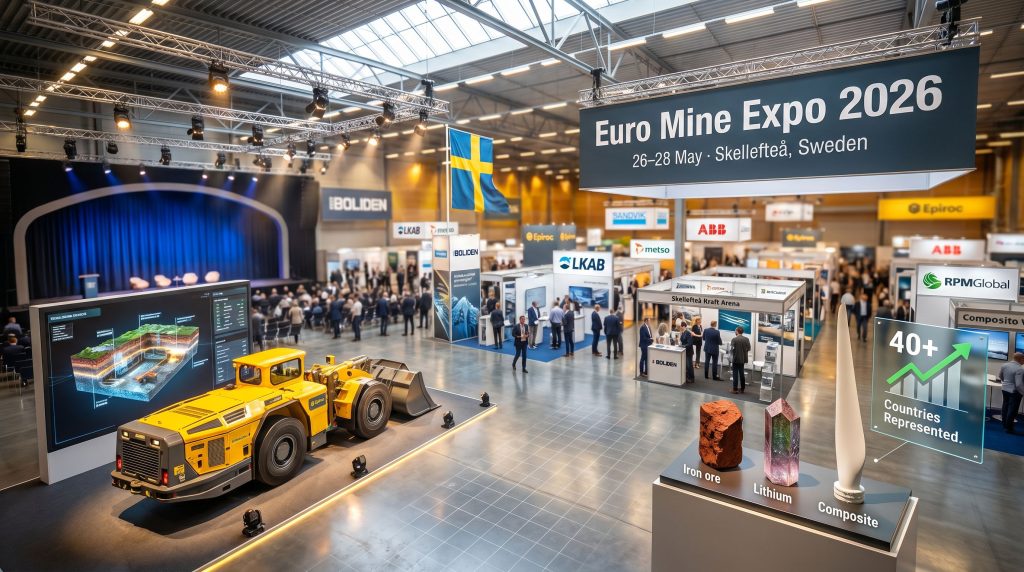
For the global mining sector, that moment arrives in Skellefteå, Sweden, at the end of May 2026. Euro Mine Expo in Sweden has become one of the most closely watched events on the international mining calendar, and the circumstances surrounding its 2026 edition tell a story that extends well beyond a trade fair announcement.
When big ASX news breaks, our subscribers know first
Euro Mine Expo in Sweden: More Than a Meeting Point
Why Skellefteå Carries Weight Beyond Its Geography
Sweden's mining sector is not a peripheral footnote to European resource production. The country sits among the continent's most significant producers of iron ore and base metals, and its northern regions have long formed a backbone of critical raw materials supply within the EU. Skellefteå, positioned within this resource corridor, has been experiencing a secondary wave of industrial relevance driven by the global shift toward electrification.
The proximity of the region to battery materials supply chain development, including large-scale industrial infrastructure investment in northern Sweden, has elevated its strategic profile considerably. Furthermore, Europe's critical minerals supply chain is increasingly dependent on the outputs of precisely these northern European production corridors.
What this means for Euro Mine Expo in Sweden is a layered symbolism: the event is not simply hosted in a mining-active country. It is hosted in a location where the tension between legacy extraction industries and next-generation green industrial requirements is being actively resolved in real time. Attendees arrive in a place that is simultaneously processing its own industrial transition, which gives the event's thematic focus a grounding that a conference centre in a financial capital simply cannot replicate.
The Biennial Rhythm and Its Strategic Value
The two-year cycle of Euro Mine Expo is not an administrative convenience. It reflects the pace at which meaningful transformation actually occurs in capital-intensive industries. Annual events in fast-moving sectors like software or consumer electronics can capture incremental updates. Mining, however, operates on longer deployment cycles, longer permitting timelines, and longer capital expenditure horizons.
By reconvening every two years, Euro Mine Expo effectively functions as a progress report for the industry, capturing not just what has been developed but what has actually been deployed, tested, and validated in operating environments. This rhythm also raises the stakes for each edition. Companies do not arrive with minor product updates. They arrive with two years of accumulated development to present, which shifts the dynamic from routine product demonstration toward genuine competitive showcase.
Event Snapshot: Key Details at a Glance
| Detail | Information |
|---|---|
| Event Name | Euro Mine Expo 2026 |
| Venue | Skellefteå Kraft Arena, Skellefteå, Sweden |
| Dates | 26 to 28 May 2026 |
| Format | International trade fair and conference |
| Cycle | Biennial (every two years) |
| Countries Represented | More than 40 |
| Exhibition Floor Status | Fully booked; waiting list active |
| Digital Magazine | Live and publicly accessible |
The exhibition floor status deserves particular attention. A fully booked exhibition with an active waiting list does not simply indicate popularity. It functions as a leading indicator of industry investment confidence. Companies commit booth space and travel budgets based on forward-looking assessments of where their markets are heading. When those commitments fill a venue to capacity months before the event opens, it suggests broad consensus across the sector that 2026 represents an important inflection point worth showing up for.
Who Fills the Exhibition Halls
The delegate and exhibitor profile at Euro Mine Expo reflects the full operating spectrum of the global mining industry. Senior executives from multinational corporations share floor space with highly specialised niche technology developers. Equipment manufacturers are positioned alongside software platforms, environmental consultants, and geotechnical service providers.
Participants include:
- Mining operators from exploration-stage through to full-scale production
- Original equipment manufacturers focused on extraction, haulage, and processing
- Automation and digitalisation specialists
- Environmental and sustainability consultants
- Investment and finance professionals tracking capital allocation in the sector
- Regulatory and policy representatives with interests in European resource strategy
This breadth is intentional. According to Euro Mine Expo Project Manager Sinnika Sjunnesson, the defining characteristic of the event is that global majors such as Boliden, LKAB, Metso, Sandvik, RPMGlobal, David Brown Santasalo, ABB, and Epiroc are positioned directly alongside highly specialised niche companies, and that meaningful industry progress tends to happen precisely at that intersection.
The observation reflects a structural truth about technology adoption in mining: the pathway from prototype to widespread deployment typically runs through the relationships formed between large operators with deployment capacity and small innovators with technical solutions.
Three Pillars Anchoring the 2026 Conference Programme
The Euro Mine Tech Talks conference component organises its programming around three defined thematic pillars, each of which reflects a genuine pressure point in the current operating environment for mining companies globally.
Innovation and Technology addresses the practical deployment of automation, artificial intelligence, and digital integration across operational workflows. AI-powered mining efficiency tools are no longer being presented as future possibilities at the 2026 edition. They are being discussed as current operational realities with documented performance data.
Social Responsibility encompasses community engagement frameworks, ethical sourcing considerations, and the reputational and regulatory dimensions of operating in proximity to communities and sensitive land classifications. This pillar has grown substantially in strategic importance as investor-led ESG frameworks and social licence considerations have moved from peripheral concerns to central elements of project financing and operational continuity.
Workplace Safety covers advances in remote operation, wearable monitoring technology, hazard detection systems, and the human factors associated with increasing automation. As autonomous systems expand their operational scope, the safety conversation shifts from traditional physical risk mitigation toward new questions about human-machine collaboration protocols.
The conference programme's structure reflects a fundamental redefinition of what operational success means in modern mining. The sector is no longer evaluated purely on tonnes moved or grade recovered. It is evaluated on a composite performance framework that incorporates human outcomes, environmental footprint, and community impact alongside production metrics.
Technologies Taking Centre Stage on the Exhibition Floor
Digitalisation and Autonomous Operations
The transition from piloting autonomous systems to treating them as standard operational infrastructure is one of the most significant shifts visible at Euro Mine Expo 2026. Autonomous haulage, drill automation, and remote monitoring systems that were being evaluated in controlled trial environments just a few years ago are now appearing in vendor presentations as mature, reference-site-backed solutions.
Digital twin technology represents a particularly consequential development within this trend. By creating real-time virtual replicas of physical mine environments, operators can simulate operational scenarios, predict equipment failure, optimise blast designs, and test process changes without disrupting production. The implications for maintenance cost reduction and unplanned downtime avoidance are substantial, particularly in underground environments where equipment access and replacement logistics are expensive.
Real-time data integration across mine planning, fleet management, and processing workflows is also maturing rapidly. The industry is moving from data collection toward data activation: the ability to generate operational decisions from sensor outputs in near real time rather than analysing historical data in batch reports.
Electrification of Mining Operations
Battery-electric vehicles are gaining ground in both underground and surface mining contexts, driven by a combination of emissions reduction targets, ventilation cost savings in underground environments, and total cost of ownership improvements as battery technology matures. In addition, mining electrification and decarbonisation targets are increasingly shaping the procurement decisions of major operators attending events like this one.
The electrification trend carries particular resonance in Sweden, where a high proportion of electricity generation comes from renewable sources. This grid advantage means that switching to electric mining equipment in a Swedish context translates more directly into genuine emissions reductions than it might in regions dependent on coal-fired generation. The alignment between national energy infrastructure and mining electrification ambitions makes Euro Mine Expo in Sweden a logically coherent location for exhibitors showcasing battery-electric solutions.
Key electrification areas on display include:
- Battery-electric load-haul-dump machines and haul trucks
- Underground charging infrastructure and battery swap systems
- Surface fleet electrification with grid integration solutions
- Hybrid drive systems for applications where full electrification presents current technical constraints
Sustainable Practices and Circular Economy Approaches
Tailings management has become one of the industry's most scrutinised operational areas, both from a regulatory compliance perspective and a reputational risk standpoint following high-profile tailings facility failures in other global jurisdictions. Innovations in tailings storage design, real-time stability monitoring, and paste backfill technologies are attracting significant attention.
Water recycling systems, closed-loop processing circuits, and by-product utilisation strategies reflect a broader shift toward circular economy thinking within mine operations. Furthermore, the adoption of renewable energy in mining settings has strengthened the economic logic considerably: as energy and water costs have risen and community tolerance for environmental impact has narrowed, the business case for resource efficiency has become self-sustaining rather than compliance-driven.
The Competitive Dynamic Between Giants and Specialists
How Anchor Exhibitors Shape the Benchmarking Environment
The presence of globally recognised names like Sandvik, Epiroc, ABB, and Metso on the exhibition floor does more than signal industry endorsement of the event. It creates a performance benchmark against which every other exhibitor is implicitly measured. When a mining operator can walk from an autonomous drill demonstration by a major OEM directly to a sensor integration pitch from a 12-person technology startup, the comparison happens naturally and immediately.
This competitive transparency is valuable precisely because it accelerates decision-making. Procurement and operations leaders do not need to arrange separate site visits or vendor evaluations for every technology category. The exhibition format compresses the evaluation process into a concentrated three-day window.
Where Disruptive Innovation Actually Happens
Historically, niche and specialist exhibitors at events like Euro Mine Expo in Sweden have been the source of some of the industry's most consequential technology transitions. Incremental improvement in large equipment platforms tends to come from the major OEMs. However, category-defining shifts, in areas like geotechnical monitoring, ventilation optimisation, processing chemistry, or mine planning software, have often originated with smaller companies whose entire operational focus is a single problem domain.
The coexistence of these two exhibitor types in the same physical space creates what might be described as a technology arbitrage environment: large operators with capital and deployment infrastructure can identify high-potential solutions from specialists and accelerate adoption through partnership, licensing, or acquisition.
The next major ASX story will hit our subscribers first
Networking Architecture: The Evening Programme as Strategic Infrastructure
The Get Together and Mingle format, alongside the Mining and Dining gala, functions as a deliberate extension of the daytime knowledge exchange into a lower-formality environment where longer-term relationship building can occur. Industry events that separate their professional programming from social engagement often find that the most consequential conversations happen at the social margins of the formal agenda.
Several of the social events associated with Euro Mine Expo 2026 are reportedly approaching full capacity, which reinforces the practical recommendation for early registration. For delegates prioritising relationship-building alongside technical content, the social programme is not optional supplementary activity. It is a core component of the event's value proposition.
Sweden's Strategic Role in 2026: A Critical Mineral Perspective
The European Critical Raw Materials Act has created a formal framework for the EU to identify and prioritise domestic production of minerals considered essential for the green and digital transition. Sweden's resource base, encompassing iron ore from the LKAB-operated mines in the north, copper and zinc from Boliden's operating portfolio, and an emerging focus on battery-relevant materials, positions the country as one of the more consequential European jurisdictions for critical mineral strategy.
The relationship between this regulatory backdrop and Euro Mine Expo in Sweden is contextual rather than operational: the event is not a mechanism for implementing policy frameworks. It is, however, a forum where the industry participants who will ultimately respond to those frameworks, through investment decisions, technology deployments, and operational expansions, gather to assess capability and align on direction.
Understanding where the mining sector's technology frontier is positioned is essential context for evaluating whether the EU's domestic mineral supply ambitions are achievable within the timelines being discussed at the policy level.
Practical Navigation Guide for Attendees
For professionals attending Euro Mine Expo 2026, a structured approach to the three-day programme will determine whether the event delivers meaningful returns on time and travel investment.
Before the event:
- Download and review the official Euro Mine Expo 2026 digital magazine, which is now live and includes the full conference schedule, exhibitor maps, and pre-event interviews
- Identify the five to eight exhibitors most directly relevant to your operational focus or investment thesis and prioritise those visits for the first half of day one
- Register for the Mining and Dining gala and Get Together and Mingle events immediately, as capacity constraints are already being reported
- Review the Euro Mine Tech Talks programme and pre-select sessions from each of the three thematic pillars to ensure cross-functional exposure
- Arrange bilateral meetings with key contacts in advance, using the event's networking tools where available
On the exhibition floor:
- Allocate deliberate time to the outdoor demonstration area, where live equipment demonstrations provide a qualitatively different evaluation experience compared to indoor static displays
- Attend at least one conference session outside your primary operational domain to gain cross-sector perspective
- Spend time with niche exhibitors, not just the anchor brands. The highest-value conversations often happen with companies whose names are not yet widely recognised
For companies on the waiting list:
The sold-out exhibition floor creates alternative visibility pathways worth considering. The digital magazine platform carries significant reach among the professional audience attending the event, and conference speaking opportunities or sponsorship of social programme elements can establish brand presence without a physical booth.
What a Sold-Out Exhibition Signals About Industry Direction
The practical significance of a fully booked exhibition floor extends beyond event logistics. Capital-intensive industries like mining do not commit exhibition budgets speculatively. The decision to exhibit at an international trade fair involves lead time, travel logistics, staffing allocations, product demonstration preparation, and in many cases, the transport of large physical equipment.
When these commitments fill a venue's available space to capacity, it represents a collective forward-looking assessment by hundreds of independent companies that the current moment justifies the investment. That consensus, expressed through booth bookings rather than analyst reports or conference speeches, is arguably one of the more reliable indicators of genuine industry confidence available.
The convergence of electrification, digitalisation, and sustainability at Euro Mine Expo 2026 is not a preview of where the industry might be heading. Sjunnesson's characterisation of digitalisation and sustainability as daily practices rather than future visions is a precise description of where the operational baseline has already shifted. The conversation at Skellefteå Kraft Arena in May 2026 will not be about whether these technologies belong in mining. It will be about deployment velocity, integration architecture, and the competitive gap opening between operators who have fully committed to this transformation and those who have not.
This article is based on publicly available information from Global Mining Review and is intended for informational purposes only. It does not constitute financial or investment advice. Readers should conduct their own due diligence before making any investment or commercial decisions.
Want to Capitalise on the Next Major ASX Mineral Discovery Before the Broader Market?
Discovery Alert's proprietary Discovery IQ model delivers real-time alerts on significant ASX mineral discoveries — transforming complex mineral data into actionable insights for both short-term traders and long-term investors. Explore how historic discoveries have generated substantial returns and begin your 14-day free trial today to position yourself ahead of the market.