May 15, 2026
The Engineering Logic Behind Filtered Tailings: Why Dewatering Is Now a Production Variable, Not a Waste Function
For most of modern mining history, tailings management sat firmly in the category of operational afterthought. Slurry went to the pond, the pond grew, and engineers periodically raised the embankment walls. That era is closing rapidly. A convergence of catastrophic dam failures, tightening environmental regulation, freshwater scarcity in arid mining regions, and throughput optimisation pressures has fundamentally repositioned tailings dewatering as a frontline production variable.
How efficiently a mine separates solids from liquids in its waste stream now directly influences how fast it can run, how much water it can reuse, and how defensible its operating licence remains over time.
This shift has opened a technically demanding and commercially significant niche for proprietary dewatering technologies that go well beyond commodity filtration equipment. The Clean TeQ Water tailings dewatering contract at Rasp Mine, awarded in May 2026, is one of the clearer expressions of this transition playing out at an active Australian operation.
When big ASX news breaks, our subscribers know first
Understanding the Rasp Mine and Why Tailings Handling Is Central to Its Growth
A Polymetallic Operation in One of Australia's Most Mineralised Districts
Broken Hill, in far-western New South Wales, carries more than a century of mining history. The district hosts one of the world's most celebrated sediment-hosted lead-zinc-silver deposits, and while the headline names of BHP and Pasminco defined its industrial peak decades ago, the region continues to attract serious capital. The Rasp Mine, operated by Broken Hill Operations as a subsidiary of Broken Hill Mines (ASX: BHM), represents a contemporary chapter in that story.
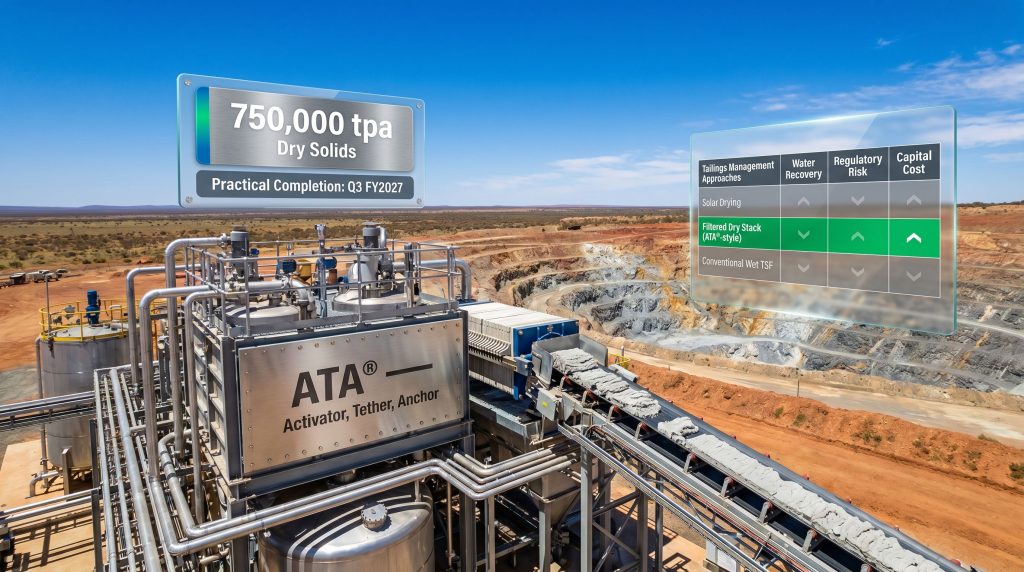
The mine targets a silver-lead-zinc orebody and is currently working through a ramp-up phase aimed at reaching nameplate processing capacity. That nameplate figure is 750,000 tonnes per annum (tpa) of dry solids, a benchmark that defines not just extraction ambition but the scale of infrastructure required to support it, including on the tailings handling side of the operation.
The Bottleneck Nobody Talks About
In polymetallic processing operations, the conversation around production capacity almost always centres on mill throughput, flotation circuit efficiency, or concentrate quality. What receives less attention, at least in mainstream coverage, is the degree to which tailings handling capacity constrains how hard a mill can run.
If a processing plant generates tailings faster than the downstream dewatering and disposal system can handle them, the only options are to slow the mill or expand the storage facility. Both carry costs. Slowing the mill sacrifices revenue. Expanding a conventional wet tailings storage facility (TSF) requires capital, consumes land, introduces ongoing dam safety liability, and in water-stressed regions, represents a significant loss of process water that could otherwise be recycled back into the circuit.
At Rasp, the tailings challenge is compounded by geography. Broken Hill sits in a semi-arid zone with average annual rainfall well below 250 millimetres. Freshwater is not cheap or abundant, and the consequences of inefficient water recovery from tailings are felt directly in operating costs. Solar drying, which some smaller operations use to dry tailings before disposal, becomes unreliable and land-intensive at the scale Rasp is targeting. It is also weather-dependent, creating operational variability that conflicts with the consistent high throughput a ramp-up demands.
Furthermore, mine reclamation obligations in arid regions compound these pressures, making the choice of dewatering approach a long-term strategic decision rather than a purely operational one.
Recovering process water from tailings in arid-zone mining is not simply an environmental consideration. It functions as a direct operating cost lever, reducing the volume of fresh or purchased water required to maintain circuit performance.
The ATA® System: What the Activator, Tether, Anchor Process Actually Does
Polymer Chemistry as a Precision Engineering Tool
Clean TeQ Water's ATA® technology takes its name from the three functional stages of its polymer-enhanced dewatering process: Activator, Tether, and Anchor. Understanding how these stages work in sequence helps explain why the system can achieve dewatering outcomes that conventional thickening or standard filtration equipment often cannot match, particularly in challenging polymetallic tailings streams.
In conventional tailings thickening, a flocculant is added to the slurry to aggregate fine particles and settle them from the liquid phase. The resulting underflow is thickened but still contains significant moisture. Further dewatering via belt press or filter press can reduce moisture further, but these approaches are sensitive to particle size distribution, mineralogy, and clay content. Polymetallic tailings from lead-zinc-silver operations often contain fine-grained material that is notoriously difficult to dewater efficiently using standard methods.
The ATA® process addresses this through staged polymer interactions. The Activator conditions the solid particles at the surface chemistry level, preparing them for more effective bonding. The Tether component then bridges particles together into structures with improved drainage characteristics. The Anchor stage finalises the binding to produce a filter cake with physical properties suitable for mechanical handling and dry stacking. You can explore more about the ATA® mine tailings thickening process directly from Clean TeQ Water's technical documentation.
The result is a tailings product that retains significantly less moisture than conventional thickening output, reducing both water loss and the mass of material requiring disposal management.
What the System Is Designed to Deliver at Rasp
| Performance Metric | ATA® System Target at Rasp Mine |
|---|---|
| Throughput capacity | 750,000 tpa dry solids |
| Tailings output format | Filter cake suitable for in-pit stacking |
| Water recovery | Enhanced relative to solar drying baseline |
| Reagent consumption | Reduced relative to conventional polymer dosing |
| Tailings storage footprint | Minimised through filtered in-pit placement |
| Completion timeline | Q3 FY2027 |
A key design priority in the ATA® system is reagent consumption efficiency. Polymer reagents represent a meaningful ongoing operating cost in any flocculant-assisted dewatering operation. If the staged chemistry of the ATA® process requires lower total polymer doses per tonne of dry solids processed, the cost advantages compound over the life of the operation.
This is particularly significant given that a long-term polymer supply agreement is under negotiation as a companion to the construction contract, meaning Clean TeQ Water has a direct commercial incentive to design a system that minimises consumption while maximising performance.
In-Pit Filtered Tailings Stacking: The Disposal Method That Changes the Risk Equation
Why the Destination of the Filter Cake Matters as Much as Its Quality
Producing a high-quality filter cake is only half the equation. Where that material goes determines the long-term liability profile of the tailings programme. At Rasp, the design intent is for the dewatered filter cake to be placed directly into mined-out pit voids, a practice known as in-pit filtered tailings stacking.
This approach differs fundamentally from conventional above-ground TSFs in several critical ways:
-
Structural stability: Filtered tailings placed in a pit void sit within a geologically constrained environment. They are not relying on constructed embankments to maintain containment, which eliminates the dam safety risks that have caused catastrophic failures at operations including Brumadinho in Brazil (2019) and Samarco (2015). Both events resulted in mass fatalities and have driven sweeping reassessments of TSF design standards globally.
-
Footprint efficiency: In-pit placement uses excavated void space that already exists, rather than consuming additional surface area for tailings impoundments. In semi-arid regions where land rehabilitation obligations are long-term and significant, reducing the above-ground tailings footprint has both economic and regulatory value.
-
Closure pathway clarity: When tailings are placed underground in mined-out voids, post-mining closure planning becomes more straightforward. The material is already in a contained environment, reducing the ongoing monitoring and maintenance obligations that above-ground TSFs carry well beyond the operational life of a mine.
-
Regulatory alignment: Australian state and federal environmental frameworks have been tightening requirements around TSF design, monitoring, and long-term liability since the mid-2010s. Filtered dry stacking is increasingly viewed as a technically preferred approach under these frameworks, though regulatory requirements vary by jurisdiction and project.
The global mining industry's shift toward filtered tailings is not primarily driven by technology availability. It is driven by the recognition that conventional wet tailings storage carries unquantifiable long-term liability that sits on a mine operator's books for decades after the operation closes.
Contract Structure and Commercial Architecture
A Design-and-Construct Model With Dual Revenue Streams
The Clean TeQ Water tailings dewatering contract at Rasp Mine is structured as a full engineering, procurement, manufacture, supply, and installation (EPCMSI) contract. This design-and-construct model places the technical accountability for the system's performance squarely with Clean TeQ Water. It is a contract structure that rewards genuine technical competence while concentrating delivery risk at the provider level.
For a technology company seeking to establish its proprietary system in the market, accepting this accountability structure is a deliberate strategic choice. Successfully delivering a 750,000 tpa facility to practical completion creates a reference site that is difficult to replicate through marketing alone. An operating plant demonstrating performance against measurable targets is the most credible sales tool available in the mining services sector.
The commercial structure of the Rasp contract reflects an increasingly common architecture in proprietary mining technology:
-
Upfront construction revenue generated through the EPCMSI phase from contract award in May 2026 through to targeted practical completion in Q3 FY2027.
-
Recurring polymer supply revenue through a long-term supply agreement currently under negotiation. This component, if finalised, would transform a capital project into an annuity-style income stream tied to the operational life of the plant.
This dual-stream model matters commercially because it aligns the technology provider's long-term financial interest with the ongoing performance of the installed system. A polymer supply agreement that rewards consistent throughput creates an incentive for Clean TeQ Water to ensure the plant operates reliably well beyond practical completion.
Timeline Summary
| Milestone | Date |
|---|---|
| Contract awarded | May 2026 |
| Engineering and procurement phase commences | Immediately post-award |
| Targeted practical completion | Q3 FY2027 |
| Long-term polymer supply agreement | Under negotiation |
The Broader Industry Context: Why Filtered Tailings Is Not a Trend But a Structural Shift
The Legacy of Catastrophic Failures and What They Changed
The collapse of the Fundão tailings dam in Brazil in 2015 and the Brumadinho failure in 2019 were not simply industrial accidents. They functioned as inflection points for global regulatory and institutional attitudes toward TSF design. The Global Industry Standard on Tailings Management, published in 2020 following a multi-stakeholder review process, introduced substantially higher expectations for TSF safety classification, independent review, and long-term liability disclosure.
Australian regulators have progressively aligned domestic requirements with this elevated international baseline. For mine operators in inland New South Wales and other arid regions, the regulatory direction of travel adds another layer of urgency to dewatering technology decisions. In addition, natural capital in mining frameworks are increasingly shaping how operators account for water use and land disturbance in their broader environmental reporting obligations.
Comparing Tailings Management Approaches
| Approach | Water Recovery | Capital Cost | Regulatory Risk | Long-term Liability |
|---|---|---|---|---|
| Solar drying | Low | Low | High (footprint) | Medium |
| Conventional wet TSF | Low | Medium | High (dam safety) | High |
| Paste thickening | Medium | High | Medium | Medium |
| Filtered dry stack (ATA®-style) | High | Medium-High | Low | Low |
Where Proprietary Technologies Fit in the Competitive Landscape
Commodity filtration equipment, belt presses, and standard filter presses have well-established performance envelopes. Their limitations are well understood: they are typically sensitive to particle size distribution, can struggle with plastic or clay-rich tailings, and do not always produce filter cake with sufficient structural integrity for dry stacking without extensive additives.
Paste thickening achieves higher solids content than conventional thickening but requires significant capital investment in high-torque thickener infrastructure and is operationally complex to manage consistently. Proprietary polymer-enhanced systems like ATA® occupy a space that addresses specific mineralogical challenges while maintaining a manageable operational complexity profile. For polymetallic tailings streams, the ability to tune the chemical conditioning stages to the specific feed characteristics is a meaningful technical differentiator.
The next major ASX story will hit our subscribers first
Operational Benefits for Broken Hill Mines: Connecting Technology to Production Outcomes
Removing the Tailings Bottleneck to Unlock Nameplate Capacity
For Broken Hill Operations, the primary benefit of a fit-for-purpose dewatering solution at the required scale is straightforward: it removes tailings handling as a constraint on mill throughput. A processing facility that can generate 750,000 tpa of dry solid tailings but lacks the downstream capacity to handle that volume cannot actually run at nameplate rates. The ATA® plant is designed to match the mill's output capacity, which means the ramp-up pathway to full production is not blocked by the waste stream.
Water as a Recoverable Asset
In Broken Hill's operational context, water recovered from tailings through high-efficiency dewatering is not waste treatment output. It is a recoverable asset that can be returned to the processing circuit, reducing the volume of fresh or purchased water needed to maintain operations. In a region where water supply is constrained and costly, this translates directly into operating cost reduction.
The financial magnitude of this benefit depends on the specific water tariffs and supply agreements in place, but the directional logic is consistent: every additional litre of process water recovered from tailings is a litre that does not need to be sourced externally. At 750,000 tpa throughput, the cumulative volume of recoverable water over a plant life cycle is substantial.
Reagent Efficiency Over the Long Term
The ATA® system's design emphasis on reduced polymer consumption per tonne of dry solids processed has compounding significance over the operational life of the plant. If the polymer supply agreement is executed at a volume tied to actual consumption rather than a fixed schedule, lower reagent intensity per tonne improves the unit economics of the dewatering operation continuously.
This is an aspect of proprietary dewatering technology that receives less attention than capital cost or throughput capacity but becomes increasingly material over multi-year operational periods, particularly for operations with decade-scale mine lives. Consequently, mining sustainability transformation increasingly depends on these cumulative efficiency gains rather than headline capital decisions alone.
Frequently Asked Questions
What is the ATA® tailings dewatering system?
ATA® stands for Activator, Tether, Anchor, reflecting the three sequential polymer-chemistry stages through which mine tailings slurry passes during the dewatering process. The system uses staged chemical conditioning to produce a filter cake with properties suitable for dry stacking, including sufficient structural integrity to be placed in mined-out pit voids without requiring further drying.
What processing capacity is the Rasp Mine tailings plant designed for?
The plant is designed to process 750,000 tonnes per annum of dry solids, aligned directly with the Rasp Mine's nameplate production target for its silver-lead-zinc ore processing circuit.
When is practical completion expected?
Practical completion is targeted for Q3 FY2027, under the design-and-construct contract awarded to Clean TeQ Water in May 2026.
What is in-pit filtered tailings stacking and why does it matter?
In-pit filtered tailings stacking places dewatered filter cake directly into excavated pit voids rather than constructing above-ground storage impoundments. This eliminates embankment dam safety risks, reduces the above-ground tailings footprint, simplifies post-mining closure planning, and aligns with tightening regulatory expectations around TSF liability management.
Does Clean TeQ Water have ongoing commercial exposure to the plant after construction?
Beyond the EPCMSI construction phase, a long-term polymer supply agreement is under negotiation. If finalised, this would generate recurring revenue tied to the operational throughput of the plant, creating a commercial relationship that extends well beyond the initial capital contract.
Why is tailings dewatering particularly important at Broken Hill?
Broken Hill's semi-arid climate creates structural water scarcity that makes conventional wet tailings storage approaches doubly costly: they lose significant volumes of recoverable process water and carry ongoing management obligations in an environment where water has material value. High-efficiency dewatering addresses both constraints simultaneously.
What This Contract Signals for Mining Water Technology
The Clean TeQ Water tailings dewatering contract at Rasp Mine is best understood not as an isolated project win but as a data point in a larger structural transition. The mining industry is moving away from the legacy model of treating tailings as a volume management problem to be solved with the cheapest available containment infrastructure. In its place, a performance-oriented approach is emerging in which the quality, recoverability, and disposal characteristics of the tailings product are optimised in the same way that ore processing circuits are optimised.
Proprietary technologies that can deliver measurably superior dewatering outcomes in chemically complex tailings streams, at commercial scale, with a recurring revenue model that aligns provider incentives with long-term plant performance, are positioned at the intersection of several converging industry forces. Mining's transformation is being driven by water scarcity, dam safety regulation, ESG reporting obligations, and production efficiency pressures — all pointing in the same direction. Furthermore, decarbonisation in mining is increasingly intertwined with water efficiency, as energy-intensive water sourcing and treatment contribute meaningfully to a mine's overall emissions footprint.
Disclaimer: This article contains forward-looking statements regarding project timelines, production targets, and commercial outcomes. These are based on publicly available information and industry context as at the time of writing and should not be construed as financial advice. All investment decisions should be made in consultation with a qualified financial adviser. Mineral project timelines and production targets are subject to a range of operational, regulatory, and market risks.
Want to Identify the Next Major ASX Mining Discovery Before the Market Moves?
Discovery Alert's proprietary Discovery IQ model delivers real-time alerts on significant ASX mineral discoveries — instantly translating complex geological and commodity data into actionable investment insights for both short-term traders and long-term investors. Explore how historic discoveries have generated extraordinary returns on Discovery Alert's dedicated discoveries page, and begin your 14-day free trial today to position yourself ahead of the broader market.