
June 8, 2026
When Industrial Heritage Meets Financial Crisis: The Precarious Future of Australian Manganese Processing
Specialist industrial infrastructure rarely collapses overnight. The conditions that bring a smelter, refinery, or processing facility to the brink of administration typically accumulate over years, shaped by ownership decisions, commodity cycles, capital investment choices, and corporate governance quality. Understanding this dynamic is essential context for anyone tracking the Liberty Bell Bay smelter workers pay reprieve situation unfolding in northern Tasmania, where Australia's sole manganese smelting operation sits at a crossroads between preservation and permanent loss.
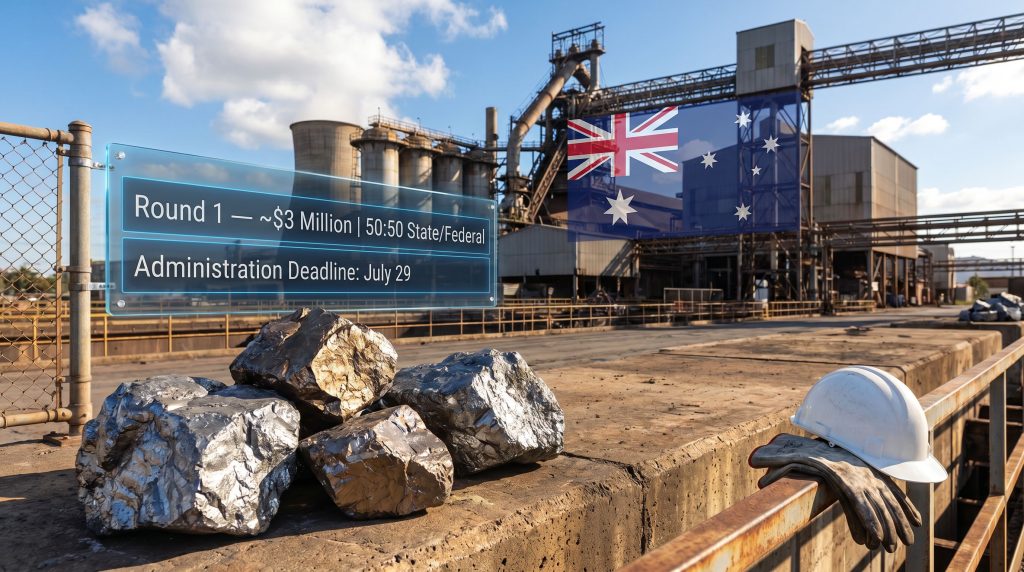
What makes this situation unusual is not just the financial distress itself, but the specific combination of factors converging simultaneously: a nationally unique industrial asset, a workforce of specialised workers whose skills are not easily replaced, a corporate ownership history now under regulatory scrutiny, and a government-funded rescue structure operating on a fortnight-by-fortnight basis against a hard administration deadline of July 29, 2026.
When big ASX news breaks, our subscribers know first
Australia's Only Manganese Smelter and Why Its Loss Would Be Irreversible
The Bell Bay industrial precinct in northern Tasmania has historically served as one of Australia's most significant concentrations of energy-intensive manufacturing. Positioned to take advantage of Tasmania's hydroelectric power supply, the precinct hosts facilities that would be extraordinarily difficult and expensive to replicate elsewhere in the country.
Liberty Bell Bay occupies a singular position within this landscape. As Australia's only manganese smelting operation, the facility transforms raw manganese ore into refined alloy products used primarily in steelmaking and, increasingly, in battery cathode chemistry. The dual-use nature of manganese, bridging both legacy steel manufacturing and emerging battery supply chains, gives the facility a strategic significance that extends well beyond its immediate workforce.
Manganese is a critical input in the production of high-strength steel alloys, where it improves hardness, toughness, and wear resistance. More recently, manganese sulphate has emerged as a key precursor material in lithium-manganese-iron-phosphate (LMFP) battery cathodes, which are gaining commercial traction as manufacturers seek lower-cost, cobalt-free alternatives to nickel-heavy chemistries. Furthermore, the battery raw materials market is evolving rapidly, adding considerable pressure to secure domestic processing capabilities.
Australia is a major manganese ore producer, ranking among the world's largest, yet its domestic processing and value-add capacity has remained underdeveloped relative to its raw material output. Liberty Bell Bay represents one of the few points in the Australian supply chain where ore is transformed into a higher-value industrial product domestically. In addition, Australian manganese supply infrastructure is expanding, making downstream processing assets like Liberty Bell Bay increasingly important to national industrial strategy.
The facility employs approximately 216 to 220 workers, many of whom hold specialist technical skills specific to high-temperature pyrometallurgical processes. This is not a generalist workforce that can be rapidly redeployed or reconstituted. Smelter operators, furnace technicians, and metallurgical specialists require years of training and hands-on experience, making workforce retention during any sales process not just a social obligation but a core component of asset value.
How Financial Deterioration Under Previous Ownership Led to Administration
Liberty Bell Bay entered voluntary administration in March 2026 following a period of financial deterioration linked to its previous ownership structure under GFG Alliance, the industrial conglomerate controlled by executive chair Sanjeev Gupta. GFG Alliance has faced significant financial difficulties across multiple jurisdictions, and the collapse of several entities within its portfolio has attracted the attention of Australia's corporate regulator.
The Australian Securities and Investments Commission has confirmed it has multiple investigations underway into Gupta's broader corporate network, following a series of collapses that have left hundreds of workers across different operations facing uncertain employment futures. The specific nature of these investigations has not been fully disclosed publicly, but the regulatory attention signals systemic concerns about corporate governance, financial management, and disclosure practices within the relevant entities.
For Liberty Bell Bay workers, the practical consequence of this corporate history has been a period of deep uncertainty, with employment security tied to the outcome of an administration process rather than the operational performance of the facility itself. The smelter's difficulties appear to stem from structural corporate issues rather than any fundamental unviability in the processing operation, a distinction that matters considerably when assessing the facility's prospects under new ownership.
The Two-Week Pay Reprieve: How the Funding Structure Actually Works
The Liberty Bell Bay smelter workers pay reprieve announced in mid-May 2026 represents the second government-funded wage support arrangement since voluntary administration commenced. Understanding how this funding is structured requires looking beyond the headline figures.
The arrangement operates as a 50:50 cost-sharing loan between the Tasmanian state government and the Australian federal government, channelled directly to administrators EY Parthenon rather than to workers or the facility as a going concern. This loan structure, rather than a direct grant, has specific implications:
- It preserves the formal legal position that workers are employees of the administered entity rather than government employees.
- It maintains the administrator's control over operational decisions without creating a government ownership interest.
- It theoretically creates a recoverable debt position for governments if a sale generates sufficient proceeds.
- It avoids characterisation as a subsidy or bailout of the previous ownership structure.
EY Parthenon partner Morgan Kelly confirmed the arrangement would support immediate workforce retention while the sales process continued, acknowledging the significant personal resilience demonstrated by workers navigating an extended period of employment uncertainty.
The funding is explicitly designed to maintain specialist industrial capability during the transition, recognising that a manganese smelter without its trained workforce is a substantially less attractive acquisition target.
Cumulative Government Funding Committed to Date
| Funding Round | Duration | Total Cost | State Contribution | Federal Contribution | Expiry |
|---|---|---|---|---|---|
| Round 1 | 3 weeks | $3 million | $1.5 million | $1.5 million | May 19, 2026 |
| Round 2 | 2 weeks | Undisclosed | Undisclosed | Undisclosed | ~June 2, 2026 |
| Total Confirmed | ~5 weeks | $3M+ confirmed | $1.5M+ confirmed | $1.5M+ confirmed | July 29 hard deadline |
The decision not to disclose Round 2 costs publicly is notable. It may reflect commercial sensitivity around the ongoing sales negotiation process, a desire to avoid creating a per-fortnight benchmark that constrains future funding discussions, or both. Based on the Round 1 cost of $3 million across three weeks, a two-week equivalent would suggest roughly $2 million as a working estimate, though this has not been confirmed.
Applied across approximately 220 workers, the Round 1 cost implies an average government outlay of approximately $13,600 per worker for three weeks, or roughly $4,550 per worker per week. This is broadly consistent with average weekly earnings in skilled manufacturing roles, noting that the funding also covers associated operational costs required to keep the facility functional.
The Union Position: Why Fortnightly Funding Is Structurally Inadequate
The Bell Bay Joint Unions coalition, comprising the Australian Workers Union (AWU), the Mining and Energy Union (MEU), the Australian Manufacturing Workers' Union (AMWU), and the Communications, Electrical and Plumbing Union (CEPU), has consistently argued that short-cycle funding packages fail to address the underlying structural problem.
AWU Assistant National Secretary Chris Donovan articulated the core tension clearly: a facility of national significance, with no domestic equivalent and a workforce of irreplaceable specialists, should not have its future determined on a pay-cycle-by-pay-cycle basis. Workers at the Liberty Bell Bay smelter who cannot plan beyond their next scheduled payday face pressure to seek alternative employment, creating the very workforce attrition that would most damage the facility's resale value.
The union delegation's decision to travel to Canberra seeking further payroll support was a deliberate escalation of political pressure, moving beyond site-level and state-level engagement to direct federal advocacy. The timing, coinciding with the closure of the non-binding indicative offers window, created a politically visible moment tied to a concrete milestone in the sales process.
The structural problem unions have identified is straightforward: smelter sales processes are measured in months, not weeks. Keeping a skilled industrial workforce together through that timeline requires certainty of employment, not rolling extensions that expire before the next milestone is reached.
Independent Member for Nelson Meg Webb has proposed a structured government loan to administrators as a more durable alternative to fortnightly packages, arguing that the economics of workforce retention are inseparable from the economics of achieving a successful sale at a price that maximises recovery for creditors and, indirectly, for taxpayers.
What a Credible Buyer Actually Needs to Demonstrate
The non-binding indicative offer window has now closed, and EY Parthenon is managing discussions with parties who submitted expressions of interest. Tasmanian Industry Minister Felix Ellis has signalled clearly that governments will be closely examining the credentials of prospective buyers, specifically whether any incoming owner has both the financial capacity and genuine operational commitment to invest in the facility's future.
This scrutiny reflects lessons learned from the previous ownership experience, where financial distress elsewhere in a corporate empire created cascading problems for facilities that were otherwise operationally sound. A buyer presenting as financially capable but carrying significant leverage or exposure in other jurisdictions would likely face close examination.
For potential acquirers, the calculus involves several interconnected considerations:
- Capital requirements for smelter acquisition, restart or continuation costs, and working capital during initial operation under new ownership.
- Raw material supply security, given that manganese ore sourcing, shipping logistics, and price hedging all require established supply chain relationships.
- Power cost structures, as energy-intensive processing assets are highly sensitive to electricity pricing and contract terms, particularly in a market where Tasmania's renewable energy advantages may be subject to changing grid economics.
- Product offtake arrangements, specifically whether buyers have established relationships with steel producers or battery material manufacturers who would provide revenue certainty.
- Workforce retention commitments, since governments and unions have both signalled that any acceptable buyer must demonstrate genuine intent to maintain and invest in the existing workforce rather than acquire the asset primarily for its land or equipment value.
International buyers may view the facility through a different strategic lens than domestic operators, potentially valuing it as a downstream processing beachhead in a jurisdiction with strong ore supply access, political stability, and established environmental permitting.
The next major ASX story will hit our subscribers first
The Strategic Case for Preserving Domestic Manganese Processing
Australia's position in global manganese markets is paradoxical. The country holds world-class manganese ore deposits, with operations including Groote Eylandt in the Northern Territory producing ore that feeds smelting facilities in locations including South Africa, China, and Europe. Yet domestic processing capacity has historically been limited, meaning Australia largely exports raw or partially processed material and imports higher-value alloy products.
This dynamic reflects a broader pattern in Australian resource development where comparative advantage in extraction has not been matched by equivalent investment in downstream processing. Consequently, Australia's critical minerals push has identified value-add manufacturing as a national priority, though the specific policy frameworks and investment mechanisms that would support such ambitions remain a subject of ongoing development rather than settled implementation.
For the steel industry, manganese alloys serve functions that cannot be readily substituted. High-manganese steel grades are used in applications requiring extreme wear resistance, including mining equipment, rail infrastructure, and heavy earthmoving machinery, which are all sectors where Australian demand is structurally significant. Losing domestic smelting capacity would increase import dependence in a supply chain where geopolitical disruptions are an increasingly recognised risk.
The battery materials dimension adds another layer of strategic relevance. However, strategic manganese projects globally are increasingly being evaluated in light of LMFP battery chemistry, which incorporates manganese as a central cathode component and is attracting substantial investment from battery manufacturers seeking alternatives to cobalt and nickel-intensive formulations.
The Regional Stakes: Bell Bay Beyond the Smelter Gates
The northern Tasmanian economy carries the weight of Bell Bay's situation in ways that employment numbers alone do not capture. Industrial precincts generate economic multiplier effects through supply chain spending, professional services, logistics, maintenance contracting, and the broader consumption activity of a relatively well-paid manufacturing workforce in a regional economy.
The Launceston metropolitan area and surrounding communities have experienced the economic consequences of industrial closures in previous decades, and the institutional memory of those events shapes how both workers and local governments approach the current situation. The urgency expressed by state government ministers, union officials, and community representatives reflects genuine understanding of what permanent closure would mean beyond the direct workforce.
Tasmania's industrial base has contracted over time, and Bell Bay remains one of the few locations where large-scale energy-intensive manufacturing continues to operate. The precinct's future depends partly on whether individual facilities like Liberty Bell Bay can successfully navigate ownership transitions, and whether the infrastructure, skills, and industrial culture of the site can be preserved through periods of financial difficulty rather than being permanently dispersed.
Key Dates and Scenarios for the Facility's Future
The July 29, 2026 administration deadline represents the hard boundary within which a sale must be finalised or an extension sought. Between now and that date, several milestones will determine the outcome:
- EY Parthenon's assessment of non-binding offers received before the indicative offer window closed, and determination of which parties proceed to detailed due diligence.
- Further pay cycle decisions, with the current two-week reprieve extending support to approximately early June 2026, leaving a significant gap before the July 29 deadline that would require additional funding rounds if no sale is completed.
- Government response to union pressure for longer-term wage guarantees, including whether either government is prepared to make a binding commitment rather than continuing to approve individual fortnightly packages.
- Buyer due diligence, which for a facility of this complexity would typically involve technical assessments, environmental reviews, workforce discussions, and commercial negotiation that could consume weeks or months.
| Scenario | Key Indicator | Worker Outcome |
|---|---|---|
| Sale completed before July 29 | Binding offer received and accepted | Continued employment under new ownership |
| Administration extended beyond July 29 | No completed sale, application for extension | Further government funding likely required |
| Facility wound up, no buyer secured | Administration concludes without sale | Redundancies, entitlement claims, skills dispersal |
| Government takes direct role | Political decision to intervene beyond loans | Operational continuity but complex governance |
Disclaimer: The scenarios presented above are illustrative frameworks based on publicly available information. They do not constitute predictions, financial advice, or assessments of probability. Outcomes will depend on commercially sensitive negotiations and administrative decisions not yet publicly disclosed.
Frequently Asked Questions: Liberty Bell Bay Smelter Pay Reprieve
What is the Liberty Bell Bay pay reprieve?
A jointly funded arrangement covering worker wages for an additional two-week period while administrators pursue a sale of the facility. The arrangement is structured as a loan split equally between the Tasmanian and Australian federal governments.
How many workers are affected at Liberty Bell Bay?
Approximately 216 to 220 workers are employed at the facility and covered by the wage support arrangement.
Who is managing the Liberty Bell Bay administration?
EY Parthenon has been appointed as voluntary administrator, with the administration period currently running until July 29, 2026.
Has a buyer been found for Liberty Bell Bay?
As of mid-May 2026, no confirmed buyer has been announced. The window for non-binding indicative offers has closed, and administrators are progressing discussions with interested parties.
Why did Liberty Bell Bay enter voluntary administration?
The facility entered voluntary administration in March 2026 following financial difficulties linked to its previous ownership structure under GFG Alliance, which is subject to ongoing regulatory investigations.
Could the smelter close permanently if no buyer is found?
If no viable buyer is secured before the administration deadline, the risk of permanent closure increases significantly, with major consequences for the direct workforce, the regional economy, and Australia's domestic manganese processing capacity.
Why is manganese smelting strategically significant?
Manganese is a critical input in steelmaking and is gaining importance as a battery cathode material. Australia is a major ore producer but has limited domestic processing capacity, making the Liberty Bell Bay smelter workers pay reprieve situation all the more urgent as a rare and difficult-to-replace industrial asset hangs in the balance.
Want to Stay Ahead of Australia's Critical Minerals Sector?
Discovery Alert's proprietary Discovery IQ model delivers real-time alerts the moment significant ASX mineral discoveries are announced, transforming complex commodity data into actionable investment insights across manganese, battery materials, and beyond. Explore why major mineral discoveries can generate extraordinary returns by visiting Discovery Alert's dedicated discoveries page, and begin your 14-day free trial to position yourself ahead of the broader market.