May 15, 2026
When Maintenance Becomes Innovation: The Engineering Story Behind a Global Patent
Across the global mining industry, the gap between planned and unplanned downtime represents one of the most consequential financial variables that operations management teams attempt to control. In mineral processing, this challenge is particularly acute inside grinding circuits, where high-throughput mills operate under relentless mechanical stress and their internal components degrade continuously from the moment production begins. For decades, the tools available to monitor this degradation lagged far behind the operational scale of the equipment being assessed, creating a structural inefficiency baked into maintenance schedules worldwide.
It is within this broader context that a site-level engineering team at one of Brazil's most significant iron ore operations quietly spent seven years solving a problem that the global mining industry had largely accepted as unsolvable without operational interruption. The result is the Anglo American patent for monitoring Vertimill liner wear at Minas-Rio, which has attracted intellectual property protection from the United States Patent and Trademark Office (USPTO) and triggered patent applications across seven additional countries, originating not from a corporate research laboratory but from the operational floor of the Minas-Rio processing facility in Conceição do Mato Dentro, Minas Gerais, Brazil.
When big ASX news breaks, our subscribers know first
The Maintenance Problem That Defined a Decade of Engineering Work
Vertimill installations sit at the core of many large-scale iron ore processing operations, reducing ore particle size through a vertical screw-driven grinding mechanism that generates enormous internal forces. The liners protecting the mill's internal shell from abrasive slurry contact bear the full brunt of this mechanical environment and wear progressively throughout their service life. Furthermore, the iron ore market types and deposit structures in Brazil mean that these processing demands are particularly intensive.
In conventional operational frameworks, assessing the condition of these liners presented a dilemma with no clean solution. The equipment had to be shut down entirely, drained, cleaned, and opened to allow personnel to physically inspect the internal surfaces. This process consumed more than 24 hours of operational time per inspection cycle, accumulating into a significant annual downtime burden across a large processing operation.
Why Safety Compounded the Productivity Cost
The safety dimension compounded the productivity cost considerably. Liner inspection required personnel to enter the mill interior, classified as a confined space under occupational safety standards. Confined space entry carries inherent risks: atmospheric hazard potential from residual chemical or gaseous environments, restricted egress in emergency scenarios, and exposure to slurry residues. These risks require rigorous permit-to-work procedures, specialist rescue standby arrangements, and atmospheric monitoring equipment, all of which add complexity, cost, and personnel exposure time to each inspection cycle.
At operations running multiple Vertimill units simultaneously, the cumulative annual downtime from liner inspection cycles alone can represent a material reduction in productive mill hours, with corresponding impacts on throughput, energy unit costs, and annual ore processing volumes.
At the Minas-Rio operation, which operates what the engineering team identified as the world's largest Vertimill installation and processes ore for transport through a 529-kilometre slurry pipeline to the port of Açu, these inefficiencies operated at exceptional scale. Marlon Fábio Lino, an Electrical Maintenance Engineer at Anglo American, later described the operational reality that catalysed the innovation effort: the only available method required opening the equipment, draining it, cleaning it, and interrupting operations for more than 24 hours, while also exposing workers to hazardous conditions. Developing an independent solution became the only viable path forward.
How the Anglo American Patent for Monitoring Vertimill Liner Wear at Minas-Rio Works
The methodology developed by Anglo American's Minas-Rio engineering team is built on a thermophysical principle: as internal liners wear progressively thinner, the thermal conductivity characteristics of the mill shell assembly change in ways that manifest as detectable, patterned shifts in the external temperature distribution of the mill casing during normal operation.
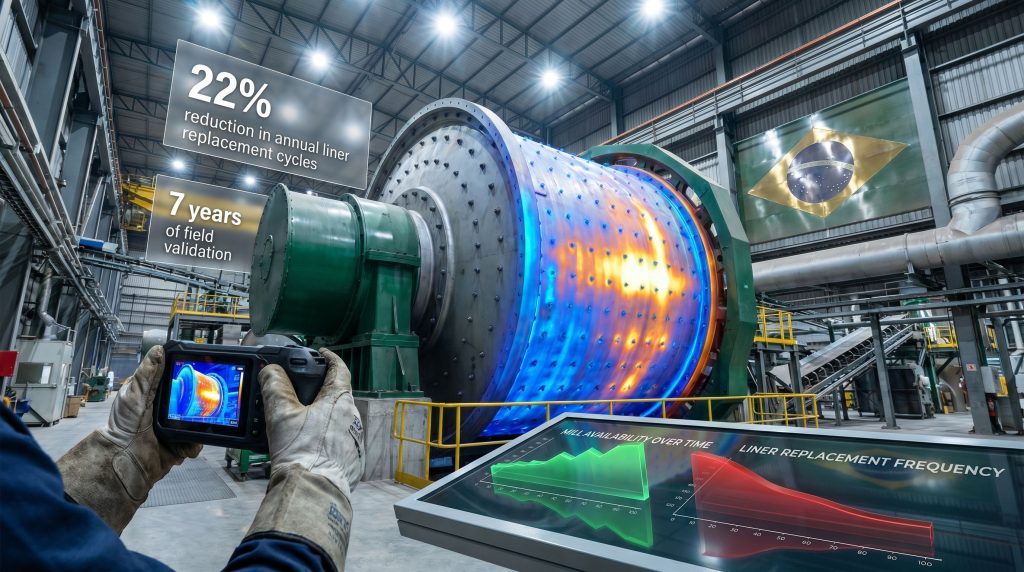
Rather than measuring temperature as a single-point value, the methodology captures high-resolution thermographic images of the entire external mill surface and applies a proprietary analytical framework to interpret the spatial and temporal pattern of heat distribution as a diagnostic indicator of internal liner condition. The mill casing effectively functions as an external measurement surface, transmitting thermal information about internal structural states without requiring any physical contact with or penetration of the liner system itself.
What Makes the Analytical Framework Unique?
Mauro Alberto Rossi, a Maintenance Engineer at Anglo American who contributed to the development team, articulated the conceptual distinction that underpins the patent's novelty: the methodology is not concerned with temperature measurement in isolation, but rather with the interpretive logic applied to thermal patterns and what those patterns reveal about the wear condition of internal components. This analytical framework, developed and validated over seven years of field testing at Minas-Rio, is characterised as unique within the global mining industry.
The implementation process follows a structured sequence:
- Thermographic Baseline Establishment — High-resolution thermal cameras capture the complete external temperature distribution profile of the Vertimill shell under defined standard operating conditions, establishing reference signatures for known liner states
- Calibration Against Physical Benchmarks — Thermal signatures captured during the development phase were correlated against liner thickness measurements obtained during scheduled physical inspections, building a validated reference dataset linking thermal patterns to structural conditions
- Wear Rate Modelling — Sequential thermal imaging cycles allow engineers to track how thermal patterns evolve over time, enabling mathematical modelling of wear progression rates and projection of remaining liner service life
- Maintenance Window Integration — Wear projections are incorporated into planned maintenance scheduling frameworks, enabling liner replacement to be timed precisely at the optimal point in the wear cycle rather than against conservative fixed-interval schedules
- Continuous Model Refinement — The analytical criteria are updated as operational data accumulates across additional mill cycles, progressively improving the accuracy of wear rate projections and service life estimates
Technical Distinctiveness: What the Patent Actually Protects
Thermographic imaging is not a novel technology. It has been applied in industrial maintenance contexts for decades, most commonly for electrical system inspection, rotating equipment bearing assessment, and structural integrity monitoring in civil engineering. What distinguishes the Anglo American patent for monitoring Vertimill liner wear at Minas-Rio is the domain-specific application and, critically, the proprietary analytical methodology developed to extract structural condition intelligence from thermal data in a vertical grinding mill environment.
The following comparison illustrates where the two approaches diverge fundamentally:
| Dimension | Conventional Inspection Method | Anglo American Patented Method |
|---|---|---|
| Operational interruption | 24+ hours per inspection cycle | Zero interruption required |
| Personnel hazard exposure | Confined space entry required | No personnel entry into equipment |
| Assessment basis | Direct visual and tactile inspection | External thermal pattern analysis |
| Maintenance scheduling | Fixed-interval or condition-triggered reactive | Data-driven predictive planning |
| Information output | Point-in-time condition snapshot | Continuous wear rate modelling |
| Infrastructure requirement | Full shutdown and drainage infrastructure | Thermographic camera positioning only |
How Does Thermal Resistance Drive the Detection Mechanism?
A technically important distinction concerns the thermal mechanism at work. As liner material is abraded away, the remaining liner cross-section becomes thinner, altering the thermal resistance of the mill wall assembly between the hot interior slurry environment and the external surface. This change in thermal resistance modifies the rate and pattern of heat conduction to the external casing, producing detectable signatures in thermographic imagery.
The proprietary analytical criteria developed by the Minas-Rio team define how to interpret these signatures quantitatively as liner thickness proxies. Advances in comminution research have demonstrated how complex the internal wear dynamics of grinding mills can be, which underscores why the interpretive framework required seven years of rigorous field validation.
This mechanism is also what separates the methodology from simpler temperature-threshold monitoring approaches. Temperature thresholds can indicate equipment overheating but cannot differentiate between liner wear at varying spatial locations, map wear gradients across the mill circumference, or project remaining service life trajectories. The Anglo American methodology addresses all three capabilities simultaneously.
Operational and Safety Outcomes at Minas-Rio
Seven years of development, field testing, and validation produced a set of quantified operational improvements that underpin the patent's commercial significance. Studies conducted during the validation phase confirmed that the methodology enables a 22% reduction in annual liner replacement cycles at Minas-Rio, a figure that represents both direct material cost savings and indirect savings from reduced labour mobilisation, equipment downtime, and associated maintenance support activities.
The operational benefit structure operates at multiple levels simultaneously:
- Mill availability improvement: By replacing liner sets at the optimal point in their wear cycle rather than against conservative precautionary schedules, mills remain in productive operation for longer continuous periods
- Liner service life extension: Each liner set extracts maximum productive life before retirement, reducing material consumption and the environmental footprint associated with liner manufacturing, transport, and disposal
- Energy efficiency optimisation: Mills operating with appropriately worn liners within acceptable tolerances maintain closer-to-optimal grinding geometry, preserving energy efficiency in ore size reduction
- Maintenance planning quality: The shift from reactive to predictive maintenance scheduling reduces the frequency of emergency mobilisations, which typically carry significant cost premiums relative to planned maintenance events
The safety improvement is arguably as significant as any productivity metric. Removing confined space entry from the routine liner assessment workflow eliminates a category of occupational risk that carries serious potential consequence severity. In mining operations globally, confined space incidents account for a disproportionate share of serious injuries and fatalities relative to total hours worked in that task category.
Kellson Takenaka Menezes, Predictive Maintenance Coordinator at Anglo American, framed the broader significance of the patent in terms of intellectual asset creation: the recognition validates that the Brazilian engineering team at Anglo American can generate intellectual property assets with measurable global value, and the multi-jurisdictional filing strategy in seven additional countries beyond the United States reflects the company's intent to protect and leverage that value internationally.
From Site Innovation to Global Intellectual Property Strategy
The granting of a USPTO patent for a mining process methodology signals something beyond operational improvement at a single site. It reflects a strategic evolution in how major mining companies conceptualise the value embedded in their operational knowledge bases. In addition, it aligns directly with broader mining innovation trends that are reshaping how the industry approaches technology development and intellectual property.
Historically, the intellectual property landscape of the mining sector has been dominated by equipment manufacturers and technology suppliers, who held patents on the machinery, reagents, and process technologies that mining operations licence and purchase. Knowledge generated within operating sites was typically retained as proprietary know-how rather than formalised as registered intellectual property.
Anglo American's decision to pursue formal patent protection for the Minas-Rio liner wear monitoring methodology, and to do so across eight jurisdictions simultaneously, represents a deliberate departure from this convention. It positions site-generated operational knowledge as an asset class worthy of formal protection, commercial licencing potential, and strategic deployment across a global portfolio.
Ana Sanches, Anglo American's Country President for Brazil, described the achievement as reinforcing the company's positioning as a benchmark for applied innovation in mining, integrating safety, efficiency, and operational excellence within a single technological advance. Furthermore, data-driven mining operations frameworks of this kind are increasingly being recognised as a source of durable competitive advantage rather than simply operational improvement.
The next major ASX story will hit our subscribers first
Industry Implications and Potential Extensions of the Technology
The thermographic liner wear monitoring methodology developed at Minas-Rio has potential applicability beyond Vertimill installations. The underlying principle — using external thermal pattern analysis to infer internal structural wear conditions non-invasively — is theoretically transferable to other rotating or pressurised equipment where internal component wear affects external thermal signatures. AI mining efficiency tools could, for instance, further accelerate the analytical processing of thermographic datasets at scale across multi-unit mill circuits.
| Equipment Category | Potential Application of Thermographic Wear Analysis |
|---|---|
| SAG and ball mills | Adaptation for liner monitoring in horizontal rotating mill configurations |
| Slurry pumps | External thermal profiling of pump casing wear in high-abrasion service |
| Cyclone clusters | Thermal pattern monitoring of cyclone wall wear in classification circuits |
| Pipeline systems | Thermographic scanning of high-wear sections in slurry pipeline infrastructure |
| Crusher liners | Thermal pattern analysis for cone and jaw crusher liner condition assessment |
Anglo American has confirmed that the Minas-Rio methodology will be assessed for replication across other operations within its global portfolio. This positions the Minas-Rio engineering team as an internal centre of expertise in predictive maintenance innovation, with the potential to influence maintenance practices at Anglo American operations in multiple geographies.
For the broader mining sector, the patent serves as a proof of concept that non-invasive condition monitoring for high-wear internal components in grinding circuits is technically achievable and commercially viable. Competitors and equipment manufacturers may now face competitive pressure to develop or acquire comparable capabilities, potentially accelerating innovation across the predictive maintenance technology landscape in minerals processing. Anglo American's Minas-Rio filtration plant further illustrates the site's broader commitment to operational excellence across multiple technical domains.
What This Means for Predictive Maintenance in Iron Ore Processing
The broader context within which this patent sits is an industry-wide shift toward predictive and condition-based maintenance frameworks, displacing the fixed-interval preventive maintenance schedules that have historically governed mill liner replacement decisions. Fixed-interval schedules, by design, incorporate conservative safety margins that result in premature liner replacement before the material is fully consumed, generating unnecessary costs and downtime.
Condition-based replacement eliminates this conservatism by substituting real-time structural data for assumed wear rates. Consequently, understanding the iron ore demand outlook becomes even more important, as higher sustained demand amplifies the value of every percentage point improvement in mill circuit availability at large-scale operations like Minas-Rio.
The challenge that has constrained adoption of condition-based liner replacement in vertical grinding mills has been the absence of a reliable, non-invasive method for assessing internal liner condition without stopping production. The Anglo American patent for monitoring Vertimill liner wear at Minas-Rio directly resolves this constraint, providing a validated field-proven methodology that can form the basis of a true condition-based maintenance regime for Vertimill liner management.
The significance of this shift extends beyond cost reduction. When maintenance decisions are driven by real equipment condition data rather than conservative schedule assumptions, the entire maintenance management framework becomes more responsive, more precise, and more aligned with the actual operational behaviour of the equipment being maintained.
For iron ore processing operations managing multiple Vertimill units across large processing facilities, the compounding benefit of applying this methodology fleet-wide could represent a substantial annual improvement in mill circuit availability, liner material consumption, and maintenance workforce deployment efficiency.
The seven-year development journey at Minas-Rio, from initial thermogram analysis through field validation and patent grant, demonstrates that substantive predictive maintenance innovation in mineral processing is achievable at the site level when engineering teams are given the mandate, resources, and institutional support to pursue original problem-solving rather than adapting existing commercial solutions.
This article draws on reporting published by Brasil Mineral on 14 May 2026. Readers seeking further coverage of mineral processing technology developments across Brazil are encouraged to explore Brasil Mineral's ongoing industry reporting at brasilmineral.com.br.
This article contains forward-looking statements and operational projections based on information available at the time of publication. Actual operational outcomes may differ from those described. This content is intended for informational purposes only and does not constitute financial advice.
Want To Stay Ahead Of Significant Mineral Discoveries On The ASX?
Discovery Alert's proprietary Discovery IQ model delivers real-time alerts the moment significant ASX mineral discoveries are announced, turning complex data across more than 30 commodities into clear, actionable insights for both short-term traders and long-term investors. Explore historic discoveries and their exceptional returns, then start your 14-day free trial at Discovery Alert to position yourself ahead of the broader market.