May 14, 2026
The Infrastructure Gap That Hybrid Technology Was Built to Solve
Open-pit mining faces a structural paradox. The equipment most critical to productivity, the haul truck fleet, is simultaneously the greatest source of fuel expenditure and the largest contributor to site-level carbon emissions. For mining operators navigating sharply rising energy costs alongside increasingly binding emissions disclosure frameworks, this convergence creates a pressure point that incremental optimisation simply cannot address. Solving it demands a fundamentally different approach to how haul trucks are powered, and that is precisely where the Rolls-Royce hybrid powertrain for haul trucks enters the picture.
The urgency behind this development is not abstract. Portions of the mining sector have committed to reducing carbon dioxide emissions by 30 to 40 percent before the end of this decade, with carbon-neutral operations targeted by 2050, according to Engineering & Mining Journal (May 14, 2026). Meeting those commitments while simultaneously controlling operating costs requires targeting the highest-leverage intervention point on any mine site, and haul trucks represent exactly that. As Cobus van Schalkwyk, Vice President Global Mining at Rolls-Royce Power Systems, has noted, haul trucks account for the largest share of production costs and a significant proportion of site-level emissions in open-pit operations, making hybrid drive systems a meaningful lever for both cost reduction and decarbonisation.
When big ASX news breaks, our subscribers know first
Why Haul Truck Powertrains Are the Highest-Leverage Decarbonisation Target
The economic weight of haul truck operations within open-pit mining cannot be overstated. In a typical large-scale open-pit operation, diesel fuel consumed by the haul fleet represents one of the largest controllable line items in the operating cost structure. These vehicles operate continuously across 24-hour shift cycles, hauling payloads that can exceed 300 tonnes per trip across routes that can span several kilometres in both distance and elevation change. The cumulative energy demand is enormous, and under conventional diesel-only systems, that demand translates directly into fuel consumption and exhaust emissions at scale.
What makes haul trucks uniquely well-suited to hybrid intervention is the inherent cyclical structure of their operation. Unlike highway freight trucks that travel predominantly on flat terrain in one direction, open-pit haul trucks repeat the same loaded descent and empty or loaded ascent cycle hundreds of times per shift. This predictable rhythm creates consistent opportunities for energy recovery that do not exist in most other heavy-duty transport applications. Furthermore, the broader mining electrification trends across the sector are accelerating the case for hybrid intervention as a near-term solution.
For decades, mtu diesel engines have powered equipment across the full spectrum of open-pit mining machinery, from blast hole drilling rigs and excavators to wheel loaders and haul trucks, across diesel-mechanical, diesel-electric, and diesel-hydraulic configurations. That depth of operational experience in high-load, high-cycle mining environments is foundational to the credibility of the hybrid architecture now under development.
How the Rolls-Royce Hybrid System Actually Works
Regenerative Energy Capture: The Core Mechanism
The engineering logic underpinning the hybrid system is elegant in its simplicity, even if the execution is technically demanding. When a fully loaded haul truck descends from a pit bench toward the crusher or dump point, gravitational potential energy is converted into kinetic energy. In conventional haul trucks, that kinetic energy is dissipated entirely as waste heat through mechanical friction brakes. The hybrid architecture intercepts this energy before it is wasted.
During the downhill descent, the system activates regenerative braking through electric motor-generators integrated into the drivetrain. These components convert kinetic energy into electrical energy, which is then stored in an onboard battery system. When the truck completes its descent, unloads, and begins the return ascent, the stored electrical energy is discharged through electric wheel motors to provide propulsive force, reducing the diesel engine's required output during this most fuel-intensive phase of the haul cycle.
The net result is that the diesel engine operates at a consistently lower and more stable load point across the full cycle. This matters for two reasons. First, diesel engines operating at reduced, stabilised load consume less fuel per unit of work performed. Second, lower operating temperatures and reduced peak thermal stress translate to improved engine longevity and potentially lower maintenance costs over time.
mtu Series 4000 Integration and Drivetrain Architecture
The system pairs the established mtu Series 4000 engine platform with a high-performance electric drivetrain in what functions as a parallel hybrid configuration. In this architecture, both the diesel engine and electric drivetrain can deliver power simultaneously when maximum output is needed, such as during heavy-load acceleration on an uphill gradient. During lower-demand phases, the electric system carries a greater share of the load, allowing the diesel to throttle back.
The mtu Series 4000 platform serves as the diesel backbone rather than being replaced outright. This design decision reflects a pragmatic engineering reality: existing mine site logistics, maintenance infrastructure, and operator training are built around diesel systems. Retaining a diesel core while layering electric capability on top minimises operational disruption while delivering meaningful efficiency gains. The electric drivetrain supplements peak output demands rather than acting as the primary propulsion source.
Modularity as a Strategic Design Principle
One of the most commercially significant aspects of the system is its explicitly modular and scalable architecture. The engineering objective is a platform adaptable to different vehicle types, mine topographies, and operational requirements. This modularity serves two distinct strategic purposes.
First, it enables retrofit applications for existing haul truck fleets rather than requiring operators to commit to new-build replacements. Given that large haul trucks represent capital investments of several million dollars each and that major mining operations may operate fleets numbering in the dozens or hundreds of units, the ability to upgrade existing equipment dramatically widens the addressable market and reduces the total capital burden on adopting operators.
Second, scalability allows battery capacity and electric motor output to be matched to the specific energy profile of a given mine site, avoiding both over-engineering for flat-terrain operations and under-engineering for high-relief environments. In addition, the renewable energy in mining space is evolving rapidly, and modular hybrid platforms are well-positioned to integrate with these emerging solutions as they mature.
Quantifying the Potential Savings
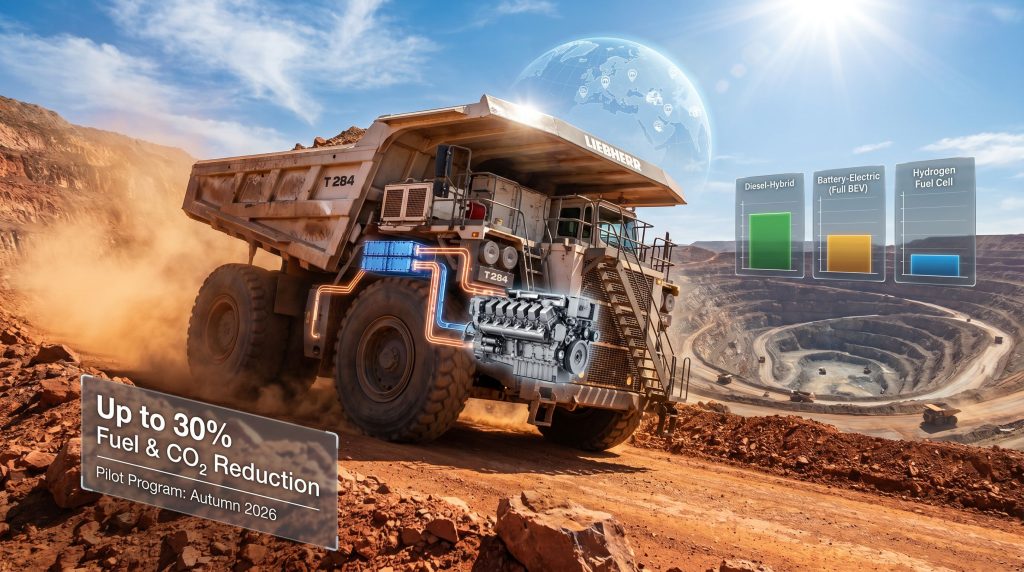
The headline performance claim is a reduction in fuel consumption and carbon dioxide emissions of up to 30 percent compared to conventional diesel-only systems, as reported by Engineering & Mining Journal (May 14, 2026). It is important to understand precisely what this figure represents and where it applies.
| Performance Dimension | Conventional Diesel System | Hybrid Drive System | Improvement |
|---|---|---|---|
| Fuel Consumption | Baseline | Up to 30% lower | Topography-dependent |
| CO₂ Emissions (operational) | Baseline | Up to 30% lower | Proportional to fuel reduction |
| Engine Load Profile | High and variable | Reduced and stabilised | Consistent across cycle |
| Brake Heat Dissipation | High (wasted energy) | Reduced via regeneration | Site-specific capture rate |
| Applicability | Universal | Gradient-dependent | Optimised for high-relief mines |
The 30-percent efficiency gain is a projected figure based on engineering analysis and modelling. As of mid-2026, field validation testing has not yet commenced. Real-world outcomes will depend on specific mine site topography, haul cycle characteristics, payload profiles, and operational management practices.
The efficiency relationship is fundamentally tied to gradient. A mine with pronounced elevation changes between ore loading and dumping points, such as a deep open-pit copper mine where haul routes descend and ascend hundreds of metres, generates significantly more recoverable braking energy per cycle than a shallow or flat operation. In topographically constrained environments, the 30-percent figure represents an optimistic upper bound; in high-relief operations with long, steep hauls, it may represent a realistic central estimate.
Three key variables shape real-world outcomes beyond topography alone:
- Payload weight per cycle: Heavier loads generate more kinetic energy during descent, increasing recoverable energy magnitude per trip
- Cycle frequency: Higher trip rates per shift amplify cumulative savings, as each cycle contributes an incremental efficiency gain
- Shift duration and continuity: Longer continuous operating periods allow battery systems to cycle through more charge-discharge events, maximising total energy recovery across the shift
Sustainable Fuel Compatibility: Compounding the Emissions Reduction
The hybrid system's diesel engine component is designed for compatibility with hydrotreated vegetable oil (HVO) and other sustainable fuel alternatives. This compatibility creates a compounding emissions reduction pathway that goes well beyond the 30-percent operational efficiency gain. Consequently, the mining decarbonisation benefits of combining hybrid technology with lower-carbon fuels extend well beyond what either approach achieves independently.
HVO is a refined second-generation biofuel produced through hydrotreatment of vegetable oils, animal fats, or waste cooking oils. Unlike biodiesel blends, HVO is chemically nearly identical to fossil diesel and can typically be used as a direct drop-in replacement without modification to existing engines or fuel systems. Lifecycle greenhouse gas emissions for HVO compared to fossil diesel can be reduced by approximately 60 to 90 percent depending on feedstock and production process, according to European Environment Agency assessments of fuel lifecycle emissions.
When HVO is used within the hybrid system instead of conventional diesel, the combined effect of operational efficiency gains and lower-carbon fuel could theoretically push total lifecycle emissions reductions well above 30 percent. For remote mine sites where grid-supplied renewable electricity for full battery-electric haul trucks remains unavailable, the HVO-plus-hybrid pathway offers a near-term decarbonisation option that requires no new charging infrastructure.
How Hybrid Technology Compares to Alternative Approaches
Understanding the hybrid system's position within the broader technology landscape requires honest assessment of competing approaches and their respective constraints.
| Technology | Primary Energy Source | Refuelling or Recharging | New Infrastructure Required | Potential Emissions Reduction | Retrofit Feasibility |
|---|---|---|---|---|---|
| Diesel-Hybrid (Regenerative) | Diesel plus onboard battery | Standard diesel refuel | Minimal | Up to 30% operational | High |
| Full Battery-Electric | Grid or renewable electricity | Hours via charging infrastructure | High | Up to 100% with green grid | Low to Medium |
| Hydrogen Fuel Cell | Green hydrogen | Minutes (if H₂ available) | Very high | Up to 100% with green H₂ | Low |
| HVO Drop-In Fuel | Hydrotreated vegetable oil | Standard diesel refuel | Minimal | 60–90% lifecycle | Very High |
| HVO plus Hybrid Combined | HVO and onboard battery | Standard HVO refuel | Minimal | Compounded reduction | High |
The fundamental constraint facing full battery-electric haul trucks is not technological capability but infrastructure. Large open-pit mines are frequently located in remote regions with limited grid connectivity. Installing the dedicated high-power charging infrastructure required to service a fleet of large battery-electric haul trucks in these environments involves substantial capital outlay, extended construction timelines, and ongoing grid management complexity. For many operators, this makes full electrification a medium-to-long-term prospect rather than an immediately executable strategy.
Hydrogen mining trucks face even more acute near-term barriers. The production, storage, and distribution of green hydrogen at remote mine sites requires supply chain infrastructure that does not yet exist at commercial scale in most mining jurisdictions. While the long-term emissions reduction potential is compelling, the practical deployment timeline for hydrogen haul trucks in operational mines remains uncertain.
The hybrid approach occupies a deliberately pragmatic position: delivering meaningful, measurable emissions reductions and fuel cost savings today, using infrastructure that already exists at mine sites, while longer-term full-electrification or hydrogen solutions mature toward commercial viability.
The next major ASX story will hit our subscribers first
Field Testing and the Road to Commercial Validation
The Autumn 2026 Pilot Programme
Rolls-Royce Power Systems has announced that field testing of a pilot vehicle will begin at a mine site in autumn 2026, as documented by Engineering & Mining Journal (May 14, 2026). The public unveiling of the system took place at the Electric Mine Conference in Lisbon on May 7, 2026, providing the industry with its first formal introduction to the technology ahead of operational deployment.
Real-world field validation serves a purpose that no amount of laboratory testing or computational modelling can replicate. Mine environments introduce variables that controlled testing cannot fully anticipate: dust infiltration affecting battery cooling systems, vibration profiles that vary with road surface quality, temperature cycling between cool morning starts and midday thermal peaks, and operational variability driven by shift changes, maintenance windows, and haul route adjustments.
What Validation Testing Will Determine
The testing phase will generate data across several critical performance dimensions:
- Actual fuel consumption reduction across the full haul cycle, benchmarked against baseline diesel-only performance under equivalent payload and route conditions
- Energy recovery rates per descent cycle, establishing how much of the available braking energy the system successfully captures and stores under real operating conditions
- Battery state-of-health progression under continuous high-duty cycling, assessing whether cell degradation rates are consistent with projected operational lifespans
- Drivetrain integration reliability, confirming that the diesel and electric systems coordinate effectively under variable load demands without mechanical or electrical fault events
- Net fuel consumption per tonne-kilometre, the standardised efficiency metric that allows direct comparison across mine sites with different haul distances and payload profiles
The generalisability of results will depend partly on the topographic profile of the selected test site. A high-relief site would validate maximum-scenario performance but might not represent conditions at flatter operations. Ideally, subsequent testing phases would extend across multiple site types to establish a performance envelope applicable across the diversity of open-pit mining geographies.
Broader Implications for Mining Decarbonisation Strategy
ESG, Investor Relations, and the Social Licence to Operate
The financial case for hybrid adoption extends beyond direct fuel savings. Mining companies operating under investor-driven ESG frameworks face growing pressure to demonstrate measurable progress toward emissions targets. A technology that delivers verifiable, reportable reductions in scope 1 emissions from haul truck operations provides a quantifiable contribution to corporate sustainability metrics that can be communicated to investors, regulators, and host communities.
Fuel savings of up to 30 percent across a large haul fleet operating continuously translate into operating cost reductions that directly improve mine economics. For an operation running 50 haul trucks each consuming thousands of litres of diesel per operating day, a 25 to 30 percent reduction in fuel consumption represents a substantial improvement in total cost of ownership that can partially or fully offset the capital premium associated with hybrid systems over a defined payback horizon.
Established Powertrain Manufacturers as Transition Integrators
There is a less-discussed dimension to this development that carries strategic significance for the broader industrial energy transition. The narrative around electrification in heavy industry often positions established combustion engine manufacturers as entities being displaced by battery and electric motor technology. The Rolls-Royce Power Systems hybrid development represents a different dynamic: an established diesel engine platform specialist leveraging its deep domain expertise in mining applications to act as an integrator of the diesel-to-electric transition rather than a casualty of it.
This positioning matters because hybrid integration is not simply a matter of attaching batteries to a diesel truck. Effective hybrid architecture requires intimate understanding of the load cycles, thermal behaviour, torque delivery characteristics, and failure modes of heavy-duty diesel systems operating under mining conditions. That knowledge base, accumulated over decades of mtu engine deployments across mining equipment categories, is precisely the prerequisite for designing a hybrid system that performs reliably in the field rather than in controlled demonstrations. Understanding this within the context of the mining energy transition underscores why incumbent manufacturers with domain expertise are uniquely positioned to lead hybrid integration at scale.
Frequently Asked Questions: Hybrid Powertrains for Mining Haul Trucks
How does a hybrid haul truck powertrain differ from a conventional diesel-electric system?
A conventional diesel-electric system uses the diesel engine to generate electricity that continuously powers traction motors, but it does not store or recover energy. The hybrid system adds an onboard battery that captures electrical energy generated during regenerative braking on downhill hauls and redeploys it through wheel motors on the ascent, reducing the diesel engine's required output and overall fuel consumption.
What mine types benefit most from hybrid haul truck technology?
Operations with significant topographic relief, specifically deep open-pit mines where haul routes involve substantial elevation changes between ore loading points and dumping or crushing facilities, generate the greatest opportunity for regenerative energy capture and will achieve the highest efficiency gains from hybrid systems.
Can existing haul trucks be retrofitted with the hybrid powertrain?
The system is explicitly designed around modularity and scalability, with retrofit compatibility across different vehicle types and mine configurations identified as a core engineering objective. This allows operators to upgrade existing fleet assets rather than committing to full fleet replacement.
When will the hybrid haul truck technology be commercially available?
Pilot field testing is scheduled to begin in autumn 2026. Commercial availability will depend on the outcomes of real-world validation testing, any required regulatory or safety certifications, and manufacturing scale-up timelines. Typical heavy-duty mining technology adoption cycles from successful pilot to broad commercial deployment can span several years.
How does HVO fuel compatibility enhance the system's environmental credentials?
When the diesel engine component operates on HVO rather than conventional fossil diesel, lifecycle greenhouse gas emissions can be reduced by approximately 60 to 90 percent depending on feedstock. Combined with the operational efficiency gains from regenerative energy recovery, the HVO-plus-hybrid pathway represents a compounded decarbonisation outcome that significantly exceeds the 30-percent operational reduction achievable from hybrid technology alone.
What are the main barriers to widespread adoption?
Key barriers include the upfront capital cost premium relative to conventional systems, the need for battery maintenance expertise within mine site technical teams, performance uncertainty in low-gradient operations where regenerative capture opportunities are limited, and the timeline required to move from successful field pilot to broad fleet deployment across an industry with long equipment procurement cycles.
The Strategic Outlook: Pragmatic Transition or Permanent Architecture?
The longer-term question that the mining industry will need to answer is whether hybrid haul truck technology represents a permanent fixture in the operational fleet or a transitional architecture that bridges toward full electrification as grid infrastructure and battery technology mature at remote mine sites.
The honest answer is likely both, depending on geography and timeline. For mines in regions where grid expansion to support large-scale battery-electric charging remains decades away, hybrid systems may represent the optimal permanent solution, particularly when combined with HVO fuels. For operations closer to reliable renewable energy grids, hybrid systems may serve as the financially rational first step in a longer journey toward full electrification, allowing operators to begin capturing fuel savings and meeting near-term emissions targets while the infrastructure for full battery-electric operation is developed.
What is not in question is the urgency. With 2030 emissions reduction commitments approaching and carbon-neutral targets anchoring long-term planning, the mining industry cannot wait for technically perfect solutions. The Rolls-Royce hybrid powertrain for haul trucks offers a commercially deployable, infrastructure-compatible, and financially justifiable pathway toward meaningful decarbonisation that is available within this planning horizon, not the next one. Successful field validation in autumn 2026 and beyond will determine how quickly that pathway translates from pilot programme to industry standard.
Disclaimer: This article contains forward-looking statements regarding projected fuel efficiency improvements and emissions reductions. The 30-percent performance figure represents a manufacturer projection based on engineering modelling and is subject to real-world validation through field testing commencing in autumn 2026. Actual results will vary depending on mine site topography, operational profiles, and equipment configurations. This article does not constitute financial or investment advice. Readers should conduct independent due diligence before making investment or procurement decisions.
Want to Invest in the Companies Driving Mining's Next Big Shift?
Discovery Alert's proprietary Discovery IQ model scans ASX announcements in real time, delivering instant alerts on significant mineral discoveries to subscribers — from the commodities powering electrification to the explorers reshaping the sector's future. Explore historic discoveries and the returns they generated, then begin your 14-day free trial at Discovery Alert to position yourself ahead of the market.