May 14, 2026
The Processing Gap That Could Define North America's EV Battery Future
Across the global battery supply chain, a structural imbalance has quietly persisted for decades. Raw materials travel thousands of kilometres to refineries concentrated in a single region, get transformed into battery-grade chemicals, and then travel back again to manufacturing hubs in North America, Europe, and beyond. For cobalt specifically, this processing bottleneck has remained stubbornly entrenched, even as electric vehicle adoption accelerates and the strategic sensitivity of battery inputs becomes impossible to ignore.
What makes the Electra solvent extraction facility in Temiskaming Shores so technically and strategically interesting is not just what it produces, but what it represents: the deliberate construction of a processing node that, until now, has not existed at commercial scale anywhere in North America. Understanding why that matters requires looking closely at the engineering logic, construction sequencing, and supply chain context that make this particular project genuinely distinct.
When big ASX news breaks, our subscribers know first
What Solvent Extraction Actually Does in Cobalt Refining
To appreciate the significance of the facility being built in Temiskaming Shores, Ontario, it helps to understand the chemistry it is designed to perform. Cobalt arriving at a refinery, whether sourced from primary concentrate or recycled black mass, does not arrive in a chemically pure form. It travels in solution alongside nickel, manganese, iron, zinc, and a range of other dissolved impurities.
Getting from that complex leach solution to a product that meets battery-grade specifications is a multi-stage chemical journey, and solvent extraction sits at its most critical juncture.
How the Chemistry Works
The process works by introducing an organic extractant, typically a phosphoric acid derivative or oxime-based compound, into the aqueous leach solution under carefully controlled conditions of pH, temperature, and reagent concentration. Cobalt ions migrate preferentially into the organic phase, effectively separating from the bulk of the impurity load. The loaded organic is then stripped with a concentrated aqueous solution to recover cobalt in a cleaner, more concentrated form before it proceeds to crystallisation as battery-grade cobalt sulfate.
What distinguishes solvent extraction from simpler purification alternatives is its capacity to achieve the purity thresholds that lithium-ion battery cathode manufacturers actually require. Direct precipitation can remove bulk impurities but struggles to drive trace contaminants down to the parts-per-million levels demanded by modern NMC and NCA cathode chemistries. Pyrometallurgical processing produces intermediate alloys rather than the soluble sulfate salts that cathode precursor chemistry requires.
Ion exchange can achieve comparable purity but becomes economically constrained at commercial throughput scales. Solvent extraction, furthermore, combines selectivity, scalability, and compatibility with both primary and recycled feed streams in a way that no current alternative fully replicates. This is particularly relevant given the evolving battery recycling process and the growing need for facilities capable of handling complex recycled inputs.
The chemistry of solvent extraction was originally developed for uranium and rare earth processing in the mid-20th century before being adapted for base metals. Its application to battery-grade cobalt refining represents one of the more consequential technology transfers in modern minerals processing history.
The $25 Million Construction Package: What Is Actually Being Built
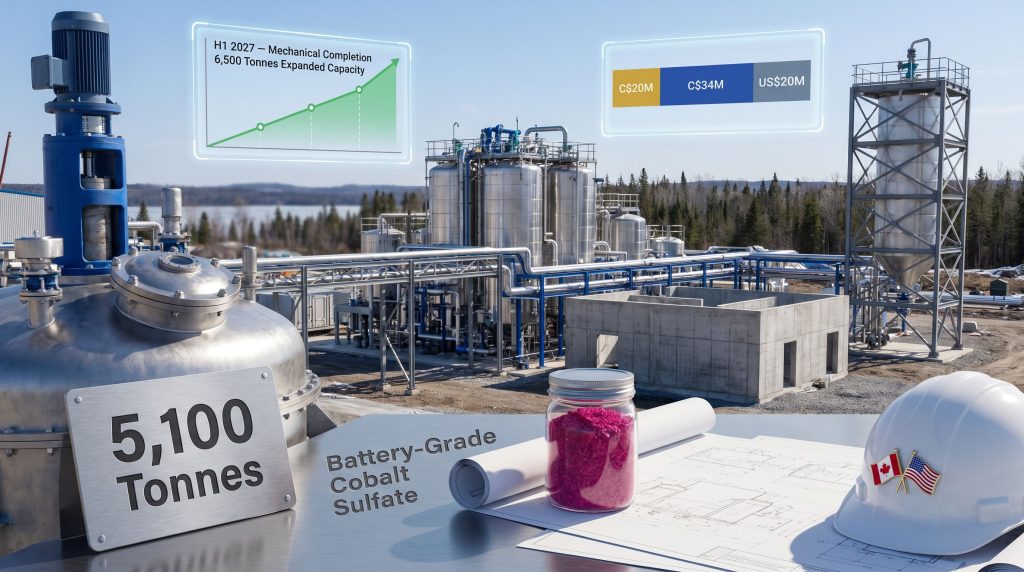
Electra Battery Materials has contracted WB Melback, an Ontario-based industrial construction company, to execute the US$25 million construction scope for the solvent extraction facility at its cobalt sulfate refinery complex in Temiskaming Shores. As reported by the Canadian Mining Journal on May 14, 2026, the construction package covers four primary trade categories: concrete works, structural steel assembly, process piping installation, and electrical systems.
A limited notice to proceed has been issued, authorising WB Melback to begin defined early-scope activities while the full construction agreement is being finalised. This sequencing approach is a deliberate risk-management mechanism in large industrial builds, allowing critical-path activities to commence before every commercial term is locked down, thereby preserving schedule momentum on items that cannot be recovered easily if delayed.
Early-Phase Progress
Early-phase activities already completed or underway include:
- Concrete work for the leach solution filter, which provides the structural foundation for upstream process equipment
- Installation of the steel structure for the neutralisation clarifier, advancing the liquid-solid separation circuit
- Delivery of key long-lead equipment, eliminating procurement risk on items with extended manufacturing lead times
- Material sequencing and logistics planning to pre-position components and minimise on-site handling complexity
- Demolition reviews to assess existing structures for integration or removal
- Enabling civil and structural works to establish the physical platform for all subsequent construction trades
The completion of the leach solution filter concrete and neutralisation clarifier steel structure are particularly meaningful milestones. These two items anchor the upstream and mid-process sections of the hydrometallurgical circuit respectively, and their physical presence on site signals that the facility is transitioning from engineering drawings to tangible infrastructure.
Construction Sequencing Logic: Why the Order of Works Matters
Industrial hydrometallurgical facilities are not built the way commercial buildings are. The sequencing of construction trades is governed by process chemistry, equipment weight loads, and the spatial relationships between unit operations rather than by conventional floor-by-floor logic. A solvent extraction facility places unusual structural demands at specific locations.
The mixer-settler banks or pulsed columns that perform the actual extraction step are heavy, chemically aggressive environments that require reinforced containment, secondary bunding, and precise piping tolerances.
Civil and concrete works must therefore precede structural steel, which must precede piping, which must precede electrical terminations and instrumentation. Getting any of these sequences out of order creates costly rework and schedule compression downstream. The fact that Electra and WB Melback have already progressed through the concrete and initial structural steel phases before the full construction agreement is finalised indicates a high degree of engineering maturity in the project's design documentation.
The delivery of long-lead equipment is equally significant from a scheduling perspective. In chemical plant construction, long-lead items — typically large pressure vessels, heat exchangers, mixer-settler units, and specialised pumps — are ordered months or even years before physical construction begins. Their delivery to site ahead of full construction mobilisation means that the most common source of industrial project delays has already been addressed.
The Broader Context: Why North America Needs This Facility
The structural argument for domestic cobalt refining capacity in North America is not new, but it has become considerably more urgent as battery demand projections have scaled upward. The global cobalt refining landscape is heavily concentrated, with the majority of processing capacity located in China. This creates a dual dependency: raw ore flows predominantly from the Democratic Republic of Congo, while the value-adding chemical transformation happens predominantly in Chinese refineries before battery-grade materials reach Western cathode manufacturers.
This concentration is not simply a commercial inconvenience. It represents a potential point of vulnerability in supply chains that underpin the electrification of transport across North America and Europe. Western battery manufacturers and automakers have increasingly sought to qualify alternative sources of battery-grade cobalt sulfate that do not pass through this processing chokepoint, but the supply of domestically refined product has remained extremely limited. The wider battery metals landscape reflects this structural tension clearly.
Approximately 70 to 80 percent of global cobalt refining capacity is currently concentrated in China, according to widely cited industry data. For battery manufacturers operating under emerging supply chain due-diligence requirements, the geographic origin of refined materials is becoming as commercially relevant as the chemical specification of those materials.
Why Canada and Temiskaming Shores?
Canada possesses specific advantages that make Temiskaming Shores a logical location for this type of processing infrastructure. The region sits within the broader Ontario cobalt-silver mining corridor, an area with over a century of metals extraction history and existing technical workforce capacity. Access to relatively low-carbon hydroelectric power reduces both the operating cost and the lifecycle emissions intensity of energy-intensive hydrometallurgical processing.
The province's existing industrial supply chain and engineering contractor base, demonstrated by the engagement of Ontario-based WB Melback, provides a practical execution foundation that newer jurisdictions attempting to build critical minerals energy security cannot replicate quickly.
The Engineering Contract Layer: EXP Services and Project Oversight
Construction contracts like the WB Melback package operate within a broader project delivery structure. Engineering, procurement, and construction management functions on industrial chemical facilities of this complexity are typically separated from the physical construction execution. EXP Services was awarded an engineering contract valued at approximately US$6.1 million (roughly C$8.3 million) in February 2026 to provide engineering and construction management oversight for the broader project, establishing the technical governance framework within which WB Melback's construction activities are being executed.
This separation of engineering management from construction execution is standard practice in process plant delivery and serves an important quality function. It creates an independent technical authority responsible for verifying that physical installation meets design specifications, managing variations to scope, and maintaining document control across disciplines. On a chemically complex facility like a solvent extraction plant, where material compatibility, containment integrity, and instrumentation calibration directly affect both safety and product quality, this oversight layer is not optional.
The next major ASX story will hit our subscribers first
Recycled Feed Streams: A Design Feature, Not an Afterthought
One technical aspect of the Electra solvent extraction facility in Temiskaming Shores that carries long-term strategic weight is its design compatibility with recycled cobalt inputs. Battery recycling generates a material called black mass — the shredded and processed residue of spent lithium-ion cells — which contains cobalt, nickel, lithium, manganese, and other valuable metals in a chemically complex mixture.
Processing black mass through conventional hydrometallurgical circuits requires robust purification capability, and solvent extraction is specifically well-suited to handling the variable and impurity-laden compositions that recycled streams produce. For context, Chinese battery recycling breakthroughs have demonstrated the commercial viability of this approach at scale, reinforcing the case for similar investment in the West.
Building recycled feed compatibility into the facility from the design stage, rather than retrofitting it later, reflects a forward-looking operational philosophy. As battery volumes on North American roads grow and the first large waves of end-of-life EV batteries begin flowing into recycling streams over the coming decade, refineries capable of accepting and processing recycled cobalt will occupy a structurally advantaged position. The Temiskaming Shores facility's architecture appears designed with this evolution in mind.
Timeline and Commissioning Outlook
Based on reporting from the Canadian Mining Journal, Electra is targeting mechanical completion and commissioning of the Electra solvent extraction facility in Temiskaming Shores in the first half of 2027. The project's construction progress through early 2026 provides a reasonable basis for confidence in that timeline, given that critical-path items including long-lead equipment delivery and foundational concrete and structural steel works have already been addressed.
The following summary reflects the project's progression based on publicly available information:
| Milestone | Status |
|---|---|
| Early works program completion | Completed |
| EXP Services engineering contract award | Awarded (February 2026) |
| WB Melback construction contract (LNTP issued) | In progress (May 2026) |
| Leach solution filter concrete works | Completed |
| Neutralisation clarifier steel structure | Completed |
| Long-lead equipment delivery | Completed |
| Full mechanical completion target | H1 2027 (projected) |
| Commissioning and first production | Post H1 2027 (projected) |
Disclaimer: Forward-looking timelines and production targets referenced in this article are based on publicly available company announcements and industry reporting. They are subject to change based on construction execution, regulatory approvals, financing conditions, and other factors outside the company's control. This article does not constitute financial or investment advice.
What This Project Signals for Canadian Critical Minerals Processing
The Electra solvent extraction facility in Temiskaming Shores represents something specific and measurable within the broader conversation about Western critical minerals self-sufficiency: it is a commercially scaled, technically credible attempt to build a hydrometallurgical cobalt refining capability where none currently exists in North America at battery-grade specification. Consequently, it joins a small but growing cohort of facilities — including Australia's first cobalt refinery — that signal a genuine structural shift in how Western nations approach battery materials processing.
What distinguishes this project from upstream mining investment, which tends to dominate critical minerals policy discussions, is that it addresses the processing deficit rather than the ore supply deficit. North America has no shortage of cobalt in the ground or in recycled material streams. What it has historically lacked is the refining infrastructure to convert those materials into the chemical forms that battery manufacturing actually requires.
Closing that gap is a more complex, capital-intensive, and technically demanding undertaking than opening a mine, which is precisely why it has taken longer to materialise.
The engagement of WB Melback and the concurrent progress across multiple construction fronts in May 2026 suggests that this particular gap is finally being addressed with genuine construction momentum, not just planning documentation. The chemistry is understood, the engineering is contracted, the equipment is on site, and the concrete is already poured. What follows is execution.
Source: Canadian Mining Journal, David Cassels, May 14, 2026. Additional technical and industry context has been incorporated from publicly available metallurgical literature and critical minerals supply chain analysis. Readers seeking further coverage of Electra Battery Materials' project progress can visit canadianminingjournal.com.
Want to Track the Next Major Battery Metals Discovery Before the Market Moves?
Discovery Alert's proprietary Discovery IQ model scans ASX announcements in real time, instantly identifying significant mineral discoveries across cobalt, nickel, lithium, and more than 30 other commodities — turning complex data into actionable investment opportunities for traders and long-term investors alike. Explore how historic mineral discoveries have generated substantial returns on Discovery Alert's dedicated discoveries page, and begin your 14-day free trial today to position yourself ahead of the broader market.