June 18, 2026
The Hidden Economics of Underground Mine Safety Consumables
Few corners of the industrial supply chain receive as little attention as the steel rods and chemical cartridges drilled into the roofs and walls of underground mines every single day. Yet without them, modern underground mining simply stops. Rock bolts and resin capsules are not glamorous products, and they rarely feature in technology showcases or investor presentations. However, they are consumed in extraordinary volumes, they are subject to strict regulatory mandates, and their reliable supply is a non-negotiable condition of mine operation. It is precisely this unglamorous criticality that makes the Sandvik joint venture with Alpha Metallurgical Resources in the US one of the more strategically revealing industrial investments announced in 2026.
When big ASX news breaks, our subscribers know first
Understanding the Joint Venture Structure
The partnership brings together two organisations with fundamentally complementary interests. Sandvik, the Swedish engineering group whose Mining and Rock Solutions division is among the most recognised names in underground equipment and consumables globally, has joined with Alpha Metallurgical Resources (NYSE: AMR), a leading Central Appalachian metallurgical coal producer, to create a dedicated US-based ground support manufacturing entity.
The ownership structure reflects the balance of control and commercial risk:
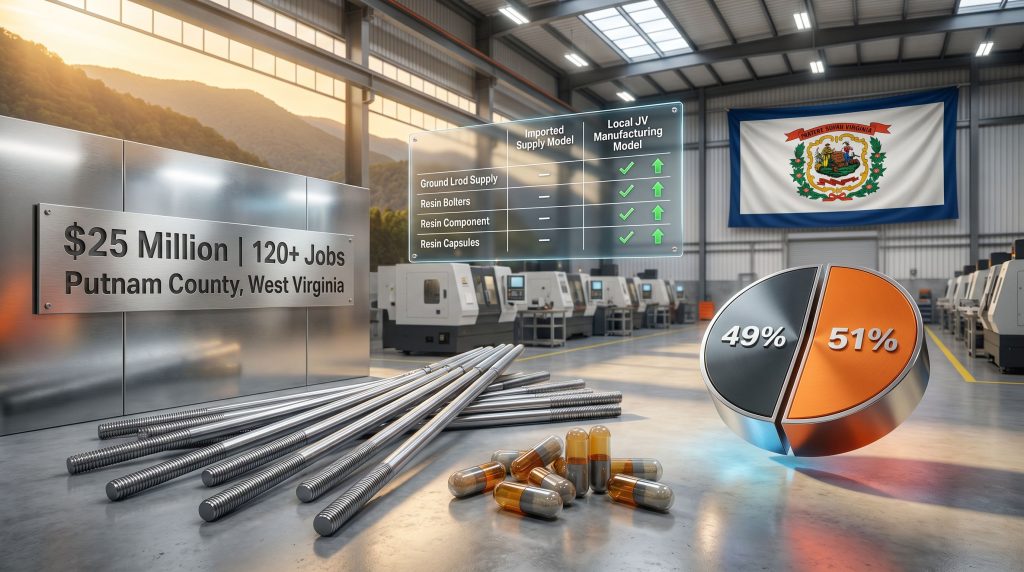
- Sandvik holds a 51% controlling interest, providing operational leadership and manufacturing expertise
- Alpha Metallurgical Resources retains a 49% stake, contributing anchor demand, regional knowledge, and shared capital
- A long-term exclusive supply agreement anchors Alpha as the primary customer, providing the demand certainty needed to justify significant upfront capital
- The joint venture is simultaneously structured to pursue third-party sales across the broader US underground mining market
This is not a distribution arrangement or a licensing deal. It is a vertically integrated manufacturing commitment, and that distinction matters enormously for understanding the strategic intent behind it. Furthermore, the scale of this commitment is reflected in the physical infrastructure planned to support it.
The initial product focus covers rock bolts and resin capsules, the two primary consumable categories used in underground mine passive ground support systems. A purpose-built 100,000 square foot manufacturing facility will be constructed in Putnam County, West Virginia, with a total capital investment of $25 million and a workforce commitment of at least 120 direct jobs upon reaching full operational capacity. You can read the official West Virginia governor's announcement for further details on the state's role in supporting this investment.
Why Sandvik Is Re-Entering US Domestic Manufacturing
Sandvik's Ground Support division had previously stepped back from direct US manufacturing, servicing North American customers through imported product supply. The decision to re-enter with a significant capital commitment reflects a shift in how the company assesses long-term market risk and customer value in this region.
Has the Supply Chain Calculus Changed?
The post-2020 period exposed deep vulnerabilities in global industrial supply chains that were previously considered manageable background noise. Transoceanic freight costs surged, lead times blew out across multiple shipping lanes, and geopolitical developments added new layers of uncertainty to import-dependent supply models. For high-volume, operationally critical consumables like rock bolts and resin capsules, these disruptions carried consequences that went beyond cost inconvenience.
Underground mining operations function on tightly managed production cycles. A longwall coal mine, for example, may install thousands of rock bolts per week as part of its mandatory roof support programme. Any interruption to consumable supply does not simply create a procurement headache; it creates a safety and regulatory compliance problem that can halt production entirely.
The comparison between supply models is stark:
| Factor | Imported Supply Model | Local JV Manufacturing Model |
|---|---|---|
| Lead Times | Weeks to months | Days to weeks |
| Freight Cost Exposure | High and variable | Substantially reduced |
| Supply Chain Risk | Elevated (logistics, geopolitical) | Significantly reduced |
| Customer Responsiveness | Constrained | High |
| Inventory Requirements | Extensive buffer stock needed | Leaner, more responsive |
A Scalable Platform, Not a One-Off Transaction
Sandvik has framed this investment as the foundation of a long-term North American growth strategy. The facility is designed with scalability in mind, with the initial product scope representing a starting point rather than a ceiling. This suggests the company is thinking beyond the immediate commercial relationship with Alpha and positioning the West Virginia plant as a beachhead for a broader domestic supply business serving the wider US underground mining sector.
The exclusive supply agreement with Alpha provides the demand anchor that makes this economics viable in the early years. As the JV establishes its manufacturing rhythm, the expansion into third-party sales creates a pathway to higher capacity utilisation and improved unit economics over time. The mining joint ventures trend more broadly reflects this kind of risk-sharing logic becoming standard across the sector.
What Alpha Metallurgical Resources Gains From the Partnership
Supply Security for Mission-Critical Materials
Alpha Metallurgical Resources operates an extensive underground coal mining network concentrated in Virginia and West Virginia, producing metallurgical coal used primarily in steelmaking blast furnaces. Metallurgical coal, also known as coking coal, commands a price premium over thermal coal because of its specific chemical properties, particularly low sulphur content and high carbon yield, which are essential for producing the coke used in steel production.
For an operation of Alpha's scale and complexity, ground support consumables represent a genuinely strategic procurement category. The company's leadership has described the venture as a meaningful step toward strengthening supply chain security for materials that are fundamental to safe and compliant operation. Holding a 49% equity stake transforms Alpha from a buyer of ground support products into a part-owner of the manufacturing infrastructure that produces them — a structural shift in its supply chain exposure.
Financial and Commercial Upside
Beyond supply security, Alpha's equity position means it participates in the commercial returns generated by third-party sales. As the JV scales its customer base beyond Alpha's own operations, the 49% stake becomes an asset that captures value from the broader US underground mining market's demand for ground support consumables. This creates a modest but meaningful earnings diversification stream for a company whose primary business is inherently cyclical and exposed to commodity price sensitivity.
The Technical Case: Why Rock Bolts and Resin Capsules Are Safety-Critical
How Underground Ground Support Systems Work
Underground mine openings, whether coal mine entries, longwall tailgates, or hard rock development headings, are constantly subject to the weight of overlying rock strata. Without active intervention, the natural tendency of fractured or stressed rock is to deform, spall, and ultimately collapse into the opening below.
Rock bolts address this problem through a deceptively simple mechanical principle: by drilling into the rock mass above or beside the opening and installing a tensioned anchor, the bolt stitches together layers of fractured rock and transfers the load into more competent material deeper in the strata. The result is a reinforced arch of rock that is far stronger than any of its individual components.
Resin capsules are the anchoring mechanism that makes this system work at scale and speed. Each capsule is a two-compartment cartridge containing a polyester or epoxy resin in one chamber and a hardener or catalyst in the other. When a rock bolt is spun into the drilled hole, the rotating action ruptures the capsule and mixes the two components. The resin then cures rapidly, sometimes within seconds for fast-setting formulations, creating an extremely strong chemical bond between the steel bolt and the surrounding rock.
The combination of mechanical tension and chemical anchoring makes the rock bolt and resin capsule system one of the most cost-effective passive ground support methods ever developed for underground mining. Its reliability, installation speed, and relatively low cost per unit explain why it has remained the dominant approach across decades of technological change in the industry.
Regulatory Requirements Drive Baseline Demand
In US underground coal mining, systematic roof support is not optional. The Mine Safety and Health Administration (MSHA) mandates that operators develop and implement roof control plans that specify the type, length, spacing, and installation standards for ground support in every section of an underground mine. These plans must be approved by MSHA district offices and are subject to ongoing inspection and enforcement.
This regulatory framework creates a non-discretionary, volume-stable demand base for rock bolts and resin capsules that persists regardless of coal price cycles or broader economic conditions. Mines cannot legally continue production without maintaining their approved roof support systems, which means ground support consumables are among the most defensible demand categories in the entire mining supply chain.
Regional Context: West Virginia as a Manufacturing Location
Why Putnam County Makes Strategic Sense
The selection of Putnam County, West Virginia for the new manufacturing facility reflects a convergence of practical and strategic factors. The county sits in the western part of the state, reasonably proximate to Alpha's operational footprint across the Appalachian coalfields, which creates logistical efficiency for the anchor customer relationship. West Virginia's workforce carries deep familiarity with mining operations and mining-related manufacturing, which consequently reduces training costs and accelerates operational ramp-up for specialised products like ground support consumables.
The state's long industrial history in coal and manufacturing creates a local supply chain ecosystem — including steel fabrication, chemical handling, and logistics infrastructure — that supports ground support manufacturing operations.
Economic Impact Beyond the Headline Numbers
The $25 million capital investment and 120+ direct jobs are the headline figures, but the actual economic impact extends further. Manufacturing employment typically generates significant multiplier effects through local procurement, contractor activity during construction, and household spending by employees. In Putnam County and the surrounding region, where industrial employment has faced structural headwinds over the past several decades, the addition of a technically skilled manufacturing workforce represents a meaningful contribution to economic diversification.
The facility also adds to the state's advanced manufacturing credentials, demonstrating that West Virginia can attract global industrial investment in sectors adjacent to its traditional resource extraction base. Governor Patrick Morrisey has acknowledged the announcement as reinforcing the state's position as a mining and manufacturing hub. West Virginia Metro News has reported further on the governor's statements and the broader economic significance of the project.
The next major ASX story will hit our subscribers first
What This Deal Reveals About the Broader US Mining Supply Chain
OEM Localisation Is Becoming a Structural Trend
The Sandvik joint venture with Alpha Metallurgical Resources in the US is not an isolated transaction. It sits within a discernible pattern of global mining equipment and consumable manufacturers reassessing their North American manufacturing footprints. Several forces are converging to accelerate this trend:
- Supply chain resilience priorities following the disruptions of the early 2020s
- Rising logistics and freight costs that erode the landed-cost advantage of offshore manufacturing
- Growing operator preference for domestic suppliers who can respond quickly to demand fluctuations
- Currency and tariff risk management, particularly relevant given US steel and aluminum tariffs and their impact on European manufacturers selling into the US market
- US industrial policy direction, which has broadly favoured domestic production across multiple manufacturing categories, including through reforms to US mining permits and related regulatory frameworks
The JV Structure as a Risk-Sharing Model
One of the less-discussed aspects of this announcement is what the joint venture structure itself signals about how global OEMs are approaching new manufacturing investments. Rather than building a wholly owned facility, Sandvik has chosen to share both the capital cost and the commercial risk with a major end-user customer.
This model has several advantages that purely financial analysis might understate:
- The anchor supply agreement de-risks the early years of operation when third-party sales volume is still building
- Alpha's 49% stake creates aligned incentives; both parties have a strong interest in operational success
- Shared governance between an equipment OEM and a mining operator brings complementary expertise to facility management
- Capital efficiency is improved, freeing Sandvik resources for other strategic initiatives while still securing the manufacturing position
This majority-owned JV with a major end-user is an increasingly common structure in industrial supply chains precisely because it solves the chicken-and-egg problem of building manufacturing capacity before the customer base fully exists. The anchor customer provides the baseline, while the equity structure ensures they remain genuinely invested in the supplier's long-term success.
Competitive Implications for Existing Market Participants
Prior to this joint venture, the US underground ground support consumables market was served by a combination of domestic niche manufacturers and imported product lines from global suppliers. The Sandvik joint venture with Alpha Metallurgical Resources in the US changes the competitive dynamics in several important ways.
Domestic manufacturers will face a well-resourced competitor with global R&D capabilities and an established brand in the underground mining space. Importers will face the lead-time and freight-cost disadvantages that domestic manufacturing inherently overcomes. Furthermore, the exclusive anchor agreement with Alpha removes a significant volume of demand from the open market for competing suppliers.
Frequently Asked Questions
What products will the joint venture manufacture?
The initial product scope covers rock bolts and resin capsules, the primary consumables used in underground mine passive ground support. The facility is designed to allow future product range expansion beyond these initial categories.
Where is the manufacturing facility being built?
The facility will be constructed in Putnam County, West Virginia, with a footprint of approximately 100,000 square feet.
What is the total investment and job commitment?
The joint venture involves a $25 million capital investment and a commitment to create at least 120 direct manufacturing jobs once the facility reaches full operational capacity.
How is ownership divided?
Sandvik holds 51% of the joint venture, with Alpha Metallurgical Resources holding the remaining 49%.
Will the JV sell to customers beyond Alpha?
Yes. While Alpha holds a long-term exclusive supply agreement as the anchor customer, the joint venture is structured to pursue third-party sales across the broader US mining market.
Key Data Summary
| Metric | Detail |
|---|---|
| JV Announcement | May 2026 |
| Total Capital Investment | $25 million |
| Facility Size | 100,000 sq ft |
| Location | Putnam County, West Virginia |
| Direct Jobs | 120+ |
| Sandvik Ownership | 51% |
| Alpha Ownership | 49% |
| Initial Products | Rock bolts, resin capsules |
| Anchor Customer Agreement | Long-term exclusive supply deal with Alpha |
| Third-Party Sales | Yes, broader US mining market |
Disclaimer: This article contains forward-looking statements and projections based on publicly announced details. Actual outcomes regarding employment, production capacity, and commercial performance may differ materially from those described. Readers should not interpret this content as financial or investment advice. The Sandvik-Alpha joint venture has been announced but has not yet commenced operations as of the date of this publication.
Want to Stay Ahead of Significant Mineral Discoveries on the ASX?
Discovery Alert's proprietary Discovery IQ model delivers real-time alerts on significant ASX mineral discoveries, transforming complex mineral data into clear, actionable insights for both short-term traders and long-term investors — explore the historic returns major discoveries have generated and begin your 14-day free trial today to position yourself ahead of the broader market.