May 14, 2026
Why Conventional Mining Is Running Out of Road
The economics of extracting minerals from the earth have been quietly deteriorating for decades. Average copper ore grades at major producing mines have fallen by roughly 25% over the past two decades, while the depth of new gold discoveries continues to increase, driving up energy and capital costs per ounce recovered. This structural depletion dynamic is not a cyclical problem that higher commodity prices can resolve indefinitely. It is a long-run productivity challenge that demands a fundamentally different operational model.
At the same time, the global energy transition is generating surging demand for precisely the minerals that are becoming harder and more expensive to extract. Lithium, copper, cobalt, nickel, and rare earth elements sit at the foundation of battery storage, electric vehicles, wind turbines, and grid infrastructure. The supply-demand tension this creates is intensifying pressure on mining operators to do more with less, at greater depth, in more complex geological environments, and under tightening environmental and social scrutiny.
This is the structural context within which the smart mining benefits and challenges debate is unfolding. The question is no longer whether connected mine technologies represent the future of the industry. The question is how fast operators can build the capability, manage the transition, and absorb the upfront costs before competitive and regulatory pressures force the issue.
When big ASX news breaks, our subscribers know first
What Smart Mining Actually Means: Separating Systems From Slogans
The Connected Mine as an Integrated Architecture
The term smart mining is used so broadly that it risks losing analytical precision. In operational terms, a connected mine is not defined by the presence of a single advanced technology. It is characterised by the integration of multiple technology layers into a unified operational architecture that collects, transmits, processes, and acts on data continuously across an entire mine site.
The core technology components of this architecture include:
- IoT sensor networks embedded in equipment, infrastructure, and the geological environment, feeding continuous data streams to centralised platforms
- Artificial intelligence and machine learning engines analysing those data streams to identify patterns, predict failures, and generate operational recommendations
- Autonomous and remotely operated vehicles executing haulage, drilling, loading, and inspection tasks without constant human intervention
- Cloud computing and edge processing infrastructure enabling real-time data management at scale across remote and underground environments
- Centralised operational dashboards integrating geological, logistics, maintenance, and environmental data into a single decision-making interface
What distinguishes this architecture from conventional digitisation is the degree of lateral integration. Earlier automation efforts were largely siloed: a haul truck monitoring system here, a ventilation sensor there. Smart mining replaces that fragmented approach with systems designed to communicate across functions, enabling the kind of real-time, cross-departmental intelligence that was previously impossible. Furthermore, automation has transformed mining technology in ways that extend well beyond simple mechanisation.
The Economic Logic Forcing Adoption
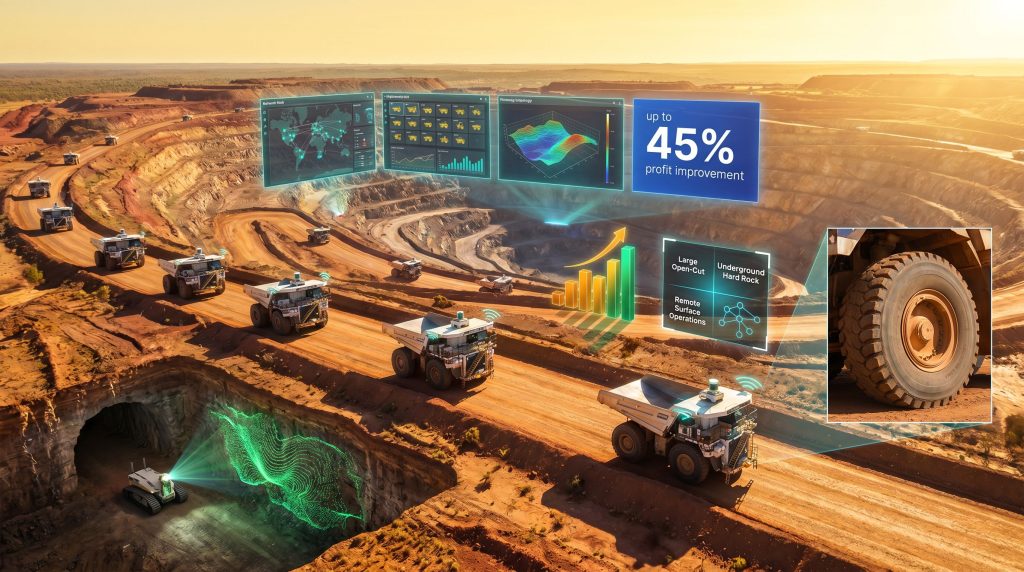
Industry analysis data suggests that mining companies implementing full-scale smart systems have reported profit improvements of up to 45% within two to three years of deployment. That figure is striking, but its significance depends on the operational baseline from which improvement is being measured. Operations running older equipment fleets, manual data collection processes, and reactive maintenance regimes have the most to gain.
The implication is that delayed adoption does not preserve the status quo. It compounds the productivity gap relative to early movers. Three structural pressures are accelerating this dynamic:
- Ore grade deterioration requiring greater tonnage to produce the same metal output, increasing energy and haulage costs per unit of production
- Environmental and social governance requirements from institutional investors, regulators, and host communities demanding measurable reductions in emissions, water use, and land disturbance
- Safety compliance requirements in jurisdictions tightening regulations around personnel exposure to underground hazards, tailings dam integrity, and seismic monitoring obligations
The Operational Benefits: What Smart Mining Delivers in Practice
Productivity and Efficiency at the Equipment Level
Autonomous haul trucks represent the most visible productivity application in open-cut mining. By eliminating shift change downtime, fatigue-related slowdowns, and human reaction time constraints, these vehicles can operate across extended cycles that conventional fleets cannot sustain. The consistency of machine-controlled operations also reduces cycle time variability, which has a compounding positive effect on throughput.
Beyond haulage, AI transforming drilling and blasting is changing how drilling programmes are designed and executed. Traditional drill programmes were based on interpolated geological models that carried inherent uncertainty between sample points. Machine learning models trained on historical geophysical and geochemical data can identify mineralisation signatures with greater spatial precision, reducing the proportion of unproductive drilling and directing capital toward higher-confidence targets.
Wireless sensor networks replacing manual data collection deliver a less visible but equally important efficiency gain. Eliminating the labour cost and time delay associated with manual rounds, the engineering complexity of maintaining legacy cabling infrastructure across dynamic mine environments, and the data latency inherent in batch reporting systems collectively represents a substantial improvement in operational data quality and responsiveness.
Predictive Maintenance: Where the Financial Case Is Clearest
Unplanned equipment downtime is one of the most financially damaging events in mining operations. A single haul truck out of service at a high-throughput open-cut operation can reduce daily production by several thousand tonnes, with downstream cost implications that extend from haulage to processing to contractual delivery commitments. When that downtime results from a component failure that AI systems could have identified days or weeks in advance, the financial case becomes straightforward.
Predictive maintenance in mining platforms work by identifying statistical signatures in sensor data that precede known failure modes. Vibration patterns in gearboxes, thermal anomalies in hydraulic systems, and pressure variations in tyre assemblies all generate detectable precursors before the failure event itself occurs. When maintenance is scheduled proactively based on these signals rather than reactively in response to breakdown, the cost differential between planned and unplanned maintenance can be substantial.
Predictive maintenance systems do not eliminate maintenance costs. They shift those costs from emergency, unplanned interventions toward scheduled, lower-cost interventions, while simultaneously reducing the broader operational disruption that unplanned downtime generates.
Worker Safety: Removing People From Harm's Way
The safety case for smart mining deserves more rigorous framing than it typically receives. The most meaningful safety benefit is not that connected systems respond to safety incidents faster. It is that well-designed smart mining architectures reduce the probability of incidents occurring at all by removing personnel from active hazard environments.
Remote monitoring and autonomous operation enable workers to control equipment and oversee operations from surface control rooms rather than in active blast zones, underground drives adjacent to geological instability, or haul roads shared with heavy vehicles. Worker tracking systems provide real-time location data for all underground personnel. Environmental monitoring sensors continuously track methane, carbon monoxide, particulate levels, and atmospheric conditions, triggering automated alerts before concentrations reach dangerous thresholds.
Environmental Performance and ESG Alignment
Precision operations reduce environmental impact through mechanisms that are directly measurable. AI-optimised blasting programmes reduce unnecessary ground disturbance and fragmentation energy waste. Autonomous haulage systems with consistent speed and load management reduce fuel consumption per tonne-kilometre compared to variable human-operated performance. In addition, renewable energy solutions in mining are increasingly being integrated alongside smart systems to further reduce emissions.
For institutional investors applying ESG screening criteria, these are not abstract commitments. They represent verifiable performance improvements that feed directly into portfolio sustainability assessments. As ESG considerations continue to influence capital allocation decisions, the connection between smart mining adoption and investment accessibility is becoming increasingly material.
The Smart Mining Challenges That Cannot Be Ignored
Capital Requirements and the Mid-Tier Disadvantage
The implementation cost of full-scale smart mining systems is substantial. Hardware infrastructure, software platforms, network connectivity, workforce training, and cybersecurity architecture collectively represent a capital requirement that large diversified miners can absorb through scale but that mid-tier and junior operators find genuinely prohibitive.
| Challenge Category | Description | Impact Level |
|---|---|---|
| Hardware Infrastructure | Sensors, autonomous vehicles, network equipment | High |
| Software and Platform Integration | AI systems, cloud platforms, analytics tools | High |
| Legacy System Replacement | Upgrading outdated infrastructure at operating sites | High |
| Workforce Training | Upskilling existing personnel for digital environments | Medium to High |
| Ongoing Cybersecurity | Continuous monitoring, threat response, data protection | Medium to High |
The payback period challenge is structurally significant. When the full financial benefit of smart mining systems requires two to three years of integration to materialise, operators with shorter planning cycles, constrained balance sheets, or commodity price uncertainty face a genuine timing mismatch between investment and return.
Modular adoption pathways offer a partial solution. Rather than attempting full-scale transformation, smaller operators can begin with targeted sensor deployment in high-value maintenance applications, cloud-based analytics platforms that avoid the need for on-site IT infrastructure investment, and incremental autonomy pilots in controlled environments before committing to fleet-wide conversion. For a broader overview of these approaches, exploring smart mining solutions provides useful context on implementation strategies across operation types.
Integration Complexity and Legacy Infrastructure
Many operating mines were engineered without digital connectivity in mind. Underground hard rock operations often lack the network infrastructure necessary for reliable IoT data transmission. Sensor durability in environments characterised by extreme heat, moisture, vibration, and chemical exposure remains a persistent engineering challenge. Perhaps most consequentially, interoperability failures between equipment from different original equipment manufacturers represent a systemic barrier that no single operator can resolve unilaterally.
The mining industry's heavy reliance on long-lived capital assets compounds this problem. A haul truck with a 20-year operational life, designed and commissioned before autonomous control systems were commercially available, cannot be converted to full autonomy without substantial re-engineering. The legacy infrastructure problem is not simply a matter of technology availability. It is a capital depreciation problem that unfolds over decades.
Cybersecurity in Connected Mine Environments
Every IoT device added to a mining network expands the attack surface available to malicious actors. Connected mine environments introduce operational technology (OT) vulnerabilities that are fundamentally different from conventional information technology (IT) security threats. An IT security breach may compromise data. An OT security breach affecting autonomous vehicle control systems could compromise physical safety and operational continuity simultaneously.
Minimum viable security architecture for connected mine deployments includes network segmentation separating operational control systems from business information systems, role-based access controls limiting system interaction to authorised personnel, and real-time threat monitoring capable of detecting anomalous behaviour patterns before they escalate to operational disruption.
Workforce Resistance and the Digital Skills Gap
Industry research consistently identifies workforce resistance as the most frequently cited barrier to smart mining rollout at established operations. This finding is counterintuitive to technology-focused analysts who assume that system capability is the binding constraint, but it reflects a genuine organisational reality. Experienced mining workforces have developed deep expertise in conventional equipment and operational practices. The introduction of autonomous systems and AI-driven decision support challenges that expertise in ways that can feel threatening rather than empowering.
Workforce resistance to smart mining adoption is not primarily a technology literacy problem. It is a change management problem that requires genuine organisational investment in communication, confidence building, and structured transition support.
Autonomous Vehicles and Robotics: The Operational Frontier
The Current State of Autonomous Haulage
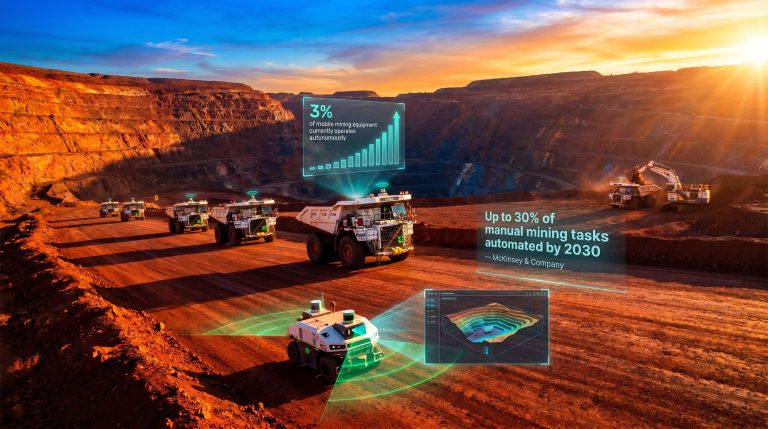
Despite significant industry attention, autonomous vehicles remain a relatively early-stage deployment across the global mining equipment fleet. Approximately 3% of mobile mining equipment currently operates autonomously, indicating that the technology's transformative potential is largely ahead of its current implementation reality. Large-scale open-cut iron ore and copper operations in Australia, Chile, and Canada have been the primary deployment environments.
Performance benchmarks from early deployments suggest meaningful improvements in equipment availability, fuel consistency, and safety incident frequency. However, the operational complexity of scaling from a pilot programme involving a handful of autonomous vehicles to a full-fleet conversion involving dozens of interacting machines across a dynamic mine environment is substantially greater than the pilot phase suggests. Autonomous mining history and challenges illustrates how this scaling complexity has evolved over time across different operation types.
Autonomous Mobile Robots in Underground Inspection
An important but less-discussed application of autonomous robotics in mining involves inspection tasks in underground environments where human access is constrained by safety risk. Autonomous Mobile Robots (AMRs) differ from Autonomous Guided Vehicles (AGVs) in a technically important way: AGVs require permanent external guidance infrastructure, while AMRs can navigate complex, dynamic environments with minimal external input by constructing and updating their own spatial maps in real time.
When equipped with LiDAR sensors, inspection AMRs can generate continuous 360-degree, high-resolution 3D maps of underground environments, identifying structural changes, water ingress, and geological movement that would previously require physical human inspection. This has particularly significant implications for the assessment of abandoned mine workings, where re-entry for geological evaluation carries substantial safety risk.
The commercial implication is potentially valuable: historical mines abandoned when certain minerals lacked commercial value may contain deposits worth revisiting under current commodity pricing. AMR-based preliminary assessment enables that evaluation to occur at far lower cost and risk than conventional re-entry.
Global Adoption Patterns and Market Trajectory
Where Deployment Is Concentrated
Smart mining technology adoption is geographically concentrated in jurisdictions combining large-scale operations, favourable regulatory environments for autonomous systems, and sophisticated operator balance sheets capable of absorbing upfront capital requirements. Australia, Canada, Chile, and Scandinavia represent the current centres of large-scale deployment activity.
Underground hard rock operations present a more complex adoption environment than open-cut mines. Network infrastructure requirements, sensor durability constraints, and the inherently dynamic nature of underground geological environments make smart mining implementation technically more demanding. However, the safety case for removing personnel from underground hazard environments arguably makes the investment rationale even stronger. Consequently, data-driven mining operations are increasingly being viewed as essential rather than aspirational across all operation types.
| Operation Type | Autonomy Readiness | Key Technology Focus | Primary Barrier |
|---|---|---|---|
| Large Open-Cut | High | Autonomous haulage, AI planning | Integration complexity |
| Underground Hard Rock | Medium | Inspection robotics, ventilation AI | Infrastructure cost |
| Remote Surface Operations | Medium to High | IoT monitoring, predictive maintenance | Connectivity |
| Small to Mid-Tier Operations | Low to Medium | Selective sensor deployment | Capital access |
Market Growth Signals
AI and IoT segments are identified across industry research as the highest-growth components of the broader smart mining market. Demand drivers include the sustained expansion of battery technology manufacturing, renewable energy infrastructure deployment, and the electrification of transport systems, all of which require increasing volumes of minerals that are simultaneously becoming harder to extract through conventional means. Institutional investor ESG requirements are acting as an additional accelerant, creating financial incentives for smart mining adoption that operate independently of purely operational cost calculations.
The next major ASX story will hit our subscribers first
Frequently Asked Questions: Smart Mining Benefits and Challenges
What distinguishes smart mining from traditional mining automation?
Conventional mining automation involved single-function, rule-based systems operating in isolation from each other. A conveyor speed controller, a ventilation fan timer, and a blast hole drill rig operating on fixed parameters are all examples of traditional automation. Smart mining replaces this fragmented approach with interconnected, AI-driven systems that share data across functions, adapt to changing conditions, and generate operational intelligence that improves decision-making across the entire mine. The defining characteristic is not mechanisation. It is data integration and real-time operational intelligence.
How significant are the upfront costs of smart mining implementation?
Costs vary substantially based on mine size, existing infrastructure quality, technology scope, and connectivity requirements. Full-scale autonomous haulage fleet deployment at a large open-cut operation involves an order-of-magnitude greater investment than a targeted predictive maintenance sensor deployment at a smaller operation. Total cost of ownership (TCO) analysis is more relevant than upfront capital figures alone, because the financial case depends critically on operational savings realised over the system's working life.
Can smaller mining companies participate in smart mining adoption?
Modular adoption pathways make smart mining accessible to operators that cannot contemplate full-scale transformation. Cloud-based analytics platforms reduce on-site IT infrastructure requirements. Targeted sensor deployments in high-value maintenance and monitoring applications generate measurable returns without fleet-wide capital commitment. Industry consortia and collaborative technology programmes are also emerging as mechanisms for smaller operators to access shared infrastructure and expertise.
What cybersecurity risks does smart mining introduce?
IoT connectivity and cloud-based data management expand attack surfaces in ways that traditional IT security frameworks were not designed to address. Operational technology vulnerabilities affecting autonomous vehicle control systems or environmental monitoring networks represent threats with physical safety consequences, not merely data integrity implications. Network segmentation, strict access controls, and real-time OT threat monitoring form the foundation of minimum viable security architecture for connected mine environments.
How does smart mining contribute to environmental sustainability?
Precision operations reduce overburden disturbance, chemical reagent consumption, and energy use per tonne of ore processed. Automated environmental monitoring supports accurate regulatory reporting and identifies compliance issues before they escalate. AI-optimised haulage and processing systems reduce carbon emissions per unit of metal produced. These improvements are measurable and increasingly relevant to both regulatory compliance and institutional investment criteria.
Building a Smart Mining Capability: A Phased Approach
Phase One: Diagnostic and Foundation Work
Successful smart mining transitions begin with honest diagnostic assessment rather than technology procurement. Understanding the current state of data infrastructure, network connectivity, workforce digital capability, and equipment interoperability identifies the specific gaps that investment must address. Establishing data governance frameworks before deploying connected systems prevents the accumulation of poor-quality data that undermines AI and analytics performance.
Treating cybersecurity architecture as a foundational requirement rather than a post-implementation consideration avoids the far greater cost of retrofitting security onto an already deployed system.
Phase Two: Targeted Deployment and Capability Building
Entry-point technology selections should prioritise applications with the clearest and fastest return on investment. Predictive maintenance and real-time environmental monitoring consistently demonstrate measurable operational and financial benefits within shorter timeframes than full autonomy deployments. Autonomous vehicle pilots in controlled environments with limited fleet scope allow operators to build understanding of system behaviour, identify integration challenges, and train operational personnel before committing to full-fleet conversion.
Simultaneous investment in internal data literacy and analytics capability ensures that the organisation can interpret and act on the intelligence that connected systems generate.
Phase Three: Integration, Optimisation, and Stakeholder Management
Full integration connects operational, geological, and supply chain data streams into a unified intelligence platform that enables mine-wide optimisation rather than function-specific improvement. Autonomous operation scaling decisions should be based on pilot performance data rather than technology vendor commitments.
Community and regulatory stakeholder engagement on workforce impacts and operational changes is not optional. Mining operations depend on community and regulatory licence to operate, and the perception that automation is occurring without transparent communication of its workforce implications generates reputational and political risk that can constrain or delay technology programmes.
The most consequential determinant of smart mining transition success is not the technology platform selected. It is the quality of change management, data governance discipline, and stakeholder alignment that surrounds the technology and makes organisational adoption possible.
The Net Assessment: Weighing Smart Mining Benefits and Challenges
The structural case for smart mining benefits and challenges analysis points clearly in favour of adoption across multiple analytical frameworks simultaneously. The operational efficiency case, the safety case, the environmental case, and the competitive positioning case all align. The financial case, supported by reported profit improvement figures for full-scale adopters, reinforces the investment rationale even after accounting for substantial upfront capital requirements.
The challenges are real, but they are largely manageable rather than prohibitive. Capital barriers can be addressed through modular adoption pathways. Integration complexity can be managed through phased deployment and interoperability standards. Cybersecurity risks can be mitigated through appropriate architecture and monitoring. Workforce resistance, the most consistently cited barrier to successful rollout, responds to genuine organisational investment in change management and transition support.
The risk of delayed adoption is underappreciated in industry discussions that frame smart mining as an optional enhancement. As ore grades continue declining, extraction depths increase, regulatory requirements tighten, and early adopters compound their operational and cost advantages, the competitive consequences of remaining on conventional operational models become progressively more severe.
The trajectory of the industry points clearly toward fully autonomous, remotely operated mine sites where AI-driven planning systems optimise resource extraction across geological, operational, and supply chain dimensions simultaneously. Smart mining is not a single transformation event. It is a continuous capability-building journey, and the operators who begin that journey earliest will define the competitive landscape that everyone else must navigate.
Disclaimer: This article contains forward-looking statements and industry projections based on currently available information. Mining technology adoption rates, financial performance figures, and market trajectory estimates are indicative and subject to change. Readers should conduct independent due diligence before making investment or operational decisions based on information contained herein. Past performance of technology implementations at specific operations is not necessarily indicative of outcomes at other sites.
Want to Track ASX Mineral Discoveries Before the Broader Market Does?
As smart mining technologies accelerate ore discovery and resource delineation across the sector, Discovery Alert's proprietary Discovery IQ model delivers real-time alerts on significant ASX mineral discoveries — transforming complex geological data into actionable investment insights the moment announcements hit the exchange. Explore historic examples of exceptional discovery outcomes and begin your 14-day free trial at Discovery Alert to position yourself ahead of the market.