May 14, 2026
When Geopolitical Shocks Force a Nation to Rethink Its Fuel Strategy
Energy security rarely becomes a first-order political priority during periods of stability. It is typically the abrupt disruption of supply chains, the rapid erosion of currency purchasing power, and the sudden repricing of imported commodities that force governments to accelerate industrial transformation agendas that might otherwise take decades to materialise. India finds itself at precisely this inflection point in 2026, with the US-Iran conflict having severed access to key Middle Eastern energy supply routes and pushed the Indian rupee to Rs94.91 per dollar by May 2026, from Rs90.76 just three months earlier in February.
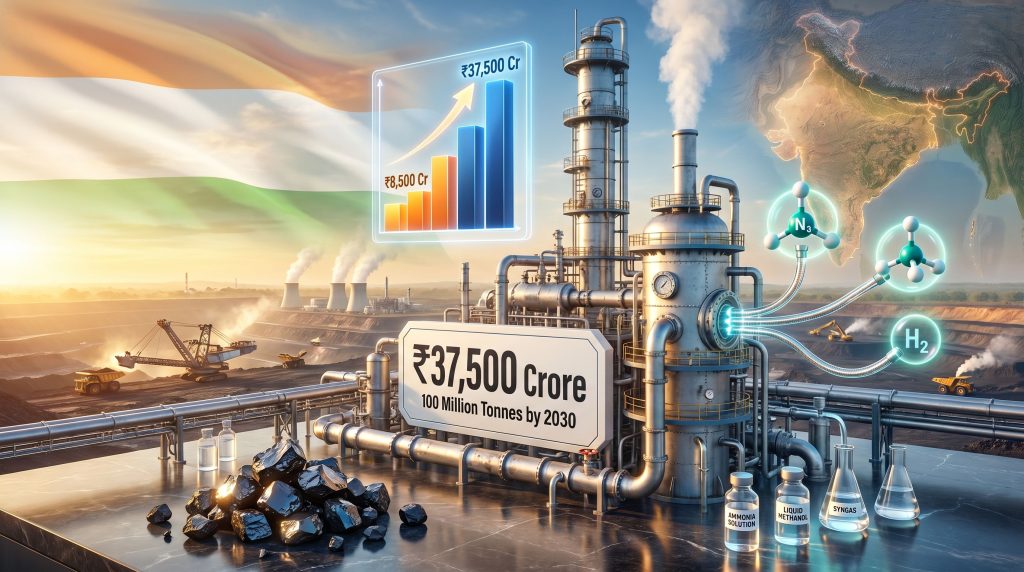
This combination of geopolitical shock and currency depreciation has compelled New Delhi to dramatically accelerate a domestic industrial strategy that was already in motion but lacked sufficient financial firepower: converting India's vast coal reserves into industrial-grade syngas through large-scale gasification. The result is a revised incentive scheme worth ₹37,500 crore (approximately $3.9 billion USD), approved in May 2026 and representing one of the most significant single-policy commitments to domestic coal utilisation in India's industrial history.
The scale of ambition embedded in this policy is difficult to overstate, and understanding it requires examining not just the financial numbers but the thermochemical logic, the downstream market opportunity, the environmental trade-offs, and the real-world execution challenges that will determine whether this becomes a transformative industrial pivot or an ambitious plan that falls short of its targets.
When big ASX news breaks, our subscribers know first
From Power Fuel to Chemical Feedstock: The Strategic Pivot Behind India's Coal Gasification Incentives
India sits atop an estimated 400.7 billion tonnes of coal reserves, a resource base that has historically served one primary function: generating electricity. Coal accounts for more than 70% of India's power generation, and while that dominance has supported rapid electrification, it has done relatively little to address the country's structural dependency on imported fuels and chemical feedstocks. Furthermore, the broader energy security pressures facing the region have intensified the urgency behind this strategic shift.
The strategic logic embedded in India's coal gasification incentives is a deliberate repositioning of coal from a combustion input into a chemical precursor. Rather than burning coal directly, gasification converts it into synthesis gas, commonly called syngas, a mixture comprising carbon monoxide, hydrogen, carbon dioxide, natural gas, and water vapour. This syngas then becomes the platform from which a wide range of downstream products can be manufactured, including ammonia, urea, methanol, hydrogen, and synthetic natural gas.
The practical implication is substantial. Instead of importing liquefied natural gas to produce ammonia for fertilisers, or importing naphtha to produce olefins for petrochemicals, Indian industrial facilities could theoretically source these feedstocks from domestically produced coal-derived syngas. In a period when the Strait of Hormuz has become a contested shipping corridor and Middle Eastern refinery loading has been disrupted, the appeal of a domestic, rupee-denominated feedstock supply chain is immediately apparent.
The closure of key Middle Eastern supply routes has elevated energy security from a medium-term policy objective to an immediate operational crisis for India's industrial sector, accelerating the case for domestic feedstock development well beyond what peacetime planning cycles would have produced.
The Anatomy of a 4.4x Policy Scale-Up
India's coal gasification mission was not conceived in 2026. The programme launched in 2024 with an initial allocation of ₹8,500 crore (approximately Rs85 billion), but industry observers widely assessed this allocation as insufficient to catalyse the scale of private investment required for commercially meaningful gasification capacity. Large-scale gasification plants are capital-intensive infrastructure projects with long lead times, and a subsidy pool that covered only a modest fraction of project capital costs was unlikely to shift investment decisions for major industrial developers.
The revised framework addresses this directly. The Cabinet-approved incentive package commits ₹37,500 crore to support coal and lignite gasification, an expansion of 4.4 times the original allocation. Crucially, the financial support mechanism provides eligible projects with up to 20% of plant and machinery costs as an upfront capital incentive, reducing the equity burden on project developers and improving the return-on-equity calculus that determines whether large capital projects proceed.
The scheme targets 25 project completions within a five-year execution window. The Ministry of Coal plans to auction dedicated coal and lignite blocks for gasification purposes, with tenders to be issued in phased tranches to manage market absorption and sequencing across the development pipeline.
A critical insight for investors and project developers: the ₹37,500 crore incentive is explicitly designed as a catalytic lever, not the comprehensive funding envelope. The government's broader investment mobilisation ambition targets up to $37 billion in total private and public capital directed toward gasification infrastructure. This implies an approximate 1:10 leverage ratio between the government incentive and total project investment, meaning the subsidy is structured to unlock private capital many times its own value.
How Coal Gasification Actually Works: The Thermochemical Pathway
For those unfamiliar with the underlying industrial process, coal gasification converts solid coal into syngas through a high-temperature thermochemical reaction in the presence of controlled amounts of oxygen and steam. The process does not involve combustion in the conventional sense. Instead, partial oxidation at temperatures typically exceeding 700 degrees Celsius breaks down the coal's molecular structure into gaseous components.
The resulting syngas composition varies depending on coal type, gasifier design, and operating parameters, but generally includes:
- Carbon monoxide (CO): the primary energy carrier and chemical building block
- Hydrogen (H₂): extractable for clean fuel applications or chemical synthesis
- Carbon dioxide (CO₂): a byproduct that must be managed or captured
- Methane (CH₄): present in smaller concentrations as a supplementary energy component
- Water vapour (H₂O): removed during downstream processing
Two distinct gasification pathways are relevant to India's programme. Surface gasification involves mining coal first and then processing it above ground in dedicated gasifier units. Underground coal gasification (UCG) takes a fundamentally different approach, injecting oxidants directly into the coal seam and gasifying the coal in-situ without surface extraction, then drawing the resulting syngas to the surface through production wells.
UCG carries a meaningfully different risk profile. While it eliminates much of the surface mining infrastructure requirement and reduces some operational costs, it introduces environmental risks specific to the subsurface environment, including potential groundwater contamination from syngas migration and land subsidence over depleted coal seams. These risks require careful geological assessment of seam depth, permeability, and proximity to aquifers before UCG projects can be responsibly deployed.
Indian coal also presents a specific technical challenge: the country's coal reserves are characterised by relatively high ash content compared to international benchmarks. High-ash coal reduces gasification efficiency because non-combustible mineral matter in the coal must be handled as slag within the gasifier. This increases operating costs and places greater demands on gasifier design, favouring entrained-flow or fluidized-bed gasifier technologies that can manage high-ash feedstocks more effectively than fixed-bed systems.
What Syngas Can Replace: The Import Substitution Opportunity by Sector
The downstream value that syngas unlocks is the central economic argument for India's coal gasification incentives. Each end-product addresses a specific import dependency:
| Syngas Derivative | Primary Application | Import Substitution Potential |
|---|---|---|
| Ammonia | Fertiliser feedstock | Reduces LNG-derived ammonia imports |
| Urea | Agricultural inputs | Supports domestic food security chain |
| Methanol | Fuel blending, platform chemical | Reduces crude oil import dependence |
| Hydrogen | Industrial processes, steel | Supports decarbonisation pathways |
| Synthetic natural gas | Industrial heat, power generation | Substitutes for piped and LNG imports |
Fertiliser manufacturing represents perhaps the most strategically significant application. India's ammonia and urea production depends heavily on imported natural gas as a feedstock. Domestically produced syngas could fundamentally alter the input cost structure for fertiliser manufacturers while simultaneously reducing government subsidy expenditure associated with subsidised imported fertiliser feedstocks.
Methanol deserves particular attention as a platform chemical. Beyond its role as a fuel blending component, methanol is a foundational input for formaldehyde, acetic acid, and a range of solvents. If India successfully builds out a domestic methanol economy anchored on coal gasification output, it creates the basis for a deeper domestic chemicals manufacturing cluster that currently relies on imported naphtha or natural gas-derived intermediates.
Steel decarbonisation represents a longer-term but increasingly important application. Hydrogen derived from syngas can substitute for metallurgical coal in direct reduced iron (DRI) production processes, providing a potential transition pathway for India's steel sector as international pressure on embedded emissions in steel exports intensifies. The decarbonisation economics of this approach are becoming increasingly compelling as carbon accounting standards tighten globally.
Underground Gasification Blocks and the 14th Round Auction Outcomes
A less-widely reported but operationally significant dimension of India's gasification programme is the parallel advancement of underground coal gasification through the commercial coal mining auction framework. Under the 14th round of commercial coal mining auctions, India's Ministry of Coal signed four development and production agreements specifically incorporating UCG provisions.
The block allocations are as follows:
- Reliance Industries secured the Recherla and Chintalpudi blocks in Andhra Pradesh state
- Axis Energy Ventures India acquired the Belpahar and Tangardihi East blocks in Odisha state
These four UCG-designated agreements sit within a broader portfolio of 138 total production and development agreements signed across commercial coal mining rounds, representing a combined peak-rated capacity of 331.54 million tonnes per year. The UCG component is a minority of this total, but it signals that commercial operators are beginning to treat in-situ gasification as a commercially viable pathway rather than a speculative technology.
Coal India Limited (CIL), the dominant state-controlled coal producer, is pursuing the surface gasification pathway through a joint venture structure. CIL formalised a joint venture agreement with state-run equipment manufacturer BHEL in October 2022, and has entered preliminary partnership arrangements with Indian Oil Corporation (IOC) and gas distributor GAIL to advance coal gasification initiatives across its extensive coalfield portfolio.
The next major ASX story will hit our subscribers first
The 2030 Capacity Target: Ambition, Infrastructure Gaps, and Execution Risks
India's stated target of 100 million tonnes per year of domestic coal and lignite in surface gasification by 2030 is an extraordinarily ambitious goal when assessed against the current development pipeline. The revised scheme targets a near-term throughput of approximately 75 million tonnes per year as an intermediate milestone, but even this figure will require rapid scaling of project development, regulatory approvals, equipment supply chains, and workforce capabilities.
Three infrastructure constraints deserve particular attention:
-
Water availability: Gasification plants are water-intensive operations, requiring substantial volumes for cooling, steam generation, and syngas scrubbing. Many of India's coal-bearing regions face competing demands on water resources, and gasification project developers will need to demonstrate reliable water access as part of feasibility assessments.
-
Carbon management readiness: Large-scale gasification without carbon capture produces significant CO₂ volumes. India's net-zero emissions commitment by 2070 implies that long-term gasification expansion will eventually require carbon capture, utilisation, and storage (CCUS) infrastructure, which currently does not exist at meaningful commercial scale within India.
-
Technology and equipment supply chains: Whether India sources gasification technology primarily from Chinese providers, Western technology licensors, or develops domestic capability through the CIL-BHEL joint venture will significantly affect project costs, technology performance, and geopolitical alignment of the supply chain.
The comparison with China's gasification buildout is instructive but imperfect. China achieved its position as the world's dominant coal gasification market through sustained state-directed investment, vertically integrated state-owned enterprise coordination, and the development of domestic technology providers over two decades. India's more fragmented private-sector-led development model will face different coordination challenges, making the five-year execution window for 25 project completions a materially ambitious target.
Real-World Evidence of Feedstock Substitution Already Underway
Before any gasification plant comes online at scale, India's industrial sector is already demonstrating the economic logic that underpins the government's policy direction. The cement industry provides a revealing case study.
Indian cement manufacturers, the world's second-largest cement market by volume, imported 10.67 million tonnes of fuel-grade petroleum coke in 2025. By the first quarter of 2026, monthly import volumes had collapsed to 707,000 tonnes, down sharply from 2.47 million tonnes in the same period of 2025. The proximate cause is competitive pricing: US Northern Appalachian coal (NAPP, high calorific value at NAR 6,900 kcal/kg) was being offered in the mid-$130s per tonne CFR on India's west coast, compared with approximately $150 per tonne for US high-sulphur petroleum coke at NAR 7,500 kcal/kg.
Combined with an import duty differential of 2.75% on NAPP coal versus 11% on coke, thermal coal has become the preferred kiln fuel at current price spreads. India's largest cement producer, Ultratech, reduced petroleum coke's share of its kiln fuel mix to 41% in the January-March 2026 quarter, down from 54% in the equivalent period of 2025, while raising thermal coal consumption. Peer company Nuvoco Vistas similarly cut coke use to 37% from 52% over the same period.
This real-time substitution behaviour illustrates the speed with which large industrial consumers can and will restructure their fuel mix in response to relative price signals, exactly the dynamic that domestically produced syngas-derived fuels could exploit at scale. The green transition trade-offs embedded in such decisions are considerable, however, and merit careful consideration alongside the economic benefits.
The rupee depreciation dimension amplifies this dynamic in a way that is frequently underappreciated. As the rupee weakens, the delivered cost of all imported fuels priced in foreign currencies rises automatically, without any change in the underlying commodity price. Domestic coal priced in rupees provides a natural currency hedge, and domestic syngas would offer the same protection. Over a multi-year investment horizon, this currency hedge has structural value that does not appear in simple levelised cost comparisons.
Environmental Trade-Offs: A More Nuanced Picture Than Proponents Suggest
Coal gasification is not a clean energy technology in the conventional sense, and accurate policy analysis requires acknowledging this clearly. Converting coal to syngas reduces direct combustion emissions relative to burning coal in conventional boilers or kilns, but the process still generates significant CO₂ volumes that must be accounted for in lifecycle emissions assessments.
The critical variable is whether CCUS infrastructure accompanies gasification at scale. Without carbon capture, large-scale gasification simply shifts the emissions profile of coal use rather than eliminating it. With effective carbon capture, the emissions intensity of coal-derived syngas can be substantially reduced, though it remains higher than renewable energy alternatives.
UCG carries additional and distinct environmental risks. Subsurface gasification creates thermal and chemical changes within the coal seam that can, under certain geological conditions, allow syngas components to migrate into surrounding strata and potentially contaminate groundwater aquifers. Risk management requires detailed geological characterisation of each block, including seam depth, overburden permeability, proximity to usable aquifers, and structural integrity of the surrounding rock mass.
The question of whether India's coal gasification expansion is consistent with its 2070 net-zero commitment is genuinely complex. In the near to medium term, domestically produced syngas replacing imported LNG or naphtha may offer modest emissions benefits while delivering significant economic and energy security advantages. However, the longer-term energy transition pathways will likely require that gasification capacity either incorporates CCUS or transitions toward biomass or waste gasification inputs.
What the Global Benchmark Landscape Reveals
India's approach sits within a global context of varied gasification strategies:
| Country | Gasification Scale | Primary Policy Mechanism | Main Output Focus |
|---|---|---|---|
| China | World's largest by volume | State-directed SOE investment | Chemicals, synthetic gas |
| India | Target 100 Mt/yr by 2030 | Capital subsidy (up to 20% capex) | Fertilisers, methanol, power |
| United States | Limited commercial scale | R&D grants, DOE funding programmes | Hydrogen, IGCC power |
| South Africa | Established commercial scale (Sasol) | Vertically integrated state enterprise | Liquid fuels, chemicals |
| Australia | Pilot-stage UCG projects | State-level exploration licensing | Gas production |
China's experience offers the most relevant benchmark, though with important caveats. The scale of China's coal-to-chemicals industry was achieved through decade-long coordinated investment by state-owned enterprises with access to cheap capital and domestic technology development programmes. The resulting industrial clusters have set global benchmarks for gasification efficiency, but they have also generated significant water consumption pressures and localised air quality challenges that India's policymakers should incorporate into their planning assumptions.
In addition, India's LNG import taxes, which have shaped India's LNG import taxes and broader energy pricing architecture, create a further structural incentive for domestic feedstock development that international comparisons alone do not fully capture.
Key Data Summary: India's Coal Gasification Incentives Programme
| Metric | Value |
|---|---|
| Total incentive package (2026) | ₹37,500 crore (~$3.9 billion USD) |
| Prior scheme allocation (2024) | ₹8,500 crore (~Rs85 billion) |
| Policy scale-up multiple | 4.4x |
| Capital support rate | Up to 20% of plant and machinery costs |
| Near-term gasification throughput target | ~75 million tonnes per year |
| 2030 surface gasification target | 100 million tonnes per year |
| Potential total investment mobilised | Up to $37 billion |
| Projects targeted for completion | 25 over five years |
| India's total coal reserves | ~400.7 billion tonnes |
| Coal share of power generation | More than 70% |
| Combined peak capacity (138 agreements) | 331.54 million tonnes per year |
| UCG blocks awarded (14th round) | 4 commercial blocks |
Disclaimer: This article contains forward-looking projections, policy targets, and market analysis based on publicly available information current as of May 2026. Actual outcomes will depend on execution timelines, private investment decisions, geopolitical developments, and regulatory factors that cannot be predicted with certainty. Nothing in this article constitutes financial or investment advice.
Frequently Asked Questions: India Coal Gasification Incentives
What is the total value of India's revised coal gasification incentive package?
The Cabinet's formal announcement confirmed a ₹37,500 crore (approximately $3.9 billion USD) incentive scheme approved in May 2026, representing a significant expansion from the ₹8,500 crore programme launched in 2024.
What does the financial support actually cover?
Eligible projects can receive government support covering up to 20% of plant and machinery capital costs as an upfront incentive, designed to reduce the financial barrier to large-scale gasification investment and improve project economics for private developers.
What is India's coal gasification capacity target by 2030?
The government targets 100 million tonnes per year of domestic coal and lignite in surface gasification projects by 2030, with an interim target of approximately 75 million tonnes per year under the current programme framework.
What products can be manufactured from coal gasification syngas?
Syngas derived from coal gasification can be processed into ammonia, urea, methanol, hydrogen, synthetic natural gas, and a range of chemical intermediates, supporting import substitution across fertiliser, chemicals, and energy sectors.
How many projects does the scheme aim to complete?
The revised scheme targets the completion of 25 gasification projects within a five-year window, with coal and lignite blocks to be auctioned in phases by the Ministry of Coal.
What is underground coal gasification and how does it differ from surface gasification?
UCG converts coal into syngas in-situ within the coal seam, without mining the coal to the surface first. Surface gasification involves mining coal and processing it above ground in dedicated gasifier units. UCG requires less surface infrastructure but carries distinct environmental risks including potential groundwater contamination and subsidence.
How does coal gasification support India's energy security goals?
By converting domestic coal reserves into syngas and downstream products including ammonia and methanol, India can reduce its dependence on imported LNG, LPG, and naphtha, feedstocks whose supply chains have been disrupted by the US-Iran conflict and whose costs have risen sharply due to rupee depreciation against the dollar.
Want to Stay Ahead of the Next Major Resource Discovery?
Discovery Alert's proprietary Discovery IQ model scans ASX announcements in real time, instantly identifying significant mineral discoveries and turning complex data into actionable investment insights — exactly the kind of market intelligence that matters when geopolitical shocks reshape commodity and energy landscapes overnight. Explore historic examples of exceptional discovery returns and begin your 14-day free trial today to position yourself ahead of the broader market.