June 16, 2026
The Hidden Complexity Behind Mining's Digital Revolution
Few industries carry the geological, operational, and environmental complexity of large-scale mining. Long before a single tonne of ore reaches a processing facility, operators must contend with deteriorating deposit quality, increasingly hostile extraction environments, and regulatory frameworks that grow more demanding with each passing year. These structural pressures are not cyclical inconveniences; they represent a secular shift in the economics of resource extraction that conventional operational methods are poorly equipped to handle.
It is precisely within this context that the conversation around smart mining benefits and challenges becomes strategically significant. Digital transformation in mining is not driven by enthusiasm for technology alone. It is driven by operational necessity, cost survival, and the growing gap between what traditional mining methods can deliver and what modern resource markets demand.
When big ASX news breaks, our subscribers know first
What Smart Mining Actually Is: Beyond the Buzzwords
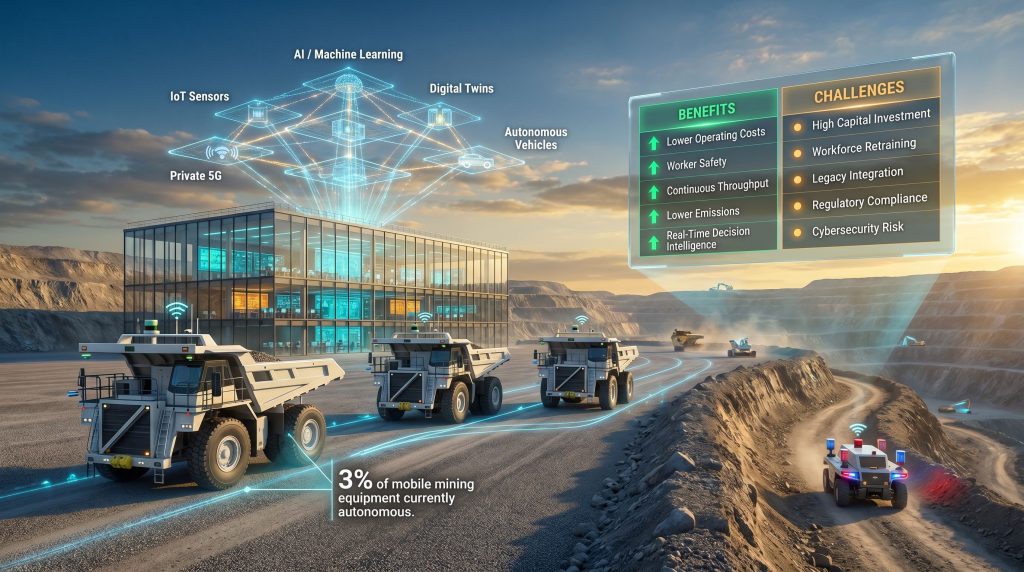
Smart mining refers to the coordinated deployment of interconnected digital technologies across a mining operation to improve efficiency, safety, and sustainability. Rather than being a single product or platform, it is best understood as a layered systems architecture where data flows continuously between machines, sensors, software platforms, and human decision-makers.
The technology stack that underpins a smart mine typically includes:
- IoT sensors and edge devices monitoring equipment health and environmental conditions in real time
- Artificial intelligence and machine learning engines that identify patterns, forecast failures, and optimise resource allocation
- Digital twins that create live virtual replicas of mine assets for simulation and planning
- Private 5G and LTE wireless networks providing the bandwidth and reliability required for remote, high-throughput environments
- Autonomous vehicles and robotics capable of continuous operation without direct human intervention
- Cloud-based dashboards that centralise operational data for cross-departmental visibility
- Big data analytics platforms that process high-volume streams from sensors and equipment across the mine footprint
What makes smart mining systems effective is not any individual component but the interoperability between all of these layers. A predictive maintenance algorithm is only as good as the sensor data feeding it. An autonomous haul truck is only as reliable as the wireless network controlling it. Integration is the differentiating factor. Furthermore, data-driven mining operations are increasingly central to how leading producers are building competitive advantage across every layer of this architecture.
| Technology Layer | Primary Function |
|---|---|
| IoT Sensors and Edge Devices | Real-time equipment and environmental monitoring |
| AI and Machine Learning | Predictive analytics, anomaly detection, fleet optimisation |
| Digital Twins | Virtual mine modelling for scenario planning and maintenance scheduling |
| Private 5G / LTE Networks | High-bandwidth, low-latency connectivity in remote environments |
| Autonomous Vehicles and Robotics | Continuous operation without direct human involvement |
| Cloud Computing and Dashboards | Unified data visibility for cross-functional decision-making |
| Big Data Analytics | Processing high-volume operational and sensor data streams |
How Connected Mine Infrastructure Operates in Practice
Understanding smart mining benefits and challenges requires first understanding how these systems function at the operational level. In a connected mine, sensor networks embedded across extraction equipment, tunnel infrastructure, and processing facilities transmit continuous data streams to centralised management platforms. Rather than relying on periodic manual inspection or reactive incident reporting, operators receive a persistent, real-time picture of conditions across the entire mine footprint.
This architecture eliminates a longstanding structural weakness in conventional mining operations: information silos. Historically, extraction teams, processing facilities, logistics coordinators, and safety managers each operated with partial visibility into adjacent functions. Connected mine infrastructure replaces this fragmented model with unified data flows, enabling faster responses to developing problems and more accurate production planning across departments.
The Role of LiDAR and Autonomous Mobile Robots
One of the more technically sophisticated applications of smart mining technology involves autonomous mobile robots (AMRs) equipped with LiDAR sensor arrays. Unlike conventional autonomous guided vehicles (AGVs), which require pre-installed physical guidance infrastructure such as magnetic strips or embedded cables, AMRs construct their own spatial understanding of their environment through continuous 3D mapping.
LiDAR-equipped AMRs generate 360-degree, high-resolution real-time maps of their surroundings, enabling dynamic obstacle identification and independent path adjustment. These sensors offer several practical advantages in mining deployments: they consume relatively low power, tolerate high-stress environmental conditions including severe weather, and can be configured remotely through web-based management platforms.
| Feature | AMRs | AGVs |
|---|---|---|
| Navigation Approach | Self-mapping, AI-driven pathfinding | Fixed cables, magnetic strips, or external sensors |
| Environmental Adaptability | High, handles unstructured and dynamic environments | Low, requires structured pre-defined routes |
| Underground Mining Suitability | High | Limited |
| Deployment Complexity | Moderate to high | Lower initial complexity |
| Use in Hazardous Areas | Submerged passages, unstable tunnels, abandoned shafts | Repetitive fixed-route transport tasks |
AMRs capable of traversing submerged passages represent a particularly important advancement. Human divers cannot safely enter flooded mine sections, muddy underground cavities, or structurally compromised tunnels. A robot equipped with cameras and multi-sensor arrays can complete geological assessments and mineral tracking in these environments without any human physical exposure to risk.
This capability carries a dimension that is not widely discussed: the potential to reopen historically abandoned mines for reassessment. Minerals that held little commercial value decades ago may now be strategically critical due to demand from battery technology, renewable energy infrastructure, or defence applications. AMRs can survey these sites and identify geological changes at a fraction of the cost of conventional human-led investigation, allowing operators to make informed decisions before committing capital to full reopening.
How Predictive Maintenance Closes the Loop on Equipment Failure
Digital twins and predictive maintenance systems represent another layer where smart mining delivers measurable operational value. A digital twin continuously mirrors the state of physical mine assets using live sensor feeds, creating a virtual model that updates in near real time.
Predictive maintenance algorithms analyse data streams including vibration signatures, thermal readings, pressure variations, and surface wear measurements against historical failure patterns. When the algorithm identifies a trend that matches a known pre-failure signature, maintenance teams receive advance notification, allowing them to schedule intervention at the optimal point: late enough to maximise component use, early enough to prevent catastrophic failure.
This shifts maintenance philosophy from the traditional reactive model (responding to breakdowns as they occur) to a prescriptive model (proactively optimising the timing of every maintenance action). The operational outcome is reduced unplanned downtime, extended asset lifespan, and lower total cost of maintenance over the life of the equipment.
Core Benefits of Smart Mining: A Performance Framework
Measurable Cost Reductions
The elimination of manual monitoring processes reduces labour requirements in data collection roles. Predictive maintenance directly addresses the two most expensive forms of equipment management: emergency repair (which carries premium parts costs, contractor fees, and productivity losses during downtime) and over-servicing (which removes functional equipment from production unnecessarily).
Optimised autonomous fleet management reduces fuel consumption by coordinating haul truck routing, loading sequences, and queuing times simultaneously, lowering the energy cost per tonne of material moved. Wireless sensor networks also reduce infrastructure overhead compared to legacy cabling-intensive monitoring installations.
Worker Safety Transformation
Perhaps the most significant of all smart mining benefits is the systematic removal of workers from the most dangerous operational environments. Blasting zones, chemically active processing areas, structurally compromised tunnels, and flooded passages can all be managed or assessed using autonomous systems and remote monitoring without requiring any human physical presence.
Real-time alert systems that continuously track atmospheric composition, structural stress indicators, and equipment anomaly signatures give operators advance warning of deteriorating conditions before incidents develop. This transforms safety management from a reactive discipline into a preventive one. In addition, advances in AI in drilling and blasting are further reducing the need for personnel in high-risk extraction zones.
Continuous Productivity Without Fatigue
Autonomous vehicles and robotic systems do not require shift changes, rest periods, or performance management. They operate across all hours of the day with consistent performance characteristics, eliminating the productivity troughs associated with human fatigue, shift handover delays, and variable operator performance across different crew compositions.
AI-powered mining efficiency tools can simultaneously optimise routing, loading sequences, and maintenance scheduling across entire equipment fleets, delivering throughput improvements that no human dispatcher could replicate at comparable speed or consistency.
Environmental Performance Gains
Smarter equipment utilisation reduces idle time and the fuel consumption associated with it, directly lowering the carbon intensity of extraction operations on a per-tonne basis. Reduced equipment failures translate to fewer chemical spill incidents and less contamination of surrounding ecosystems. IoT-integrated water management systems allow precise usage tracking and consumption reduction at processing facilities.
As environmental disclosure obligations increase across major mining jurisdictions, the ability to generate granular, auditable operational data also becomes a compliance and reputational asset.
Decision Intelligence at Scale
Centralised dashboards that aggregate data from extraction, processing, logistics, and safety simultaneously give operational leadership a level of situational awareness that was previously unattainable. AI-powered scenario modelling allows teams to simulate the downstream impact of operational decisions before committing to them, reducing the cost of strategic miscalculation.
Smart mining's deepest value may not be in any individual efficiency gain but in the compounding effect of better decisions made faster, across every function of the operation, simultaneously.
The Significant Challenges That Smart Mining Must Overcome
Understanding smart mining benefits and challenges requires honest engagement with the barriers that are slowing or preventing adoption across much of the industry.
Capital Intensity and ROI Uncertainty
Full smart mine infrastructure, encompassing private wireless networks, sensor arrays, autonomous vehicle fleets, software licensing, and system integration, requires substantial upfront capital commitment. For smaller and mid-tier operators, ROI timelines can extend beyond the horizons of typical project financing, making internal business cases difficult to construct with confidence.
Hardware procurement, software platforms, integration engineering, and workforce retraining costs compound quickly. Without clearly modelled value creation pathways tied to specific operational pain points, capital allocation decisions risk being misaligned with actual performance outcomes.
Cybersecurity in Converged IT/OT Environments
Every sensor, autonomous vehicle controller, and networked device in a smart mine represents a potential attack surface. What makes cybersecurity particularly complex in mining environments is the convergence of operational technology (OT) and information technology (IT). Traditional IT security models were designed for data environments.
Smart mines are cyber-physical systems where a successful breach does not simply expose data; it can result in loss of control over physical machinery, autonomous vehicles, or safety-critical monitoring systems. Network segmentation, endpoint protection, access control management, and incident response protocols must all be designed with this physical consequence risk in mind. Mining operators transitioning to connected infrastructure are entering a security architecture domain that many existing IT teams are not fully equipped to manage without specialist expertise.
Legacy System Integration
The overwhelming majority of the world's active mines were designed around analogue or early-generation digital infrastructure. Retrofitting smart technologies onto this foundation requires custom middleware development, equipment interface engineering, and in many cases partial replacement of existing assets. Interoperability between different vendors' autonomous systems, analytics platforms, and sensor networks remains an unresolved technical challenge across the industry.
Digital transformation in mining is rarely a clean-slate project. It is an iterative, multi-year integration process that must maintain operational continuity at each stage while progressively building toward a connected infrastructure state. However, the mining automation trends emerging across the sector suggest that modular, phased approaches are increasingly helping operators navigate these legacy constraints.
The Digital Skills Gap
Smart mining systems require operational personnel who can manage AI-driven analytics platforms, diagnose network infrastructure issues, and interpret data dashboards alongside their traditional domain expertise. Many existing mining workforces have deep geological, mechanical, and process knowledge but limited exposure to these digital disciplines.
Frontline worker concern about automation displacing roles is also a material adoption barrier. Change management programmes that fail to address these concerns transparently risk generating resistance that slows deployment timelines and reduces the effectiveness of new systems even after installation.
Connectivity Constraints at Remote Sites
High-value mineral deposits are frequently located in remote or topographically complex terrain where commercial telecommunications infrastructure is absent or inadequate. Standard 4G networks cannot reliably support the latency and bandwidth demands of real-time autonomous vehicle control and high-volume sensor data transmission simultaneously.
Private 5G networks are increasingly recognised as the connectivity backbone required for smart mine operations, but their deployment in remote terrain carries significant engineering and cost challenges of its own. Satellite connectivity is emerging as a supplementary option for ultra-remote sites, though propagation latency remains a constraint for time-sensitive control applications.
Regulatory Complexity and Certification Timelines
Autonomous vehicle safety certification, AI system deployment approvals, and data sovereignty compliance requirements vary significantly across mining jurisdictions. In many regions, regulatory frameworks have not yet evolved to accommodate the operational realities of autonomous mine environments. This creates uncertainty about deployment timelines and compliance obligations for operators planning large-scale smart mining rollouts.
| Dimension | Benefit | Associated Challenge |
|---|---|---|
| Cost Management | Reduced operating and maintenance costs | High upfront capital investment required |
| Worker Safety | Remote operations reduce hazardous exposure | Workforce resistance and retraining costs |
| Productivity | Continuous autonomous throughput | Legacy system integration complexity |
| Environmental Performance | Lower emissions and smarter resource use | Regulatory compliance across jurisdictions |
| Decision-Making | Real-time data improves planning accuracy | Cybersecurity risks in connected environments |
| Connectivity | Private 5G enables high-bandwidth operations | Remote site infrastructure constraints |
A Strategic Framework for Successful Smart Mining Deployment
Mining companies that have successfully navigated the transition to smart operations share a common characteristic: they approached technology adoption as a business transformation exercise, not a technology procurement exercise. The following framework reflects the implementation logic that supports sustainable smart mining outcomes.
Step 1: Define value drivers before selecting technology
Identify the specific operational pain points, whether unplanned downtime, safety incident frequency, energy costs, or ore recovery rates, that offer the clearest ROI from digitalisation. Technology investment decisions should be anchored to these value pathways, not driven by vendor capability alone.
Step 2: Assess and upgrade IT and OT infrastructure foundations
Audit existing network architecture, equipment interoperability, and data management capabilities before deploying sensor-heavy or autonomous systems. Private wireless connectivity infrastructure must be functional and reliable before it can support real-time autonomous operations.
Step 3: Build data readiness as a core operational capability
Implement data governance frameworks that ensure sensor outputs are accurate, secure, and accessible to the decision-makers who need them. AI and predictive analytics systems cannot function effectively on poorly structured or inconsistently collected data. Data quality is a prerequisite, not an afterthought.
Step 4: Execute phased technology deployment
Begin with high-impact, lower-complexity implementations such as remote monitoring and predictive maintenance before progressing to full autonomous vehicle fleet deployment. A phased approach reduces implementation risk, builds internal capability progressively, and generates early ROI evidence to justify continued investment.
Step 5: Embed change management as a parallel workstream
Engage frontline workers, supervisors, and relevant community and regulatory stakeholders early in the transformation process. Develop role-specific digital training programmes that build new competencies without undermining existing operational expertise. Transparent communication about how automation creates new roles, rather than simply eliminating existing ones, is essential for sustaining workforce engagement through the transition.
The next major ASX story will hit our subscribers first
The Outlook: Where Smart Mining Goes From Here
With only approximately 3% of mobile mining equipment currently operating autonomously, the industry remains in the early-to-mid stages of a transformation that will take decades to complete at scale. That figure simultaneously underscores how much runway remains for technology adoption and how significant the structural, financial, and organisational barriers still are for operators attempting to accelerate the transition.
Several emerging technology trends are reshaping the trajectory of smart mining adoption:
- AI-driven geological modelling is improving ore body prediction accuracy and reducing exploration capital waste
- Digital twin ecosystems are expanding from individual asset modelling to full mine-scale virtual environments capable of simulating entire production scenarios
- Edge computing is reducing dependence on cloud connectivity by processing sensor data locally at the mine site, lowering latency and improving resilience
- Integration of hydrogen power and battery electric vehicles with smart energy management systems is accelerating fleet decarbonisation
- Remote operations centres are consolidating control of multiple geographically dispersed mine sites into single, centralised facilities staffed by multi-disciplinary teams
The ESG dimension of smart mining is also intensifying as an investor-driven force. Carbon pricing mechanisms in key mining jurisdictions are increasing the financial incentive to reduce energy consumption. Institutional investors applying sustainability performance screens to resource sector allocations are creating capital allocation pressure that makes the safety and environmental benefits of smart mining strategically valuable beyond operational efficiency considerations alone. For a broader perspective on how smart mining solutions are being implemented across the industry, leading infrastructure providers offer detailed technical breakdowns worth consulting.
The mining companies positioned to lead through the next decade of resource demand are not simply those that deploy the most advanced technologies. They are those that build the organisational capability, data infrastructure, and workforce readiness to extract compounding value from those technologies across the full life of the operation.
The smart mining benefits and challenges equation will continue to evolve as technology matures, connectivity infrastructure expands into remote regions, and regulatory frameworks catch up with operational realities. What is clear is that the direction of travel is irreversible. The question for mining operators is not whether to engage with digital transformation, but how deliberately and strategically they choose to do so.
For additional industry coverage on connected mines, autonomous operations, and mining technology trends, visit Metals Mining Review and World Sensing's smart mines knowledge centre.
Want to Identify the Next Major Mineral Discovery Before the Broader Market Does?
Discovery Alert's proprietary Discovery IQ model delivers real-time alerts on significant ASX mineral discoveries, instantly converting complex geological data into actionable investment insights for both short-term traders and long-term investors — explore historic examples of exceptional discovery returns to understand the scale of opportunity, and begin your 14-day free trial at Discovery Alert to position yourself ahead of the market.