
June 9, 2026
When Infill Drilling Exposes the Gap Between Resource Models and Reality
Every published mineral resource estimate carries an embedded assumption: that the geological model constructed from available drill data accurately reflects what lies between the holes. In practice, that assumption is most fragile in the inferred category, where drill spacing is widest and interpolation does the heaviest lifting. When systematic infill campaigns begin collapsing that uncertainty, the results can reveal a deposit that looks materially different from its official paperwork, and not always in a modest way.
That is precisely the dynamic playing out at the Cosalá Operations in Sinaloa, Mexico, where the Americas Gold Cosalá drilling results announced in June 2026 are returning grades that average two to three times above the inferred resource model across multiple zones. Some individual intercepts have reached five times the modelled grade. For mine planners preparing operational schedules for H2 2026, this is not an abstract geological upgrade. It is actionable intelligence feeding directly into extraction sequencing, and none of it has yet been reflected in the company's published resource figures.
When big ASX news breaks, our subscribers know first
Why Infill Drilling Is a Different Animal to Exploration
The distinction between infill drilling and greenfield exploration is more consequential than it might appear from the outside. Greenfield programs are trying to find something. Infill programs are trying to understand something that has already been found, and that understanding has direct commercial implications.
Under both NI 43-101 and JORC classification frameworks, inferred resources represent the lowest confidence category of mineralization. They are defined using limited or widely spaced drill data, meaning the geological model relies heavily on statistical interpolation rather than direct sampling. Furthermore, interpreting drill results correctly requires understanding that inferred grades often represent conservative estimates, particularly where the deposit has structural complexity or where high-grade shoots exist between drill holes.
When infill drilling systematically returns results at two to three times the modelled inferred grade, it tells a specific geological story: the block model was built with insufficient drill density to capture the full grade distribution, and the real deposit is both higher-grade and likely more geometrically continuous than the existing model assumes.
A block model is only as good as the data that built it. Inferred categories are designed to signal uncertainty, not to define economic limits. Conversion drilling is the process of replacing that uncertainty with direct measurement, and at Cosalá, that measurement is consistently outperforming the model.
For investors, this creates a structural information gap: the officially published resource understates what mine planners are actually encountering in the ground. That gap narrows with each successive update.
Americas Gold Cosalá Drilling Results: A Zone-by-Zone Breakdown
San Rafael Upper Zone: Shallow, Wide, and High-Grade
The San Rafael Upper zone has produced some of the most compelling individual intercepts in the current campaign, notable not just for their grade but for their shallow depth, which directly reduces the cost per tonne of extraction. Careful drill results interpretation is essential when contextualising these figures against the existing resource model.
| Drill Hole | Interval (m) | Silver Grade (g/t) | Copper Grade (%) | Start Depth (m) |
|---|---|---|---|---|
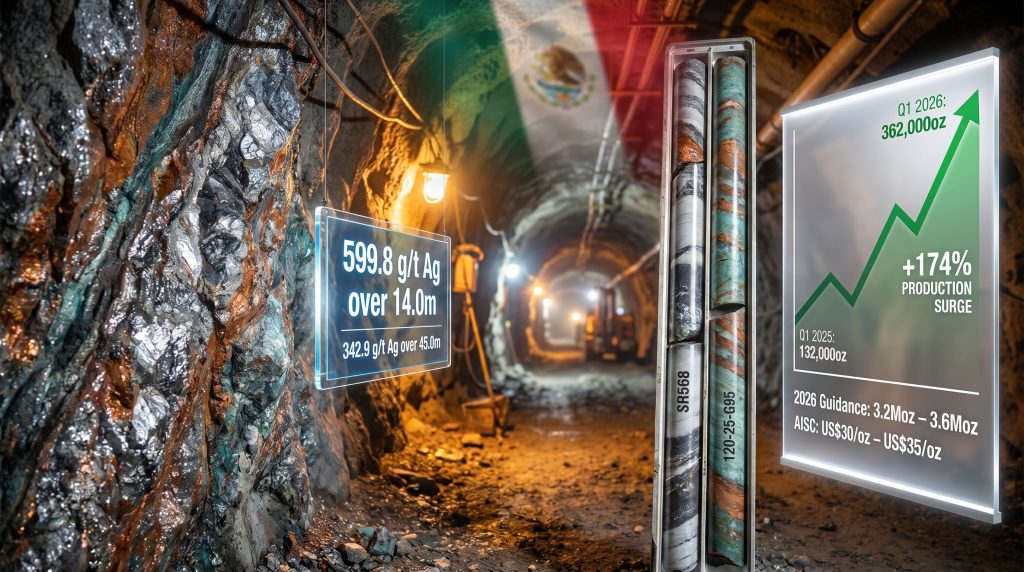
| SR568 | 14.0m | 599.8 g/t Ag | 0.83% Cu | 38.2m |
| SR566 | 10.0m | 509.7 g/t Ag | 0.43% Cu | 12.0m |
SR568's result of 599.8 g/t silver over 14 metres beginning at just 38.2 metres depth is a combination that underground mine operators specifically target. Wide, shallow, high-grade intersections minimise development costs and allow rapid incorporation into active mine schedules. SR566's mineralisation beginning at only 12 metres depth further underscores that meaningful silver concentration is accessible near-surface in this zone.
Both holes sit adjacent to existing mining infrastructure, meaning the logistical barrier between assay result and ore extraction is minimal. This proximity is a significant operational advantage that compresses the timeline from drill bit to production metric. For a full breakdown of these high-grade intercepts, the Cosalá infill drilling press release provides the complete technical disclosure.
120 Lower Zone: Bulk Mining Geometry
Where San Rafael Upper is characterised by high-grade near-surface intercepts, the 120 Lower zone exhibits a different mineralogical architecture: broader widths at depth that are more suited to bulk extraction methods and higher throughput scheduling.
| Drill Hole | Interval (m) | Silver Grade (g/t) | Copper Grade (%) | Start Depth (m) |
|---|---|---|---|---|
| 120-25-G94 | 33.7m | 388.0 g/t Ag | 0.98% Cu | 100.0m |
| 120-25-G95 | 45.0m | 342.9 g/t Ag | 0.85% Cu | 106.0m |
The 45-metre intercept from 120-25-G95 is the widest reported in the current campaign and suggests a broad, laterally continuous mineralised corridor rather than the narrow, discontinuous vein structures that can complicate underground scheduling. This kind of geometrical consistency is what mine planners need to justify bulk extraction methods that reduce per-tonne costs.
Copper grades consistently above 0.80% across both zones are not incidental. In silver-copper systems, by-product copper credits can meaningfully reduce the all-in sustaining cost per silver ounce equivalent, effectively subsidising extraction economics even when silver prices fluctuate. This reflects silver's dual role as both a monetary metal and an industrial input, which underpins its resilience across different market cycles.
The Cut-Off Date Problem: Why These Results Are Not in the Resource Model
All reported holes from the current campaign were completed between Q4 2025 and Q1 2026, placing them after the October 31, 2025 cut-off date used to construct the March 2026 Mineral Resource and Reserve statement. This is a critical point for anyone reading the official resource figures in isolation.
The published Cosalá measured and indicated resource of 4.87Mt grading 119 g/t silver for 18.7 Moz contained does not include any of the high-grade intercepts described above. The 2-3x grade outperformance being encountered in conversion drilling is entirely excluded from that figure. The next scheduled resource update will be the first opportunity for operational grade reality to catch up with the published model.
The EC120 Transformation: What a 174% Production Jump Looks Like in Practice
The Americas Gold Cosalá drilling results don't exist in a vacuum. They are part of a wider structural repositioning of the Cosalá operation, anchored by the transition from the San Rafael zinc-lead-silver deposit to the EC120 silver-copper orebody.
Americas declared commercial production at EC120 effective January 1, 2026, marking the formal end of San Rafael as an active mining operation. The distinction between the two orebodies is not merely geological. It represents a complete reset of the operation's economic architecture:
- EC120 carries higher silver grades and superior metallurgical recoveries compared to San Rafael's zinc-lead-silver profile
- The transition eliminates zinc and lead as primary revenue drivers, replacing them with silver and copper, both of which currently command stronger market dynamics
- During its 2025 pre-commercial ramp-up alone, EC120 generated 1 million ounces of silver and delivered US$44.8 million in net revenue before formal production was even declared
| Metric | San Rafael (Historical) | EC120 (Current) |
|---|---|---|
| Primary metals | Zinc, lead, silver | Silver, copper |
| Commercial production declared | Prior periods | January 1, 2026 |
| Q1 2025 Cosalá silver output | ~132,000oz | – |
| Q1 2026 Cosalá silver output | – | ~362,000oz |
| Year-on-year change | – | +174% |
The 174% increase in Cosalá's silver output in Q1 2026 versus Q1 2025 is the most direct quantitative measure of what the EC120 transition means in production terms. It also establishes the baseline against which H2 2026 ramp-up performance will be assessed.
Company-wide, Americas reported record Q1 2026 silver production of 787,000oz, up 76% year-on-year from 446,000oz, alongside record quarterly sales of 830,000oz. Full-year 2026 guidance of 3.2 Moz to 3.6 Moz at an all-in sustaining cost of US$30/oz to US$35/oz is underpinned by continued EC120 scaling, with infill drilling results feeding directly into the H2 schedule.
Company-Wide Resource Growth: Reading the March 2026 Update
The Significance of Inferred Grade Exceeding M&I Grade
The March 2026 resource update delivered a 10% increase in company-wide measured and indicated resources to 15Mt grading 240 g/t silver for 115.7 Moz contained. Inferred resources grew 15% to 15.7Mt at 264 g/t silver for 133.3 Moz contained.
A detail worth noting: the inferred resource grade of 264 g/t exceeds the measured and indicated grade of 240 g/t. This is geologically meaningful. It suggests that the higher-confidence portions of the deposit have been systematically mined or developed over time, while the remaining lower-confidence material may sit in zones with stronger inherent grade. If conversion drilling confirms this pattern, subsequent resource updates could deliver both grade and contained ounce upgrades simultaneously.
Galena Complex: A Parallel Growth Engine in Idaho
While Cosalá anchors the Mexico operations, the Galena Complex in Idaho represents an equally compelling growth narrative. Measured and indicated resources at Galena climbed 19% to 5.46Mt grading 501 g/t silver for 87.9 Moz contained, a grade profile that is more than four times the Cosalá M&I average of 119 g/t.
A fourth discovery at the complex, the 43L-TJ vein complex, was identified approximately 150 metres southwest of the 149 Vein and within 25 metres of existing infrastructure, an important qualifier that limits incremental development capital. The standout assay from hole 43-317 returned 0.21m grading 24,913 g/t silver and 16.9% copper, an extremely high-grade but narrow intercept indicative of bonanza-style vein mineralisation where economic value is concentrated in very thin but extraordinarily rich veins.
For context, bonanza-grade silver mineralisation of this type typically forms in epithermal or mesothermal vein systems where hydrothermal fluids have deposited metal over long periods in structurally controlled pathways. Whilst individual narrow intercepts at these grades are not directly usable in resource estimates without significant width, they serve as pathfinders to nearby bulk-mineable material and help define the structural architecture of the broader vein system. Understanding true vs apparent width is consequently essential when evaluating these narrow but exceptionally high-grade intercepts.
Infrastructure investment at Galena is advancing alongside exploration:
- A new paste backfill plant targeting a reduction in mining cycle times of approximately 250%
- Shaft No. 3 upgrades targeting hoisting capacity of approximately 105 short tons per hour and 1,350 tonnes per day
- Mill expansion from 750 t/d to 1,200 t/d, representing a 60% increase in processing capacity
2026 Capital Allocation Across the Portfolio
| Capital Item | Budget (US$) |
|---|---|
| Total 2026 drill campaign | ~US$20 million |
| Total drill metres planned | 64,000m |
| Crescent Mine (Idaho) capex | US$30M to US$40M |
| Total 2026 capex (company-wide) | US$90M to US$120M |
The 64,000-metre drill campaign has been described by management as the largest in the company's history, reflecting a deliberate acceleration of both resource conversion and exploration activity across both operating jurisdictions. Americas also consolidated full ownership of Galena in December 2024 and added the nearby Crescent Mine for US$36 million the same month. In February 2026, a 51-49 joint venture with United States Antimony was formed to develop a hydromet processing plant in Idaho, adding a processing dimension to the portfolio beyond conventional milling.
Sprott Stream Termination: What Removing a US$45M Liability Means at Peak Silver Prices
Silver streaming agreements are a form of project financing in which a company receives upfront capital in exchange for committing to deliver a set volume of metal at a fixed or discounted price in the future. The arrangement is beneficial when silver prices are low or uncertain, but becomes economically burdensome when spot prices rise significantly above the contractual delivery rate.
On May 22, 2026, Americas reached an agreement with Sprott Mining to terminate a silver delivery obligation of 592,000oz, exchanging the remaining liability for 7,956,696 common shares issued at a deemed price of US$5.57 per share. The transaction eliminates more than US$45 million in future debt obligations.
Terminating a streaming obligation in a strong silver price environment reflects a straightforward financial calculation: the cost of share dilution is lower than the cost of delivering silver at below-market rates over the remaining obligation period. The company trades a fixed future liability for a one-time equity cost, and gains full spot market exposure on every ounce produced thereafter.
With the stream terminated, every ounce of silver produced at Cosalá and Galena is now available for sale at prevailing market prices. In an environment the company has characterised as a record silver market, the economic leverage of that positioning is amplified relative to what it would have been under the legacy streaming structure. Furthermore, understanding cut-off grade economics helps contextualise why full spot market exposure materially improves the viability of lower-grade ore that was previously marginal under the streaming structure.
The next major ASX story will hit our subscribers first
Sinaloa's Operating Environment: Understanding the Risk Geometry
Security and Weather as Non-Geological Variables
Mexico's Sinaloa state has long been one of the country's most productive silver mining jurisdictions, but it carries a security profile that requires explicit acknowledgement in any operational analysis. In early 2026, Cosalá experienced a 24.9% reduction in production attributable to a combination of heavy rainfall and security disruptions that temporarily halted the mill.
Security conditions in Sinaloa represent a risk category that mine planning cannot fully neutralise. Unlike geological risk, which can be reduced through additional drilling, or metallurgical risk, which responds to process optimisation, security risk is systemic and external. For investors evaluating the company's full-year guidance of 3.2 Moz to 3.6 Moz, this variable warrants a dedicated risk-adjustment consideration. An independent analysis of six key considerations from the Cosalá drill results provides additional perspective on how analysts are framing these operational risks.
The San Rafael Blockade: Historical Context That Still Matters
The Cosalá operation has navigated significant labour disruption in the recent past. The San Rafael mine was subject to a union-led blockade from January 2020 through September 2021, a 17-month suspension that was eventually resolved through federal mediation involving Mexico's Ministries of Economy, Interior, and Labor. The mine has operated continuously since the resolution of that dispute.
The historical episode is worth retaining in any forward-looking assessment, not because its recurrence is probable, but because it establishes that labour relations and community dynamics at Cosalá are material risk factors with demonstrated capacity to interrupt production for extended periods. The combination of historical labour disruption and current security conditions in the state makes Sinaloa's operating environment structurally more complex than purely technical metrics suggest.
Safety Performance as an Operational Discipline Indicator
Both the Galena Complex and Cosalá Operations achieved one full year without a lost-time accident during 2026, with Galena reaching the milestone on March 11 and Cosalá on April 14. In mining operations, LTI-free performance over sustained periods is generally interpreted as an indicator of broader operational discipline. Consistent safety culture tends to correlate with workforce stability, process adherence, and production reliability, all of which matter when assessing whether guidance targets are achievable.
Frequently Asked Questions: Americas Gold Cosalá Drilling Results
What grades did the Cosalá infill drilling return?
The highest-grade intercept from the current campaign was 599.8 g/t silver and 0.83% copper over 14.0 metres from hole SR568 in the San Rafael Upper zone, starting at 38.2 metres depth. In the 120 Lower zone, hole 120-25-G95 returned 342.9 g/t silver and 0.85% copper over 45.0 metres, the widest intercept in the campaign.
Why are the drill results excluded from the current resource estimate?
All reported holes were completed after the October 31, 2025 resource model cut-off date used for the March 2026 Mineral Resource and Reserve statement. They will be incorporated into a future resource update.
How do the results compare to the existing model?
Across both the San Rafael Upper and 120 zones, conversion drilling has been averaging 2 to 3 times the previously modelled inferred resource grades, with select individual intercepts reaching up to 5 times the modelled grade.
What is Americas Gold's 2026 silver production guidance?
Full-year guidance stands at 3.2 Moz to 3.6 Moz of silver at an all-in sustaining cost of US$30/oz to US$35/oz.
What is EC120 and why does it change the economics at Cosalá?
EC120 is a silver-copper orebody at Cosalá that entered commercial production on January 1, 2026. It carries higher silver grades and better metallurgical recoveries than the previous San Rafael zinc-lead-silver operation, and drove a 174% year-on-year increase in Cosalá's Q1 2026 silver output. During its 2025 pre-commercial ramp-up, EC120 generated 1 million ounces of silver and US$44.8 million in net revenue before commercial production was formally declared.
What are the primary operational risks at Cosalá?
The principal risks are security conditions in Sinaloa and weather-related disruptions. In early 2026, a combination of both factors caused a temporary mill stoppage and a 24.9% production reduction. The operation also has a documented history of labour disruption, with the 17-month San Rafael blockade between 2020 and 2021 serving as the most significant precedent.
This article is intended for informational purposes only and does not constitute financial advice. Forward-looking production estimates, resource projections, and cost guidance are subject to material risks and uncertainties, including but not limited to geological variability, security conditions, commodity price movements, and operational interruptions. Past production performance and drilling results are not necessarily indicative of future outcomes. Readers should conduct their own due diligence before making any investment decisions.
Want to Know When the Next High-Grade Silver Discovery Hits the ASX?
Discovery Alert's proprietary Discovery IQ model scans ASX announcements in real time, instantly identifying significant mineral discoveries across silver, copper, and 30-plus other commodities — delivering actionable insights before the broader market reacts. Explore historic examples of major mineral discoveries and the returns they generated, then begin your 14-day free trial at Discovery Alert to position yourself ahead of the next major find.