
June 2, 2026
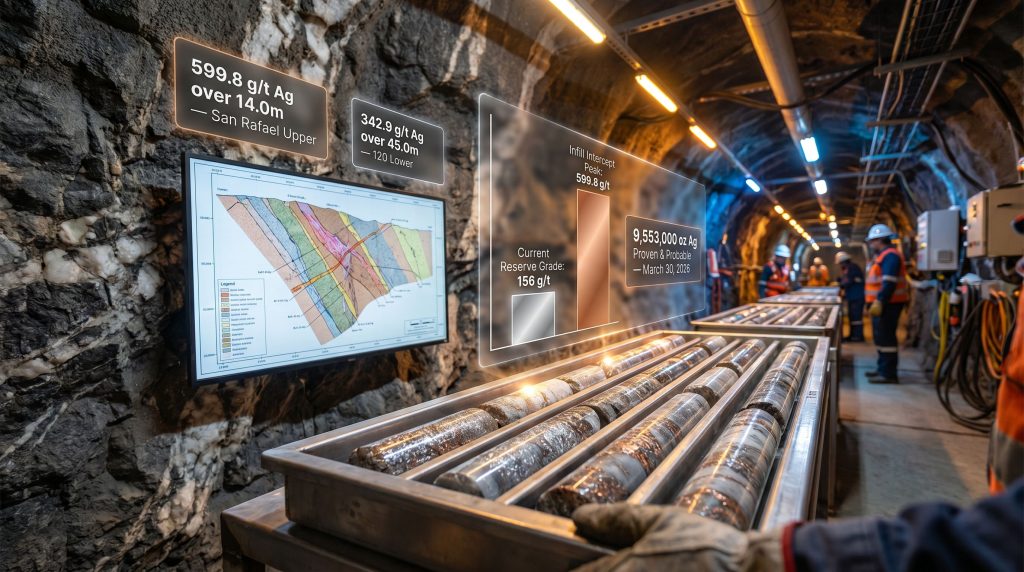
The Hidden Architecture of High-Grade Silver: Why Infill Drilling Tells a Different Story Than the Reserve Statement
Most investors tracking silver mining companies focus on headline production numbers, guidance revisions, and cost metrics. Far fewer understand the mechanical process by which drill results transition from raw assay data into formal reserve statements, mine schedules, and ultimately production ounces. That process involves a structured lag built into the regulatory architecture of mineral reporting, and understanding it is essential to interpreting what the Americas Gold & Silver Cosalá drill results actually mean versus what they appear to mean on the surface.
When infill drilling returns silver grades that are two to five times higher than a current resource model, the natural instinct is to treat that as either a correction of a flawed model or an immediate uplift to production guidance. Neither interpretation is quite right. The reality is more nuanced, more operationally interesting, and ultimately more instructive for anyone trying to understand how grade reconciliation works in a structurally complex, high-grade silver-copper system.
When big ASX news breaks, our subscribers know first
Why Grade Models in High-Grade Silver Deposits Carry Systematic Conservatism
Resource models are constructed from drill data. When drill spacing is wide, as is typical of inferred mineral resource categories, the grade assigned to each block in the model is interpolated from relatively few data points. The interpolation algorithms used in geostatistical estimation, most commonly kriging or inverse distance weighting, have a property that matters enormously in high-grade structurally controlled systems: they smooth grade variability.
In a deposit where silver mineralisation is concentrated in discrete high-grade lenses controlled by fault structures or stratigraphic contacts, that smoothing effect means the model will systematically underestimate the peak grades within those lenses while overestimating grades in the surrounding lower-grade material. The net effect on total contained metal in the block model may be relatively minor, but the effect on any single drill intercept comparison is stark.
This is not a failure of the modelling process. It is a feature of it. Inferred resource models are designed to capture broad-scale grade trends with sufficient confidence for resource reporting, not to predict the exact grade of any given stope. Infill drilling is the mechanism by which that spatial uncertainty is resolved. For investors interested in drill results interpretation, understanding this distinction is fundamental.
Key Concept: When infill drilling confirms structural thickness but returns grades materially above the resource model, the economic impact is asymmetric. The same tonnes carry significantly higher contained metal value, and the production schedule built around those tonnes will generate more revenue per tonne milled than the reserve statement implied.
Breaking Down the Cosalá Intercept Data Zone by Zone
The 14-hole infill program at Cosalá, completed between the fourth quarter of 2025 and the first quarter of 2026, targeted three zones within the Cosalá Complex: San Rafael Upper, 120 Upper, and 120 Lower. All intercepts are reported as estimated true widths, which reflects the geologically meaningful thickness of the mineralised interval rather than the raw length of drill core. Understanding true widths vs apparent widths is particularly important when evaluating these results.
San Rafael Upper Zone: Where the Grade Differential Is Most Pronounced
The San Rafael Upper zone produced the program's most striking grade variance relative to the current resource model.
| Intercept | Silver Grade (g/t) | Copper Grade (%) | True Width (m) | vs. Modelled Grade (~110 g/t) |
|---|---|---|---|---|
| Highlight 1 | 599.8 | 0.83 | 14.0 | ~5.5x above model |
| Highlight 2 | 509.7 | 0.43 | 10.0 | ~4.6x above model |
The modelled grade for the San Rafael Upper section was approximately 110 grams per tonne silver. The 599.8 g/t intercept over 14 metres of true width represents not just a headline figure but a fundamentally different picture of what the stope economics for this zone could look like when the H2 2026 optimised mine plan is published.
The copper co-credit in these intercepts is also operationally meaningful. In a polymetallic system, the net smelter return per tonne reflects both silver and copper recovery. At 0.83% copper over the same 14-metre interval, the silver-equivalent grade of the headline intercept is materially higher than the silver assay alone suggests, directly reducing the all-in sustaining cost per silver ounce recovered from that material.
120 Lower Zone: Wide True Widths and Consistent Copper Credits
Where San Rafael Upper delivers the highest grade differentials, the 120 Lower zone contributes bulk mining optionality through wide true widths combined with meaningful copper credits.
| Intercept | Silver Grade (g/t) | Copper Grade (%) | True Width (m) | Grade Multiplier vs. Model |
|---|---|---|---|---|
| Intercept A | 388.0 | 0.98 | 33.7 | ~2.5x |
| Intercept B | 342.9 | 0.85 | 45.0 | ~2.2x |
A 45-metre true width at 342.9 g/t silver with 0.85% copper is not a narrow high-grade lens that requires precision mining methods. It is the kind of geometry that supports longitudinal or transverse open stoping, allowing for higher throughput and lower unit development costs per tonne extracted. The combination of meaningful width and above-model grade in the 120 Lower zone creates conditions that favour both volume and grade in the same stope design.
120 Upper Zone: Spatial Continuity Between the Two High-Grade Lenses
The 120 Upper zone plays a connecting role in the deposit geometry, bridging the spatial gap between San Rafael Upper and 120 Lower. Confirming mineralised continuity between two high-grade zones is important for underground development sequencing because it allows mining engineers to plan a logical progression of development headings that services both zones without dead-end lateral development. Continuity confirmation in the 120 Upper zone reduces the risk that development capital spent on access to one zone becomes stranded if the connecting material turns out to be poorly mineralised.
The Reserve Statement Timing Problem: What the October 31, 2025 Cutoff Date Actually Means
One of the most commonly misunderstood aspects of mineral resource and reserve reporting is the cutoff date convention. Under NI 43-101 (the Canadian standard governing Americas Gold & Silver's reporting), every mineral resource and reserve statement must specify an effective date. All data included in the estimate must have been available and verified prior to that date. Drill results received after the cutoff, regardless of how significant they are, cannot be incorporated into that statement.
All 14 infill holes at Cosalá were completed between Q4 2025 and Q1 2026. The MR&R statement published on March 30, 2026 carries an effective cutoff of October 31, 2025. Every one of the 14 holes therefore falls outside the statement's data horizon.
What the Current Reserve Statement Actually Shows
| Resource Category | Silver (000 oz) | Grade (g/t Ag) | Status |
|---|---|---|---|
| Proven & Probable Reserve | 9,553 | 156 | March 30, 2026 statement |
| Measured & Indicated Resource | 18,691 | 119 | March 30, 2026 statement |
| Infill drill intercepts (14 holes) | Not yet incorporated | Up to 599.8 | Excluded — post-cutoff |
The current Proven and Probable reserve grade of 156 g/t silver and the infill intercept of 599.8 g/t silver are not in contradiction with each other. The reserve statement is accurate as of its cutoff date. The infill drilling simply represents knowledge acquired after that date. The two figures coexist because they describe different points in time, not competing interpretations of the same data.
Investor Note: The H2 2026 optimised mine plan is the first disclosed milestone at which the post-cutoff infill data will be assigned formal production assumptions. Investors monitoring this story should treat the mine plan release as the key disclosure event, not the existing reserve statement.
From Drill Core to Production Schedule: How Infill Data Moves Through the Mine Planning Process
Understanding the procedural steps between receiving assay results and seeing them reflected in a mine schedule helps calibrate realistic expectations about timing and disclosure. Furthermore, interpreting drill results correctly within this framework is what separates informed analysis from reactive speculation.
-
Drill hole assay results are received, checked, and validated by the qualified person responsible for the estimate.
-
The geological interpretation is updated, incorporating new understanding of zone geometry, grade distribution, and structural controls.
-
The resource block model is revised using updated geostatistical parameters informed by the denser drill spacing.
-
Economic cut-off grades are recalculated using current metal price assumptions and the site's actual operating cost structure. Cut-off grade economics are a critical determinant of which material ultimately enters the mine schedule.
-
Stope designs are optimised around the revised block model, adjusting for dilution, selectivity, and access geometry.
-
The mine schedule is updated to sequence the highest-value stopes into the production plan in a technically and logistically feasible order.
-
The optimised mine plan is published, carrying revised production and cost guidance that reflects the new grade assumptions.
The critical enabler accelerating this timeline at Cosalá is infrastructure adjacency. All 14 intercepts sit directly alongside existing mine workings. That means there is no requirement for new capital development headings to access the high-grade material. The development infrastructure to reach and mine these stopes already exists. That adjacency removes the lead time that would otherwise delay grade uplift realisation by 12 to 24 months in a deposit where high-grade zones were located in undeveloped ground.
Cosalá's Operating Foundation: Production Metrics That Contextualise the Drill Data
The Cosalá Complex delivered 1.2 million ounces of silver in 2025 at an AISC of US$26.52 per ounce, reaching commercial production at the EC120 Mine at approximately 1,550 tonnes per day. That performance established Cosalá as one of the lower-cost primary silver operations in the Americas at the time. Furthermore, Americas Gold & Silver's Cosalá production has demonstrated the operational credibility underpinning these exploration ambitions.
| Metric | 2025 Actual | 2026 Guidance | Change |
|---|---|---|---|
| Cosalá Silver Production | 1.2M oz | Part of 3.2–3.6M oz consolidated | — |
| Cosalá AISC | US$26.52/oz | US$30–$35/oz consolidated | +13–32% |
| EC120 Throughput | ~1,550 tpd | Optimisation ongoing | — |
| Q1 2026 Consolidated Silver | 786.9K oz | — | ~30% of full-year midpoint |
The Q1 2026 consolidated AISC of US$34.12 per ounce sits at the upper bound of full-year guidance, which is not unusual for Q1 in an operation where ramp-up activity and development capital spending are front-loaded. The more instructive question is what the AISC trajectory looks like through H2 2026 if the infill drilling feeds into a mine schedule that prioritises the higher-grade stopes now identified.
Hypothetical Scenario: At 1,550 tpd throughput and 85% recovery, moving from a 156 g/t head grade to 300 g/t would theoretically increase annualised silver output from approximately 2.1 million oz to approximately 4.1 million oz from Cosalá alone, before accounting for dilution, mining selectivity, or stope sequencing constraints. This is illustrative only and does not represent company guidance.
The grade sensitivity relationship is direct and powerful in this throughput range. Every 100 g/t of head grade improvement on the same milled tonnage adds roughly 730,000 ounces of annualised silver production at 85% recovery, while the fixed cost base remains largely unchanged. That dynamic is why grade reconciliation at high-grade operations attracts disproportionate investor attention relative to throughput expansions of the same theoretical scale.
The next major ASX story will hit our subscribers first
The 64,000-Metre Drilling Program: Scale, Scope, and What It Signals
The 2026 drilling campaign, described by the company as the largest in its history at approximately 64,000 metres, spans all three operating assets.
| Program Component | Location | Strategic Purpose |
|---|---|---|
| Infill drilling | Cosalá (San Rafael, 120 zones) | Grade model upgrade, mine plan optimisation |
| Exploration drilling | Cosalá North (7 IP/magnetic targets) | New resource discovery |
| Infill and development | Galena Complex, Idaho | Resource conversion, mine life extension |
| Exploration | Crescent Mine, Idaho | New zone identification |
The 14 Cosalá holes discussed here represent only the infill component of that program from Q4 2025 through Q1 2026. The broader campaign reflects a capital commitment of US$15 to $20 million in exploration embedded within a total 2026 investment budget of US$90 to $120 million, comprising US$30 to $40 million in sustaining capital and US$60 to $80 million in growth capital.
The growth-to-sustaining capital ratio of approximately 2:1 is significant. It signals that the company is in an active production-expansion cycle rather than a steady-state maintenance mode, which is consistent with the stated target of returning consolidated silver production to 5 million ounces per year from a 2025 base of 2.65 million ounces. That represents approximately 89% growth from the current production base, requiring contributions from Cosalá grade uplift, Galena Complex modernisation, and Crescent Mine development running in parallel.
Americas Gold & Silver's Executive Vice President of Corporate Development, Oliver Turner, has described the production target as an active multi-year objective, noting that the company intends to reach that 5-million-ounce annual level and then assess what further growth is achievable beyond it.
Cosalá North: Seven Geophysical Targets and the Exploration Pipeline Beyond the Current Reserve
While the infill program addresses grade confidence in known zones, the exploration component of the Cosalá program addresses the longer-term question of resource life beyond what is currently delineated.
The company has identified seven major induced polarisation and magnetic anomaly trends at Cosalá North through the reinterpretation of historical geophysical datasets. IP surveying detects zones of elevated chargeability, which in polymetallic silver-copper systems often reflects disseminated sulphide mineralisation that has not yet been drill-tested. Magnetic surveys complement IP by identifying structural controls that channel hydrothermal fluids carrying the metals of interest. Reprocessing historical geophysical data with modern algorithms and updated geological context can reveal targets that earlier exploration campaigns either missed or deemed insufficiently anomalous to drill.
Initial drilling at the El Alacrán target returned 27.6 metres at 69 g/t silver, 0.2 g/t gold, and 0.2% copper. That result is below the grade of Cosalá's existing reserve zones, but it is an initial intercept from an early-stage exploration target, not an infill hole in a well-characterised ore zone. The relevant benchmark for El Alacrán is not Cosalá's current reserve grade but rather whether the intercept confirms the geophysical model and justifies further drilling to define a potentially economic resource.
| Target | Silver (g/t) | Gold (g/t) | Copper (%) | Interval (m) |
|---|---|---|---|---|
| El Alacrán | 69.0 | 0.2 | 0.2 | 27.6 |
The company has noted that the Cosalá property has been considered underexplored since the Scorpio Mining acquisition in 2014, suggesting that the current resource envelope does not reflect the full mineralised potential of the land package.
Silver Supply Dynamics and the Case for Primary Producers
A structural factor that adds context to primary silver operations like Cosalá is the nature of global silver supply. Approximately 70% of the world's silver is produced as a byproduct of base metal mining, principally copper, lead, and zinc operations. This means primary silver supply is largely inelastic to silver price movements because the production decisions for byproduct silver are driven by the economics of the base metal host, not by silver's own price signal. Indeed, silver's dual role as both a precious metal and an industrial commodity makes this supply dynamic particularly consequential for price formation.
A lesser-known constraint affecting byproduct silver availability from copper operations involves sulfuric acid supply. Copper smelters generate sulfuric acid as a processing byproduct, and where regional sulfuric acid markets become oversupplied, smelter throughput can be curtailed, indirectly reducing silver output from those facilities. This creates an additional layer of supply constraint that most silver market commentators do not address.
Against that supply backdrop, silver's inclusion on the US critical minerals list establishes a policy framework that formally recognises the metal's strategic importance across industrial, technological, and defence applications. For primary silver producers operating in stable jurisdictions with existing infrastructure, this supply context creates a long-term price environment that is structurally more supportive than headline supply figures alone would suggest. It should be noted, however, that critical minerals classification at the national level is a broad policy designation and does not constitute project-specific support, funding, or accelerated regulatory treatment for any individual company or mine.
Frequently Asked Questions: Americas Gold & Silver Cosalá Drill Results
What silver grades did the Cosalá infill drilling return?
The headline intercept from the Americas Gold & Silver Cosalá drill results was 599.8 g/t silver and 0.83% copper over 14 metres of true width at the San Rafael Upper zone, against a modelled grade of approximately 110 g/t for that section. The 120 Lower zone returned 342.9 g/t silver and 0.85% copper over 45 metres, one of the widest high-grade intercepts in the program. Across all 14 holes, silver grades averaged two to three times the previously modelled inferred mineral resource grades.
Why aren't these results in the current reserve statement?
The MR&R statement published on March 30, 2026 carries an effective cutoff date of October 31, 2025. All 14 infill holes were completed after that date, between Q4 2025 and Q1 2026, and therefore cannot be incorporated into the existing statement regardless of their significance.
When will the new mine plan incorporating these results be released?
The company has targeted the second half of 2026 for an optimised mine plan that will assign production assumptions to the infill drilling data. No specific date has been disclosed.
What is the current Cosalá silver reserve?
9,553 thousand ounces at 156 g/t silver (Proven and Probable), per the March 30, 2026 MR&R statement. The Measured and Indicated resource stands at 18,691 thousand ounces at 119 g/t silver.
What is Americas Gold & Silver's 2026 production guidance?
Consolidated silver production guidance for 2026 is 3.2 to 3.6 million ounces at an AISC of US$30 to $35 per ounce, representing approximately 30% growth over 2025 output of 2.65 million ounces.
What is Cosalá North targeting?
Seven IP and magnetic anomaly trends identified through historical geophysical data reinterpretation. Initial drilling at the El Alacrán target returned 27.6 metres at 69 g/t silver, confirming the presence of mineralisation at a new exploration target outside the current resource envelope.
Key Analytical Takeaways
-
The grade differential is real but not yet formalised: The current reserve carries 156 g/t silver. Infill intercepts are returning two to five times that figure. Until the H2 2026 mine plan is published, that differential exists in the drilling record but not in any production-planning document.
-
Reporting lag is structural, not a red flag: The October 31, 2025 cutoff is a standard feature of NI 43-101 compliant reporting. The March 30, 2026 statement is accurate. The infill data postdates it. Investors should not interpret this gap as inconsistency.
-
Infrastructure adjacency is the operational differentiator: All 14 intercepts sit next to existing mine workings, meaning the conversion from drill result to production stope does not require a new capital development cycle.
-
The 64,000-metre program is a production-growth mechanism: The drilling scale reflects the capital commitment required to support a near-doubling of consolidated silver production from the current base toward the 5-million-ounce target.
-
Cosalá North adds genuine optionality: Seven geophysical targets represent a discovery pipeline structurally separate from the infill program's near-term mine plan impact, offering potential resource growth beyond the current reserve envelope.
-
Silver supply inelasticity amplifies the value of primary producers: With the majority of global silver produced as a byproduct of base metal operations, primary silver mines like Cosalá occupy a structurally differentiated position in the supply landscape.
This article contains forward-looking statements and hypothetical scenarios for illustrative purposes only. Nothing in this article constitutes financial or investment advice. Readers should conduct their own due diligence and consult a qualified financial adviser before making any investment decisions. All production figures, resource estimates, and cost guidance referenced are sourced from Americas Gold & Silver Corporation's public disclosures.
Want to Catch the Next Major Silver Discovery the Moment It Hits the ASX?
Discovery Alert's proprietary Discovery IQ model scans ASX announcements in real time, instantly identifying high-grade mineral discoveries across silver, copper, and 30+ other commodities — so subscribers can act before the broader market responds. Explore historic discovery returns on Discovery Alert's dedicated discoveries page and start your 14-day free trial to secure your market-leading edge.