August 10, 2026
When Legacy Contracts Become the Enemy of Shareholder Value
In precious metals mining, some of the most consequential financial decisions are not made in the boardroom during a bull market. They are made years earlier, in the depths of a capital drought, when junior producers sign away future commodity deliveries in exchange for the lifeline of immediate funding. These streaming and delivery agreements are rarely scrutinised at inception with the same intensity they deserve during periods of rising spot prices. The true cost of these instruments only reveals itself when commodity prices climb and the company's operational leverage gets systematically siphoned off by contractual obligations.
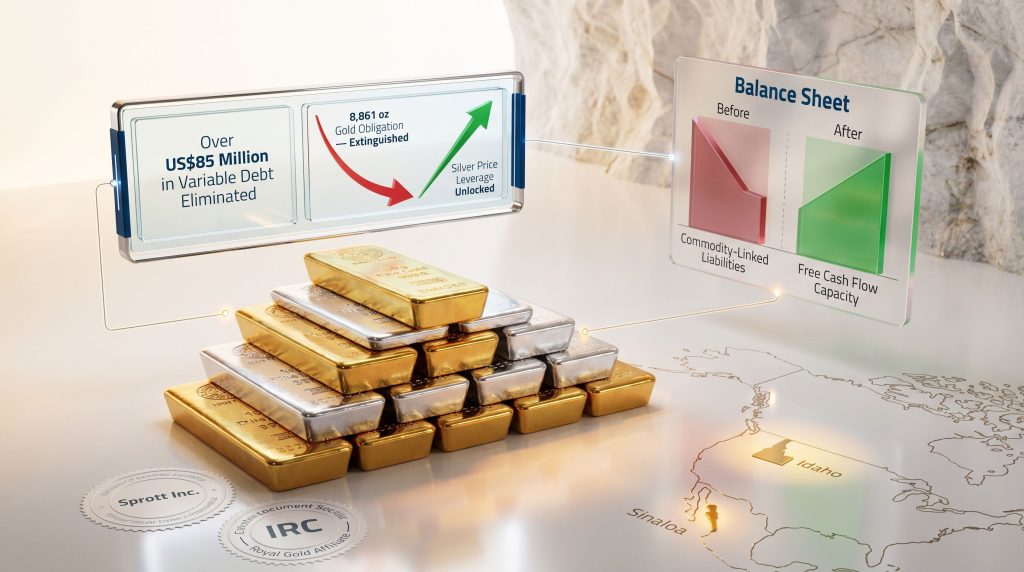
This structural tension sits at the heart of a significant balance sheet transformation that Americas Gold & Silver settles gold delivery obligation with Royal Gold affiliate in a transaction that forms part of a two-part restructuring completed within days. The company's settlement with International Royalty Corporation (IRC), an affiliate of Royal Gold, Inc., announced on 26 May 2026, followed just days after the termination of a separate silver delivery obligation to Sprott Inc. on 22 May 2026. Together, these transactions eliminate more than US$85 million in variable, precious metals price-linked future debt, dramatically sharpening the correlation between spot silver price movements and shareholder returns.
When big ASX news breaks, our subscribers know first
How Precious Metals Delivery Agreements Function as Hidden Financial Liabilities
To understand why this settlement matters, it is necessary to understand how precious metals streaming and delivery agreements actually work, and why they create a form of financial exposure that standard balance sheet analysis often fails to capture adequately. These instruments are not traditional loans. They do not carry a fixed interest rate or a predetermined repayment schedule denominated in cash. Instead, they require the producer to deliver physical quantities of a commodity to a counterparty at market rates over a future period.
This creates a counterintuitive dynamic that is often poorly understood by generalist investors. When gold or silver prices rise, which is precisely the environment in which investors buy precious metals equities to gain commodity exposure, a producer carrying significant delivery obligations finds that its liabilities are simultaneously expanding. A company obligated to deliver 8,861 ounces of gold faces a materially larger effective liability at US$3,200 per ounce than it did when the agreement was first signed at significantly lower gold price levels. Unlike fixed-rate debt, these obligations have a built-in mechanism for growth that directly competes with the operational benefits of a bull market.
The damage is compounded by the interaction between multiple delivery obligations across different metals. A producer facing simultaneous gold and silver delivery requirements experiences correlated expansion of both liabilities during precious metals bull markets, as gold and silver market trends confirm that prices tend to rise in tandem during risk-off and monetary debasement cycles. This creates a situation where the very market conditions that should maximise operational cash generation instead channel a disproportionate share of that cash toward legacy counterparties.
Why Junior Producers Are Most Vulnerable to These Structures
The vulnerability of junior and mid-tier producers to legacy delivery agreements stems from the financing environment they navigate during early development phases. When a company requires capital to develop or expand a mine, traditional lending markets impose strict covenants and sometimes prohibitive interest rates. Streaming companies emerged as an alternative capital source precisely because they offered upfront funding with fewer restrictive covenants, accepting commodity price risk in exchange for participation in future production.
Furthermore, the long-dated nature of these obligations amplifies their impact. Agreements executed years before production reaches scale may initially appear manageable, but as production grows and the asset base matures, the proportion of output dedicated to legacy delivery requirements can become increasingly material. By the time Americas Gold & Silver had developed its Galena Complex into the United States' largest antimony mine, the legacy delivery agreements struck during capital-scarce development phases represented a meaningful drag on financial returns.
The Anatomy of the Royal Gold Affiliate Obligation
The specific gold delivery commitment at the centre of this settlement originated under a Precious Metals Delivery and Purchase Agreement dated 3 April 2019, entered into with Sandstorm Gold Ltd. as part of the Relief Canyon Transaction. This agreement provided necessary capital during a period when the company was navigating the development of its operational asset base, and the delivery agreement represented the cost of accessing that capital in a constrained financing market.
The counterparty landscape shifted materially in October 2025, when International Royalty Corporation completed its acquisition of Sandstorm Gold Ltd. and assumed all contractual rights and obligations, including the Americas Gold & Silver delivery agreement. IRC's status as an affiliate of Royal Gold, Inc. repositioned this obligation within a significantly larger institutional framework. This type of counterparty transition is a well-documented feature of the royalty and streaming sector, where gold M&A activity among larger players regularly shifts the institutional home of legacy agreements without altering their underlying contractual terms.
Under the original delivery schedule, Americas was obligated to deliver a total of 8,861 ounces of gold to IRC in scheduled tranches spanning June 2026 through December 2027. At gold prices prevailing at the time of settlement, this obligation represented a variable liability exceeding US$40 million in effective future value. The decision to settle ahead of schedule, using a combination of physical delivery and equity rather than cash, reflects a calculated assessment that locking in settlement costs at current valuations is more advantageous than deferring obligations into an environment where gold may continue appreciating. As detailed analysis of the gold price impact on mining equities demonstrates, rising prices simultaneously increase revenues and the cost of unresolved delivery liabilities.
Breaking Down the Settlement Structure and Mechanics
The settlement agreement reached between Americas Gold & Silver and IRC represents a structurally sophisticated transaction that draws on multiple financial instruments to minimise cash outflow while fully extinguishing the obligation. Understanding the mechanics of each component reveals the degree of advance planning that underpinned the eventual settlement.
| Settlement Component | Detail |
|---|---|
| Total Obligation Extinguished | 8,861 oz of gold |
| Physical Gold Delivered | 5,000 oz (immediate delivery) |
| Equity Component | 2,652,532 common shares at US$5.86 per share |
| Hedge Proceeds Applied | Approximately US$7 million from unwinding in-the-money gold price protection instruments |
| Additional Funding Source | Cash on hand (covering any shortfall beyond hedge proceeds) |
| Regulatory Condition | TSX approval required for share issuance |
| Share Restriction Period | 4-month hold period under applicable securities laws |
| Variable Debt Eliminated | Over US$40 million |
The physical delivery component of 5,000 ounces was funded primarily through the proceeds generated by unwinding gold price protection instruments that Americas had proactively put in place during mid-2025, in direct anticipation of this liability. By entering gold price protection positions approximately twelve months before the delivery obligation was scheduled to commence, the company's treasury team effectively pre-funded a significant portion of the settlement cost. When those instruments were unwound at settlement, they generated approximately US$7 million in proceeds, applied directly against the cash outlay required for the physical delivery.
The Liability-Matched Hedging Approach
This hedging approach represents what practitioners in mining treasury management describe as liability-matched hedging, a technique where derivative instruments are specifically sized and timed to correspond to known future obligations rather than being deployed as broad commodity price protection across the production portfolio. The distinction matters because liability-matched hedging is a more precise and targeted approach than general portfolio hedging, which can obscure underlying operational performance.
By designing the hedge specifically around the IRC delivery obligation, Americas' treasury team created a self-funding mechanism for the settlement. According to the official settlement announcement, the approximately US$7 million in hedge proceeds transformed what would otherwise have been a direct cash outlay into a partially self-funded transaction, reducing the net impact on cash reserves and demonstrating a level of financial engineering sophistication that distinguishes well-managed mid-tier producers.
"The settlement of the gold delivery obligation removes over US$40 million in variable future debt that fluctuated with the price of gold. Americas' proactive gold price protection instruments, entered in mid-2025, yielded an approximate US$7 million return, positively offsetting the cash outlay associated with the physical delivery component."
The equity component introduces a second dimension of settlement sophistication. By issuing 2,652,532 common shares at a deemed price of US$5.86 per share to IRC as partial consideration, Americas effectively converted a portion of the gold delivery liability into an equity claim. This structure eliminates the cash requirement associated with that portion of the obligation while simultaneously aligning IRC's future interest with the company's equity performance, converting a creditor relationship into a shareholder relationship.
The Cumulative Balance Sheet Transformation: Dual Settlement Impact
The gold delivery settlement with IRC cannot be evaluated in isolation. Its strategic significance becomes fully apparent only when considered alongside the termination of the silver delivery obligation to Sprott Inc., announced just four days earlier on 22 May 2026. The sequencing of these two announcements within days of each other reflects a coordinated liability reduction strategy that management had been building toward across multiple financial periods.
| Obligation | Counterparty | Nature of Liability | Approximate Value Eliminated |
|---|---|---|---|
| Silver Delivery Agreement | Sprott Inc. | Variable silver price-linked delivery obligation | Component of US$85M+ total |
| Gold Delivery Agreement | IRC (Royal Gold affiliate) | Variable gold price-linked delivery obligation | Over US$40 million |
| Combined Total | Multiple counterparties | Variable precious metals delivery obligations | Over US$85 million |
The combined elimination of more than US$85 million in variable precious metals liabilities represents a genuine step-change in Americas Gold & Silver's financial profile. Variable, commodity price-linked obligations are particularly damaging to investor returns during bull markets for two interconnected reasons. First, they directly consume operating cash flow that would otherwise be available for reinvestment or distribution. Second, and more insidiously, they suppress the earnings sensitivity that investors are paying for when they purchase precious metals equities.
What Improved Silver Price Leverage Actually Means for Shareholders
The concept of silver price leverage is central to understanding why institutional investors allocate to silver producers rather than holding physical silver directly. A well-run silver mining company should deliver returns that are a multiple of the underlying silver price movement during bull markets, because fixed costs remain largely constant while revenue scales with price. This operational leverage is the core value proposition of silver equity investing, and it is precisely this leverage that variable delivery obligations systematically erode.
When Americas Gold & Silver directed a portion of its silver cash flows toward satisfying delivery obligations whose cost escalated with the prevailing silver price, it was effectively paying for its own leverage to be reduced. With those obligations now extinguished, the company's financial results will reflect a more complete pass-through of silver price movements to the bottom line, a development confirmed in the company's investor materials.
Management has framed this outcome explicitly: removing both the gold and silver delivery liabilities at what the company describes as a compelling equity valuation is expected to significantly increase silver price leverage for shareholders and simplify the relationship between silver price movements and reported financial performance.
Americas Gold & Silver's Asset Base and the Strategic Context for Reinvestment
The elimination of more than US$85 million in variable liabilities creates meaningful capacity for capital redeployment, but the strategic significance of that freed capital depends entirely on the quality of the assets available for investment. A review of Americas Gold & Silver's operational portfolio reveals an asset base with substantive optionality across precious metals and critical minerals.
The Galena Complex in Idaho serves as the company's flagship asset, operating as both the United States' largest antimony mine and a high-grade silver operation with significant resource depth. The underground nature of the mine typically supports high head grades that translate into superior silver recoveries relative to surface or low-grade operations, making capital deployed at Galena particularly effective in generating silver ounces at competitive cost profiles.
Nine miles from Galena sits the Crescent Silver Mine, which hosts what the company describes as the world's third highest-grade silver resource. This ranking positions Crescent as an asset of genuine global significance in the context of silver supply. High-grade silver resources generate positive economics across a wider range of silver prices, providing greater margin resilience during price weakness and superior returns during price strength.
The critical mineral dimension of Americas' portfolio adds a strategically important layer to the investment thesis. In February 2026, Americas Gold & Silver formed a 51/49 joint venture with US Antimony to construct a new antimony processing hub at the Galena Complex. Understanding antimony's critical mineral role is essential here, as its designation by multiple western governments reflects its essential role in flame retardants, ammunition, lead-acid batteries, and emerging energy storage technologies. Moreover, antimony shortage risks further reinforce the commercial value of establishing a domestic US mine-to-finished-product supply chain, which is not replicable by most other silver producers.
Americas' Cosalá Operations in Sinaloa, Mexico provide geographic diversification and an additional producing asset that contributes to the company's aggregate production profile, adding breadth to its exposure to precious metals production.
The next major ASX story will hit our subscribers first
Pending Conditions, Near-Term Catalysts, and Investor Monitoring Points
The operational mechanics of the settlement require several procedural steps before the transaction is fully closed. The primary outstanding condition is the receipt of TSX approval for the issuance of 2,652,532 common shares to IRC at the deemed price of US$5.86 per share. TSX review processes for share issuances of this nature are typically procedural rather than substantive, and the review timeline is generally measured in days to weeks. Once approved, the issued shares will carry a mandatory 4-month hold period under applicable Canadian securities law.
Investors monitoring the company's near-term newsflow should track the following developments in sequence:
- Formal confirmation of TSX approval for the share issuance to IRC
- Announcement of completion of the 5,000-ounce physical gold delivery
- Quarterly financial reporting that reflects the balance sheet impact of both settlements in consolidated financial statements
- Management commentary on capital redeployment priorities across the Galena Complex, Crescent Silver Mine, and Cosalá Operations
- Updates on the antimony joint venture with US Antimony, including construction progress on the processing hub at Galena
Why Balance Sheet Simplification Creates Durable Competitive Advantages
The strategic lesson embedded in Americas Gold & Silver's dual settlement program extends beyond the specifics of this particular company and speaks to a broader principle of value creation in the mining sector. Companies that proactively address legacy liability structures during periods when their equity valuation provides the tools for cost-effective settlement are making a forward-looking decision that compounds in value over time.
The conventional framing of balance sheet simplification as a defensive financial exercise misses the more important offensive dimension. By removing variable, commodity price-linked obligations before an anticipated production growth phase, Americas Gold & Silver is effectively resetting the financial leverage profile of its equity. Every additional silver ounce produced after this settlement contributes more directly to reported earnings than the same ounce would have under the previous liability structure.
Furthermore, the use of pre-positioned hedging instruments to partially self-fund the settlement represents an additional strategic sophistication that investors in smaller mining companies rarely see executed this cleanly. Entering gold price protection instruments in mid-2025, specifically in anticipation of delivery obligations not commencing until June 2026, required considerable foresight and conviction in both the settlement timeline and the likely direction of gold prices.
"The removal of over US$85 million in variable legacy liabilities at what management characterises as a compelling equity valuation fundamentally repositions Americas Gold & Silver's financial architecture ahead of its next production growth phase, with freed cash flow directed toward reinvestment in operations for the benefit of shareholders."
For investors evaluating precious metals equities, this episode highlights the analytical importance of looking beyond headline production metrics to understand the full structure of a company's financial obligations. A producer with compelling operational metrics but a significant legacy delivery burden may offer substantially less upside leverage than its nominal production growth profile would suggest. Consequently, a company that successfully eliminates those structural impediments at the right point in the price cycle may be creating more value through financial restructuring than through a comparable increase in production tonnage.
Americas Gold & Silver's successful execution of back-to-back settlements eliminating more than US$85 million in variable liabilities within a single week, funded partly through a pre-positioned hedging programme that generated approximately US$7 million in proceeds, reflects exactly this kind of deliberate and well-sequenced financial management. For shareholders, the result is a fundamentally cleaner vehicle for accessing silver and antimony price exposure through a North American asset base that includes assets of genuine global quality.
This article is intended for informational purposes only and does not constitute financial advice or an investment recommendation. Investors should conduct their own due diligence and consult a qualified financial adviser before making any investment decisions. Forward-looking statements and scenario projections discussed in this article are subject to material risks and uncertainties, and actual outcomes may differ materially from those described.
Want to Track the Next Major ASX Mineral Discovery Before the Market Does?
Discovery Alert's proprietary Discovery IQ model delivers real-time alerts on significant ASX mineral discoveries, transforming complex mineral data into clear, actionable insights for both traders and long-term investors — explore historic examples of major discoveries and their returns to understand the scale of opportunity, then begin your 14-day free trial at Discovery Alert to position yourself ahead of the broader market.