
June 18, 2026
The Hidden Cost of Chemical Dependency: How India's Industrial Ambitions Are Reshaping Domestic Production
Every tonne of ammonium nitrate that crosses India's borders carries more than a price tag. It carries a strategic liability. For decades, nations that built their industrial base on imported chemical inputs discovered, often at considerable cost, that supply chain fragility becomes most apparent precisely when demand is highest. India, now the world's fifth-largest economy and among its most ambitious infrastructure builders, has reached an inflection point where that lesson is being translated directly into industrial policy.
India's first commercial coal-to-ammonium nitrate project in Odisha represents something more than a single large-scale chemical facility. It is a test case for an entirely different model of industrial development, one built on domestic technology, domestic feedstock, and domestic execution capability. Understanding what this project actually involves, and why its structure matters, requires looking well beyond the headline investment figure.
When big ASX news breaks, our subscribers know first
Why Ammonium Nitrate Is More Strategically Sensitive Than Most People Realise
Ammonium nitrate occupies an unusual position in the industrial chemicals landscape. It is simultaneously a fertiliser precursor, a commercial explosives feedstock, and a critical enabler of civil construction at scale. In practical terms, this means that virtually every major infrastructure project underway in India — whether a highway tunnel through the Western Ghats, a metro system beneath a tier-two city, or a new deepwater port on the eastern coastline — depends on a reliable and competitively priced supply of ammonium nitrate.
India's infrastructure expansion has accelerated materially over the past decade. The National Infrastructure Pipeline, which targets capital expenditure of approximately ₹111 lakh crore across multiple sectors, has driven sustained demand growth for construction-grade explosives. Yet domestic ammonium nitrate production capacity has not kept pace with this demand trajectory, leaving a structural gap that has historically been filled by imports.
India currently spends approximately ₹2.7 lakh crore annually importing end-use and intermediate chemical products, with nitrogen-based compounds including ammonium nitrate representing a significant portion of that outflow. This is not merely an economic inefficiency. It is a supply chain vulnerability that becomes acutely visible during periods of geopolitical disruption, shipping bottlenecks, or global commodity price volatility. Indeed, these energy security concerns have become central to India's broader industrial planning.
The gap between India's domestic ammonium nitrate production capacity and its industrial consumption is one of the country's most strategically exposed chemical supply chain weaknesses, and one that has persisted largely unaddressed for years.
The Lakhanpur Project: What Is Actually Being Built
The facility taking shape at Lakhanpur in Jharsuguda district, Odisha, is being developed by Bharat Coal Gasification and Chemicals Limited (BCGCL), a joint venture incorporated on 21 May 2024 between two of India's largest public sector enterprises: Bharat Heavy Electricals Limited (BHEL) and Coal India Limited (CIL).
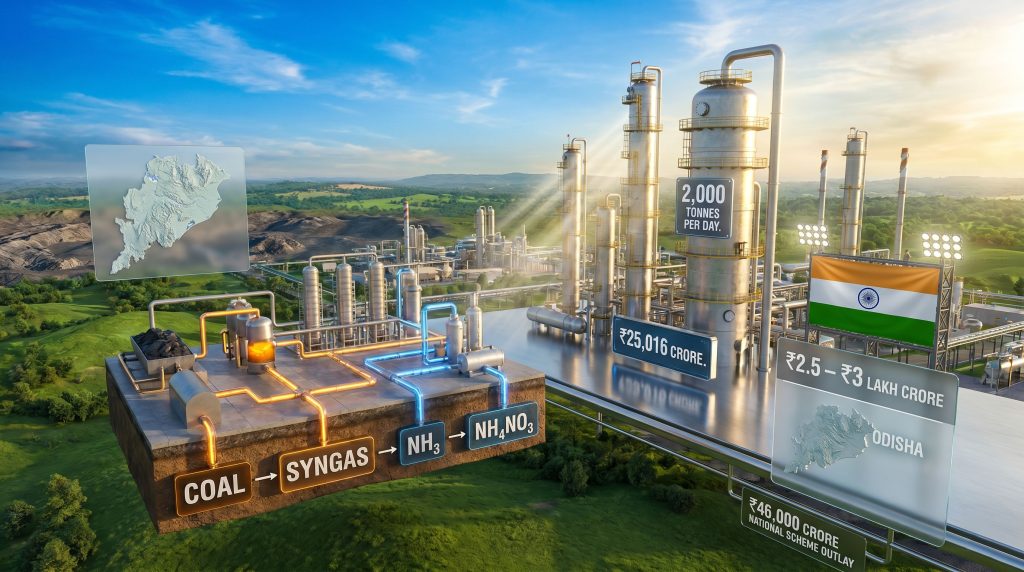
The numbers involved are substantial by any measure. Total project investment stands at ₹25,016 crore, making this one of the largest single chemical manufacturing investments in Indian industrial history. The facility will occupy approximately 350 acres of land under the possession of Mahanadi Coalfields Limited (MCL), a Coal India subsidiary, in one of India's most productive coal-bearing regions. The expected completion date is September 2029. For further context on India's first commercial coal-to-ammonium nitrate project, the broader domestic manufacturing implications are significant.
At full capacity, the plant will produce 2,000 tonnes of ammonium nitrate per day, translating to approximately 730,000 tonnes annually. That scale positions it among the largest single-site ammonium nitrate production facilities in Asia upon commissioning.
Key Project Metrics at a Glance
| Parameter | Detail |
|---|---|
| Developer | Bharat Coal Gasification and Chemicals Limited (BCGCL) |
| Joint venture partners | BHEL and Coal India Limited |
| Location | Lakhanpur, Jharsuguda District, Odisha |
| Land area | ~350 acres (MCL possession) |
| Daily production capacity | 2,000 tonnes of ammonium nitrate |
| Annual equivalent output | ~730,000 tonnes |
| Total project investment | ₹25,016 crore |
| Scheme support received | ₹1,350 crore (Category-I, Coal Gasification Promotion Scheme) |
| Core technology | BHEL indigenously developed coal gasification system |
| EPC contractor | Larsen and Toubro (L&T), lump-sum turnkey |
| Target completion | September 2029 |
From Coal to Chemical: Understanding the Conversion Pathway
One of the less commonly understood aspects of this project is the elegance of the underlying chemistry. Coal gasification is not a new technology globally, but its application to high-ash Indian coal using indigenously developed equipment represents a meaningful technical achievement that deserves careful examination.
The conversion process follows a sequential chain of thermochemical and catalytic reactions:
- Coal Feed Preparation — Domestic high-ash coal is processed and fed into the gasifier under controlled conditions.
- Gasification Reaction — The coal reacts with steam and oxygen at elevated temperatures, typically above 1,000 degrees Celsius, breaking molecular bonds to produce synthesis gas, or syngas, a mixture primarily composed of hydrogen and carbon monoxide.
- Gas Cleaning and Conditioning — Raw syngas contains sulphur compounds, particulate matter, and carbon dioxide that must be removed before downstream processing. This step is critical for protecting catalysts in subsequent reaction stages.
- Hydrogen Separation — Hydrogen is selectively extracted from the cleaned syngas stream through pressure-swing adsorption or membrane separation technologies.
- Ammonia Synthesis — The extracted hydrogen combines with atmospheric nitrogen via the Haber-Bosch process, one of the most consequential industrial chemical reactions ever developed, to produce ammonia.
- Nitric Acid Production — Ammonia undergoes catalytic oxidation, known as the Ostwald process, to produce nitric acid.
- Ammonium Nitrate Formation — Ammonia and nitric acid are neutralised in a controlled reaction to yield ammonium nitrate as the final product.
Process Flow Summary
| Stage | Input | Output |
|---|---|---|
| Gasification | High-ash coal, steam, oxygen | Raw syngas (H₂ + CO) |
| Gas conditioning | Raw syngas | Purified H₂ and CO |
| Ammonia synthesis | H₂ and atmospheric N₂ | Ammonia (NH₃) |
| Nitric acid production | NH₃ and O₂ | Nitric acid (HNO₃) |
| Ammonium nitrate synthesis | NH₃ and HNO₃ | Ammonium nitrate (NH₄NO₃) |
Why High-Ash Coal Is the Critical Feedstock Variable
This point is frequently overlooked in mainstream coverage of the project. India's domestic coal reserves are characterised by high ash content, often ranging from 30 to 45 percent by weight, compared to globally traded thermal coal which typically carries ash content below 15 percent. This characteristic has historically limited the application of international gasification technologies in India, because most commercially proven gasifiers were designed and optimised around lower-ash coal varieties.
BHEL's indigenous gasification technology was specifically engineered to handle Indian coal's ash profile. This is not a minor technical footnote. It means the Lakhanpur facility can draw its feedstock entirely from domestic coalfields rather than depending on imported low-ash coal, which would largely defeat the import substitution objective. The technology adaptation represents a significant R&D investment that the Lakhanpur project now commercialises at industrial scale for the first time.
The Three-Entity Architecture: Why the Joint Venture Structure Matters
The ownership and execution structure of this project is deliberately designed to distribute both capability and risk across India's most capable industrial actors.
BHEL as the Technology Anchor
BHEL contributes the proprietary coal gasification system at the project's core. This is a domestically engineered solution rather than a licensed foreign technology. That distinction carries significant long-term implications for operational cost control, technology transfer sovereignty, and the potential for exporting Indian gasification expertise to other coal-rich economies. Countries in Southeast Asia and Sub-Saharan Africa with large high-ash coal reserves could, in theory, represent future markets for this proven technology once Lakhanpur demonstrates commercial viability.
Coal India Limited as the Resource and Land Backbone
CIL's participation through its MCL subsidiary provides both the physical land parcel and a structurally secured domestic coal supply chain. Feedstock security is arguably the single most critical risk mitigation factor for a capital-intensive chemical facility with a multi-decade operating life. By embedding the coal supplier directly into the ownership structure, BCGCL eliminates the contract renegotiation and price exposure risks that have undermined similar projects elsewhere.
Larsen and Toubro as EPC Executor
L&T secured the Engineering, Procurement and Construction contract for the nitric acid and ammonium nitrate manufacturing plant on a lump-sum turnkey basis. This contractual structure is significant from a project finance perspective: it transfers construction cost overrun risk to L&T rather than leaving it with the project owner. For a first-of-its-kind facility of this scale, that risk transfer is a material protection against budget blowouts common in pioneer industrial projects. Furthermore, Odisha's coal gasification project details confirm the scale of ambition behind this initiative.
The three-entity structure distributes technology risk, feedstock risk, and execution risk across different parties with complementary strengths, reducing the single-point failure exposure that has undermined other large-scale industrial ventures in emerging markets.
The Policy Architecture Enabling This Investment
The Lakhanpur project does not exist in a policy vacuum. On 7 February 2024, the Government of India formally approved a Coal and Lignite Gasification Promotion Scheme carrying a cumulative financial outlay of up to ₹46,000 crore. The scheme targets surface coal and lignite gasification projects across coal-bearing states and is structured around project categories with differentiated incentive levels.
The BCGCL Lakhanpur project received ₹1,350 crore in support under Category-I of this scheme. This financial support is specifically tied to the project's categorisation under the promotion scheme. In addition, India's broader push to improve its resource and energy exports competitiveness has reinforced the strategic rationale for domestic chemical self-sufficiency.
The projected economic multiplier effects from the national programme, if all 25 targeted projects reach commissioning, are substantial:
| Policy Metric | Projected Figure |
|---|---|
| Total government scheme outlay | ₹46,000 crore |
| Private investment expected to be catalysed | ₹2.5 to ₹3 lakh crore |
| Total projects targeted nationwide | 25 projects |
| Direct and indirect employment projected | ~50,000 jobs |
| Annual chemical import displacement potential | Share of ₹2.7 lakh crore import bill |
The broader Aatmanirbhar Bharat industrial self-reliance framework positions coal gasification as a priority technology pathway alongside semiconductor manufacturing, defence production, and critical mineral processing. The Lakhanpur project is explicitly cited as a model intended to demonstrate the template for future coal gasification ventures across India's coal-bearing regions.
The next major ASX story will hit our subscribers first
Confronting the Carbon Question Directly
Any serious analysis of this project must grapple with its environmental dimensions honestly, particularly given India's commitments under the Paris Agreement.
Coal gasification is not a zero-emission process. The thermochemical conversion of coal produces carbon dioxide as a byproduct, and without carbon capture and storage infrastructure, the Lakhanpur facility will carry a measurable carbon footprint over its operational life. This is an unavoidable technical reality that needs to be weighed against the project's strategic and economic objectives.
India's official framing positions coal gasification as a transitional technology, specifically a bridge between current import-dependent industrial chemistry and a future hydrogen-based economy. This framing has genuine technical merit. The syngas production pathway at Lakhanpur is structurally compatible with future integration of green hydrogen. In a scenario where electrolytic hydrogen costs fall sufficiently, the hydrogen derived from coal gasification in the ammonia synthesis loop could theoretically be replaced or supplemented with renewable-powered electrolytic hydrogen, dramatically reducing the facility's lifecycle emissions. This transition pathway aligns with the broader trend towards green industrial production taking shape across Asia's heavy industry sector.
A comparative view illustrates the trade-offs involved:
| Production Pathway | Carbon Intensity | Import Dependency | Technology Readiness in India |
|---|---|---|---|
| Imported ammonium nitrate | Offshore displaced | Very high | Not applicable |
| Coal gasification (domestic) | Moderate to high | Very low | High (BHEL proven) |
| Green hydrogen-based ammonia | Near-zero | Low | Emerging |
| Coal gasification with CCS | Low to moderate | Very low | Early stage |
The honest assessment is that Lakhanpur improves India's supply chain sovereignty and generates substantial economic value while carrying real environmental costs. Whether those costs are acceptable depends on one's timeframe, risk weighting, and confidence in the speed of India's renewable energy buildout. However, momentum around green transition materials suggests that pathways to lower-carbon production are developing faster than many analysts anticipated.
Economic Outcomes: What Full Capacity Actually Delivers
At 730,000 tonnes of annual ammonium nitrate production, the Lakhanpur facility directly displaces an equivalent import volume. Given that global ammonium nitrate spot prices have ranged between USD 250 and USD 450 per tonne depending on market conditions, the foreign exchange saving potential at full capacity runs into several thousand crore rupees annually.
For the Jharsuguda region specifically, a ₹25,016 crore facility generates substantial construction-phase employment across engineering, civil works, and equipment installation, followed by permanent operational and maintenance roles. The national programme's projected 50,000 direct and indirect jobs across 25 projects represents a meaningful contribution to industrial employment in coal-belt communities where economic diversification is both necessary and overdue.
The technology commercialisation angle adds another dimension. A successfully operating Lakhanpur facility creates a validated reference plant for BHEL's indigenous gasification technology. In international project development, reference plant status is frequently the deciding factor in technology selection for new facilities. Furthermore, India's import tax structure for chemicals and energy inputs has historically shaped investment decisions in exactly this kind of capital-intensive sector. India's ability to demonstrate large-scale, high-ash coal gasification at commercial throughput could open markets that no amount of laboratory demonstration or pilot-scale testing can access.
Frequently Asked Questions
What is India's first commercial coal-to-ammonium nitrate project?
The facility at Lakhanpur in Jharsuguda district, Odisha, being developed by BCGCL, a joint venture between BHEL and Coal India Limited. It will produce 2,000 tonnes of ammonium nitrate per day using BHEL's indigenously developed coal gasification technology, with total investment of ₹25,016 crore and a target completion of September 2029.
Why was Jharsuguda chosen as the project location?
The district sits within a major coal-bearing region, with Mahanadi Coalfields Limited controlling the approximately 350-acre land parcel allocated for the facility. Proximity to domestic coal supply reduces feedstock logistics costs and aligns with the project's core objective of utilising high-ash Indian coal.
When is the Lakhanpur plant expected to be completed?
The official target completion date is September 2029.
Who is building the chemical plant at Lakhanpur?
Larsen and Toubro holds the EPC contract for the nitric acid and ammonium nitrate manufacturing plant on a lump-sum turnkey basis. BHEL provides the coal gasification technology, and BCGCL is the project developer and owner. The BCGCL tender announcement provided early confirmation of the project's commercial structure and scale.
What government scheme support has the project received?
The project has been approved for ₹1,350 crore in financial support under Category-I of India's Coal and Lignite Gasification Promotion Scheme, which was formally approved on 7 February 2024 with a national outlay of up to ₹46,000 crore.
What the Lakhanpur Project Tells Us About India's Industrial Trajectory
Stepping back from the technical and financial specifics, India's first commercial coal-to-ammonium nitrate project in Odisha reflects a deliberate strategic choice: that India's industrial maturity will be measured not only by its consumption of chemicals and materials, but by its capacity to produce them from domestic inputs using domestic technology.
The key dimensions of that choice are worth summarising:
- Scale and ambition: At 2,000 TPD, this ranks among the largest planned ammonium nitrate facilities anywhere in Asia
- Technology sovereignty: BHEL's indigenous system eliminates dependence on licensed foreign gasification technology
- Structural risk distribution: The BHEL, CIL and L&T architecture allocates technology, feedstock, and execution risk to the parties best positioned to manage each
- Economic multiplier potential: A facility of this scale, if replicated across 25 planned projects, could address a material share of India's ₹2.7 lakh crore annual chemical import bill
- Employment and regional development: The Jharsuguda location targets industrial diversification in a coal-dependent region
- Transitional technology framing: The syngas infrastructure is compatible with future green hydrogen integration as renewable costs continue to fall
Disclaimer: This article contains forward-looking projections and programme-level estimates drawn from government policy disclosures and publicly available data. Actual outcomes including production volumes, investment catalysed, employment generated, and completion timelines are subject to execution risks, market conditions, and policy continuity. Readers should conduct independent research before drawing conclusions for investment or policy purposes.
Want to Stay Ahead of the Next Major Resource Discovery?
Discovery Alert's proprietary Discovery IQ model scans ASX announcements in real time, instantly identifying significant mineral discoveries across the commodities reshaping global industrial supply chains — from the critical minerals underpinning India's infrastructure ambitions to the resources driving the global energy transition. Explore historic discoveries and their remarkable returns to understand the scale of opportunity, then begin your 14-day free trial at Discovery Alert to position yourself ahead of the broader market.