June 18, 2026
India's Ammonium Nitrate Problem: Why Domestic Chemical Manufacturing Can No Longer Wait
Industrial chemical supply chains rarely attract public attention until they fail. When the availability of a single compound determines whether a mine can blast, a tunnel can be excavated, or a crop can yield adequately, the stakes of import dependency become impossible to ignore. Ammonium nitrate occupies precisely that position in India's industrial architecture, sitting at the intersection of mining productivity, infrastructure construction, and agricultural output. For decades, India's reliance on imported supplies has created a structural vulnerability that periodic shipping disruptions and geopolitical volatility have repeatedly exposed.
The announcement of the L&T coal-to-ammonium nitrate project in Odisha, contracted at a value between ₹2,500 crore and ₹5,000 crore, represents a deliberate attempt to address that vulnerability at scale. Understanding why this project matters requires looking beyond the contract announcement itself and into the industrial logic underpinning India's decision to build domestic ammonium nitrate capacity through a coal gasification pathway.
When big ASX news breaks, our subscribers know first
The Strategic Case for Domestic Ammonium Nitrate Production
Ammonium nitrate (NH₄NO₃) serves two fundamentally different but equally critical industrial purposes. In mining, quarrying, and infrastructure construction, it forms the basis of ANFO (ammonium nitrate-fuel oil), the most widely used commercial blasting agent globally. In agriculture, furthermore, it functions as a concentrated nitrogen-delivery system, supporting crop yields in nitrogen-deficient soils.
This dual utility creates an unusually broad demand base. When ammonium nitrate supply tightens, the ripple effects are not confined to a single sector. Coal extraction slows, road and tunnel construction faces delays, and fertiliser availability contracts. Few industrial compounds carry that level of cross-sector consequence, and fewer still are sourced so heavily through imports in a country with India's industrial scale.
The fragility of import-dependent chemical sourcing has been demonstrated repeatedly through global supply chain disruptions, with shipping cost inflation and geopolitical instability compressing supply windows and widening price volatility. Consequently, for India's planners, these episodes have underscored an uncomfortable arithmetic: a country with the world's second-largest population, a rapidly expanding infrastructure pipeline, and an enormous agricultural sector cannot afford to have its industrial explosive and fertiliser supply calibrated primarily by international freight markets.
Converting domestically mined coal into ammonium nitrate through gasification effectively transforms a commodity with limited domestic value-add into a high-demand import substitute, addressing both the trade balance and supply security dimensions simultaneously.
Project Fundamentals: Scope, Scale, and Structure
Key Project Parameters at a Glance
| Parameter | Confirmed Detail |
|---|---|
| Contract Value | ₹2,500 crore to ₹5,000 crore |
| Production Capacity | 2,000 tonnes of ammonium nitrate per day |
| Execution Model | Lump-Sum Turnkey (LSTK) |
| Project Location | Odisha, India |
| Client Entity | Bharat Coal Gasification and Chemicals Ltd (BCGCL) |
| Client Ownership | Joint venture: Coal India Ltd (CIL) and BHEL |
| Contract Award | May 5, 2026 |
| Executing Division | L&T Energy Hydrocarbon Onshore |
The Lump-Sum Turnkey (LSTK) execution model is a critical structural detail. Under this arrangement, L&T assumes full delivery accountability across the entire project lifecycle, from basic design and detailed engineering through procurement, construction, commissioning, performance testing, and formal plant handover. Unlike cost-reimbursable or risk-sharing contract models, LSTK places schedule, cost overrun, and performance guarantee risk squarely on the contractor.
This structure is typically reserved for contractors with demonstrated large-scale project delivery track records, as the financial exposure from delays or underperformance falls entirely on the executing party. According to reporting by the Economic Times, L&T's scope under what is designated as Package-4 of the broader BCGCL facility covers the nitric acid and ammonium nitrate plant specifically.
In large industrial megaprojects, this package architecture is standard practice: separating coal handling and gasification, syngas processing and ammonia synthesis, and downstream chemical conversion into discrete packages allows specialised contractors to focus on their core competencies while enabling parallel execution across project streams. Package-4 represents the downstream conversion end of the process chain, where ammonia is transformed into nitric acid and subsequently into ammonium nitrate.
From Coal to Ammonium Nitrate: The Process Pathway
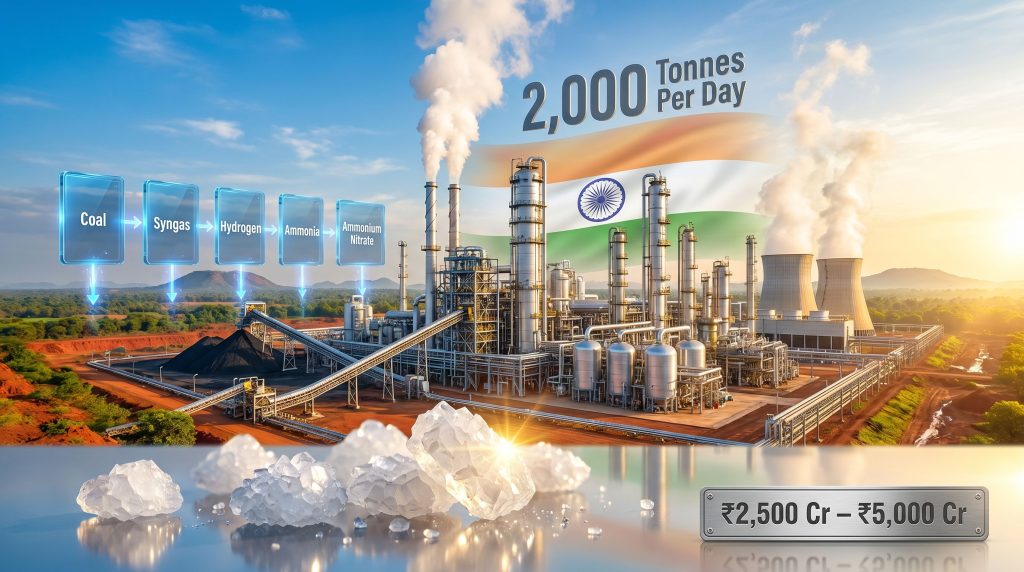
The technical pathway converting high-ash domestic coal into industrial-grade ammonium nitrate involves five sequential stages, each presenting distinct engineering challenges:
-
Coal Gasification: High-ash domestic coal is fed into pressurised gasification reactors, where controlled partial oxidation converts the solid feedstock into synthesis gas (syngas), a mixture of carbon monoxide (CO) and hydrogen (H₂).
-
Syngas Cleaning and Processing: Raw syngas contains contaminants including sulphur compounds, particulates, and excess CO. Water-gas shift reactions (CO + H₂O → CO₂ + H₂) adjust the gas composition to maximise hydrogen yield, while scrubbing systems remove sulphur and particulate matter.
-
Ammonia Synthesis: Purified hydrogen and nitrogen (sourced from air separation) are combined via the Haber-Bosch process at elevated pressure (150-350 atmospheres) and temperature (400-500°C) over an iron catalyst to produce ammonia (NH₃).
-
Nitric Acid Production: Ammonia undergoes catalytic oxidation over platinum-rhodium catalysts at temperatures between 800-1000°C, converting ammonia into nitric oxide (NO), which is subsequently absorbed in water to form nitric acid (HNO₃).
-
Ammonium Nitrate Crystallisation: Nitric acid reacts with ammonia in a neutralisation reaction, producing ammonium nitrate solution, which is then concentrated and granulated or prilled into the final commercial product.
A less commonly understood aspect of this process is that India's coal resource base, characterised by high ash content that makes it suboptimal for conventional power generation, remains technically viable as a gasification feedstock. This positions India's vast reserves of lower-grade coal as a strategic chemical feedstock rather than a second-tier energy resource.
The BCGCL Joint Venture: Industrial Policy Made Operational
Coal India and BHEL as Strategic Partners
Bharat Coal Gasification and Chemicals Ltd (BCGCL) is a purpose-built joint venture between two of India's most significant state-owned enterprises: Coal India Limited (CIL), the country's dominant coal producer, and Bharat Heavy Electricals Limited (BHEL), India's major heavy electrical and engineering equipment manufacturer.
The logic of this pairing is structurally coherent. Coal India controls access to domestic coal reserves and has strong incentives to develop downstream value-adding applications for coal beyond raw extraction and sale. As global energy transition narratives apply increasing pressure to coal's long-term market position, developing coal-to-chemicals conversion capacity represents a diversification strategy that extends the economic life of India's coal assets.
BHEL, furthermore, contributes engineering heritage in heavy industrial plant design, particularly in thermal power systems, and brings fabrication and technical integration capabilities relevant to large-scale process plant construction. Together, the joint venture consolidates both the feedstock supply chain and the technical manufacturing expertise under a single institutional umbrella, reducing the coordination complexity that has historically fragmented India's coal chemical ambitions.
Why Odisha Was the Logical Site Selection
Odisha's selection as the project location is not coincidental. The state hosts some of India's most productive coal-bearing districts, including Angul, Jharsuguda, and Sundargarh, which collectively provide immediate feedstock proximity for the gasification process. Reducing the distance between coal extraction and chemical conversion directly improves the facility's feedstock cost economics.
Beyond coal proximity, Odisha's existing heavy industrial infrastructure, concentrated in its mineral belt, reduces greenfield development risk. The state has established industrial clusters in steel, aluminium, and energy production that provide experienced construction workforces, logistics infrastructure, and utility supply networks. These factors collectively lower the execution complexity of building a facility of this scale.
End-Use Markets and the 2,000 Tonnes Per Day Threshold
Ammonium Nitrate Demand Across Indian Industry
| End-Use Sector | Primary Application | Key Demand Driver |
|---|---|---|
| Mining and Quarrying | ANFO blasting agents for coal, iron ore, limestone | Sustained extraction growth across multiple mineral commodities |
| Infrastructure Construction | Rock fragmentation for tunnels, highways, dams | National Infrastructure Pipeline project execution |
| Agriculture | Nitrogen-based fertiliser inputs | Food security and crop yield intensification programmes |
| Defence and Specialty Chemicals | Controlled explosive formulations | Strategic industrial reserve and defence procurement |
The 2,000 tonnes per day production capacity is a meaningful threshold when contextualised against India's industrial demand base. At this output rate, the facility would produce approximately 730,000 tonnes of ammonium nitrate annually, a volume capable of displacing a significant share of India's current import dependency. For India's mining sector specifically, where ANFO remains the dominant blasting agent for large-scale operations, a domestic supply source of this magnitude addresses both pricing and availability risks that have historically been contingent on global shipping conditions.
Infrastructure contractors working on the National Infrastructure Pipeline, which encompasses roads, railways, ports, and urban infrastructure, similarly benefit from a more secure domestic supply chain for construction blasting requirements. The commodity price impacts of more stable domestic ammonium nitrate supply would consequently ripple across multiple sectors simultaneously.
L&T Energy Hydrocarbon Onshore: Engineering Capability at Scale
L&T's Energy Hydrocarbon Onshore division brings relevant large-scale process plant delivery experience to a project of this technical complexity. Coal-to-ammonium nitrate facilities require seamless integration across multiple process trains that operate simultaneously, including gasification units, syngas cleaning systems, air separation units, ammonia synthesis loops, nitric acid trains, and ammonium nitrate crystallisation systems.
The engineering complexity is compounded by several factors specific to this project:
-
High-ash coal feedstock variability affects gasification efficiency and syngas composition consistency, requiring adaptive process controls across the gasification and syngas cleaning sections.
-
Multi-train integration demands precise interface management between process packages, particularly at the ammonia synthesis and nitric acid production boundary where gas purity specifications are critical to catalyst performance.
-
Safety classification requirements for ammonium nitrate under Indian regulatory frameworks impose specific design standards for storage, containment, ventilation, and emergency shutdown systems throughout the facility.
-
High-pressure system engineering across the ammonia synthesis loop requires specialised metallurgy and non-destructive testing protocols that elevate construction quality requirements above standard industrial plant work.
Under the LSTK model, L&T is responsible for delivering a facility that meets pre-agreed performance targets before formal handover is accepted, meaning commissioning and performance testing phases carry contractual weight beyond standard project completion milestones.
The next major ASX story will hit our subscribers first
India's Broader Coal Gasification Ambitions
The 100 Million Tonne Capacity Target
India has articulated an ambitious national target of developing 100 million tonnes of coal gasification capacity by 2030, a goal that positions coal gasification as a bridge technology between the country's current fossil-fuel-intensive industrial base and its longer-term clean energy transition commitments. The L&T coal-to-ammonium nitrate project in Odisha contributes meaningfully to that capacity target while simultaneously delivering an industrial chemical output that addresses a specific supply security gap.
India's position contrasts with countries that established coal chemical industries decades earlier. China operates the world's largest coal chemical sector, producing methanol, ammonia, synthetic natural gas, and olefins from coal at industrial scale. South Africa's Sasol, for instance, developed coal-to-liquids technology as a strategic energy independence measure during the apartheid-era sanctions period. India's current push represents a later-mover entry into coal chemicals, but one informed by the technology maturity and lessons accumulated through those earlier programmes.
Aatmanirbhar Bharat and the Import Substitution Imperative
The Aatmanirbhar Bharat (self-reliant India) policy framework has reshaped procurement priorities across state-owned enterprises, with particular emphasis on reducing import dependency in strategic industrial materials. Ammonium nitrate fits squarely within this framework: it is a high-volume industrial compound, its import bill represents a recurring foreign exchange drain, and its domestic production is technically feasible given India's coal resource endowment.
The economic logic is compelling at multiple levels. Foreign exchange conservation from displacing ammonium nitrate imports at the scale of 730,000 tonnes annually represents a structural improvement in India's current account position for industrial chemicals. India's resource and energy exports provide a useful comparative framework here, as value-addition strategies that convert raw commodities into processed chemical compounds capture industrial margin domestically rather than surrendering it to foreign producers.
Economic and Industrial Ripple Effects
The ₹2,500-5,000 crore contract value range reflects the pricing uncertainty typical of large, complex LSTK projects at announcement stage, where detailed engineering has not yet quantified every equipment and construction cost component. This range translates into substantial capital deployment across engineering design services, equipment procurement, civil and structural construction, and instrumentation installation.
Employment generation follows several pathways:
-
Construction phase: Large workforces for civil, structural, mechanical, piping, and electrical installation across a multi-year build programme
-
Permanent operations: Skilled operators, maintenance technicians, process engineers, and supporting logistics and administration functions
-
Procurement multiplier: Domestic sourcing of structural steel, instrumentation, process equipment, and fabricated components generates secondary employment across India's manufacturing base
Beyond the immediate project, a functioning coal chemical facility in Odisha carries precedent value. Demonstrating successful LSTK delivery of a coal-to-ammonium nitrate plant at this scale provides a replicable model for similar projects in other coal-bearing states including Jharkhand, Chhattisgarh, and Madhya Pradesh, each of which possesses comparable feedstock resources and industrial demand bases.
Key Risks That Investors and Policymakers Should Monitor
Technical and Execution Risks
-
Coal feedstock ash content variability can affect gasification reactor performance and syngas cleaning system loading, potentially reducing throughput efficiency against design targets
-
Multi-package integration complexity creates interface risk between gasification, ammonia synthesis, and downstream ammonium nitrate systems if package boundaries are not carefully managed
-
Skilled workforce availability for specialised coal chemical plant construction in Odisha may require workforce development programmes to supplement local labour supply
Regulatory and Safety Considerations
Ammonium nitrate is classified as a regulated hazardous material under Indian law, subject to strict controls across manufacturing, storage, transportation, and end-user distribution. The Beirut port explosion of 2020, caused by the improper storage of ammonium nitrate, has heightened regulatory scrutiny of this compound globally, and Indian regulators have consequently tightened compliance requirements.
Environmental clearance processes for coal gasification facilities must address air quality emissions, water treatment, ash disposal, and carbon accounting, all of which can extend permitting timelines if not proactively managed. In addition, mining permit fast-tracking approaches adopted in other jurisdictions offer instructive comparisons for how regulatory acceleration can be balanced against safety and environmental standards.
Market and Policy Risks
-
Coal price sensitivity: The facility's production economics depend on domestic coal feedstock pricing, which is subject to Coal India's pricing policies and government energy cost frameworks
-
Global ammonium nitrate price risk: A sustained fall in international ammonium nitrate prices would compress the import substitution economic case and potentially affect the facility's competitive position against imported product
-
Policy continuity: A multi-year construction timeline spanning state and central government election cycles introduces risk of shifting priorities, though the state-owned enterprise structure of BCGCL provides some institutional continuity buffer
Coal Gasification and India's Energy Transition: A Necessary Tension
The intellectual tension at the heart of India's coal gasification expansion is the simultaneous pursuit of industrial modernisation and decarbonisation commitments. India has pledged net-zero emissions by 2070 under the Paris Agreement while simultaneously accelerating coal chemical investments that lock in coal-dependent industrial infrastructure for decades.
The distinction between coal-to-chemicals and coal-to-power deserves analytical attention. Coal gasification for chemical production typically achieves higher overall carbon efficiency than direct coal combustion for power generation, because the chemical value chain captures more economic output per tonne of coal consumed. Additionally, the concentrated CO₂ streams produced in gasification facilities are technically more amenable to carbon capture and utilisation (CCU) retrofits than the dilute flue gases from combustion-based power plants.
Critical minerals and energy security considerations are, however, increasingly shaping how governments evaluate industrial investments of this nature. Looking further along the product roadmap, the gasification infrastructure being built for ammonium nitrate production is technically compatible with future product diversification. The syngas backbone can, in principle, support production of methanol, dimethyl ether (DME), synthetic natural gas (SNG), or hydrogen, depending on downstream processing configurations.
This optionality means the Odisha facility's core infrastructure could serve as a platform for broader coal chemicals development, including potential integration of green or blue hydrogen production as those technologies mature. The critical raw materials transition occurring globally, furthermore, underscores why industrial nations are looking to leverage existing feedstock assets during this period of technological evolution rather than stranding them prematurely.
Germany, Japan, and South Korea have each navigated the challenge of managing coal chemical industrial legacies through transition periods, with varying combinations of technology retrofitting, feedstock switching, and planned capacity retirement. India's coal gasification investments will eventually face similar transition pressures, but in the near to medium term, the import substitution rationale and industrial development imperative provide a compelling case for proceeding.
Frequently Asked Questions
What is the L&T coal-to-ammonium nitrate project in Odisha?
It is a large-scale industrial facility being developed by Larsen and Toubro's Energy Hydrocarbon Onshore division for Bharat Coal Gasification and Chemicals Ltd (BCGCL), a joint venture of Coal India Limited and BHEL. The facility will convert domestic coal into ammonium nitrate at a planned capacity of 2,000 tonnes per day, targeting reduced import dependency in India's mining, infrastructure, and agricultural sectors.
Who awarded L&T the contract?
BCGCL, the contracting entity and purpose-built joint venture of Coal India Ltd and Bharat Heavy Electricals Limited, awarded the contract to L&T Energy Hydrocarbon Onshore on May 5, 2026. Business Standard's coverage of the award provides further detail on the announcement and its broader industrial context.
How much is the contract worth?
The contract is valued between ₹2,500 crore and ₹5,000 crore. This range is characteristic of complex LSTK megaprojects where detailed engineering scope has not been fully quantified at the time of announcement.
What will the facility produce and at what capacity?
The facility will produce ammonium nitrate at a planned rate of 2,000 tonnes per day, approximately 730,000 tonnes annually, through a coal gasification and chemical synthesis process.
How does coal become ammonium nitrate?
Coal is gasified to produce syngas (CO + H₂), which is processed to maximise hydrogen yield. Hydrogen and nitrogen combine via the Haber-Bosch process to form ammonia. Ammonia is catalytically oxidised into nitric acid, which then reacts with more ammonia to form ammonium nitrate through a neutralisation and crystallisation process.
When will the plant be operational?
No specific commissioning date has been publicly confirmed. LSTK projects of comparable scale and complexity in the coal chemicals sector typically require four to six years from contract award to full operational handover, suggesting a potential operational window in the 2030-2032 timeframe, though this is indicative rather than confirmed.
This article is intended for informational and analytical purposes only. Forward-looking statements regarding project timelines, production capacities, economic outcomes, and policy directions involve inherent uncertainties and should not be construed as investment advice or guarantees of future performance. Readers should conduct independent research and consult qualified advisors before making any investment or business decisions based on the information presented here.
For ongoing coverage of India's energy and chemicals sector developments, ET EnergyWorld at energy.economictimes.indiatimes.com provides regular analysis on coal, infrastructure, and industrial policy topics.
Want to Capitalise on the Next Major ASX Mineral Discovery Before the Market Moves?
Discovery Alert's proprietary Discovery IQ model delivers real-time alerts on significant ASX mineral discoveries — instantly transforming complex data across 30+ commodities into clear, actionable insights for investors at every level. Start your 14-day free trial today and explore Discovery Alert's discoveries page to see how historic finds have generated extraordinary returns.