
August 24, 2026
Ocean Governance at a Crossroads: When Commercial Ambition Collides With International Law
The architecture of international ocean law was built on a single foundational premise: that the deep seabed, lying beyond any nation's territorial reach, belongs to no one and therefore to everyone. For nearly five decades, that principle has functioned as the legal bedrock of maritime governance. Today, the Allseas deep-sea mining contract violates UN law in ways that the vast majority of the world's nations regard as legally invalid.
Understanding why this dispute matters requires looking beyond the corporate transaction itself and examining the legal architecture it allegedly breaches, the geopolitical fault lines it exposes, and the ecological stakes that give environmental groups urgent cause for intervention.
When big ASX news breaks, our subscribers know first
The Legal Architecture Governing the International Seabed
What UNCLOS Established and Why Its Jurisdictional Reach Is Unique
The United Nations Convention on the Law of the Sea, adopted in 1982 and entering into force in 1994, is widely regarded as the most comprehensive framework ever developed to govern maritime activity. With 168 parties as of its current status, it covers everything from territorial waters and exclusive economic zones to navigation rights and, critically, the exploitation of resources in areas beyond national jurisdiction.
The Convention created a distinct legal category for the international seabed floor, designating it and its mineral resources as the "common heritage of mankind." This is not merely rhetorical language. It carries specific legal consequences: no state, corporation, or private individual may claim ownership of seabed resources in this zone or conduct commercial extraction without authorisation from the body the Convention itself created to govern such activity.
The International Seabed Authority's Exclusive Mandate
The International Seabed Authority (ISA), established under UNCLOS and headquartered in Kingston, Jamaica, holds exclusive regulatory jurisdiction over all mineral-related activities on the international seabed. Its mandate includes issuing exploration and exploitation licences, setting environmental standards, and ensuring that any economic benefits derived from the commons are shared equitably among the international community.
Despite holding this mandate since 1994, the ISA has never finalised a commercial mining code. Negotiations over the so-called "exploitation regulations" have spanned more than a decade, repeatedly stalling over disagreements about environmental thresholds, financial models, and benefit-sharing mechanisms. This prolonged regulatory vacuum has created a structural opening that some commercial operators have sought to exploit through alternative permitting routes.
The "Common Heritage" Doctrine Under Commercial Pressure
The common heritage principle is reinforced not only by the UNCLOS treaty text but also by customary international law, meaning it applies even to states that have not ratified the Convention. This is a legally significant distinction: a country operating outside UNCLOS cannot simply declare itself exempt from the underlying norms the Convention codifies, because those norms have achieved the status of binding customary obligations recognised by the broader international community.
The precautionary principle adds a further legal dimension. In areas where scientific understanding of ecosystem impacts remains incomplete, international environmental law generally requires that uncertainty itself function as a barrier to potentially irreversible activity. Deep-sea ecosystems, which evolved over millions of years in conditions of extreme stability, are considered among the most difficult to remediate once disturbed.
The Allseas and TMC Commercial Arrangement: What Is Actually Planned
Operational Scope and Technical Parameters
In May 2026, offshore engineering company Allseas, a Swiss-Dutch entity, entered into a commercial partnership with The Metals Company (NASDAQ: TMC) to develop and operate what would constitute the world's first commercial nodule mining potential recovery system. The operational specifications involved are significant in scale.
| Operational Parameter | Detail |
|---|---|
| Target Resource | Polymetallic nodules (Pacific Ocean floor) |
| Operating Depth | More than 4 kilometres below the ocean surface |
| Annual Production Capacity | 3 million wet tonnes |
| Collector Vehicles Deployed | Two autonomous collector units |
| Authorisation Pathway | Unilateral U.S. permit, bypassing ISA framework |
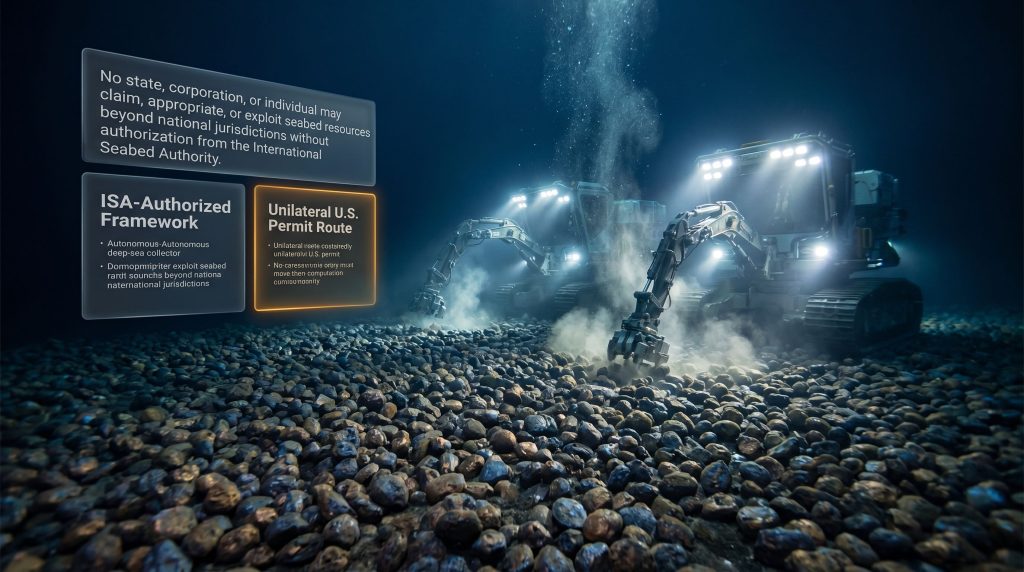
The nodule recovery system would deploy two autonomous collector vehicles operating at depths exceeding four kilometres, harvesting mineral-rich formations from the Pacific seabed with a combined annual production capacity of 3 million wet tonnes. Crucially, the authorisation for this activity does not flow from the ISA. Instead, TMC secured a permit through a domestic United States regulatory process, a pathway that bypasses the multilateral framework entirely.
Why Polymetallic Nodules Attract Commercial Interest
Polymetallic nodules explained are irregularly shaped mineral concretions that form over millions of years on the deep ocean floor, accreting layer by layer around a small nucleus such as a shark's tooth or a fragment of shell. What makes them commercially extraordinary is their mineral composition: individual nodules typically contain significant concentrations of nickel, cobalt, manganese, and copper.
These four metals sit at the centre of the global energy transition. Furthermore, the critical minerals demand for nickel and cobalt as critical inputs for lithium-ion battery cathodes continues to grow rapidly. Manganese is essential for steel production and increasingly relevant in battery chemistry. Copper underpins virtually every electrification technology. The Clarion-Clipperton Zone in the Pacific alone is estimated to contain nodule deposits with metal content that dwarfs known terrestrial reserves for several of these commodities.
A less commonly appreciated dimension is the grade profile of deep-sea nodules relative to terrestrial ores. Nickel grades in nodules frequently exceed those found in laterite deposits currently being mined commercially, while cobalt concentrations can reach levels that would be considered high-grade by any land-based standard. This is part of what drives commercial interest despite the formidable engineering challenges of deep-ocean extraction.
How the U.S. Permit Route Sidesteps ISA Authority
The United States has not ratified UNCLOS, placing it in a distinct legal position from the 168 countries that have. Because the U.S. does not recognise the ISA's authority as binding, it has proceeded to authorise deep-sea mining activity through its own domestic Deep Seabed Hard Mineral Resources Act, enacted in 1980 well before UNCLOS entered into force.
From a U.S. domestic legal perspective, this permitting pathway is coherent. However, from the perspective of international law, it is deeply contested. UNCLOS parties, which include the European Union and virtually every major maritime nation, regard the ISA's jurisdiction as exclusive and non-delegable. A unilateral national permit issued by a non-signatory does not, in their view, confer any legitimate right to exploit resources that belong to all of humanity.
The University of Amsterdam Legal Opinion: Core Findings
A Finding of Direct Violation, Not Legal Ambiguity
The legal analysis commissioned by Greenpeace Netherlands and authored by Professor André Nollkaemper of the University of Amsterdam reaches a conclusion that its author characterises as unambiguous. The finding is not that the arrangement sits in a legal grey zone or raises questions that courts might eventually resolve. Rather, the opinion classifies the arrangement as a direct violation of UNCLOS obligations binding on Allseas as a Swiss-Dutch corporate entity.
The critical reasoning flows from Allseas's jurisdictional character. As a corporation registered and operating under Dutch and Swiss law, Allseas is subject to the treaty obligations of states that have ratified UNCLOS. The Netherlands is a full UNCLOS party. Its corporate nationals therefore carry the same obligations under international law that the state itself carries, and proceeding with commercial seabed exploitation under a unilateral U.S. permit rather than ISA authorisation constitutes a breach of those obligations.
The Shift From Hypothetical to Active Legal Breach
One of the most legally significant elements of the opinion is its framing of the temporal dimension. Previous discussions of deep-sea mining controversy often treated legal risks as prospective concerns tied to future operational activity. The Amsterdam analysis reframes this entirely: the existence of a binding commercial contract is itself sufficient to trigger legal obligations, regardless of whether physical mining operations have yet commenced.
In this framework, the signing of the Allseas-TMC agreement moves the legal situation from the realm of anticipatory risk to that of present violation. The threat, as the analysis characterises it, has become an active reality. This framing has direct implications for the Dutch government's obligations.
Is the Dutch Government Legally Obligated to Intervene?
State Responsibility and Home-State Jurisdiction
International law has long recognised the concept of state responsibility for the acts of corporate nationals. When a company registered under a state's jurisdiction engages in activity that violates international treaty obligations binding on that state, the state itself may bear legal responsibility for failing to prevent or remedy that conduct.
The legal opinion concludes that the Dutch government's obligation to act is already engaged. The existence of a binding commercial contract between a Dutch-registered entity and a deep-sea mining operator is sufficient under international law to trigger state-level legal responsibility, independent of whether physical extraction has begun.
This principle is well established in environmental treaty contexts, where states have been held responsible for failing to exercise adequate oversight over corporations operating under their jurisdiction. The ISA framework makes this obligation explicit: UNCLOS sponsor state provisions require that states with nationals holding ISA contracts ensure those nationals comply with the Convention's requirements.
What Intervention Would Practically Require
If the Dutch government accepts the legal opinion's findings, its practical options would likely include:
- Formally notifying Allseas that its participation in the TMC project constitutes a breach of Netherlands' UNCLOS obligations
- Initiating regulatory proceedings under Dutch law to prohibit or suspend Allseas's involvement in the commercial contract
- Engaging at the ISA level to formally register the Netherlands' objection to unilateral U.S.-permitted seabed mining
- Coordinating with EU partners to develop a collective European response to the broader regulatory challenge
Failure to act carries its own legal risks. If the Netherlands remains passive while a Dutch-registered entity proceeds with activity classified by credible legal analysis as an UNCLOS violation, the state could itself face international legal exposure.
Comparing Legal Pathways: ISA-Authorised vs. Unilateral U.S.-Permitted Mining
| Dimension | ISA-Authorised Framework | Unilateral U.S. Permit Route |
|---|---|---|
| Legal Basis | UNCLOS treaty obligations | Domestic U.S. legislation |
| International Recognition | Universally recognised among UNCLOS parties | Disputed by most UNCLOS signatories |
| Environmental Oversight | ISA precautionary standards | U.S. regulatory standards only |
| State Accountability | Multi-state governance framework | Single-nation accountability |
| Commercial Certainty | Pending finalised ISA exploitation code | Operational but legally contested |
| Risk of Legal Challenge | Low once ISA code finalised | High, with ongoing international dispute |
| Benefit Sharing | Mandatory equitable sharing | No multilateral distribution mechanism |
The next major ASX story will hit our subscribers first
The U.S. Non-Ratification Problem and Its Precedent Implications
A Structural Fault Line in Ocean Governance
The United States' continued non-ratification of UNCLOS represents one of the most consequential gaps in international legal architecture. Every other permanent member of the UN Security Council has ratified the Convention. The U.S. position is unique among major powers and creates a structural tension that the Allseas-TMC situation has now brought into sharp focus.
The concern among international law scholars extends beyond the immediate case. If a major economy can authorise its domestic companies to conduct seabed exploitation in the international commons without ISA oversight, the incentive structure for compliance with the ISA system begins to deteriorate. In addition, the deep-sea mining regulations that govern this space face unprecedented pressure from this unilateral approach.
Three Scenarios for How This Dispute Could Resolve
-
Dutch government intervenes: The Netherlands acts on the legal opinion's findings, initiating regulatory proceedings to halt Allseas's participation. This would represent the first instance of a state invoking its UNCLOS obligations to block a corporate deep-sea mining contract and would set a significant precedent.
-
ISA fast-tracks a commercial mining code: Under pressure from the demonstrated viability of the U.S. permit route, the ISA accelerates finalisation of its exploitation regulations, potentially offering a legitimate and commercially credible alternative pathway.
-
Contested parallel governance emerges: The U.S. route proceeds operationally while remaining legally disputed internationally, establishing a de facto fragmented governance landscape in which different operators are subject to incompatible regulatory regimes depending on their national sponsorship.
Environmental Stakes: Why Activists Frame This as an Emergency
Deep-Sea Ecosystem Fragility and Irreversibility
The ecological case against proceeding outside established international frameworks centres on a characteristic unique to deep-sea environments: the near-impossibility of remediation following physical disturbance. Organisms that have evolved over geological timescales in conditions of extreme stability, minimal water movement, and perpetual darkness have no mechanism for rapid recovery from sediment plumes and physical disruption generated by collector vehicle operations.
Scientific studies of previous small-scale seabed disturbance experiments, including the DISCOL experiment conducted in the Peru Basin in 1989, have documented that recovery of benthic communities at disturbed sites remains measurably incomplete more than 25 years after the disturbance event. At the commercial scale contemplated by the Allseas-TMC system, the ecological footprint would be orders of magnitude larger.
The Greenpeace Netherlands Coalition and Its Formal Demands
Greenpeace Netherlands, together with five other major environmental organisations, dispatched a formal letter to the Dutch government demanding immediate regulatory intervention following the publication of the University of Amsterdam legal opinion. The coalition's framing is notable for its shift in tone: this is no longer a campaign against a speculative future risk but a demand for action against what the legal opinion characterises as an existing violation.
The involvement of multiple environmental organisations rather than a single campaigning body signals that opposition to the Allseas-TMC arrangement has consolidated beyond the environmental advocacy community into a coordinated legal and political pressure campaign.
The ISA's Response and the Road Ahead for Deep-Sea Mining Governance
Investigating Unilateral Contractors and the Regulatory Race to Catch Up
The ISA has announced its intention to investigate contractors and operators pursuing deep-sea mining outside its authorisation framework. This represents a significant escalation in the organisation's posture, which had previously been characterised more by negotiation than enforcement. Whether the ISA possesses the practical enforcement mechanisms to give effect to such investigations against non-member state activities remains an open question.
For the ISA's long-term authority to be preserved, most international law observers argue that the organisation needs to finalise a commercially workable exploitation code. Consequently, the key elements such a framework would need to include are:
- Defined environmental thresholds with clear monitoring requirements
- A financial model that enables commercial viability while ensuring equitable benefit distribution
- Transparent licence allocation processes with enforceable compliance mechanisms
- Provisions specifically addressing sponsor state responsibilities and liability
The question of whether the Allseas deep-sea mining contract violates UN law has, intentionally or not, created the most urgent pressure the ISA has faced to resolve a regulatory standoff that has persisted for over a decade. How the Netherlands responds, how the ISA acts on its announced investigation, and whether the U.S. permit route becomes operationally entrenched or legally challenged will together determine whether the common heritage principle survives its most direct commercial test.
This article contains analysis of ongoing legal and regulatory developments. Legal opinions referenced herein represent the views of their authors and do not constitute legal advice. Readers should not rely on this analysis for investment or compliance decisions. The regulatory and legal landscape surrounding deep-sea mining remains subject to rapid change.
Want to Track the ASX Mineral Discoveries Shaping the Critical Minerals Race?
As deep-sea mining governance faces unprecedented legal scrutiny and critical mineral demand accelerates, Discovery Alert's proprietary Discovery IQ model delivers real-time alerts on significant ASX mineral discoveries — instantly turning complex data across 30+ commodities into actionable investment insights. Explore historic discoveries and their market returns, then begin your 14-day free trial at Discovery Alert to position yourself ahead of the next major find.