June 17, 2026
The Hidden Mechanics Behind Egypt's Oil Production Treadmill
Every oil-producing nation faces the same brutal arithmetic: natural field depletion never stops. Reservoirs lose pressure, recovery rates decline, and output falls unless new wells continuously replace what aging infrastructure can no longer deliver. For Egypt, a country managing a sprawling portfolio of onshore and offshore hydrocarbon assets while simultaneously carrying significant external debt obligations, this treadmill dynamic defines the urgency behind every drilling campaign and every technology deployment decision made today.
The Egypt Western Desert oil production increase has become the most visible arena where Egypt is confronting this challenge head-on. A roughly 12,000 barrel-per-day increase recorded over a two-week period ending June 8, 2026 represents more than a headline production figure. It signals a deliberate operational posture: faster well completions, smarter reservoir management, and a coordinated push across multiple operators to generate incremental volumes that can partially offset the chronic decline pressures eating into Egypt's broader production base.
When big ASX news breaks, our subscribers know first
Why the Western Desert Carries Disproportionate Strategic Weight
The Western Desert is not a single field. It is a vast sedimentary basin system stretching across northwestern Egypt, hosting dozens of active concessions at varying stages of development and maturity. Geologically, the basin contains both conventional sandstone reservoirs and carbonate formations, with hydrocarbons trapped in structural and stratigraphic configurations that have rewarded explorers since the 1960s. The Matruh, Abu Gharadig, and Khalda sub-basins collectively represent one of the most productive onshore hydrocarbon provinces on the African continent.
What makes the Western Desert particularly valuable in Egypt's current production context is its relative accessibility compared to deepwater or frontier plays. Onshore logistics reduce development costs, existing infrastructure lowers tie-in timelines for new discoveries, and the established regulatory framework for joint ventures between international operators and the Egyptian General Petroleum Corporation (EGPC) means capital can be deployed efficiently once commercial wells are identified.
Furthermore, the basin also plays a compensatory role. Egypt's offshore Mediterranean fields, while substantial, carry higher development costs and longer lead times. The Western Desert provides a faster-response production environment where incremental output gains can be achieved within months of drilling decisions rather than years.
Breaking Down the 12,000 bpd Gain: Where the Barrels Actually Came From
The production increase was not the result of a single project. It was distributed across two distinct operational programmes, each reflecting a different aspect of Egypt's upstream development strategy.
Khalda Petroleum: The Primary Growth Engine
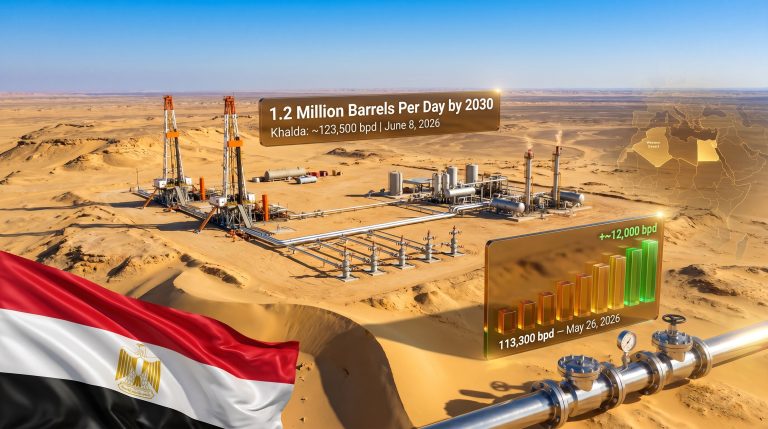
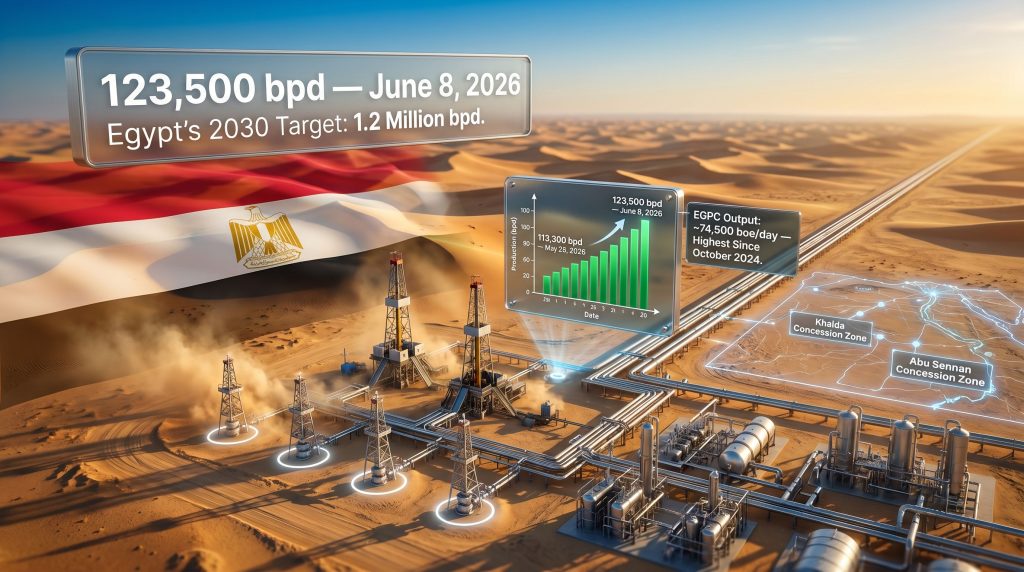
Khalda Petroleum Company, structured as a joint venture between Apache Corporation of the United States and EGPC, contributed the dominant share of the Western Desert increase, adding more than 10,000 barrels per day to its output. Khalda's production trajectory over the relevant period moved from approximately 113,300 bpd on May 26, 2026, to roughly 123,500 bpd by June 8, 2026, driven primarily by five new wells reaching production status.
This rate of well completion is notable. Bringing five wells online within a two-week window requires significant pre-planning: drilling rigs must be positioned, completions crews mobilised, and surface facilities ready to handle the incremental flow. The fact that Khalda achieved this throughput reflects both the operational maturity of its Western Desert infrastructure and a deliberate acceleration of its drilling programme. However, it is worth noting that drilling activity decline elsewhere in the world makes Egypt's sustained drilling commitment all the more strategically significant.
Apache has maintained a long-standing operational presence in Egypt, and the Khalda joint venture model has historically served as one of the more productive templates for international-national oil company cooperation in the region. The partnership structure allocates development capital and production entitlements in a manner that aligns the commercial interests of both parties, creating an incentive framework that encourages continued reinvestment rather than extraction without reinvestment.
Abu Sennan and the GPF-1X Discovery
The General Petroleum Company (GPC), a state-owned upstream operator, contributed the remaining approximately 1,500 bpd from the Abu Sennan concession area. The primary source of this increment was the GPF-1X exploration well, which successfully encountered commercial hydrocarbons and was brought into production during the same period.
The significance of GPF-1X extends beyond its modest barrel contribution. Successful exploration wells in established concession areas validate the continued prospectivity of the Western Desert's underexplored zones. Every new discovery in a producing corridor reduces the cost and risk of future development by leveraging existing pipeline networks, processing facilities, and operational teams already in place.
The Role of AI and Digital Oilfield Technology
Egypt's petroleum ministry has explicitly acknowledged the deployment of new technology and artificial intelligence as part of the operational framework driving these production gains. In addition, the shift towards data-driven operations is becoming increasingly central to how mature basin management is conducted across the resource sector. While the specific platforms and software architectures being used are not publicly detailed, the integration of AI into oilfield operations typically encompasses several distinct functions:
- Predictive well performance modelling, which uses historical production data and real-time sensor inputs to anticipate decline curves and optimise lift strategies
- Reservoir simulation optimisation, where machine learning algorithms refine geological models to improve well placement decisions
- Downtime prediction and maintenance scheduling, where predictive maintenance reduces the hours of non-productive time that erode realised production volumes
- Production allocation and surface network optimisation, ensuring that fluid handling infrastructure operates at peak efficiency as new wells are brought online
This technology layer represents a meaningful shift in how mature basin management is conducted. Historically, production gains in established fields were almost entirely a function of capital intensity: more rigs, more wells, more steel in the ground. AI-assisted operations introduce an efficiency dimension that can amplify the output of each capital dollar deployed, a model increasingly relevant as Egypt seeks to maximise returns from its existing asset base before committing to more expensive frontier development.
EGPC's Broader Output Picture: A Benchmark Milestone
The Western Desert gains contributed to a broader improvement in EGPC's consolidated production metrics. Following the completion of the Khalda and Abu Sennan increments, total EGPC output reached approximately 74,500 barrels of oil equivalent per day, with a crude oil component of nearly 61,000 barrels per day. This represents the highest recorded EGPC output level since October 2024, marking a meaningful inflection point in the organisation's production trajectory.
The concurrent performance of Egypt's Sinai offshore fields adds further dimension to this multi-basin recovery narrative. On June 7, 2026, Sinai offshore production reached approximately 27,000 barrels per day, its highest level since 2017, following an optimisation programme led by Eni in partnership with EGPC. The timing is not coincidental: it reflects a coordinated national effort to generate simultaneous production improvements across geographically distinct producing provinces.
| Production Region | Recent Output Milestone | Key Operator | Notable Development |
|---|---|---|---|
| Western Desert (Khalda) | ~123,500 bpd (June 8, 2026) | Apache Corp / EGPC | Five new wells online |
| Western Desert (Abu Sennan) | +1,500 bpd incremental | General Petroleum Company | GPF-1X exploration well |
| Sinai Offshore | ~27,000 bpd (June 7, 2026) | Eni / EGPC | Highest level since 2017 |
| EGPC Total Output | ~74,500 boe/day | EGPC consolidated | Highest since October 2024 |
The 2030 Target: Ambition, Arithmetic, and Reality
In February 2026, Petroleum Minister Karim Badawi publicly stated Egypt's ambition to double crude oil production to 1.2 million barrels per day by 2030. The arithmetic required to achieve that target from current levels is demanding.
Egypt's current national crude production sits well below the 1.2 million bpd threshold. Reaching it by 2030 requires not only generating net new production through exploration and development but also overcoming the natural decline rates of existing fields, which in mature basins can run at 5% to 10% per year without active intervention. This creates a compounding challenge: the production treadmill demands that a significant portion of new drilling simply replaces lost output rather than adding net barrels.
Reaching a production target of 1.2 million bpd by 2030 from a materially lower base requires Egypt to sustain a growth rate that historically few oil producers have achieved without either major new basin discoveries or substantial enhanced recovery investments across their existing portfolio.
Several structural factors will shape whether this ambition translates into reality:
-
Sustained IOC investment: International oil companies must continue deploying capital in Egypt at current or accelerating rates. Apache's Khalda operations demonstrate what sustained investment can deliver, but broader IOC commitment depends on commercial terms, fiscal stability, and global portfolio prioritisation decisions made outside Cairo.
-
Enhanced oil recovery (EOR) deployment: Water flooding, gas injection, and polymer flooding techniques can meaningfully extend the productive life of mature fields and improve recovery factors from reservoirs currently yielding only a fraction of their original oil in place.
-
Exploration success rates: New field discoveries are needed to supplement production from ageing assets. The GPF-1X success at Abu Sennan illustrates the exploration potential remaining in established corridors, but exploration programmes carry inherent geological risk.
-
Refining and infrastructure capacity: Increased crude output creates downstream bottlenecks if refining capacity and pipeline networks are not expanded in parallel.
Egypt's Position in the North African Upstream Landscape
Understanding the Egypt Western Desert oil production increase requires regional context. North Africa's upstream sector presents a mixed picture, with Egypt standing out as one of the more actively managed production growth stories on the continent.
| Country | Recent Production Trend | Key Basin | Primary Challenge |
|---|---|---|---|
| Egypt | Growth (12,000 bpd Western Desert gain) | Western Desert, Sinai | Mature field decline, import dependence |
| Libya | Volatile, conflict-driven disruptions | Sirte Basin | Geopolitical instability |
| Algeria | Gradual decline pressure | Hassi Messaoud | Ageing infrastructure |
| Tunisia | Declining output | Sfax, Ghadames | Chronic underinvestment |
Egypt's IOC partnership ecosystem gives it a structural advantage over regional peers. While Libya's production potential remains hostage to political instability and Algeria's state-dominated upstream model limits capital efficiency, Egypt has cultivated a diversified operator base that includes Apache, Eni, BP, and others, each bringing technical expertise and capital that state-owned entities cannot fully replicate independently.
The next major ASX story will hit our subscribers first
The Fiscal Logic: Why Every Barrel Matters
Egypt carries a complex economic position. The country is simultaneously a hydrocarbon producer and a significant net importer of refined petroleum products, meaning that domestic crude output increases serve a dual fiscal purpose: generating government revenue through production-sharing and joint venture frameworks while reducing the foreign currency expenditure required to cover refined product imports.
Under pressure from external debt obligations and currency management challenges that have defined Egypt's macroeconomic environment in recent years, incremental crude production gains carry outsized fiscal significance. Monitoring current crude oil prices is therefore critical for Egypt's planning, as the sensitivity of this relationship to oil prices adds another variable: Brent crude price movements amplify or compress the revenue value of each additional barrel. Consequently, Egypt's fiscal position is simultaneously a function of production volume and global commodity markets.
The government's production acceleration agenda is therefore not purely an energy sector decision. It is embedded within a broader economic stabilisation framework where hydrocarbon revenues provide critical support for the country's balance of payments and fiscal consolidation efforts. Furthermore, understanding longer-term crude oil price trends will be essential for Egypt as it calibrates investment decisions through to its 2030 production target.
Frequently Asked Questions: Egypt Western Desert Oil Production
What drove the Egypt Western Desert oil production increase of 12,000 bpd?
The gain resulted from two concurrent operational programmes: five new well completions at Khalda Petroleum contributing more than 10,000 bpd, and the successful GPF-1X exploration well at Abu Sennan adding approximately 1,500 bpd. AI-assisted operational optimisation also played a supporting role in improving field efficiency across both programmes.
Who operates Khalda Petroleum in Egypt's Western Desert?
Khalda Petroleum is a joint venture between Apache Corporation, a U.S.-based international oil company, and the Egyptian General Petroleum Corporation (EGPC). Apache manages day-to-day field operations while EGPC participates as the state partner under a structure common to Egyptian upstream concession agreements.
What is Egypt's crude oil production target for 2030?
Petroleum Minister Karim Badawi announced in February 2026 that Egypt aims to double national crude oil production to 1.2 million barrels per day by 2030, requiring sustained drilling investment, enhanced recovery deployment, and continued exploration success across multiple basins.
What is EGPC's current production level?
Following the Western Desert gains, EGPC's total output reached approximately 74,500 barrels of oil equivalent per day, including nearly 61,000 barrels per day of crude oil. This represents the highest output level recorded by EGPC since October 2024.
How does the Western Desert gain fit into Egypt's broader multi-basin production recovery?
The Western Desert increase coincided with Sinai offshore fields reaching approximately 27,000 bpd, their highest level since 2017, following an Eni-led optimisation programme. Together, these simultaneous gains across geographically distinct basins reflect a coordinated national production recovery effort rather than isolated field-level improvements.
Key Metrics at a Glance
| Metric | Value |
|---|---|
| Western Desert production increase | ~12,000 bpd (two weeks to June 8, 2026) |
| Khalda Petroleum incremental output | >10,000 bpd |
| Khalda output on May 26, 2026 | ~113,300 bpd |
| Khalda output by June 8, 2026 | ~123,500 bpd |
| New wells brought online at Khalda | 5 |
| Abu Sennan (GPC) incremental output | ~1,500 bpd |
| EGPC total output post-gains | ~74,500 boe/day |
| EGPC crude oil component | ~61,000 bpd |
| Previous EGPC output high | October 2024 |
| Sinai offshore concurrent milestone | ~27,000 bpd (highest since 2017) |
| Egypt's 2030 crude production target | 1.2 million bpd |
This article contains forward-looking production targets and forecasts sourced from public statements by Egyptian government officials. Actual outcomes will depend on investment volumes, commodity prices, exploration results, and operational execution. This content does not constitute financial or investment advice.
Want to Track the Next Major Mineral Discovery Before the Market Does?
While Egypt's upstream operators race to replace declining barrels, Discovery Alert's proprietary Discovery IQ model scans ASX announcements in real time, instantly identifying significant mineral discoveries and turning complex data into actionable opportunities — explore historic discovery returns on Discovery Alert's discoveries page and begin your 14-day free trial to position yourself ahead of the market.