June 17, 2026
The Engineering Economics of Long-Distance Slurry Transport in Indian Mining
Few infrastructure decisions in large-scale mining carry as much long-term consequence as the choice between road haulage and pipeline-based mineral transport. At volumes exceeding tens of millions of tonnes per year, the logistics model a producer selects does not simply affect operating costs. It shapes carbon exposure, workforce requirements, road infrastructure dependency, and ultimately the economic ceiling of the entire operation. In India's iron ore sector, this decision is now being made with increasing urgency as production targets climb and decarbonisation pressure intensifies across industrial supply chains.
The procurement decision made by Lloyds Metals and Energy Limited at its Surjagarh mine in Maharashtra offers one of the most technically detailed case studies in this evolving infrastructure calculus. The Q1 2026 Weir GEHO PD pumps order for Lloyds Metals slurry pipeline Phase Two expansion reveals not only a supplier relationship built on demonstrated performance, but also a strategic commitment to pipeline-based logistics that will define the operation's cost and carbon profile for decades.
When big ASX news breaks, our subscribers know first
Why Indian Iron Ore Producers Are Rethinking Bulk Logistics
India's iron ore sector is navigating a structural inflection point. The country's steel production ambitions require sustained increases in iron ore throughput, yet road-based logistics networks in many mining corridors are operating near practical capacity. Truck fleets covering distances of 100 km or more introduce compounding inefficiencies: fuel cost variability, driver availability constraints, road degradation, accident risk, and diesel emissions that increasingly conflict with corporate and national sustainability commitments.
For producers operating at multi-million tonne annual volumes, these inefficiencies are not marginal. They represent a fundamental mismatch between logistics infrastructure and production ambition. Slurry pipeline technology addresses this mismatch by converting the transport problem from a fleet management challenge into an engineering and infrastructure one, with the key advantage that once the pipeline is in place, per-tonne operating costs fall substantially and remain relatively stable over time.
The iron ore demand outlook for India and broader Asian markets continues to intensify, making the Surjagarh mine's scale increasingly relevant. Lloyds Metals holds government-approved mining rights for approximately 56 million tonnes per year of iron ore at Surjagarh. Moving material at that scale via road haulage would require an extraordinary fleet operation. Pipeline infrastructure, by contrast, converts throughput into a flow management problem governed by pump specification, pipeline diameter, and pressure engineering rather than truck availability.
How the Surjagarh Slurry Pipeline Scales from Phase One to Phase Two
The Surjagarh pipeline project has been constructed in discrete phases, each building on the engineering and operational foundations of the previous one. This phased approach reduces technical risk by allowing operators to validate pipeline performance at smaller scales before committing to full system expansion.
| Project Phase | Pipeline Length | Throughput Capacity | Operational Status |
|---|---|---|---|
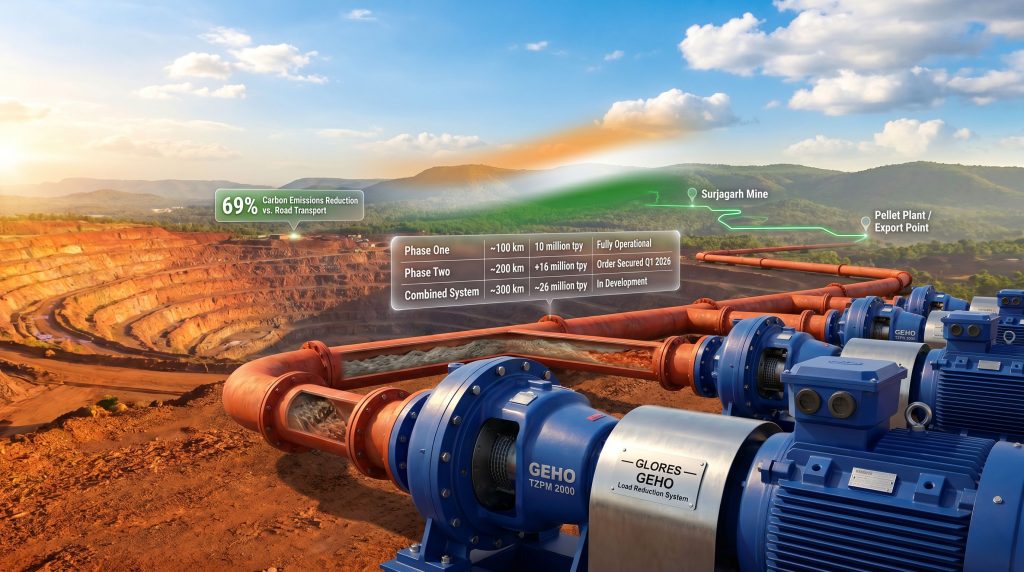
| Phase One | ~100 km | 10 million tpy | Fully Operational |
| Phase Two | ~200 km | +16 million tpy | Order Secured Q1 2026 |
| Combined System | ~300 km | ~26 million tpy | In Development |
Phase One, a 100 km corridor with a capacity of 10 million tonnes per year, is now fully operational. Its successful commissioning provided the commercial confidence and technical validation necessary to proceed with the more ambitious Phase Two extension.
Phase Two adds approximately 200 km to the system, bringing the integrated pipeline corridor to a total length of roughly 300 km with combined throughput capacity of approximately 26 million tonnes per year. This makes the Surjagarh system one of the most substantial long-distance iron ore slurry pipelines under development in the Indian subcontinent, with a geographic reach that extends across Maharashtra's mining corridor toward downstream processing and port infrastructure.
The phased construction model used at Surjagarh is a deliberate risk management strategy. Rather than committing the full capital requirement upfront against unproven performance assumptions, the operator validated throughput, slurry behaviour, pump reliability, and maintenance requirements across the first 100 km before extending the system. This methodology is increasingly common in large-scale mining infrastructure where the financial consequences of design errors at full scale are severe.
What Makes the GEHO TZPM 2000 Suited to Long-Distance Iron Ore Slurry Applications
Positive Displacement vs. Centrifugal Pump Technology
Understanding why the GEHO TZPM 2000 was specified for this application requires grasping a fundamental divide in industrial pump engineering: the difference between positive displacement and centrifugal pump architectures.
Centrifugal pumps move fluid by imparting rotational velocity through an impeller, then converting that velocity to pressure. They are efficient at high flow volumes in relatively low-viscosity, low-abrasion applications. In long-distance slurry pipelines carrying abrasive mineral particles at high pressures, however, centrifugal pumps face significant limitations. Impeller wear rates increase sharply with particle abrasiveness, pressure consistency degrades across extended distances, and maintaining adequate pipeline velocity to prevent settling requires careful hydraulic management.
Positive displacement pumps operate differently. They move a defined volume of fluid with each stroke cycle, delivering consistent flow regardless of downstream pressure variation. For long-distance, high-pressure slurry applications, this consistency is critical. The pipeline must maintain sufficient velocity throughout its length to keep iron ore particles in suspension. Any pressure inconsistency along the route risks settlement zones that can block the pipeline or cause severe localised wear.
GEHO TZPM 2000 Architecture and the Role of GLORES
The GEHO TZPM 2000 is purpose-built for demanding slurry applications where operating pressures, abrasive particle loads, and continuous duty cycles would rapidly degrade less specialised equipment. Key characteristics relevant to the Surjagarh application include:
- High-pressure capability appropriate for sustained operation across 200 km of pipeline
- Abrasion-resistant internal geometry designed for mineral slurry contact surfaces
- Consistent volumetric output per stroke cycle to maintain suspension velocity throughout the pipeline
- Modular design enabling field maintenance without full pump removal from service
The GLORES system, GEHO's proprietary Load Reduction System, addresses one of the most technically demanding aspects of sustained slurry pump operation: mechanical fatigue from continuous high-pressure cycling. In a long-distance pipeline running at multi-million tonne annual throughputs, pump components are subjected to relentless stress cycles. Over time, this accumulation of mechanical load is a primary driver of unplanned maintenance events and premature component failure.
GLORES manages load distribution across the pump's mechanical system, reducing peak stress concentrations during pressure cycles. The practical effect is an extension of component service life and a reduction in unplanned downtime frequency. For an operation of Surjagarh's scale, where pipeline availability directly governs tonnes delivered, any reduction in downtime probability has compounding commercial value.
P R Prasad, Director of Projects at Lloyds Metals, confirmed that the addition of GLORES was a decisive factor in the technology selection process, expressing full confidence in the GEHO technology and noting that GLORES provided additional assurance that the solution represented the strongest available option on the market. Weir's Global Product Manager for GEHO, Tony Hendriks, emphasised that the TZPM 2000's architecture is specifically designed to support capacity increases without introducing new technical risk into an already complex system.
Why 14 Units Were Specified
The selection of 14 GEHO TZPM 2000 units for the Phase Two extension reflects the hydraulic engineering requirements of pumping iron ore slurry across 200 km at 16 million tonnes per year. Long-distance slurry pipelines require multiple pump stations distributed along the route, each maintaining pipeline pressure and flow velocity within design parameters.
The distribution of pump units across the pipeline also provides operational redundancy. If one unit requires maintenance, the remaining stations can maintain reduced throughput while repairs are completed, avoiding total pipeline shutdown. This redundancy architecture is standard practice in critical mining logistics infrastructure where downtime carries significant per-hour revenue impact.
Quantifying the Carbon Reduction Case for Slurry Pipeline Transport
The environmental economics of pipeline versus road transport at this scale are substantial. Lloyds Metals estimates that its pipeline solution is projected to avoid approximately 69% of carbon emissions compared with equivalent road-based transport of the same iron ore volumes.
| Transport Method | Estimated CO₂ Emissions (Relative) | Infrastructure Capital Cost | Per-Tonne Operating Cost Trajectory |
|---|---|---|---|
| Road Haulage | Baseline (100%) | Lower upfront | Rises with fuel costs and fleet aging |
| Slurry Pipeline | ~31% of road baseline | Higher upfront | Falls over time as fixed costs amortise |
This 69% reduction derives primarily from the elimination of diesel-powered truck fleets covering long haul distances. A truck fleet moving 16 million tonnes per year across distances of 200 km or more consumes fuel at a scale that translates into substantial Scope 1 emissions for the mine operator. Replacing that fleet with an electrically driven pump system, particularly as India's grid decarbonises over the coming decades, creates a pathway toward progressively lower lifecycle emissions per tonne transported.
Furthermore, the broader push toward mining decarbonisation benefits is increasingly informing infrastructure investment decisions like this one, where long-term emissions reduction is built into the capital structure of the project from the outset. It is important to note that the 69% figure is a projection based on comparative modelling between road and pipeline transport assumptions. Actual emissions outcomes will depend on electricity grid carbon intensity, slurry water consumption and treatment requirements, and operational factors including pipeline availability rates.
Water management in particular represents an environmental trade-off that pipeline operators must address. Slurry pipelines require significant water volumes to maintain appropriate pulp density, and water recovery at the destination facility is an operational necessity in water-constrained mining regions.
The Strategic Logic of Repeat Procurement and Supplier Trust
One of the most analytically interesting aspects of the Weir GEHO PD pumps order for Lloyds Metals slurry pipeline Phase Two is what it reveals about procurement decision-making in complex infrastructure projects. Lloyds Metals did not reopen the pump supply to competitive tender for Phase Two. The repeat engagement with Weir reflects a pattern common in long-duration infrastructure relationships: once a supplier has demonstrated performance at scale in a demanding application, the risk calculus strongly favours continuity over switching.
Switching pump suppliers between phases of the same pipeline introduces several categories of risk:
- Hydraulic compatibility between Phase One and Phase Two pump characteristics must be carefully managed to ensure the integrated system operates within design parameters
- Spare parts and maintenance standardisation across 14 new units is significantly simpler if the technology matches the existing fleet
- Operational staff familiarity with GEHO technology accumulated during Phase One reduces training requirements and improves maintenance response times
- Technical support continuity from Weir across the full pipeline lifecycle reduces coordination complexity
Pushpal Banerjee, Weir's Indian Regional Manager for GEHO, described the relationship as one built on early engagement, close collaboration, and rigorous technical work. From Weir's commercial perspective, this relationship also represents a replicable model for entering and deepening its position in India's growing mining infrastructure market. Indeed, Weir's award of this significant pumps order from Lloyds Metals has attracted considerable industry attention as a benchmark for supplier-operator partnerships in emerging market mining.
The next major ASX story will hit our subscribers first
Global Precedents and What They Signal for Indian Pipeline Adoption
Long-distance slurry pipelines are not a new concept in global mining. Brazil's iron ore sector, Chilean copper operations, and Australian mineral concentrate pipelines have demonstrated the commercial viability of pipeline-based bulk transport across distances comparable to and exceeding the Surjagarh system.
Brazil's Samarco mine operated one of the world's longest iron ore slurry pipelines, stretching approximately 400 km from the mine to a pelletising plant on the coast. Chilean copper concentrate pipelines have demonstrated the technology's applicability across challenging Andean terrain. These precedents are important for contextualising the Surjagarh project: India is not pioneering an untested technology, but rather applying a proven global engineering solution to a domestic logistics challenge that road infrastructure alone cannot efficiently resolve.
For the broader Indian mining sector, the Surjagarh project's evolution from a 100 km pilot to a 300 km integrated system provides a visible, locally demonstrated blueprint that other large-scale producers can reference when evaluating their own logistics infrastructure investments. Considerations around the China steel and iron ore market are also shaping how Indian producers position themselves competitively, adding further impetus to efficiency-focused infrastructure investment.
For mining operations processing more than 10 million tonnes per year across distances exceeding 100 km, slurry pipeline infrastructure typically approaches cost parity with road haulage within five to eight years of commissioning. Beyond that crossover point, the per-tonne operating cost advantage of pipeline transport compounds annually, driven by lower fuel exposure, reduced fleet replacement capital, and more predictable maintenance scheduling.
Frequently Asked Questions
What are GEHO TZPM 2000 positive displacement pumps used for in mining?
GEHO TZPM 2000 PD pumps are engineered specifically for high-pressure, long-distance slurry transport applications in large-scale mining operations. They are designed to handle abrasive mineral slurries continuously across extended pipeline corridors, maintaining consistent flow without the pressure degradation that limits centrifugal pump performance at long distances.
How many GEHO pumps were ordered for the Lloyds Metals Phase Two pipeline?
The Phase Two order, secured in Q1 2026, covers 14 GEHO TZPM 2000 positive displacement pumps, each equipped with the GLORES load reduction system, for deployment across a 200 km pipeline extension at the Surjagarh mine in Maharashtra, India.
What is the GLORES system and why does it matter for long-distance slurry pipelines?
GLORES is GEHO's proprietary Load Reduction System. It manages mechanical stress distribution across pump components during sustained high-pressure operation, reducing fatigue accumulation that would otherwise cause premature wear and unplanned maintenance events. In a continuous-duty pipeline application at the scale of Surjagarh, the reliability improvement from GLORES directly translates to higher pipeline availability and lower lifetime maintenance costs.
How does a slurry pipeline reduce carbon emissions compared to road transport?
By replacing diesel-powered truck fleets with electrically driven pump systems, slurry pipelines eliminate the primary source of logistics-related Scope 1 emissions in long-haul bulk mineral transport. Lloyds Metals estimates that its pipeline solution is projected to avoid approximately 69% of carbon emissions relative to equivalent road-based transport. This figure is a modelled projection and actual outcomes will depend on grid carbon intensity and operational variables.
What was the capacity of the first phase of the Lloyds Metals slurry pipeline?
Phase One comprised a fully operational 100 km pipeline corridor with a throughput capacity of 10 million tonnes per year. This infrastructure provided the technical validation and commercial confidence that underpinned the decision to proceed with the larger Phase Two expansion.
How does this project connect to broader trends in green iron production?
The emissions profile of iron ore logistics is increasingly relevant to the emerging green iron production sector. Consequently, pipeline-based transport, with its significantly lower carbon footprint per tonne, aligns closely with the supply chain requirements of downstream processors pursuing low-emissions steelmaking. In addition, advances in hydrogen iron ore reduction are further reshaping expectations around the full lifecycle emissions of iron ore supply chains.
Key Takeaways: What the Weir GEHO Order Signals for Indian Mining Infrastructure
-
14 GEHO TZPM 2000 PD pumps ordered for a 200 km, 16 million tpy pipeline extension in Q1 2026
-
Combined system will span approximately 300 km with total throughput capacity of roughly 26 million tpy
-
69% projected carbon emissions reduction versus road transport, based on Lloyds Metals' comparative modelling
-
Surjagarh mine holds government-approved mining rights for approximately 56 million tpy of iron ore
-
GLORES technology was a decisive factor in technology selection, offering enhanced pump longevity and operational reliability
-
Repeat procurement from Weir confirms the commercial and technical performance benchmark set by Phase One
-
The project represents a scalable blueprint for pipeline-based decarbonisation of bulk mineral logistics in India and across emerging market mining geographies
Want to Stay Ahead of the Next Major ASX Mineral Discovery?
Discovery Alert's proprietary Discovery IQ model delivers real-time alerts the moment significant ASX mineral discoveries are announced, turning complex data across 30+ commodities into clear, actionable investment insights — explore the historic returns major discoveries have generated and begin your 14-day free trial to secure your market-leading edge.