June 17, 2026
The Structural Shift Redefining What Underground Mining Machines Can Do
For most of mining's industrial history, the relationship between operator and machine underground has been inseparable. A human being sat in the cab, or later at a remote console, making real-time judgements about terrain, load conditions, and traffic. The machine was an extension of human decision-making, not a replacement for it. That paradigm is now being systematically dismantled, and the implications stretch far beyond productivity metrics.
The emergence of Nerospec SK full autonomy underground technology represents something more consequential than an incremental equipment upgrade. It signals a redefinition of what underground mining machines are fundamentally capable of, and more importantly, what they no longer require humans to do at all.
When big ASX news breaks, our subscribers know first
What Full Machine Autonomy Actually Means Underground
There is a meaningful distinction between a machine that can be operated remotely and one that operates without any human supervision whatsoever. The mining industry has spent decades navigating the space between those two definitions, and the terminology has often been used loosely in ways that obscure genuine technical differences.
Remote control simply relocates the operator. The machine still depends on human perception, reaction time, and judgement to function. Assisted operation introduces automation into specific sub-tasks, such as tramming along a predetermined path, but the human remains actively engaged. Supervised autonomy allows a machine to execute full cycles independently while a person monitors and retains override capability.
Full machine autonomy, as implemented in the Nerospec SK system, eliminates the supervisory role entirely within designated operating zones. The machine plans its path, executes loading, weighs its payload, hauls to the dump point, and resets for the next cycle without any human input at any stage. This is not a subtle upgrade. It is a categorical change in operational architecture.
The Four Levels of Underground Autonomy: A Framework
| Autonomy Level | Description | Human Role |
|---|---|---|
| Level 1 – Remote Control | Operator controls machine from a remote station | Full manual control, remote location |
| Level 2 – Assisted Operation | System assists with specific tasks such as tramming | Operator supervises and intervenes |
| Level 3 – Supervised Autonomy | Machine operates autonomously with human oversight | Operator monitors, intervenes when needed |
| Level 4 – Full Machine Autonomy | Entire cycle runs without human input in auto zones | No supervision required in designated zones |
Why Underground Environments Are Exceptionally Difficult for Autonomy
Autonomous systems in open-pit mining have existed for over two decades. Rio Tinto's autonomous haulage fleet in Western Australia, for instance, has operated at scale since the early 2010s. Underground environments, however, present a fundamentally different challenge set that has historically made full autonomy far harder to achieve.
The physical constraints are considerable. Underground headings are narrow, confined, and irregular. Dust, humidity, and poor lighting degrade sensor performance. GPS positioning, which underpins most surface autonomous systems, is unavailable underground. Ground conditions shift constantly as mining progresses, meaning the operating environment itself is not static. Furthermore, traffic management in single-lane underground roads requires precise coordination between machines operating in proximity.
Add to this the communications infrastructure problem. Many underground automation solutions rely on high-bandwidth wireless networks to stream positional data, sensor feeds, and control commands in real time. Installing and maintaining broadband-grade underground communications across an active mine is expensive, operationally complex, and often unreliable in deep or geometrically complex workings. Current mining automation trends reflect growing recognition of these infrastructure challenges across the industry.
The absence of GPS, the presence of confined geometry, and the unreliability of underground communications infrastructure have historically been the three most significant technical barriers to full machine autonomy below surface. Solving all three simultaneously is what separates genuine underground autonomy from remote-assisted operation rebranded.
How the Nerospec SK System Works: The Autonomous Cycle Step by Step
The Nerospec SK approach addresses these challenges through an architecture built around what the company describes as auto zone logic, a spatial designation system that defines where full autonomous operation is permitted and enforces the boundary between supervised and unsupervised machine behaviour.
The complete autonomous loading and hauling cycle unfolds as follows:
- The machine enters a pre-designated auto zone and transitions automatically from operator-assisted to fully autonomous mode
- Onboard positional intelligence, operating without external broadband dependency, navigates the machine to the muck pile
- The front loader executes the full loading sequence, including bucket positioning and filling, without manual input
- Payload weight is measured automatically mid-cycle, generating real-time loading data for fleet management systems
- The machine hauls to the designated dump point and executes the dump cycle without operator intervention
- The system resets autonomously and initiates the next loading pass
This infrastructure-independent architecture is one of the most commercially significant aspects of the Nerospec SK design. Because the system does not require a broadband underground network to function, it can be deployed in mines where high-bandwidth communications infrastructure either does not exist or cannot be practically installed. This dramatically expands the addressable market for the technology beyond well-capitalised tier-one operations.
Retrofit Autonomy vs. OEM-Integrated Solutions: A Direct Comparison
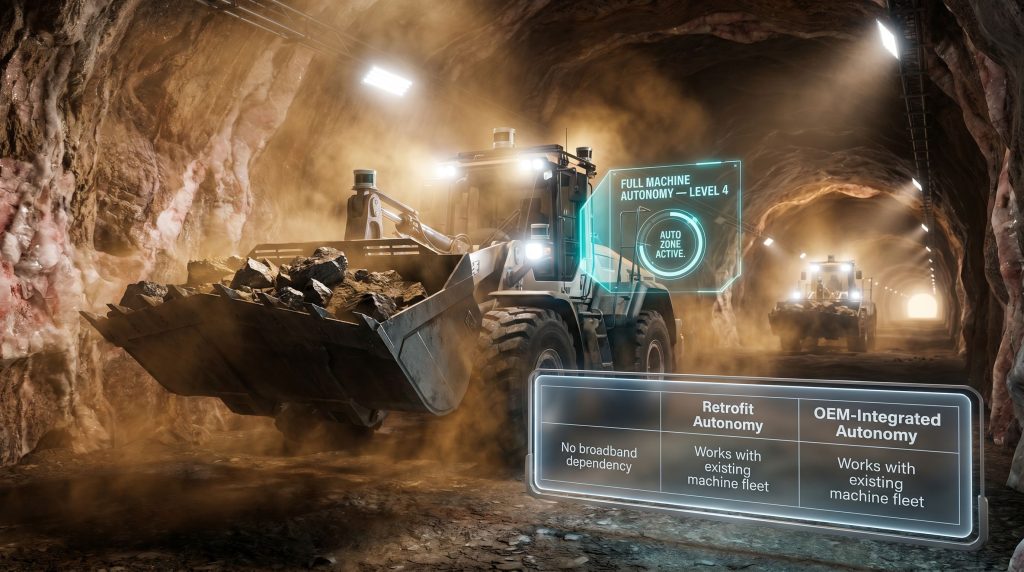
| Feature | Retrofit Autonomy (Nerospec SK Approach) | OEM-Integrated Autonomy |
|---|---|---|
| Hardware Dependency | Works with existing machine fleet | Requires purpose-built or approved OEM platforms |
| Infrastructure Requirement | No broadband dependency | Often requires high-bandwidth underground communications |
| Deployment Speed | Faster fleet-wide rollout | Longer lead times tied to capital procurement |
| Capital Intensity | Lower upfront cost | Higher capital expenditure |
| Operational Flexibility | Adaptable across mixed fleets | Typically OEM-specific |
The retrofit-first philosophy carries substantial strategic weight. A mine operator seeking to automate does not necessarily want to replace its entire loader or haul truck fleet to do so. The ability to apply autonomous functionality to existing equipment removes one of the most significant capital barriers to adoption and allows operators to phase automation progressively across their fleet rather than committing to a full replacement cycle.
The German Potassium Mine: A Demanding Real-World Test Case
Nerospec SK has deployed its full autonomy system in an active underground operation in Germany, a choice of test environment that carries particular technical significance. Potassium mining, conducted primarily in evaporite formations, presents a demanding combination of operating conditions for autonomous systems.
Evaporite environments are characterised by highly variable ground conditions, including salt and sylvinite sequences that can alter drift geometry as mining progresses. The mineralogy itself, potassium chloride mixed with halite and other evaporite minerals, generates fine particulate dust that can degrade sensor performance and optical navigation systems. Confined heading geometries in potassium mines are also particularly tight, requiring precise spatial awareness during loading operations.
Deploying full machine autonomy in an active evaporite mine, where ground conditions, dust loading, and confined navigation corridors compound simultaneously, is a considerably more rigorous proving ground than many surface or open-geometry underground environments. A system that performs reliably in these conditions carries credible transferability to hard-rock mining environments.
The deployment was driven by specific productivity challenges that are broadly representative of modern underground mining economics. Shift change inefficiencies, operator skill variability in loading consistency, and the cost of maintaining personnel in active mining zones all contributed to the operational case for autonomous intervention. The results reported from the deployment indicate measurable productivity gains, with autonomous operation enabling more consistent cycle times and improved equipment utilisation across the operating shift structure.
The Macro-Economic Forces Making Underground Autonomy Necessary
Understanding why Nerospec SK full autonomy underground technology is attracting serious industry attention requires situating it within the broader structural pressures reshaping underground mining globally.
Three converging forces are driving the automation imperative:
- Declining ore grades and deeper deposits. Average copper ore grades have fallen by roughly 30% over the past two decades according to industry data, forcing miners to process greater volumes of material to produce the same metal output. As high-grade near-surface deposits are exhausted, mines are going deeper, increasing per-tonne extraction costs and the operational complexity of underground logistics.
- Labour constraints and safety exposure. Skilled underground equipment operators are increasingly difficult to recruit and retain in most mining jurisdictions. Beyond availability, every person placed in an active underground working represents an ongoing safety liability. Removing personnel from autonomous operating zones directly reduces exposure to ground fall, collision, and atmospheric risks.
- Productivity pressure from cost inflation. Energy, consumables, and labour costs have risen sharply across the mining sector since 2020. Autonomous systems that can operate continuously across shift boundaries, without the productivity losses associated with crew changes, meal breaks, and operator fatigue, offer a structural efficiency advantage that compounds over time.
Where autonomous haulage at surface was once a competitive differentiator for the largest mining houses, underground autonomy is transitioning toward operational necessity for mines that need to improve productivity without proportional increases in workforce size or capital expenditure.
The next major ASX story will hit our subscribers first
Productivity and Economic Benefits: Quantifying the Autonomy Advantage
The economic case for full underground autonomy rests on several distinct productivity levers that operate simultaneously rather than in isolation. Furthermore, data-driven mining operations are increasingly demonstrating that the compounding effect of these levers delivers returns well beyond what any single improvement could achieve independently.
Key productivity improvements unlocked by full autonomy deployment include:
- Elimination of shift change downtime. In conventional operations, shift transitions typically involve machine standdowns, handover procedures, and variable restart times. Autonomous systems operating within defined auto zones can continue productive cycles through these periods without interruption.
- Consistent loading performance. One of the most underappreciated sources of productivity loss in underground operations is variability in operator loading technique. Experienced operators consistently achieve higher bucket fill factors than less experienced colleagues. Autonomous loading removes this variability entirely, delivering repeatable fill factors on every cycle.
- Real-time payload data. Automated mid-cycle weighing generates granular data on loading performance, enabling fleet managers to identify inefficiencies, optimise cycle routing, and benchmark machine performance over time.
- Reduced personnel exposure costs. Fewer people in active mining zones translates to lower insurance liabilities, reduced compliance overhead, and a structurally smaller incident response requirement.
- Extended utilisation windows. Autonomous systems can operate in conditions — dust events, after-blast ventilation clearing periods, or other circumstances — that would otherwise require human personnel to stand clear, effectively expanding the productive operating window without adding headcount.
Safety Architecture and Emerging Regulatory Considerations
Full machine autonomy does not eliminate risk from underground operations. It fundamentally transforms the risk profile, shifting the hazard landscape from proximity-based physical exposure toward system reliability and software integrity concerns.
The auto zone architecture at the core of the Nerospec SK system is designed to manage this transition. Zones are physically and electronically defined, and the system enforces strict entry and exit protocols that determine when and where autonomous operation is permitted. Multi-machine environments require traffic management logic that prevents collision scenarios, and the system incorporates collision avoidance functionality to manage interactions between autonomous units operating within shared underground corridors.
Full machine autonomy shifts the dominant risk category in underground operations from physical proximity hazards to cyber-physical system integrity. This means that fail-safe design, software validation, and cybersecurity protocols become first-order safety concerns rather than secondary considerations.
Regulatory frameworks governing autonomous underground equipment vary considerably across jurisdictions. In most major mining countries, including Australia, Canada, and European Union member states, regulations are still adapting to Level 4 autonomy scenarios where no human supervisor is present during machine operation. This evolving regulatory landscape means operators deploying full autonomy systems must engage proactively with relevant authorities to establish agreed operating parameters and demonstrate system reliability.
Frequently Asked Questions: Nerospec SK Full Autonomy Underground
What is the difference between remote control and full autonomous operation underground?
Remote control relocates the operator but keeps a human in direct control of every machine action. Full autonomous operation, as implemented in the Nerospec SK system, removes the human from the decision-making loop entirely within designated auto zones. The machine self-navigates, self-loads, and self-hauls without any operator input.
Does full underground autonomy require broadband or Wi-Fi network infrastructure?
No. The Nerospec SK architecture is specifically designed to operate without broadband dependency. This is a key differentiator from many competing approaches that require high-bandwidth underground communications to function, making the system deployable in a broader range of underground environments.
Can the system be retrofitted to existing underground loaders and haul trucks?
Yes. The retrofit-first design philosophy is central to the Nerospec SK approach. Rather than requiring operators to procure new OEM-specific equipment, the system is designed for compatibility with existing machine fleets, reducing the capital barrier to adoption.
How does an autonomous machine handle unexpected obstacles or system failures?
The system incorporates collision avoidance logic and fail-safe protocols designed to stop machine operation safely if unexpected obstacles are detected or if system integrity cannot be confirmed. Auto zone architecture also provides a physical and electronic boundary within which autonomous operation is permitted, with defined procedures for system re-entry following any interruption.
What productivity improvements can mines realistically expect?
Results vary depending on baseline operational conditions, but the primary gains come from consistent loading performance, elimination of shift-change downtime, and extended utilisation windows. The German potassium mine deployment provides a documented real-world reference case for the productivity outcomes achievable in demanding underground conditions.
Is full underground autonomy commercially available or still in a pilot phase?
The Nerospec SK system has moved beyond the pilot phase, with the German potassium mine deployment representing an active commercial operation. The system is available for deployment across underground mining applications.
The Forward Trajectory: Fleet Coordination, Electrification, and AI Navigation
Single-machine autonomy is the current frontier, but the logical next development phase involves coordinated autonomous fleet operation, where multiple machines within a mine share positional and operational data to optimise collective productivity in real time.
This progression intersects directly with the broader underground electrification trend. As diesel-powered loaders and haul trucks are progressively replaced by battery-electric mining fleets, the integration of autonomous operation with electric drivetrains creates new opportunities for optimising energy consumption, battery state-of-charge management, and charging cycle scheduling without human coordination overhead.
Artificial intelligence and machine learning are also beginning to influence underground navigation capability. Current autonomous systems rely on predefined spatial maps and sensor-based obstacle detection. Next-generation systems are expected to incorporate adaptive learning, with AI-enhanced navigation enabling machines to update their understanding of drift geometry, ground conditions, and muck pile characteristics dynamically rather than relying on static pre-programmed parameters.
The convergence of these technological threads — retrofit autonomy, infrastructure-independent communications, advanced navigation, and electrified drivetrains — suggests that the gap between today's single-machine full autonomy and tomorrow's coordinated autonomous fleet operation may close faster than conventional technology adoption timelines would imply. In addition, the role of AI in mining operations continues to expand, reinforcing the structural case for full autonomy deployment at scale.
Key Takeaways: Why Underground Autonomy Is a Structural Shift, Not a Trend
The significance of Nerospec SK full autonomy underground technology extends well beyond the specific productivity gains demonstrated in any single deployment. It illustrates a broader transition in underground mining from a labour-intensive, human-supervised operational model toward a machine-led model where autonomous systems handle the physically hazardous and repetitive elements of the production cycle.
Several conclusions stand out as particularly important for operators, investors, and industry observers tracking this space:
- Retrofit autonomy is the scalable path. OEM-integrated solutions serve mines building new fleets. Retrofit solutions serve the vastly larger installed base of existing underground equipment, making them the more commercially expansive model.
- Infrastructure independence is a genuine competitive differentiator. Systems that require broadband underground networks limit their own addressable market. Systems that do not carry a structural deployment advantage in the majority of operating underground environments globally.
- Evaporite mine validation matters. Demonstrating full autonomy in a German potassium mine under genuine production conditions, with all the associated technical challenges of that environment, provides a credible proof-of-concept that transfers meaningfully to other underground mining applications including hard-rock gold, copper, and nickel operations.
- Regulatory engagement is now a competitive variable. As autonomy systems advance, the operators and technology providers that establish constructive working relationships with mining regulators will have a significant first-mover advantage in deploying full autonomy at scale.
Readers seeking broader coverage of underground mining automation developments and fleet technology trends can explore ongoing reporting and analysis at Mining Magazine, which provides continuous coverage of autonomous systems, equipment innovation, and operational technology across the global underground mining sector.
This article contains forward-looking analysis regarding technology development trajectories and industry adoption patterns. Such statements involve assumptions and uncertainties, and actual outcomes may differ materially from projections presented here. Nothing in this article constitutes financial or investment advice.
Want to Capitalise on the Next Major Mineral Discovery Before the Market Does?
Discovery Alert's proprietary Discovery IQ model scans ASX announcements in real time, instantly identifying significant mineral discoveries across 30+ commodities and turning complex data into clear, actionable opportunities — the same kind of structural shifts reshaping industries like underground mining are also unlocking new exploration frontiers worth watching closely. Explore historic discovery returns on Discovery Alert's dedicated discoveries page and begin your 14-day free trial to position yourself ahead of the broader market.