
June 17, 2026
Royalty Gaps, Governance Cracks, and the Pacific's Bauxite Accountability Test
Across the extractive industries of the developing Pacific, the gap between what resource companies are legally obligated to pay and what actually reaches government coffers and local communities has long been a defining governance challenge. In small island developing states, where institutional capacity is limited, legal professional pools are thin, and export documentation systems can lag behind operational realities, this gap often persists for years before it attracts formal scrutiny. The Solomon Islands 33 bauxite shipments probe now unfolding around West Rennell operations is a case study in precisely this dynamic, with consequences that reach well beyond any single mining company.
When big ASX news breaks, our subscribers know first
West Rennell's Contested Mining History
Rennell Island sits at the southern tip of the Solomon Islands archipelago and carries a complex extractive history shaped by competing interests. The island's bauxite deposits have been at the centre of overlapping claims involving customary landowners, provincial authorities, and the national government for well over a decade. West Rennell, in particular, represents one of the Pacific's most legally and environmentally contentious mining zones, partly because its geography places industrial extraction operations in proximity to East Rennell, a UNESCO World Heritage Site recognised for its ecological significance.
The operational structure at the centre of the current investigation involves Asia Pacific Investment Development Ltd (APID) as the principal contractor, with Bintan Mining SI Ltd serving as the executing mining entity on the ground. This layered contractor arrangement is common in Pacific Island resource projects but can, however, create accountability gaps when it comes to tracking which entity bears ultimate financial responsibility for statutory payment obligations.
The Financial Dimension: What Is Alleged and Who Is Affected
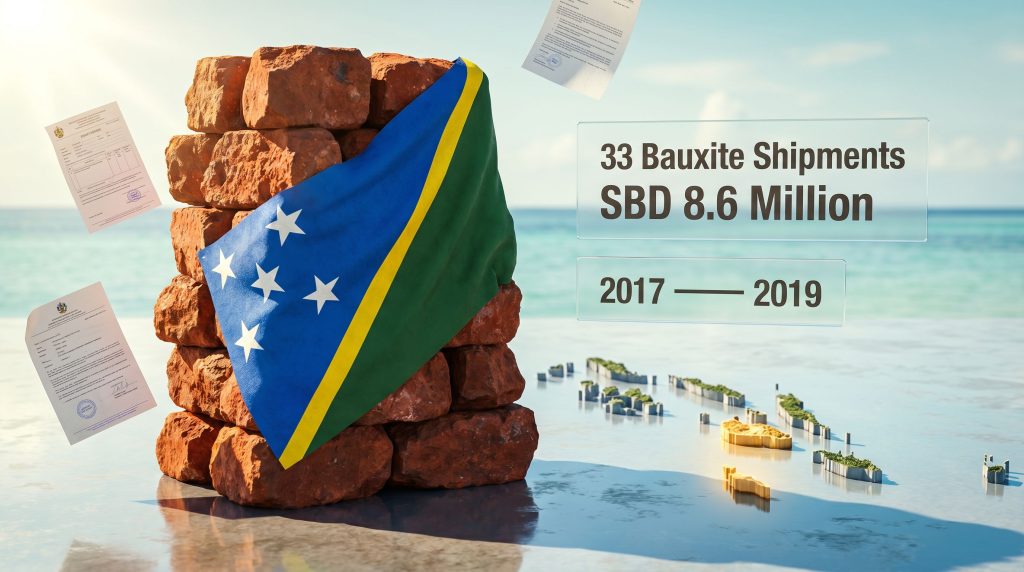
The Solomon Islands 33 bauxite shipments probe centres on export consignments conducted between 2017 and 2019, a period during which investigators allege that royalty payments, government fees, and related financial obligations were not fully discharged.
| Metric | Detail |
|---|---|
| Shipments Under Investigation | 33 bauxite export consignments |
| Period of Alleged Non-Payment | 2017 to 2019 |
| Total Alleged Unpaid Amount | SBD 8.6 million (~USD 1.07 million) |
| Mining Operator | Bintan Mining SI Ltd (contracted by APID) |
| Investigation Formally Initiated | 1 June 2026 |
| Lead Oversight Bodies | Attorney General's Chambers and Mines Division |
Three distinct parties are identified as beneficiaries of the allegedly unpaid obligations: the Solomon Islands national government, the relevant provincial authorities, and customary landowners. This multi-beneficiary payment structure is characteristic of Pacific Island mining royalty frameworks, where revenues are intentionally distributed across governance levels to ensure that communities living closest to extraction sites receive a direct economic share of resource revenues.
Furthermore, understanding how these royalty structures intersect with global bauxite production trends helps contextualise why Pacific Island governance frameworks are under growing pressure to perform.
"In Pacific Island resource governance, royalty distribution to customary landowners is not merely a financial transaction. It represents the primary economic justification that communities are given for tolerating the environmental and social disruption of large-scale extraction."
The Procedural Anatomy of the Investigation
The Attorney General's Directive and Document Request
On 1 June 2026, Attorney General Gabriel Suri wrote formally to the Director of Mines, Christa Tatapu, directing the compilation and submission of documentation covering all 33 disputed shipments. The document request was comprehensive and covered five core evidentiary categories:
- Export permits authorising the legal departure of each bauxite consignment from Solomon Islands territory
- Consignment permits detailing the composition, declared volumes, and ore characteristics of each shipment
- Customs clearance documentation allowing cross-referencing of declared export values against customs records
- Refinery assay reports establishing the commercial grade and market value of the shipped ore at the point of processing
- Operational correspondence encompassing internal and external communications related to the management and execution of the 33 shipments
Each of these document categories serves a distinct investigative function. Assay reports, in particular, carry significant analytical weight because they allow investigators to verify whether royalty calculations were based on accurate ore valuations or whether declared grades were understated, a practice that can systematically reduce royalty liability. Consequently, questions of grade and permitting accuracy sit at the very heart of this investigation.
"Bauxite royalty calculations in many Pacific jurisdictions are typically tied to the value or volume of ore exported. If assay data reveals that shipped ore was of higher commercial quality than the declared grade used for royalty computation, the gap between declared and actual royalty obligations can be substantial."
Escalation to the Financial Intelligence Unit
Beyond the mining compliance dimension, Suri subsequently directed that the compiled documentation be forwarded to the Solomon Islands Financial Intelligence Unit (FIU). This referral is a significant procedural escalation that transforms the probe's character. FIU involvement in Pacific Island jurisdictions typically indicates that authorities are exploring whether financial flows associated with a matter may fall within the scope of anti-money laundering legislation or proceeds of crime frameworks.
In practical terms, this means the investigation is no longer confined to royalty recovery. It has expanded into a multi-agency financial governance exercise in which the question of whether unpaid obligations constitute recoverable criminal proceeds is now formally on the table. A formal probe into the 33 shipments was publicly confirmed, marking a pivotal moment in Solomon Islands' extractive industry accountability.
The Conflict of Interest Debate
Sogavare's Recusal Demand
Opposition Leader Manasseh Sogavare has formally demanded that Attorney General Gabriel Suri withdraw from all proceedings related to APID. The foundation of this demand is Suri's prior professional role as legal counsel to APID before his appointment to public office. Sogavare's position frames the issue not as a minor procedural technicality but as a fundamental test of institutional credibility.
Sogavare has urged Prime Minister Matthew Wale to publicly clarify what recusal or screening protocols have been applied to APID-related matters since Suri took up his public appointment. The underlying governance principle is that in matters of public interest, it is not enough that an official is personally free from bias. The perception of impartiality must also be safeguarded.
Suri's Counter-Position
Suri has formally rejected the recusal demand, drawing a precise boundary around the nature and scope of his earlier legal work for APID. His prior engagement was limited to defending APID's mining lease when that lease was legally challenged by landowners and subsequently revoked by former Mines Minister Bradley Tovosia. Suri maintains that his previous legal work bore no connection to APID's operational mining activities, including the loading, exportation, or commercial administration of any of the 33 bauxite shipments under investigation.
Comparing the Two Governance Standards
| Dimension | Sogavare's Argument | Suri's Counter-Position |
|---|---|---|
| Nature of Prior Relationship | Legal counsel to APID | Limited to mining lease litigation |
| Scope of Alleged Conflict | Broad, covering any APID matter | Narrow, confined to operational matters |
| Proposed Resolution | Full recusal; delegate to independent counsel | No recusal required; prior work unrelated |
| Governance Standard Invoked | Apparent conflict of interest | Actual conflict of interest |
| Public Accountability Mechanism | PM to clarify screening protocols | FIU referral demonstrates procedural rigour |
The distinction between actual and apparent conflicts of interest is not merely academic. In jurisdictions where the legal profession is small and practitioners routinely move between private practice and public office, the apparent conflict standard sets a higher bar precisely because the professional connections between government officials and private sector clients are more visible and more concentrated. Reports indicate that Sogavare wants the AG to step down over these concerns, underscoring how politically charged the governance debate has become.
What This Probe Reveals About Pacific Mining Governance
Three Structural Vulnerabilities Exposed
The Solomon Islands 33 bauxite shipments probe brings three systemic weaknesses into sharp relief:
- Royalty monitoring gaps — The alleged accumulation of SBD 8.6 million in unpaid obligations across a two-year window points to the absence of robust real-time tracking mechanisms linking export permit issuance to royalty payment verification
- Conflict of interest management in small jurisdictions — Pacific Island nations with limited legal professional communities face structural challenges that larger jurisdictions do not, as the same individuals often cycle between private advisory roles and senior public appointments
- Multi-beneficiary payment complexity — When royalty obligations are distributed across three separate recipient classes (national government, provincial authorities, and landowners), the risk of payment disputes, administrative gaps, and accountability failures increases substantially
Mines Minister Manuari's Reform Signal
Mines Minister Derick Manuari has publicly positioned the investigation within a broader sectoral reform agenda aimed at improving transparency and accountability across Solomon Islands' extractive industries. This framing is strategically significant. By anchoring the probe within a reform narrative rather than treating it as an isolated compliance matter, Manuari is sending a sector-wide signal that export permit conditions, royalty calculation methodologies, and payment tracking systems are all under review.
In addition, understanding mining project feasibility standards becomes increasingly relevant as Solomon Islands considers how to restructure its approval and monitoring frameworks going forward.
Rennell Island and the Broader Pacific Bauxite Context
Why This Matters Beyond Solomon Islands
While Solomon Islands occupies a marginal position in global supply, dominated by Guinea, Australia, and China, the governance outcomes from West Rennell carry disproportionate symbolic weight for Pacific Island resource policy. Rennell Island hosts one of the few commercially active bauxite deposits in the Pacific, and its proximity to the UNESCO-listed East Rennell ecosystem has consistently attracted international attention.
For context, examining the leading bauxite mines worldwide highlights just how modest the Solomon Islands' output is — yet its governance implications are outsized relative to its production scale.
Solomon Islands bauxite exports have historically flowed toward Asian refining markets, placing APID's operations within the broader China-Pacific resource trade network. In this context, governance failures carry consequences beyond the domestic sphere, affecting how international trading partners and refining counterparties assess sovereign risk and contract integrity in Pacific Island resource supply chains. Developments like this are increasingly discussed at forums focused on bauxite and alumina markets, where supply chain integrity is a growing priority.
"For customary landowners on Rennell Island, royalty income is not supplementary revenue. It is frequently the primary financial benefit that communities receive in exchange for the permanent environmental transformation of their ancestral land."
Bauxite Quality and Royalty Valuation: A Technical Note
Bauxite is not a homogeneous commodity. Its commercial value depends heavily on aluminium oxide content (expressed as available alumina, or Al2O3), reactive silica levels, and moisture content. Higher-grade bauxite with elevated Al2O3 and low reactive silica commands premium pricing in Asian refinery markets.
If shipment grades declared for royalty calculation purposes understated actual ore quality, even modestly, the cumulative royalty underpayment across 33 shipments could be materially larger than the SBD 8.6 million figure currently under investigation. This is precisely why refinery assay reports are central to the evidentiary framework. They provide an independent, commercially grounded record of actual ore quality at the point of processing, against which declared shipment values can be forensically compared.
The next major ASX story will hit our subscribers first
Frequently Asked Questions
What exactly are the 33 bauxite shipments being investigated?
The 33 shipments refer to bauxite export consignments carried out by Bintan Mining SI Ltd from West Rennell operations under contract to APID between 2017 and 2019. Investigators are examining whether each shipment complied with export permit conditions and whether associated royalty and statutory fee obligations were fully discharged.
How much money is allegedly owed, and to whom?
APID allegedly failed to pay SBD 8.6 million (approximately USD 1.07 million) in royalties and related obligations owed across three beneficiary groups: the Solomon Islands national government, provincial authorities, and customary landowners.
Why has the Financial Intelligence Unit been brought in?
The FIU referral signals that authorities are exploring whether the financial flows associated with the unpaid obligations may constitute recoverable proceeds under Solomon Islands anti-money laundering legislation, expanding the probe beyond a straightforward royalty recovery exercise.
What is the significance of the conflict of interest debate?
The debate over Attorney General Suri's prior legal relationship with APID touches on a governance principle with wide implications for Pacific Island jurisdictions: whether the apparent conflict of interest standard — which requires not just actual freedom from bias but the perception of independence — should apply to senior public officers who previously practised privately in related matters.
Key Takeaways
- The Solomon Islands 33 bauxite shipments probe is among the most significant mining governance actions the country has seen in recent years, combining royalty recovery and potential financial crime dimensions
- The dual escalation to both the Mines Division and the Financial Intelligence Unit reflects a deliberate strategy to address both the civil recovery and criminal proceeds aspects of the alleged non-payment
- Refinery assay reports are a critical but underappreciated element of the evidentiary framework, with the potential to reveal whether declared ore grades accurately reflected commercial realities
- The conflict of interest debate surrounding the Attorney General highlights a structural governance challenge that is particularly acute in small Pacific Island jurisdictions where professional networks are dense and career transitions between private and public roles are common
- Mines Minister Manuari's reform framing suggests the probe may catalyse lasting changes to how export permits are issued, how royalty calculations are audited, and how multi-beneficiary payment obligations are monitored across the Solomon Islands mining sector
- Governance and legal outcomes from this investigation are likely to influence how future bauxite and broader mineral export frameworks are designed, monitored, and enforced across Pacific Island resource jurisdictions
This article is intended for informational purposes only and does not constitute legal or financial advice. Readers should consult qualified professionals before making decisions based on the matters discussed.
Want to Stay Ahead of Significant ASX Mineral Discoveries as They Happen?
Discovery Alert's proprietary Discovery IQ model delivers real-time alerts on significant ASX mineral discoveries, transforming complex mineral data into actionable insights for both short-term traders and long-term investors — explore historic discovery returns to understand the scale of opportunity. Begin your 14-day free trial at Discovery Alert today and position yourself ahead of the broader market.