June 17, 2026
When Commodity Cycles Turn, the Pilbara Feels It First
The iron ore sector has long operated on a simple but brutal equation: when Chinese steel demand weakens, Pilbara margins compress, and operational structures that looked efficient at peak prices suddenly become liabilities. That dynamic is playing out again in 2026, and Hancock Iron Ore cuts jobs after Pilbara review has become the headline that crystallises a broader reckoning across Australia's most productive mining corridor.
Understanding what is happening at Hancock requires looking beyond the workforce numbers. This is a story about life-of-mine engineering, post-merger integration economics, and the strategic logic of trimming labour intensity in mature operations while simultaneously committing billions to the next generation of Pilbara assets. The iron ore demand outlook shapes much of this calculus.
When big ASX news breaks, our subscribers know first
The Life-of-Mine Review: What It Is and Why It Matters
Most large-scale mining operations conduct annual life-of-mine planning cycles, a process that is far more consequential than the term implies. These reviews integrate geological modelling, commodity price assumptions, processing throughput data, waste-to-ore strip ratios, and long-term cost forecasts to determine the optimal extraction sequence for the remaining reserve base.
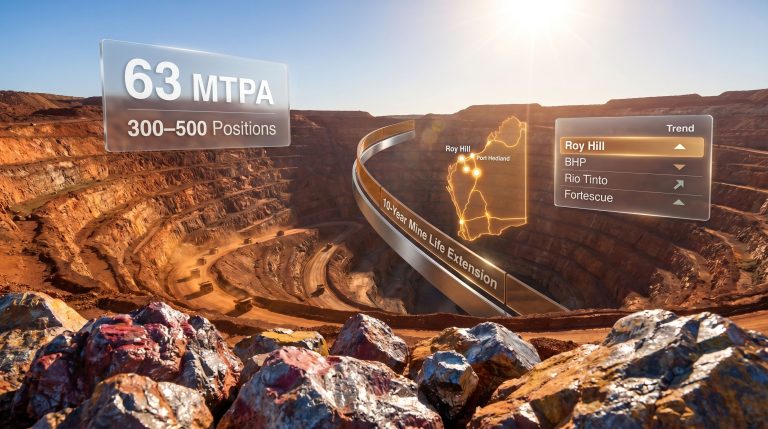
In Hancock Iron Ore's case, the most recent cycle produced a structurally significant outcome: the revised mining plan extends the operational life of the Roy Hill system by ten years while simultaneously reducing the volume of waste rock that needs to be moved to access ore. This is a dual efficiency gain that carries real financial weight.
Why Waste Reduction Changes the Labour Equation
Waste mining, known in the industry as overburden removal, is one of the most labour and equipment-intensive activities in open-cut iron ore operations. When a life-of-mine review identifies a pathway to access equivalent or superior ore volumes with less waste movement, the consequence is a reduced requirement for the truck-and-shovel fleets and associated personnel that drive overburden haulage.
This is not a layoff driven by production failure. It reflects a deliberate shift in how the orebody is sequenced. Counterintuitively, a plan that cuts jobs in the short term can be the most economically rational outcome for long-term reserve realisation.
"The reduction in waste mining is not a retreat from production ambition. It is a recalibration of how tonnes are extracted, with the efficiency dividend extending the mine's productive life by a decade."
From Two Entities to One: The Integration Factor
The July 2025 unification of Roy Hill and Atlas Iron under the Hancock Iron Ore banner created a combined operation producing more than 70 million tonnes per annum and employing approximately 5,000 people across its Pilbara footprint. That scale makes it one of Australia's largest iron ore producers outside the BHP and Rio Tinto duopoly.
Post-merger workforce adjustments are a structural inevitability when two previously independent operational teams, each with their own planning, geology, maintenance, and administrative functions, are brought under a single management architecture. The rationalisation phase typically follows the legal consolidation by six to eighteen months, as duplicated roles across technical, supervisory, and corporate functions are identified and resolved.
The Hancock restructuring appears to be the first significant workforce event since the merger closed, suggesting the company has reached that rationalisation inflection point. Australia's iron ore advantage in global markets, however, remains structurally intact despite these operational adjustments.
What the Numbers Say About Scale
| Reported Estimate | Source Type | Company Verified? |
|---|---|---|
| More than 150 roles | Industry sources | Not formally confirmed |
| 300 to 500 roles | Media reports | Disputed by company |
| Exact total | Official disclosure | Not provided |
The absence of a precise public figure is itself informative. Hancock Iron Ore is a privately held entity with no obligation to disclose workforce numbers with the granularity required of ASX-listed companies. According to reporting by The Australian, more than 150 workers have been shown the door at the billionaire's iron ore operations. What is confirmed is that the company has committed to supporting all affected employees through the transition.
Financial Pressure: The Profit Collapse That Context Demands
The workforce reduction cannot be assessed in isolation from Hancock Iron Ore's financial performance in the 2025 financial year. The numbers tell a stark story. Furthermore, the broader iron ore price decline across 2025 amplified the pressure on Pilbara operators already managing elevated cost bases.
| Business Unit | FY2025 Net Profit | Prior Year | Change |
|---|---|---|---|
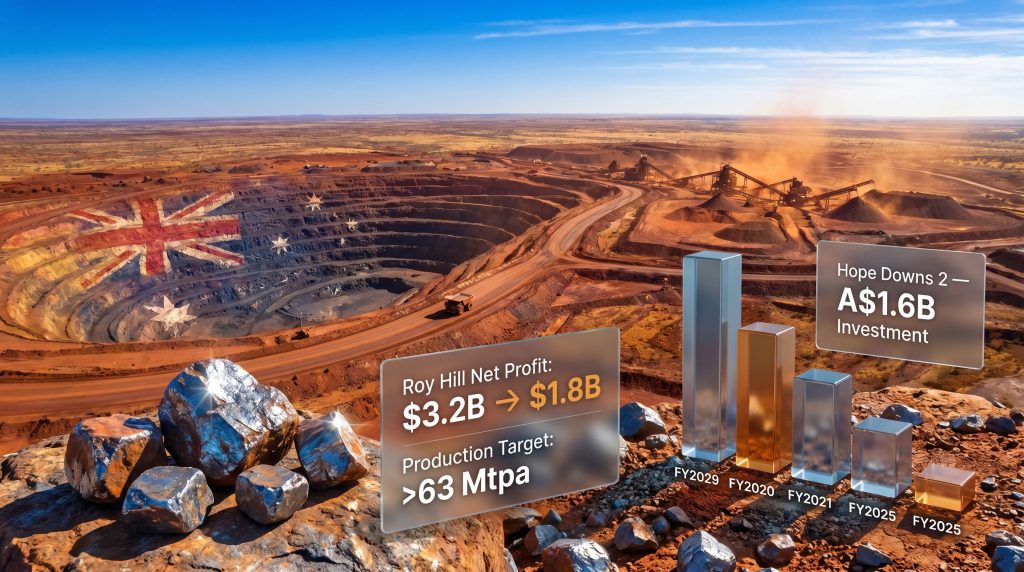
| Roy Hill | $1.8 billion | $3.2 billion (record) | Down approximately 44% |
| Atlas Iron | $260 million | $440 million | Down approximately 41% |
Across just two business units, approximately $1.6 billion in profit was erased in a single financial year. Two forces drove that outcome:
- Global iron ore price softness, reflecting persistent headwinds from China's property sector correction, which has structurally reduced steel demand from the construction segment that historically absorbed a disproportionate share of seaborne ore volumes.
- Cyclone Zelia, which disrupted Roy Hill's operations during FY2025 and added a one-off cost and lost-production dimension that compressed margins beyond what pricing alone would have produced.
For a private company that must fund its own capital expenditure programs without equity market access, a $1.6 billion profit reduction in a single year creates direct pressure to reduce unit operating costs. The life-of-mine review's timing is not coincidental.
Iron Ore Price Dynamics: The Structural Context
Iron ore pricing is fundamentally a derivative of Chinese steel production, which in turn is shaped by three demand pillars: infrastructure investment, manufacturing output, and residential construction. The China steel-iron ore market faces a multi-year correction in its property sector that has materially weakened the third pillar, and government stimulus programs have only partially offset that demand destruction through accelerated infrastructure spending.
Pilbara producers at the higher end of the global cost curve face disproportionate margin compression during price downturns because their cost base does not flex as readily as lower-cost operations. Labour costs in the Pilbara, whether for fly-in fly-out workers or residential employees, remain among the highest for any comparable mining jurisdiction globally, reinforcing the economic logic of workforce optimisation when revenues fall sharply.
Production Targets Held: The Operational Signal Worth Noting
Despite the workforce reduction and the step-down in mining activity at Roy Hill, Hancock Iron Ore has stated it expects to maintain production above 63 million tonnes per annum for the Roy Hill system. That figure is significant for two reasons.
First, it demonstrates that the job cuts are not a production contraction. The company is targeting equivalent or superior throughput from a leaner operational structure, which implies the efficiency gains from the revised mining plan are real and material.
Second, sustaining 63-plus Mtpa at Roy Hill while integrating Atlas Iron's volumes keeps Hancock's combined output above 70 Mtpa, a scale threshold that preserves its commercial leverage with shipping, port, and downstream customers.
New Capital Investment: The Other Side of the Equation
Perhaps the most analytically important counterpoint to the job cuts is the pipeline of capital projects Hancock Iron Ore is advancing simultaneously. These commitments reveal a company that is pruning its cost structure in mature assets while actively investing in the next generation of production. In addition, the Pilbara iron capacity expansion underway across multiple operators signals that long-term confidence in the region endures.
Hancock Iron Ore's Active Development Pipeline
| Asset | Status | Key Detail |
|---|---|---|
| Roy Hill | Operating | Production target above 63 Mtpa maintained |
| Atlas Iron portfolio (Sanjiv Ridge, Mt Webber, Miralga Creek) | Operating | Part of 70+ Mtpa combined output |
| McPhee Creek | Under construction | First ore targeted for 2026 |
| Mulga Downs | Development phase | Future production pipeline |
| Hope Downs 2 (JV with Rio Tinto) | Announced | A$1.6 billion investment commitment |
The Hope Downs 2 joint venture with Rio Tinto is particularly significant. At A$1.6 billion, it is a capital commitment that signals long-term conviction in Pilbara iron ore economics. The project is expected to support more than 950 construction jobs during its development phase and sustain approximately 1,000 full-time-equivalent roles once operational, providing a meaningful offset to the roles being removed from the current structure.
"A company simultaneously cutting jobs in mature operations and committing A$1.6 billion to new capacity is executing a portfolio rebalancing strategy, not a sector withdrawal."
The next major ASX story will hit our subscribers first
What This Means for the Pilbara Workforce and Regional Economy
The Pilbara's regional economy is structurally dependent on the employment decisions of its major iron ore operators. Fly-in fly-out work patterns mean that workforce reductions ripple outward to affect accommodation villages, charter aviation, ground transport, catering, and the broader service economy that supports mining operations.
Even at the lower confirmed estimate of more than 150 roles, the impact on regional employment is meaningful. WA Today's coverage of the job cuts confirms that workers with transferable skills in haul truck operation, crushing and screening, maintenance, and geology will be entering a labour market that remains competitive, though not uniformly so, across the Pilbara's active project pipeline.
Offsetting factors include:
- McPhee Creek's construction and ramp-up phase targeting first ore in 2026
- The Hope Downs 2 project's anticipated construction workforce demand
- BHP and Rio Tinto's continued capital programs across their own Pilbara operations
- The broader expansion of lithium, rare earth, and base metal projects in Western Australia creating new demand for workers with mining-sector transferable skills
Frequently Asked Questions
Why Did Hancock Iron Ore Cut Jobs in the Pilbara?
The company completed its annual life-of-mine planning review, which identified how to reduce waste mining and optimise processing and blending across Roy Hill and Atlas Iron assets. The revised plan extends mine life by ten years but requires fewer workers to execute the new extraction sequence.
How Many Positions Were Affected?
The exact number has not been officially disclosed. Media reports range from more than 150 to as many as 300 to 500 roles, with the company disputing the higher estimates. No independently verified figure has been confirmed.
Will Production at Roy Hill Be Maintained?
Yes. Despite reduced mining activity, the company expects to sustain output above 63 million tonnes per annum for the Roy Hill system.
Is Hancock Still Investing in the Pilbara?
Actively. The McPhee Creek mine is targeting first ore in 2026, Mulga Downs is progressing through development, and the A$1.6 billion Hope Downs 2 joint venture with Rio Tinto has been announced with approximately 1,000 ongoing roles expected once operational.
What Caused Roy Hill's Profit to Fall So Sharply?
Roy Hill's net profit declined from a record $3.2 billion to $1.8 billion in FY2025, driven by weaker global iron ore prices and operational disruption caused by Cyclone Zelia.
Key Takeaways
- Hancock Iron Ore cuts jobs after Pilbara review driven by a life-of-mine planning outcome that extends mine life by ten years while reducing waste mining intensity
- The workforce reduction is the first major restructuring event following the July 2025 merger of Roy Hill and Atlas Iron under a single entity
- Combined profit across both business units declined by approximately $1.6 billion in FY2025, creating direct pressure to reduce operating costs
- Roy Hill production is expected to remain above 63 Mtpa despite the operational changes
- A$1.6 billion committed to Hope Downs 2 with Rio Tinto, McPhee Creek targeting first ore in 2026, and Mulga Downs in development all signal continued long-term Pilbara investment
- The restructuring reflects a cost-optimisation and portfolio-rebalancing strategy characteristic of mature resource companies navigating commodity price cycles, not a withdrawal from the region
Want to Capitalise on the Next Major Iron Ore or Mineral Discovery Before the Market Does?
Discovery Alert's proprietary Discovery IQ model delivers real-time alerts on significant ASX mineral discoveries, instantly translating complex geological and commodity data into actionable investment insights for both short-term traders and long-term investors. Explore how historic mineral discoveries have generated substantial returns by visiting Discovery Alert's dedicated discoveries page, and begin your 14-day free trial today to position yourself ahead of the broader market.