
June 17, 2026
The Mine Planning Logic That Most Media Coverage Gets Wrong
When a major iron ore producer announces workforce reductions, the instinct of most observers is to reach for a familiar narrative: falling prices, weakening demand, corporate cost-cutting. That reflexive framing rarely captures the full operational picture, and in the case of the Hancock Iron Ore job losses in the Pilbara, it misses the most important part of the story entirely.
The actual driver here is something far more technical and, in many ways, more strategically rational: a fundamental reassessment of how to extract maximum value from a finite orebody over a longer time horizon. Understanding why that decision leads to workforce reductions, without necessarily reducing production, requires looking at how large-scale iron ore mines actually work.
When big ASX news breaks, our subscribers know first
Life of Mine Planning: The Annual Exercise That Shapes Everything
Every major iron ore operation in the Pilbara undergoes what is known as an annual life of mine review. This is not a reactive exercise triggered by market volatility. It is a continuous geological and financial modelling process in which operators update their understanding of the orebody, revise economic assumptions, and recalculate the optimal sequence for extracting ore over the remaining life of the asset.
The outputs of these reviews directly determine workforce requirements. A revised mine plan that changes the sequence of extraction, adjusts cut-off grade economics, or modifies the rate of material movement will have immediate implications for how many people are needed and in which roles. In this context, the Hancock Iron Ore job losses in the Pilbara are better understood as a structural operational recalibration than a crisis response.
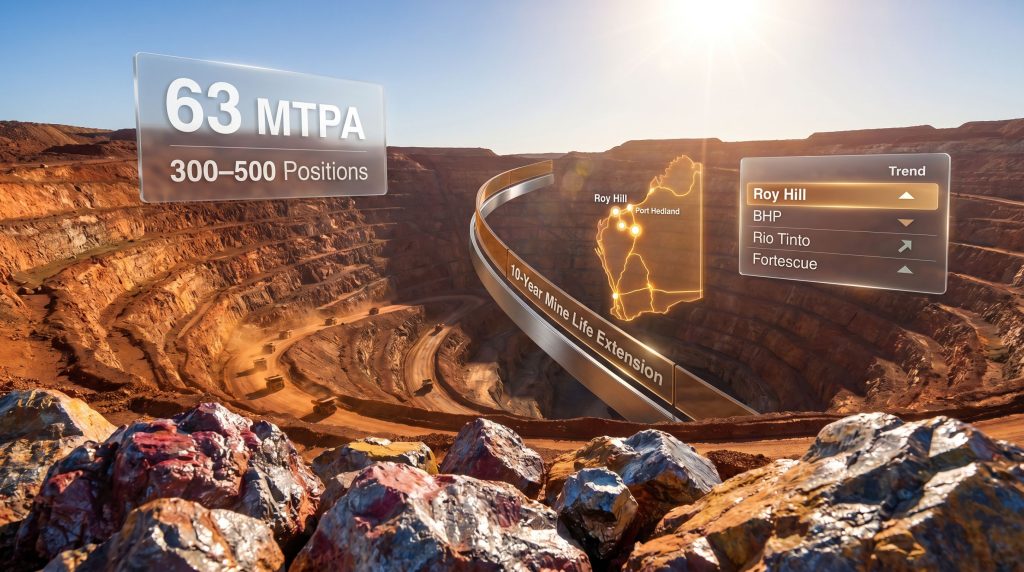
Hancock Iron Ore has confirmed that its most recent annual life of mine review has extended the operational life of the Roy Hill asset by approximately 10 years. This is a significant outcome by any measure, and it carries important implications for how the orebody will be worked going forward.
Strip Ratio Management: The Technical Detail Behind the Headlines
One of the least-understood aspects of this story is the role of strip ratio management. In open-cut iron ore mining, the strip ratio refers to the volume of waste material (overburden) that must be removed for every tonne of ore extracted. Managing this ratio is central to mine economics.
When a revised mine plan identifies opportunities to reduce the strip ratio, the operator can maintain ore output while significantly reducing the volume of total material moved. This translates directly into lower fuel consumption, reduced equipment hours, and a smaller workforce requirement for mining operations, even as the tonnes of saleable product leaving the port remain unchanged.
Hancock has stated that the revised plan allows it to maximise how much of the orebody is converted into product while reducing waste mining. This is precisely what a strip ratio optimisation looks like in practice. The result: mining activity at Roy Hill is being reduced, while the Roy Hill system production rate is maintained above 63 million tonnes per annum (MTPA). Furthermore, Pilbara iron logistics infrastructure continues to support throughput targets even as the mining footprint adjusts.
The distinction between mining activity and production output is critical. Reducing the former does not automatically mean reducing the latter. This nuance is what separates a strategic mine plan revision from a production retreat.
How Many Jobs Are Being Cut, and Who Is Affected?
Hancock Iron Ore has declined to confirm a specific headcount figure publicly, stating only that it is working with all those affected. Industry sources cited in multiple media reports, including ABC News, have placed the scale of reductions somewhere between 300 and approximately 500 positions, which would represent roughly 10% of the combined operational workforce across Pilbara activities.
The following breakdown reflects the likely exposure across different operational areas based on the nature of the changes described:
| Operational Area | Likely Exposure | Rationale |
|---|---|---|
| Roy Hill Mining Operations | High | Reduced material movement directly flagged |
| Blending and Logistics | Moderate to High | Post-merger duplication risk |
| Corporate and Administrative | Moderate | Integration of dual-entity back-office functions |
| Port and Rail Operations | Lower | Throughput maintained above 63 MTPA |
| Atlas Iron Legacy Sites | Moderate | Integration rationalisation following merger |
Under Australian employment law, specifically the Fair Work Act, workers facing redundancy are entitled to formal consultation, statutory notice periods, and redundancy payments scaled to length of service. At a workforce reduction of this scale, the company would be subject to large-scale redundancy notification obligations, typically triggered when 15 or more positions are affected simultaneously.
The Roy Hill and Atlas Iron Merger: Why Timing Matters
The Roy Hill and Atlas Iron operations were formally consolidated under the unified Hancock Iron Ore banner approximately one year before this workforce announcement. That timing is not incidental. Post-merger integration in large mining operations typically follows a predictable pattern: the immediate priority is operational continuity, while structural rationalisation of overlapping functions happens in the 12 to 24 months following consolidation.
Atlas Iron operated a portfolio of smaller direct-shipping ore (DSO) deposits across the Pilbara, with a different operational profile to Roy Hill's large-scale integrated mine, rail, and port system. Combining these entities creates structural redundancy across logistics coordination, mine planning, maintenance scheduling, procurement, and corporate administration. Workforce rationalisation in these areas is a predictable, if disruptive, consequence of integration at this scale.
What makes this particular announcement more complex is that it combines two distinct drivers simultaneously: the post-merger integration rationalisation and the mine plan optimisation at Roy Hill. Both are occurring at the same time, which may explain why the scale of reductions appears larger than a single cause would typically generate.
What This Means for the Pilbara's Regional Economy
The Pilbara's key population centres, including Port Hedland and Newman, carry significant economic dependence on mining employment. A reduction of 300 to 500 positions carries a multiplier effect that extends well beyond the directly affected workers. Each direct mining role is estimated to support approximately two to three indirect positions across regional services, hospitality, transport, and logistics.
The distinction between fly-in fly-out (FIFO) and residential workforce impacts matters here:
- FIFO workforce reductions affect workers and families primarily based in Perth and other metropolitan and regional hubs, with more diffuse economic impacts across the state.
- Residential workforce reductions in Newman and surrounding communities are felt more acutely, as local housing demand, school enrolments, and small business activity are directly sized to the residential mining workforce.
- Historical precedents from the 2015 to 2016 iron ore price downturn, when benchmark prices fell below USD 40 per tonne, showed how rapidly Pilbara towns can experience population contraction and service reduction following large-scale mining workforce changes.
The Western Australian Department of Jobs, Tourism, Science and Innovation has mechanisms to monitor large-scale redundancy events, and state-funded retraining programmes can provide pathways for displaced workers. However, the pace at which such programmes mobilise rarely matches the speed of workforce reductions in major mining operations.
How Hancock's Approach Compares to Pilbara Peers in 2025 and 2026
The mine plan optimisation strategy being pursued by Hancock is not occurring in isolation. Across the Pilbara, major iron ore producers are navigating a common set of pressures: maturing orebodies, rising operational costs, iron ore price uncertainty, and the accelerating deployment of automation technology. Australia's iron ore advantage remains significant globally, yet producers are increasingly focused on efficiency rather than volume growth.
| Company | Recent Operational Strategy | Workforce Trend |
|---|---|---|
| BHP Iron Ore | Ongoing productivity programmes; South Flank ramp-up | Broadly stable with targeted efficiency measures |
| Rio Tinto | AutoHaul autonomous haulage expansion | Gradual reduction in haulage and site-based roles |
| Fortescue | Cost reduction programmes alongside green energy investment | Mixed across divisions |
| Hancock Iron Ore | Mine life extension; Roy Hill activity reduction | Reported 300 to 500 position reduction |
The Role of Automation in Reshaping Pilbara Workforces
The autonomous haulage system (AHS) rollout by Rio Tinto is a useful reference point for understanding the structural direction of Pilbara employment. WA iron ore rail upgrades and AHS technology do not simply eliminate jobs; they shift workforce composition. Demand for remote operations centre technicians, AHS monitoring specialists, and data analysts grows while traditional site-based haulage roles decline. The net result over time is fewer but more technically specialised positions per tonne of ore produced.
Hancock, as a private company not subject to quarterly ASX earnings scrutiny, has greater operational flexibility to implement structural changes on its own timeline. This is a meaningful advantage when executing a long-range mine plan revision of this nature.
The next major ASX story will hit our subscribers first
Chinese Steel Demand and the Iron Ore Market Context
No analysis of Hancock Iron Ore job losses in the Pilbara is complete without acknowledging the demand-side environment shaping producer behaviour. The China steel demand outlook remains consequential, given that China accounts for approximately 70 to 80% of Australian iron ore export demand, making its steel sector dynamics the single most important external variable for Pilbara operators.
Several structural shifts are currently creating medium-term uncertainty on the demand side:
- China's property sector weakness has suppressed steel-intensive construction activity, reducing the demand growth trajectory that underpinned Pilbara expansion during the previous decade.
- China's green steel transition ambitions, which involve increased use of electric arc furnace technology, could reduce demand for high-volume iron ore in favour of scrap steel over a longer horizon.
- Iron ore price volatility, with benchmark prices moving through a wide range in recent years, has accelerated the industry-wide shift from volume maximisation to value optimisation in mine planning.
In this environment, extending asset life while reducing per-tonne costs is a rational strategic response. The 10-year mine life extension at Roy Hill improves asset value on the balance sheet, lowers per-tonne amortisation costs, and positions the operation more competitively against peers who face higher strip ratios and shorter remaining mine lives at current extraction rates.
Frequently Asked Questions: Hancock Iron Ore Job Losses in the Pilbara
How Many Jobs Is Hancock Iron Ore Cutting in the Pilbara?
Industry sources have placed the figure between approximately 300 and 500 positions, representing an estimated 10% of operational headcount. Hancock has not publicly confirmed a specific number. For further context on the company's operational scope, the Hancock Iron Ore website provides an overview of its Pilbara assets.
Why Is Hancock Reducing Its Workforce Now?
The company has linked the decision to a revised annual life of mine plan that extends Roy Hill's operational life by approximately 10 years. The revised plan reduces mining activity, primarily through lower waste material movement, while maintaining production output above 63 MTPA.
Will Iron Ore Production Fall as a Result?
Based on Hancock's own statements, total system production for Roy Hill is expected to remain above 63 MTPA. The reductions relate to the rate of material moved, not to saleable ore output.
Does the Merger With Atlas Iron Play a Role?
The consolidation of Roy Hill and Atlas Iron under Hancock Iron Ore approximately one year prior to this announcement created structural redundancy across overlapping functions. Post-merger integration rationalisation is consequently contributing to the scale of the reduction alongside the mine plan changes.
What Entitlements Do Affected Workers Have?
Under the Fair Work Act, workers are entitled to redundancy consultation, appropriate notice periods, and statutory redundancy payments based on length of service. Specific entitlements will vary according to applicable enterprise agreements.
Key Takeaways
- Scale: Industry reports indicate 300 to 500 positions are being reduced, approximately 10% of the operational workforce.
- Primary driver: Annual life of mine review delivering a 10-year extension to Roy Hill's operational life through optimised extraction sequencing and reduced waste mining.
- Production impact: Minimal. Roy Hill system output is maintained above 63 MTPA.
- Merger context: The Roy Hill and Atlas Iron consolidation, completed approximately one year prior, is contributing to integration-related rationalisation across overlapping functions.
- Regional impact: Significant flow-on effects for Pilbara communities and Perth-based FIFO workers, with a multiplier effect of two to three indirect roles per direct mining position.
- Industry signal: Reflects a broader Pilbara-wide shift toward value-optimised, longer-life mine planning as deposits mature and automation adoption accelerates.
This article is intended for informational purposes only and does not constitute financial advice. References to workforce figures are based on industry source reporting as cited by ABC News and have not been independently confirmed by Hancock Iron Ore. Readers should conduct their own research before making any investment or employment-related decisions.
Want to Identify the Next Major ASX Mineral Discovery Before the Broader Market?
Discovery Alert's proprietary Discovery IQ model delivers real-time alerts on significant ASX mineral discoveries, instantly converting complex geological and commodity data into actionable investment insights — explore historic examples of exceptional discovery outcomes to understand the scale of opportunity, and begin your 14-day free trial at Discovery Alert to position yourself ahead of the market.